
Utility-Scale Containerized BESS: Grid Codes and Fire Safety
Utility-scale battery storage has moved from demonstration to procurement. Global new battery storage deployment reached 108 GW in 2025, according to the IEA's Global Energy Review 2026, and LFP chemistry accounted for approximately 90% of that capacity. Once a technology reaches that scale, the competitive question stops being whether the hardware exists. It becomes whether a project can be connected to a network, dispatched by an operator, protected against faults and permitted by local authorities.
That is the compliance problem. For utility-scale projects it is rarely a single test or a single certificate. It is a stack of market-specific obligations that begins with a grid impact study and ends with a fire-safety sign-off, and every layer has to be documented before the asset is allowed to operate and earn revenue.
Why Compliance, Not Hardware, Is the Binding Constraint
In utility-scale renewable integration and grid-side energy storage, the project requirements are explicit and unusually broad. Storage assets deployed by utilities, independent power producers and renewable energy developers carry a defined set of special requirements: grid impact study, local grid-code compliance, protection coordination, dispatch-interface requirements, cybersecurity, fire safety and environmental assessment. Each of these is a separate workstream with its own owner, deliverable and approval route.
The same pattern appears at smaller scales. Commercial and industrial peak-shaving projects list grid-connection approval, protection coordination and fire-safety compliance. Solar-plus-storage projects list grid-code compliance and export-limitation requirements. Critical-load backup projects list islanding protection, a black-start strategy, an emergency response plan and fire-safety compliance. In other words, compliance cost scales with grid interaction, not with nameplate capacity alone.
The Five-Layer Compliance Stack
Buyers who treat compliance as a single item tend to under-budget and under-schedule. It is more useful to think of five layers, each producing a different type of evidence.
| Layer | What it covers | Typical evidence |
|---|---|---|
| 1. Interconnection and grid code | Whether the asset may connect, and under what operating rules | Grid impact study; grid-code test or compliance documents for the specific market |
| 2. Protection coordination | How the plant isolates faults without disturbing the wider network | Protection settings study; coordination with utility protection and control systems |
| 3. Dispatch interface and cybersecurity | How the operator commands the plant and how that channel is secured | SCADA and plant-level EMS integration; communication protocols; cybersecurity provisions |
| 4. Fire safety and thermal management | Detection, suppression, shutdown logic and emergency response | Cell-level and pack-level test evidence; suppression design; site fire approval |
| 5. Environmental assessment and permitting | Land, noise, visual and site-level environmental conditions | Environmental assessment documentation; permitting correspondence |
The order matters. A grid impact study typically runs before final equipment selection is frozen, because its conclusions feed back into C-rate choice, inverter and PCS sizing, and the transformer and switchgear configuration. Starting with a container order and working backwards usually produces rework.
Why the Container Is the Natural Compliance Unit
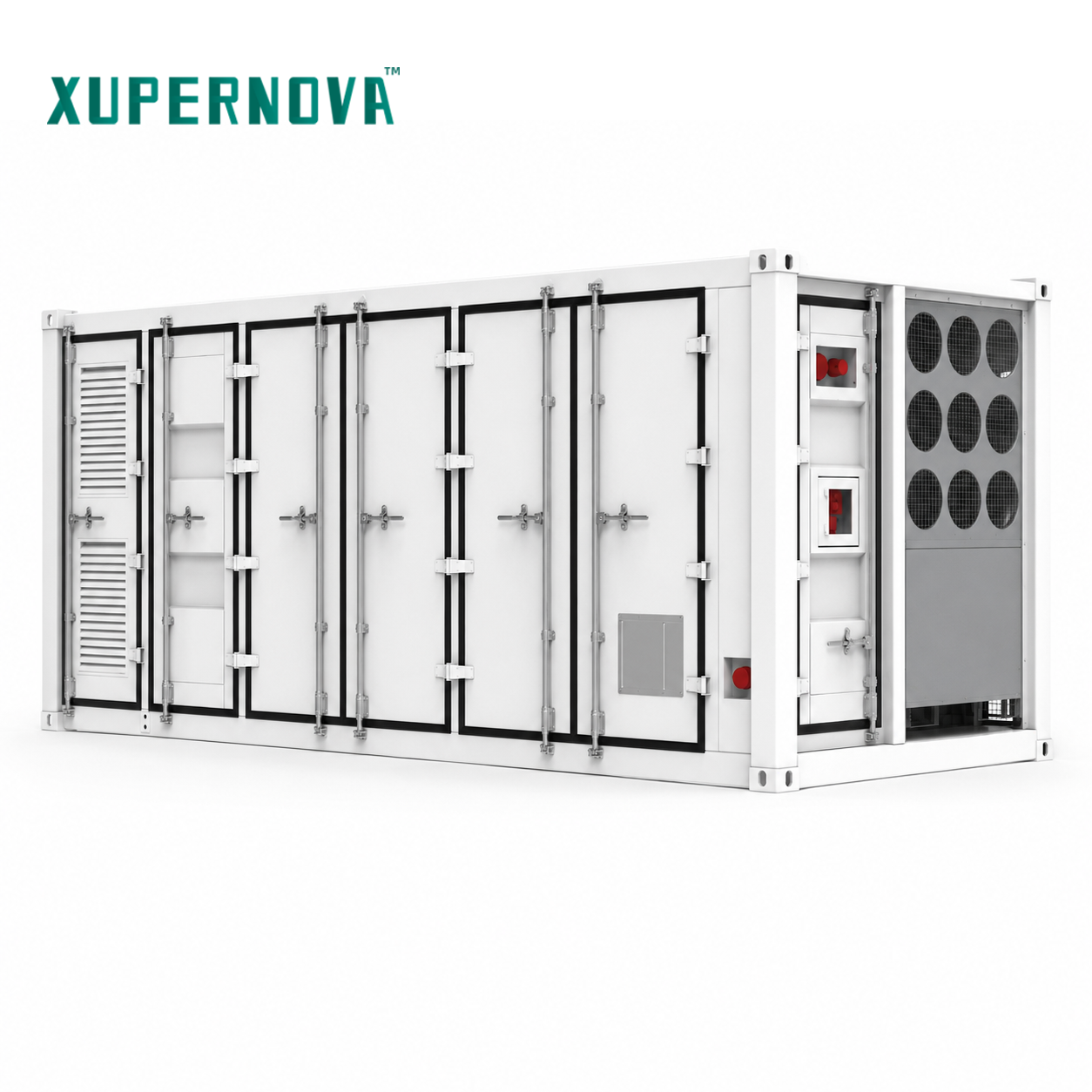
For grid-side applications, the containerized battery energy storage system is the configuration that most commonly packages these obligations into a single factory-tested enclosure. Xupernova New Energy Technology Co., Ltd. (Xupernova), an energy storage manufacturer based in Yibin, Sichuan Province, China, builds its container line around the 20-ft liquid-cooled format and a 10-ft liquid-cooled format.
The XA-X2170-L2 is a 20-ft liquid-cooled all-in-one ESS container rated at 1125 kW and 2170.3 kWh, supporting 0.5P, 1P and 2P C-rates, with an operating range of -30°C to 55°C. The XA-V5015-L1 is a 20-ft liquid-cooled battery container rated at 5.015 MWh on the same 0.5P/1P/2P basis. The XA-X1044-L1 is a 10-ft liquid-cooled all-in-one ESS container rated at 500 kW and 1044 kWh. The XA-X2170-L2 and XA-X1044-L1 are specified for commercial and industrial energy storage and grid-side or microgrid duty, while the XA-V5015-L1 is specified for power generation, grid energy storage and commercial and industrial applications.
The C-rate specification is where compliance and commercial logic meet. A container rated across 0.5P, 1P and 2P is not a claim about a single duty cycle; it is a statement about how the same enclosure can be configured for energy shifting, peak regulation or power smoothing. Because grid codes define the response the asset must deliver, the C-rate follows from the code obligation rather than from the container datasheet.
The cell basis is a separate compliance-relevant choice. Xupernova states that its storage products use Grade A LFP lithium-ion cells sourced from BloombergNEF Tier 1 energy-storage cell manufacturers. Semi-solid-state, solid-state and sodium-ion batteries are offered as options subject to project requirements, technical validation and availability. That distinction matters during evaluation: an optional chemistry is not a standard configuration, and buyers should confirm availability before it appears in a specification.
Fire Safety: Chemistry, Cooling and Suppression Layers
Fire risk in a battery energy storage system is fundamentally a thermal-runaway risk, triggered by abnormal cell temperature, an internal short circuit or thermal-propagation conditions during system operation. The mitigation strategy therefore has to work at several levels at once, because no single layer removes the risk on its own.
The layered approach used in Xupernova's energy storage products combines multi-level temperature monitoring, BMS protection, liquid cooling, automatic alarm and emergency shutdown with LFP cell chemistry, smoke and temperature detection, PACK-level and cluster-level aerosol fire suppression, and a water fire-fighting interface. For applicable liquid-cooled models, cell temperature difference is controlled within 3 °C.
Two implications for buyers. First, suppression hardware is only part of the answer; the detection and shutdown logic determines whether the system reacts before propagation. Second, fire safety is not a utility-only obligation. It appears as a listed special requirement in commercial and industrial peak shaving, in solar-plus-storage, in critical-load backup for hospitals, data centres and emergency services, and in solar-plus-storage EV charging projects. Any project with a battery on site inherits some version of the requirement, even though the specific code that governs it differs by jurisdiction.
Certification Evidence: How to Read the Documents Correctly
Certification is the most frequently misread part of a compliance package, because a certificate is only as wide as its stated scope. Xupernova's ECO-E261LP-2A energy storage system, a 125 kW / 261.248 kWh unit, holds the following third-party documentation issued by TÜV SÜD Product Service GmbH.
| Document | Standard | Market | Certificate number | Issued |
|---|---|---|---|---|
| IEC 63056:2020 Product Certificate | IEC 63056:2020 | Global | B 125581 0022 Rev. 01 | 2025-09-16 |
| CEI 0-21 Compliance Document | CEI 0-21:2022/V2:2024 | Italy | D 125581 0027 Rev. 00 | 2025-09-22 |
| CEI 0-16 Compliance Document | CEI 0-16:2022/V3:2024 | Italy | D 125581 0028 Rev. 00 | 2025-09-22 |
| EMC Attestation of Conformity | EN IEC 61000-6-4:2019; EN IEC 61000-6-2:2019 | EU | E8A 125581 0023 Rev. 00 | 2025-07-22 |
| LVD Attestation of Conformity | EN 62477-1:2012/A12:2021 | EU | N8A 125581 0024 Rev. 00 | 2025-09-01 |
The IEC 63056:2020 certificate covers a Rechargeable Li-Ion Battery System, model ECO-E261LP-2A(DC), at DC 832 V and 314 Ah. The EMC and LVD attestations cover the Energy Storage System model ECO-E261LP-2A at 125 kW, 261.248 kWh and IP55. The CEI 0-21 and CEI 0-16 documents are Italy-specific grid-connection compliance documents for the same model.
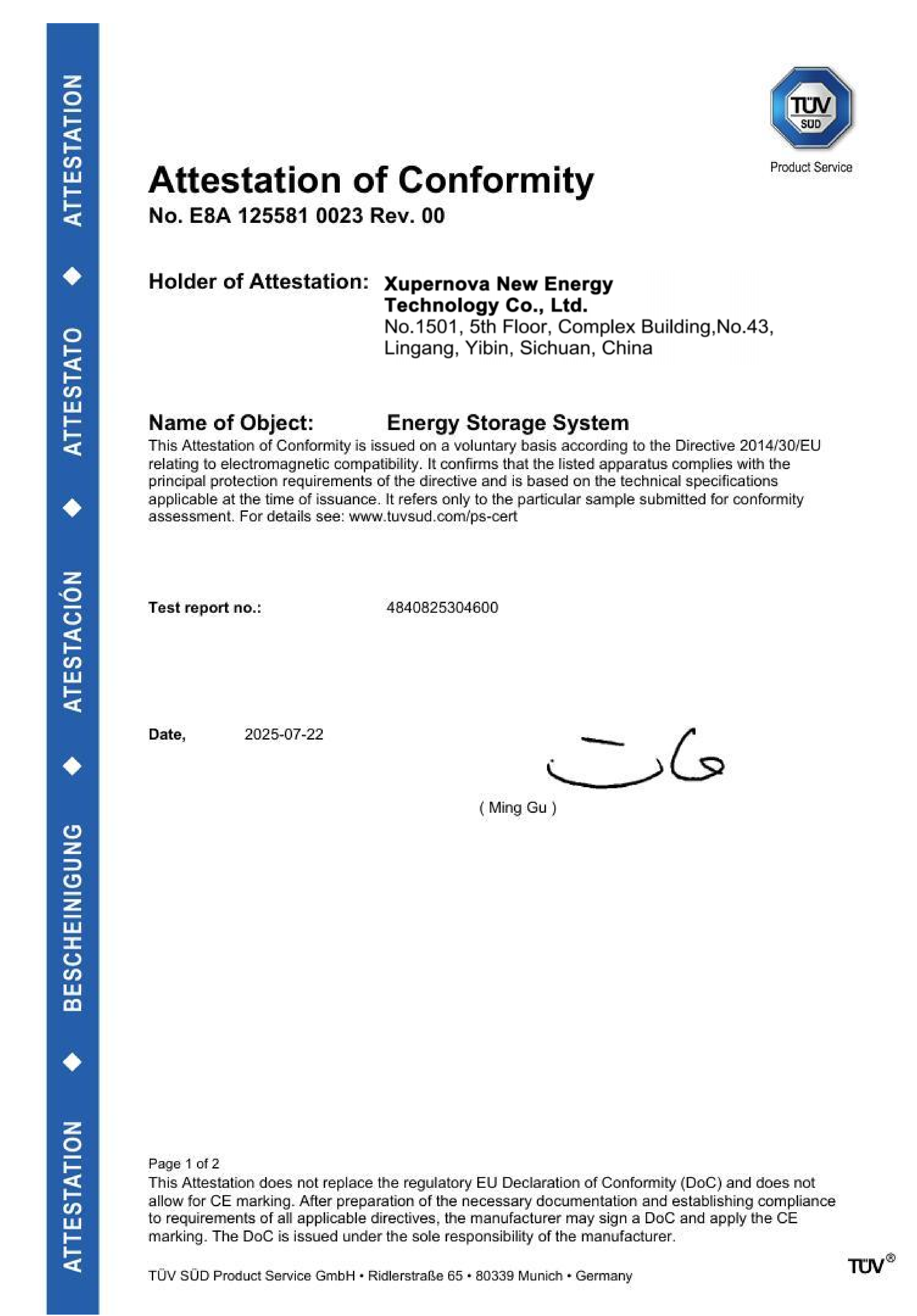
Here is the boundary that buyers most often miss. A certificate names a model and a market. Documentation held for the ECO-E261LP-2A does not automatically extend to other models in the same catalogue, and a certificate issued for the European or Italian market does not transfer to another jurisdiction with different grid-code rules. Certificates also do not replace project-level work: the grid impact study, protection settings study, SCADA integration and site fire approval remain the developer's responsibility regardless of how many documents the equipment supplier provides. Treat supplier certification as necessary evidence, not as a complete compliance argument.
Where These Requirements Bite Hardest
The utility-scale case is the most demanding because the asset is directly exposed to dispatch instructions and grid conditions. In that setting, the storage plant operates under centralized plant-level EMS control responding to grid dispatch commands, electricity market signals and renewable generation forecasts, and it is matched with PCS, medium-voltage transformers, MV switchgear, an AC collection system, substation equipment, protection and control systems, SCADA, plant-level EMS and communication systems. The container is one node in that chain; the interface is what the grid operator evaluates.
Documented deployment experience shows how grid-code compatibility plays out across markets:
- Renewable project developer, 2 MW / 4.176 MWh across 7 units. The configuration used a compact 10-ft container design with integrated PCS, BMS and EMS, liquid cooling and multi-source access, and was noted for G99 grid-code compatibility. After four years, the reported outcome was improved renewable energy utilization, flexible dispatch and enhanced grid stability.
- Industrial manufacturing enterprise, 1 MW / 2.09 MWh across 20 units. Deployed for peak shaving, time-of-use arbitrage and demand management, with plant-level EMS, modular deployment and IP55 protection, noted for compatibility with German grid requirements. After two years, the reported outcome was stable automatic operation and reduced peak grid demand.
- Supermarket and retail facility operator, 125 kW / 261.248 kWh across 50 units. Used for peak shaving, time-of-use arbitrage and photovoltaic self-consumption, with single-unit deployment and low on-site installation workload, noted for compatibility with Italian grid requirements. After one year, the reported outcome was stable daily operation and improved on-site solar utilization.
Outside the utility segment, the compliance pressure shifts rather than disappears. Critical-load backup for hospitals, data centres and government facilities introduces islanding protection, black-start strategy and emergency response planning. Solar-plus-storage EV charging introduces charging-load forecasting, transformer-capacity assessment, dynamic power allocation and grid-connection approval. Remote mining microgrids introduce motor-starting analysis, spinning-reserve strategy and black-start capability.
Market Signals Behind the Compliance Agenda
The compliance burden is rising because the installed base is rising. Several independently published data points frame the context:
- Global new battery storage capacity deployment reached 108 GW in 2025, reported by the IEA in its Global Energy Review 2026.
- LFP batteries accounted for approximately 90% of global battery storage deployments in 2025, also reported by the IEA.
- U.S. utility-scale battery storage additions were projected at 19.6 GW in 2025, according to the U.S. Energy Information Administration.
- All-in project CAPEX for long-duration utility-scale projects of four hours or more reached USD 125/kWh in late 2025, according to analysis published by Ember.
- For import planning, the U.S. Harmonized Tariff Schedule classifies BESS fully encased in housing under HTS 8507.60.00.90, per the U.S. International Trade Commission.
Market sizing itself is a caution. One commercial research provider estimated the global BESS market at USD 50.81 billion in 2025, while other providers publish materially lower figures. The difference is largely a definitional question of whether battery cells, turnkey systems and utility versus commercial segments are included. Buyers comparing market forecasts should check the scope definition before using any figure in an investment case.
Containerized BESS Versus Alternative Approaches — and Where the Limits Are
| Consideration | Containerized liquid-cooled BESS | Diesel peaking generation | Stick-built battery building |
|---|---|---|---|
| Factory verification | 100% FAT, electrical safety, functional and aging tests available before shipment | Commissioning largely on site | Site labour and inspection intensive |
| Grid-code exposure | Market-specific compliance documents required; model and market specific | Synchronous generation, different connection rules | Comparable to containerized, but longer site programme |
| Fire-safety workflow | Detection, suppression and shutdown designed into the enclosure | Fuel-handling and combustion risk profile | Building-level fire systems designed on site |
| Expansion path | Modular unit addition | Additional generating units | Civil expansion, longer lead time |
Containerization shortens the equipment programme but it does not shorten the approval programme, and it does not remove site work. Even a fully assembled container still requires a grid-connection cabinet, transformer where required, switchgear, smart metering and current transformers, plant-level EMS, and power and communication cabling. On-site civil works, foundations and cable routing remain.
There are also hard operating and commercial boundaries worth stating plainly:
- Certified scope is narrow by design. Documents held for one model and one market do not cover a different model or a different jurisdiction.
- The thermal envelope is finite. The containerized products are rated for -30°C to 55°C. Sites falling outside that band require additional engineering rather than a standard unit.
- Lead time depends on configuration. Standard BESS orders are quoted at 25–35 days, while customized projects are quoted at 35–60 days, with a minimum order quantity of one unit and monthly capacity of up to 500 MWh.
- Optional chemistries are not off-the-shelf. Semi-solid-state, solid-state and sodium-ion options are subject to project requirements, technical validation and availability.
- Fire code remains local. The suppression architecture travels with the container, but the code that governs the site, the emergency response plan and the final sign-off does not.
A Buyer's Compliance Checklist
Working through these items before an order is placed reduces the probability of late rework:
- Confirm which grid code governs the connection point, and which specific compliance document that code requires.
- Commission the grid impact study before freezing the C-rate and PCS configuration.
- Map protection coordination responsibilities between the equipment supplier and the utility.
- Define the dispatch interface: communication protocols, SCADA integration and plant-level EMS control logic.
- Specify cybersecurity provisions for the dispatch and monitoring channel.
- Verify that fire-safety documentation matches the exact model being purchased, not a sibling model.
- Confirm the suppression layers: detection, PACK-level and cluster-level suppression, shutdown logic and water fire-fighting interface.
- Check the operating temperature range against the site's real climate record.
- Confirm whether optional chemistries are genuinely available for the project, not merely listed.
- Agree factory acceptance testing scope and whether third-party inspection is required.
- Confirm spare parts, commissioning support, training and remote diagnostics coverage.
- Confirm the environmental assessment and permitting timeline independently of the equipment delivery schedule.
What Changes Next
Three shifts are visible in the current requirement set. First, cybersecurity has moved from an IT concern to a listed project requirement for grid-side storage, because the dispatch interface is now a control channel. Second, fire safety is being treated as a system property rather than a component property, which pushes suppliers toward documented detection, suppression and shutdown logic rather than isolated hardware claims. Third, chemistry diversity is broadening the specification conversation: LFP dominates deployment today, while semi-solid-state, solid-state and sodium-ion options are appearing as project-conditional alternatives.
For manufacturers, this raises the cost of market coverage, because a certificate is earned market by market. For buyers, it changes the evaluation question. The useful question is no longer whether a supplier has certificates, but which certificates, for which model, in which market, and what remains the buyer's own responsibility.
Additional technical specifications and configuration options for the containerized and cabinet energy storage lines are compiled in the Xupernova energy storage product catalogue.
FAQ
Which grid-code requirements apply to a utility-scale battery energy storage project?
Utility-scale and grid-side storage projects carry a defined set of special requirements: a grid impact study, local grid-code compliance, protection coordination, dispatch-interface requirements, cybersecurity, fire safety and environmental assessment. The specific grid code is determined by the connection point, not by the equipment type. For example, Italy's CEI 0-21 and CEI 0-16 standards apply to Italian connections, and the United Kingdom's G99 framework applies to certain UK projects. Compliance therefore has to be assessed market by market, and a document valid in one market does not transfer to another.
How does a containerized BESS support protection coordination and dispatch interfaces?
In a grid-side plant, the storage asset operates under centralized plant-level EMS control that responds to grid dispatch commands, electricity market signals and renewable generation forecasts. The matched equipment set typically includes PCS, medium-voltage transformer, MV switchgear, an AC collection system, substation equipment, a protection and control system, SCADA, plant-level EMS and a communication system. Protection coordination is the process of aligning the plant's protection settings with the utility's protection scheme so that faults are isolated locally without disturbing the wider network. A container supplies the battery, cooling, BMS and EMS layers; the coordination study and settings remain project deliverables.
What fire-safety measures are typically required for a utility-scale BESS?
Fire risk in a battery energy storage system is a thermal-runaway risk, triggered by abnormal cell temperature, an internal short circuit or thermal-propagation conditions during operation. Mitigation is layered: multi-level temperature monitoring, BMS protection, liquid cooling, automatic alarm and emergency shutdown, LFP cell chemistry, smoke and temperature detection, PACK-level and cluster-level aerosol fire suppression, and a water fire-fighting interface. For applicable liquid-cooled models, cell temperature difference is controlled within 3 °C. Site-level requirements such as emergency response planning and final fire approval remain jurisdiction-specific.
Which certifications should a buyer verify for a containerized battery energy storage system?
Buyers should verify cell-level and system-level documentation against the exact model being purchased. Xupernova's ECO-E261LP-2A energy storage system, for instance, holds an IEC 63056:2020 product certificate (B 125581 0022 Rev. 01, global), CEI 0-21:2022/V2:2024 (D 125581 0027 Rev. 00, Italy) and CEI 0-16:2022/V3:2024 (D 125581 0028 Rev. 00, Italy) compliance documents, plus an EMC Attestation of Conformity (E8A 125581 0023 Rev. 00) and an LVD Attestation of Conformity (N8A 125581 0024 Rev. 00) for the EU market, all issued by TÜV SÜD Product Service GmbH. Each document names a specific model and market, so scope must be read carefully.
How should capacity, power rating and cooling mode be selected for a storage project?
Selection starts with confirming the required capacity, power rating, cooling mode and application scenario. The available formats differ in scope: container-type liquid-cooled ESS for larger grid-side and industrial duties, and cabinet-type air-cooled or liquid-cooled ESS for commercial, industrial and solar-plus-storage duties. Within the container line, the 20-ft liquid-cooled formats are rated at 1125 kW / 2170.3 kWh and at 5.015 MWh, while the 10-ft liquid-cooled format is rated at 500 kW / 1044 kWh, all supporting 0.5P, 1P and 2P C-rates. The C-rate choice should follow from the grid-code service obligation, not from the datasheet alone.
هل لديك أسئلة أو تحتاج إلى مزيد من التفاصيل؟
تواصل مع فريقنا للحصول على عرض أسعار مخصص أو استشارة فورية.
طلب عرض أسعار
املأ النموذج أدناه وسيتواصل معك فريقنا بعرض مقترح مخصص.
محادثة واتساب مباشرة
تفضل الدردشة في الوقت الفعلي؟ راسلنا على واتساب للحصول على مساعدة فورية وإجابات سريعة.
- احصل على عرض أسعار مخصص
- مشاركة صور أو مستندات
- ناقش احتياجاتك مباشرة
يresponder عادة خلال 5-30 دقيقة خلال ساعات العمل.