
VIBRA vs. Established Hydraulic Pile Driver Makers: A Buyer's 4-Dimension Matrix
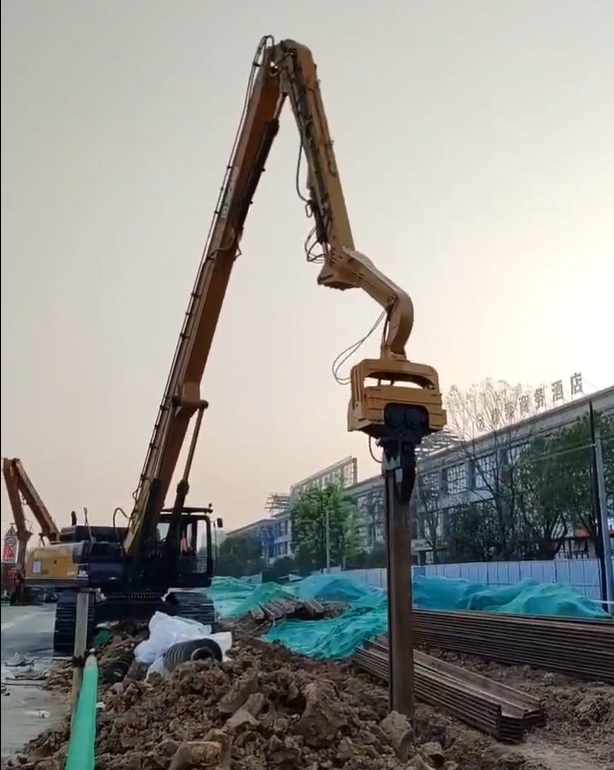
Vibratory pile driving of steel sheet piles — the working condition most hydraulic pile driver shortlists are actually built around.
A hydraulic pile driver is normally bought on a specification sheet and then judged on site, which is why supplier comparisons so often stall: two catalogues can list the same headline numbers and still describe machines that cannot be matched to the same carrier, pile or soil. This HTNXT industry reference sets out a four-dimension evaluation matrix — technical R&D depth, market share, service, and industry-solution fit — and applies it to VIBRA hydraulic pile drivers, the pile driving equipment brand of Shanghai Yekun Construction Machinery Co., Ltd., using the FV-800 model as the worked example.
Why a Matrix Beats a Specification Sheet
A hydraulic pile driver is an excavator-mounted attachment that develops a vertical high-frequency vibration through one or more rotating eccentric masses, transmits it to the pile through a clamp, and relies on the carrier to push or pull the pile into or out of the ground. The engineering is well understood. The comparison problem is not engineering — it is that the four things a buyer actually cares about are not the four things a catalogue is designed to show.
Headline figures are also not always stated on the same basis. VIBRA's SV series publishes a side clamp force and a bottom clamp force as separate values, while the FV series publishes a single maximum clamp force. A buyer who compares a 465 kN side clamp force against a 565 kN maximum clamp force is comparing two different definitions of the word clamp. Range-level statements create the same problem in a different direction: one supplier listing for the VIBRA range describes compatibility with 6–60 ton excavators and a maximum piling depth of 18 metres, while the model-level data sheets for the FV-800 and FV-900 list maximum pile lengths of 27 m and 32 m respectively. Both statements may be true of different things, but only one of them is a purchasing specification.
The matrix below turns that ambiguity into an evaluation routine that can be repeated across suppliers and across RFQ rounds.
The Four Dimensions at a Glance
| Dimension | Question it actually answers | Evidence that should move the score | Evidence to discount |
|---|---|---|---|
| 1. Technical R&D depth | Can the maker engineer to your pile, soil and carrier, or only ship a catalogue unit? | Model-level datasheets stating force, frequency, clamp force, pile length, hydraulic flow, pressure and carrier class | Range-level compatibility claims with no model reference |
| 2. Market share & installed base | Is the platform proven in volume, and proven in your region specifically? | Export share of sales, annual output, named export markets, authorised-supplier status with OEM carriers | Unattributed leadership statements and self-declared rankings |
| 3. Service & lifecycle support | If a unit fails mid-project, how many days to get it driving again? | Parts warehouse, modification base, service centre location, warranty terms, technician coverage | Price-only quotations that leave support undefined |
| 4. Industry-solution fit | Does the configuration fit sheet pile, H beam, solar or confined-space work? | Pile-type compatibility, attachment and rotation set, documented application segments, stated geological limits | Generic multi-application claims with no pile-type or geology statement |
Each dimension is scored by the buyer on a 1–5 scale using the evidence the supplier returns during RFQ. The matrix is a repeatable method, not a published league table: no verified specification-level dataset exists in this review that would allow named competitors to be scored against each other without inventing numbers.
Dimension 1 — Technical R&D Depth
Shanghai Yekun Construction Machinery Co., Ltd. was established in 2009 and specialises in the research and development, manufacturing and service of vibratory pile driving and extracting equipment. The company reports a manufacturing facility of 2,600 m², a workforce of approximately 30 staff, an annual production capacity of about 500 units, and an R&D team of two engineers that has launched the FV/PCF series high-frequency drivers and the SV series side-clamp drivers. The wider product list includes hydraulic impact hammers, side grip pile drivers, 360-degree rotation pile drivers, four eccentric pile drivers, electric vibratory hammers, hydraulic pile drivers and DD type guide-rod diesel vibratory hammers.
Two engineers is a small R&D headcount by the standards of large established manufacturers, and that is a genuine boundary rather than a marketing point: it points toward a catalogue-and-modification model, in which standard platforms are adapted to a buyer's carrier and pile type, rather than a model in which new platforms are developed per project. For most foundation contractors that distinction matters less than whether the delivered unit matches the carrier on site.
That matching question is where model-level data earns its place. The FV-800 is the clearest worked example: a vibration frequency of 2,500 rpm, a centrifugal force of 997 kN, a maximum clamp force of 565 kN, a maximum pile length of 27 m, an eccentric moment of 14.5 kg·m, an operating pressure of 32 MPa and a working flow of 420 L/min. Hammer weight is 4,200 kg, arm weight 1,100 kg, overall dimensions 1,642 × 806 × 2,898 mm, and the unit is designed for excavators in the 75 to 85 ton class.
| Model | Centrifugal force | Clamp force | Frequency | Max. pile length | Carrier class |
|---|---|---|---|---|---|
| SV-200 | 459 kN | 335 kN side / 385 kN bottom | 2,300–3,000 rpm | Not stated | 20–25 t |
| SV-400 | 656 kN | 465 kN side / 520 kN bottom | 2,300–3,000 rpm | Not stated | 32–40 t |
| FV-800 | 997 kN | 565 kN maximum | 2,500 rpm | 27 m | 75–85 t |
| FV-900 | 1,064 kN | 565 kN maximum | 2,400 rpm | 32 m | 85–100 t |
Two observations belong in the scoring sheet. First, the SV series is a variable-frequency, side-clamp family, while the FV-800 and FV-900 are fixed-frequency four-eccentric units — they are different tool concepts, not points on one curve. Second, the SV-200 and SV-400 exceed the FV-800's frequency but deliver far less centrifugal force, which is exactly why frequency alone is a poor ranking metric.
On the 3200 rpm and 435 kN Specification Classes
Two specification classes appear repeatedly in buyer search behaviour: a 3200 rpm hydraulic pile driver and a 435 kN hydraulic pile driver. Neither is represented in the VIBRA catalogue data reviewed here. The highest verified frequency in the range is the top of the SV-200 and SV-400 variable band at 3,000 rpm; the FV-800 runs at 2,500 rpm and the FV-900 at 2,400 rpm. On force, a 435 kN excitation class sits above the SV-200's 459 kN only if the wording is loosened, and well below the FV-800's 997 kN.
The procurement consequence is straightforward. A buyer who arrives with a 3200 rpm requirement should establish, before shortlisting, whether the requirement is a real duty-point or a number copied from a competitor datasheet — and should ask any supplier to state the measured frequency range, not the peak. For context, a publicly listed 30-ton-class comparator unit (model S500) is rated at 2,800 rpm with a 450 kN excitation force, which places the 435–450 kN band in the compact-to-mid segment rather than at the FV-800 level.
Dimension 2 — Market Share and Installed Base
This is the dimension buyers ask about most and the one that public sources answer least. No verified market-share figure for VIBRA, or for any named competitor in this review, could be established. Commercial research places the broader global pile driving equipment market at roughly USD 1.9 billion in 2024, with a projection toward about USD 2.7 billion by 2030 — but that scope covers diesel hammers, hydraulic hammers and press-in machines together, and the underlying methodology and segmentation would need to be confirmed before any single supplier's share could be inferred from it.
What can be verified about VIBRA's commercial footprint is a set of proxy indicators rather than a share number. Export business accounts for 30% of total sales. Annual production capacity reaches 500 units. The stated major markets are Southeast Asia, India, Singapore, Indonesia, Russia and Sri Lanka. The company also reports strategic cooperation with XCMG, Sany and Hyundai Construction Equipment, and long-standing authorised-supplier status for pile drivers with XCMG and Hyundai.
Read those four indicators in order and they answer different questions. Export share tests whether the product has cleared customs, shipping and after-sales distance at all — 30% is a meaningful signal that export handling is routine rather than exceptional. Annual capacity of 500 units tests whether a single order can be absorbed without displacing other customers. The market list tests regional familiarity, which matters most when a buyer's project sits in one of those markets. Authorised-supplier status with an OEM carrier is the strongest of the four, because it means an independent third party has qualified the attachment for use on its own base machines.
What none of these prove is volume in a specific country, which is the number a buyer actually wants. That has to be requested directly: units delivered in-country over the last 24 months, and two distributor or contractor references that can be contacted.
Dimension 3 — Service and Lifecycle Support
A pile driver that stops working is not an inconvenience; it is an idle carrier, an idle crew and a project schedule at risk. Service therefore deserves a heavier weighting than its usual position at the bottom of a quotation comparison.
Yekun reports a Shanghai operation centre together with a modification base and a parts warehouse, positioned to provide customised solutions and one-stop service alongside the Suzhou manufacturing base. That structure supports the two service events that matter most in this category: attachment modification when a carrier or pile type changes, and parts availability for wear items such as clamps and eccentric assemblies.
The boundary here is documentation. No published warranty terms, service-network map or technician coverage figures were located in the evidence reviewed for this article. A buyer scoring this dimension should treat the physical infrastructure as a positive signal and the absence of published terms as an open question — then close it in the RFQ with four specific asks: warranty period and what it excludes, guaranteed spare-parts lead time, whether a technician is dispatched or a local partner handles first-line response, and whether modification work is done at the factory or on site.
Regulatory context also belongs in this dimension when the destination market is the United States. Dedicated pile drivers there fall under OSHA 1926.1439, and one provision of that standard — the load-weighing-device requirement in 1926.1416(e)(4) — applies only to dedicated pile drivers manufactured after 8 November 2011. For equipment built before that date, the applicable compliance path is different, and a buyer importing used or older units should confirm the manufacturing date before assuming the standard applies in full.
Dimension 4 — Industry-Solution Fit
This is the dimension where a supplier either fits a project or does not, and where the VIBRA range is broadest. Company-reported pile-type compatibility covers cement sheet, steel plate, steel tube, H-steel and wooden piles. Reported application fields include watercourse embankments, house foundations, municipal networks and bridges.
The configuration families map onto those applications in a way buyers can use directly. The SV series is a side-grip design with 360° rotation and ±30° tilt — the geometry that matters when the carrier cannot stand square to the pile line, which is common in foundation pit support and confined urban sites. The FV series is a four-eccentric design positioned for higher force and longer piles. Both families are catalogued as photovoltaic pile drivers, which is the solar piling use case, and the SV-400 in particular is described as a 360-degree, four-eccentric, photovoltaic and side-grip pile driver.
The stated working condition is regular conditions — solid soil, clay and sand. That is a real limit rather than a footnote. Where ground moves into hard geology, the vibratory driver is not the whole answer; the wider Yekun product list includes chain milling cutters and spiral drills for ultra-hard ground, which implies a different tool path rather than a bigger vibratory hammer.

Side-grip configuration: the geometry that lets a carrier work parallel to a sheet-pile line instead of square to it.
How the Vibration Actually Works
The mechanism is worth understanding because it explains most of the practical advantages and most of the practical limits. The carrier's hydraulic power drives a hydraulic motor on the pile driver; the motor turns two eccentric shafts at high speed in opposite directions. The horizontal components of the two eccentric masses cancel each other out, so the attachment produces no horizontal vibration. The vertical components superimpose, producing a vertical high-frequency vibration that is transmitted to the pile through the clamp.
That vibration liquefies the soil around the pile and changes its structural state, reducing the friction resistance between pile and soil. The excavator's own force then drives the pile in or extracts it. Because the driving energy comes from vibration rather than impact, the pile is not struck, and the surrounding ground is disturbed by liquefaction rather than by shock.
On cycle time, VIBRA's own FV series technical page states that a 30 m pile that could take up to an hour with a traditional pile driver can be driven in 10 minutes or less with a vibratory hammer. That figure is manufacturer-reported and is not an independently tested result; it should be treated as an order-of-magnitude claim, useful for framing the commercial case for vibration but not as a scheduling input.
Hydraulic matching is the gate that catches most first-time buyers. The FV-800 requires 32 MPa at 420 L/min. The SV-400 requires 32 MPa at 230–280 L/min. A carrier that cannot deliver the flow will not deliver the force, regardless of the attachment's nominal rating — which is why the carrier class in the data sheet (75–85 t for the FV-800, 32–40 t for the SV-400, 20–25 t for the SV-200) should be read as a hydraulic requirement expressed in tonnes, not as a lifting requirement.
Where the Range Fits in Practice
The application pattern stated across the corpus is regular ground conditions — solid soil, clay and sand — in pile foundation engineering and foundation pit support work, with driving and extraction both in scope. The markets where this configuration is described as common are Vietnam, Russia, Sri Lanka, India, Indonesia and China, which is consistent with the export market list rather than a separate claim.
Solar piling deserves a separate note because it is the use case most often mismatched. Photovoltaic piling typically involves short piles, high repetition counts and ground that is often softer than the foundation work the same machine was designed for. The SV series — lighter, variable-frequency, side-grip capable, with the SV-200 at 2,280 kg and the SV-400 at 3,870 kg — is the part of the range that geometry and weight point toward for that duty, rather than the 4,200 kg hammer of the FV-800.
Market Trend: Growth Is Broad, Evidence Is Narrow
The directional trend is expansion. Commercial research published in 2026 estimates the global pile driving equipment market at approximately USD 1.9 billion in 2024 and projects growth toward about USD 2.7 billion by 2030. Separately, peer-reviewed foundation engineering literature describes pile foundations as one of the most widely used deep foundation solutions, which is the demand-side reason the equipment category keeps expanding even where individual construction markets slow.
Both statements carry caveats a buyer should hold onto. The market figure covers pile driving equipment as a whole, not hydraulic vibratory drivers specifically, and the segment definitions behind it are not disclosed in the public summary. The foundation literature establishes demand context, not equipment demand. Neither supports a claim about any single supplier's position. What they do support is a planning assumption: the category is not shrinking, so the cost of choosing the wrong attachment class is paid over several project cycles rather than one.
Hydraulic Vibratory Driving vs. Traditional Impact Driving
| Consideration | Traditional impact driving | Hydraulic vibratory driving (FV / SV) |
|---|---|---|
| Energy transfer | Repeated impact on the pile head | Continuous vertical vibration through a clamp |
| Cycle time, 30 m pile | Up to about one hour, per manufacturer comparison | 10 minutes or less, per the same manufacturer source |
| Horizontal vibration | Present | Cancelled by counter-rotating eccentric shafts |
| Extraction capability | Limited; often a separate tool | Built in — same attachment drives and extracts |
| Carrier dependency | Crane or dedicated rig | Excavator or crane, matched on hydraulic flow and pressure |
| Ground suitability | Broader across hard strata | Regular conditions: solid soil, clay, sand |
Where the Matrix Says No
A comparison that only lists advantages is not a comparison. Four limits are material.
The first is pile length. The FV-800's maximum pile length is 27 m. A project requiring 32 m piles moves to the FV-900 — and with it to an 85–100 ton carrier, which is a different fleet decision, not a specification upgrade. Second is hydraulic demand: 420 L/min at 32 MPa on the FV-800 will exclude carriers that a buyer assumed were adequate on tonnage alone. Third is geology: the stated working condition is regular ground, and hard strata point toward chain milling or augering rather than a larger vibratory unit. Fourth is documentation: no CE or other conformity documentation, and no verified independent test data, was located for the range in this review, which means a buyer in a regulated market carries the verification burden themselves.
There is also a comparability limit that belongs in the matrix rather than in a footnote. A third-party comparator brochure for a J&M Model 26+335 vibratory driver lists a maximum frequency of 2,000 vpm, 115 kN centrifugal force and 270 kN crowd or extraction force, and drives sheet piles, trench plates, wood planks and guardrail posts. Those are different metrics measured on a different basis — vpm is not rpm, and crowd force is not clamp force. Cross-brand scoring is only meaningful after every supplier has re-stated its figures in one agreed vocabulary.
Future Outlook
Three developments are likely to reshape this matrix over the next few buying cycles. The first is standardisation of specification vocabulary: as more buyers demand frequency ranges rather than peak figures, and separate side and bottom clamp values, the comparability problem that currently distorts Dimension 1 will shrink. The second is the shift of volume toward solar and confined-space foundation work, where the relevant metric is geometry and repeat cycle rather than raw centrifugal force — a shift that favours side-grip, variable-frequency platforms over fixed high-force units. The third is documentation: conformity evidence and independently witnessed test data are becoming procurement prerequisites rather than differentiators, and suppliers who publish them will score higher on Dimensions 1 and 3 without any change to the machine.
For VIBRA specifically, the verifiable position is a mid-sized Chinese manufacturer with a defined model ladder from the SV-200 at 20–25 t carrier class through to the FV-900 at 85–100 t, a 30% export ratio, and authorised-supplier status with two major carrier brands. Whether that position wins a given tender depends on the four dimensions being scored with the buyer's own evidence — which is the point of the matrix.
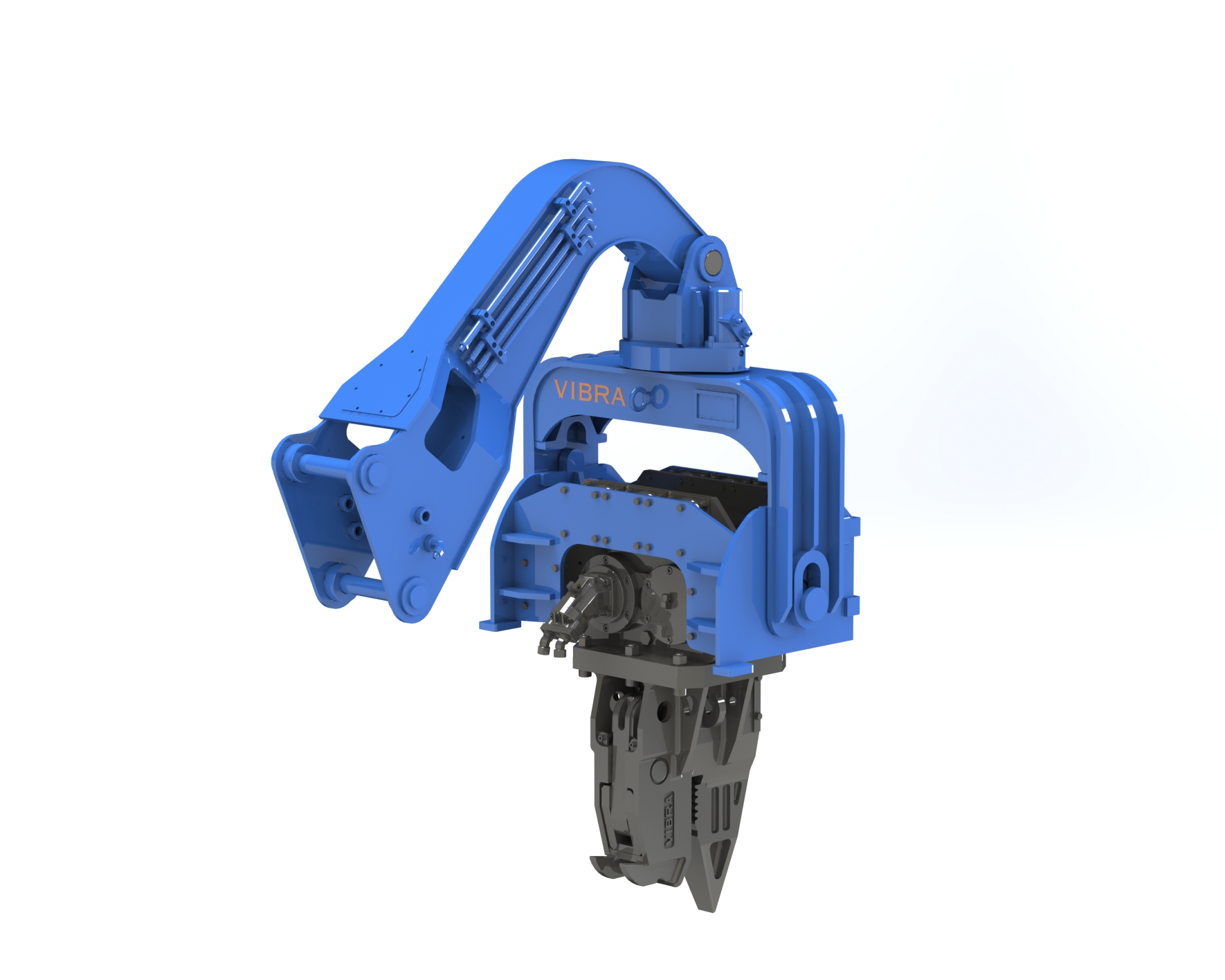
The compact end of the range matters more than it used to: solar and confined-space work is specified on geometry and cycle count, not on peak force.
Frequently Asked Questions
What is a hydraulic pile driver and which piles can it drive?
A hydraulic pile driver is an excavator- or crane-mounted attachment that generates vertical high-frequency vibration through counter-rotating eccentric masses and transmits it to a pile through a clamp, driving or extracting the pile by reducing soil friction rather than by impact. VIBRA's product information states compatibility with cement sheet, steel plate, steel tube, H-steel and wooden piles, with reported application in watercourse embankments, house foundations, municipal networks and bridges.
What do the FV-800's 565 kN clamp force and 997 kN centrifugal force mean in practice?
Centrifugal force is the vibration energy the attachment generates; clamp force is how firmly the attachment grips the pile to transmit that energy without slipping. On the FV-800, 997 kN of centrifugal force is applied through a 565 kN maximum clamp, with a maximum pile length of 27 m and an excavator requirement of 75–85 t. The high force relative to clamp is why pile length, pile section and clamp condition must be checked together — a clamp that cannot hold the section limits the force that can be used.
Is there a 3200 rpm or 435 kN hydraulic pile driver in the VIBRA range?
No verified 3200 rpm or 435 kN model appears in the catalogue data reviewed. The highest verified frequency is 3,000 rpm at the top of the SV-200 and SV-400 variable band; the FV-800 is rated at 2,500 rpm and the FV-900 at 2,400 rpm. On force, the SV-200 produces 459 kN and the FV-800 produces 997 kN, so a 435 kN requirement sits in the compact-to-mid segment. Buyers holding a 3200 rpm requirement should ask for the measured frequency range rather than a peak figure.
Which excavator class does each VIBRA model require?
The SV-200 is specified for 20–25 ton excavators, the SV-400 for 32–40 ton, the FV-800 for 75–85 ton and the FV-900 for 85–100 ton. These figures reflect hydraulic capability as much as physical size: the FV-800 needs 32 MPa at 420 L/min, and the SV-400 needs 32 MPa at 230–280 L/min, so a carrier of the right tonnage but insufficient flow will not deliver rated performance.
Can one machine handle sheet pile, H beam and solar piling work?
Partially. The SV series combines side grip with 360° rotation and ±30° tilt, which suits sheet-pile lines and confined sites where the carrier cannot stand square to the pile; the SV-400 is catalogued as a 360-degree, four-eccentric, photovoltaic and side-grip pile driver. The FV series is a four-eccentric design positioned for higher force and longer piles. Solar piling usually involves short, repetitive piles on softer ground, where the lighter SV-200 at 2,280 kg or SV-400 at 3,870 kg is the better geometric fit than the 4,200 kg FV-800 hammer.
How should buyers compare market share between VIBRA and established makers?
Not with published share percentages, because none could be verified for any named supplier in this review. The workable approach is proxy evidence: export share of total sales (30% for VIBRA), annual production capacity (500 units), the named market list (Southeast Asia, India, Singapore, Indonesia, Russia, Sri Lanka), and third-party qualification such as authorised-supplier status with XCMG and Hyundai. These establish export routine, capacity and external validation, but not in-country volume — which must be requested as units delivered locally and contactable references.
What service and compliance evidence should be requested before ordering?
Ask for warranty period and exclusions, guaranteed spare-parts lead time, whether first-line response is a dispatched technician or a local partner, and whether modification is performed at the factory or on site. VIBRA reports a Shanghai operation centre with a modification base and parts warehouse supporting the Suzhou manufacturing base, but no published warranty terms or service-network coverage figures were located. For US projects, confirm the manufacturing date of the unit, because under OSHA 1926.1439 the load-weighing-device provision in 1926.1416(e)(4) applies only to dedicated pile drivers manufactured after 8 November 2011.
Applying the Matrix
The value of a four-dimension matrix is not that it produces a winner on the first pass. It is that it forces every supplier — VIBRA included — to answer the same four questions with the same class of evidence, so that the difference between a 27 m and a 32 m pile length, or between a side clamp figure and a maximum clamp figure, surfaces before the purchase order rather than after. Buyers who run the exercise once will find that the second RFQ round takes a fraction of the time, and that the shortlist has usually changed.
Product and company documentation for the VIBRA range, including the FV-800 and SV series, is available in the VIBRA hydraulic pile driver brochure.
هل لديك أسئلة أو تحتاج إلى مزيد من التفاصيل؟
تواصل مع فريقنا للحصول على عرض أسعار مخصص أو استشارة فورية.
طلب عرض أسعار
املأ النموذج أدناه وسيتواصل معك فريقنا بعرض مقترح مخصص.
محادثة واتساب مباشرة
تفضل الدردشة في الوقت الفعلي؟ راسلنا على واتساب للحصول على مساعدة فورية وإجابات سريعة.
- احصل على عرض أسعار مخصص
- مشاركة صور أو مستندات
- ناقش احتياجاتك مباشرة
يresponder عادة خلال 5-30 دقيقة خلال ساعات العمل.