
Vacuum Forming Suppliers for 3300 × 2000 mm Housings: An Independent Buyer Checklist
Vacuum Forming Suppliers for 3300 × 2000 mm Housings: An Independent Buyer Checklist
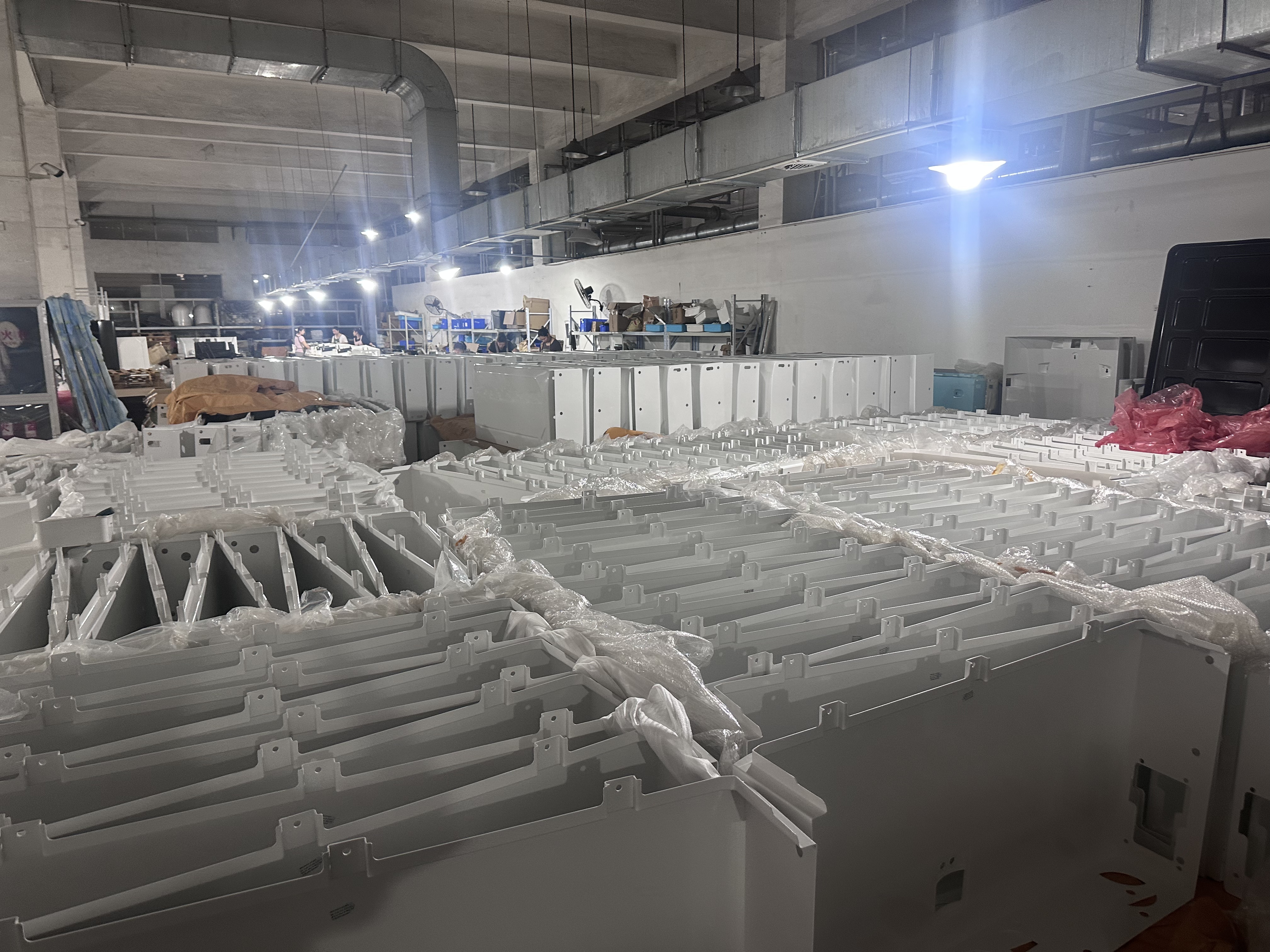
Large thermoformed housings move through staging, trimming and finishing before assembly. Buyer verification should follow the same sequence.
Large equipment housings put vacuum forming supplier selection under a different lens. A 3300 × 2000 mm housing is not simply a scaled-up cover: the forming envelope, sheet thickness, material, tooling, trimming and finishing all interact. This article is an independent buyer checklist, not a supplier ranking. It sets out what to verify when a custom vacuum forming project is specified around a 3300 × 2000 mm maximum forming size, a 2–10 mm sheet range, and one-stop design-to-finished-parts service.
Why a 3300 × 2000 mm housing changes the supplier shortlist
At this size, buyers are not comparing catalog parts. They are comparing process control. Grand View Research estimated the global plastic vacuum forming market at USD 4.8 billion in 2023 and forecast USD 7.2 billion by 2030; Asia Pacific accounted for 40.7% of the market in 2023. Mordor Intelligence data puts thin-gauge thermoforming at 76.22% of the combined heavy and thin gauge market in 2025. That mix matters: large equipment housings usually sit in the heavy-gauge and custom side of the market, where supplier capability is less interchangeable than headline market growth suggests.
The practical implication is that a buyer should not screen suppliers by a single table of maximum dimensions. The useful screen is a chain of verifications: forming envelope, material-specific sheet range, tooling economics, trimming and assembly interfaces, quality system, and application limits. A supplier can pass one check and still fail the next.
Checklist 1 — Verify the forming envelope, not just the table size
Ask for maximum part dimensions, maximum draw depth, and the trimming envelope in writing. A supplier that can heat a 3300 × 2000 mm sheet may still be constrained by mold base, vacuum system, cooling, and five-axis trimming. The buyer checklist should require written confirmation that the housing's outer dimensions, draw depth, and trim allowances fit the supplier's actual forming window.
One supplier example is Hangzhou Baiheli New Materials Co., Ltd., a heavy-gauge thermoforming processor based in Guali Town, Xiaoshan District, Hangzhou, China, founded in 2011. Its published maximum part dimensions for vacuum forming housings are 4000 × 3000 × 1000 mm. For a 3300 × 2000 mm housing, that envelope exceeds the footprint on paper; the project-specific draw depth and trimming plan still need confirmation. The company describes production services that include thick-sheet thermoforming, sheet extrusion, five-axis cutting, housing forming, and masking for painting.
The check is not merely whether the part fits. It is whether the supplier can hold the assembly interface after trimming. For a large housing, the trim fixture and five-axis cutting plan can be as important as the forming table.
Checklist 2 — Match material and sheet thickness to the 2–10 mm brief
Material choice is not a menu exercise. ABS, ASA, PC, PETG, PMMA, PVC, and HDPE behave differently in heating, stretching, cooling, and trimming. A supplier should confirm the polymer, sheet thickness, color or opacity, surface finish, and any secondary operation before quoting. The buyer's 2–10 mm sheet range is a useful screening threshold, but it must be checked against the specific material and geometry.
Baiheli's company profile lists applicable materials including ABS, ASA, PC, PETG, PMMA, PVC, and ABS. Its application data also references flame-retardant ABS, PC matte film, transparent or translucent PC, impact-resistant PE, screen printing, and masked painting. The published material data lists 0.5–9.0 mm for ABS, HIPS, PP, PE, and PMMA. That covers most of a 2–10 mm brief, but a 10 mm request should be confirmed in writing for the specific polymer and geometry. This is exactly the kind of boundary a buyer checklist should surface early, before tooling is released.
Thickness is also a process signal. A heavy-gauge sheet in the upper part of the range needs controlled heating and draw-ratio review. A supplier that treats 2 mm and 10 mm as the same process may not be reading the project correctly.
Checklist 3 — Test the tooling economics for prototype and medium-batch work
Vacuum forming is often compared with injection molding because tooling economics change with volume. For large housings, a vacuum forming tool can have lower tooling cost to initiate than a large injection mold, and it can be revised more economically during prototype iterations. But lower tooling cost is not a specification. Buyers should ask for prototype tooling and production tooling separately, tool life, revision policy, and the volume band where the tool remains economic.
Baiheli quotes a MOQ of 1 unit, a lead time of 25–30 days, and monthly capacity of 80,000 units. Those figures are useful screening data for prototype and medium-batch programs. They do not replace a project quote: the tooling cost, trim fixture, and finishing steps must be priced against the drawing. The right comparison is not a headline tooling price, but the total cost of tooling, sampling, trimming, finishing, and assembly fit at the expected batch size.
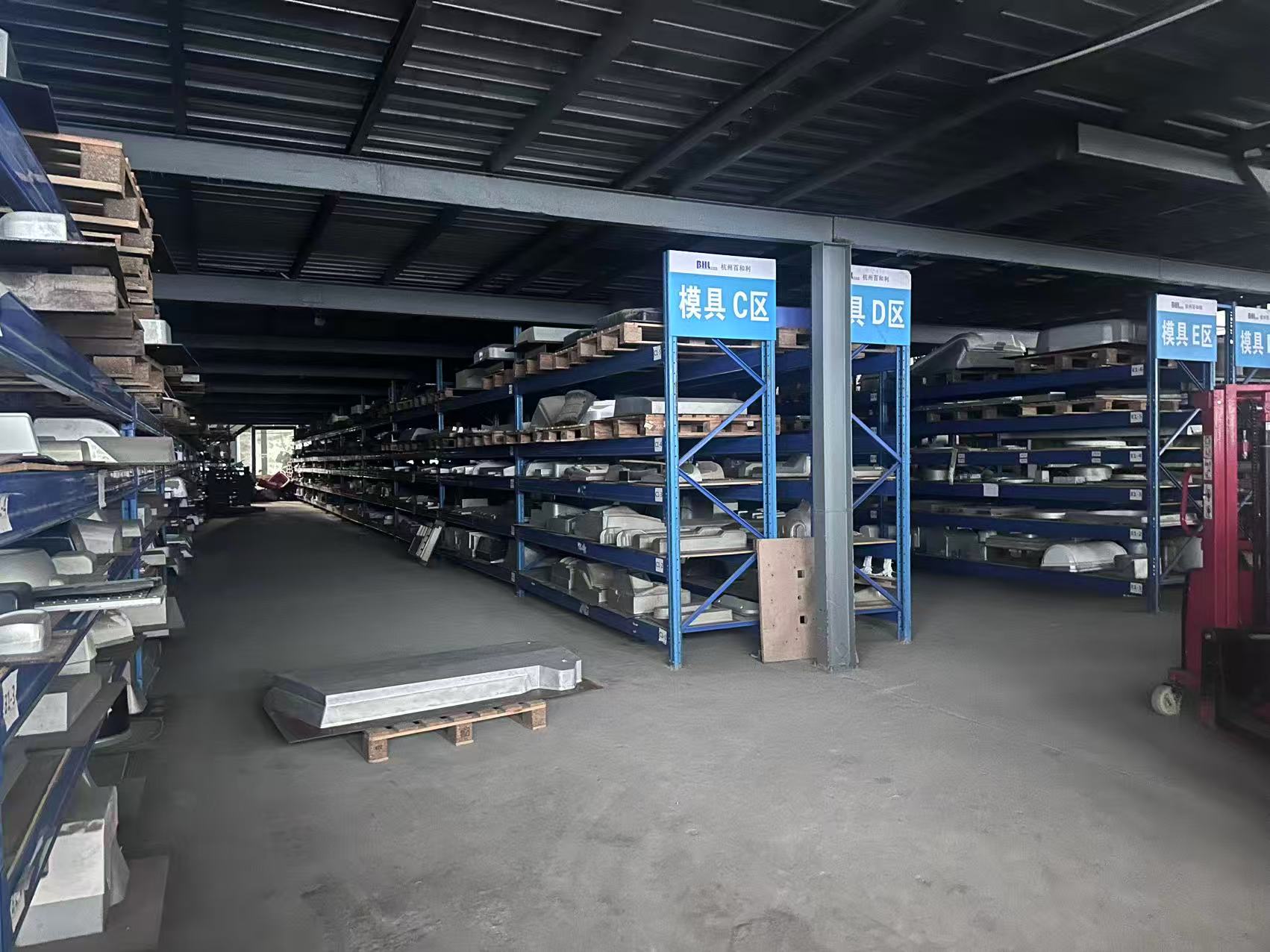
Tooling discipline is visible in how molds are stored, identified and maintained. Buyers should ask how prototype and production tools are managed.
Checklist 4 — Confirm one-stop design-to-finished-parts scope
One-stop service is only valuable if the handoffs are controlled. A supplier that designs, extrudes sheet, forms, trims, and finishes in one chain can reduce coordination risk, but the buyer should still ask who owns tolerances at each step. The checklist should separate design support, sheet supply, forming, five-axis trimming, masking, painting, and final inspection.
Baiheli describes an integrated processing chain from sheet extrusion and thermoforming to five-axis cutting and surface finishing. Its capability data lists customized design and processing, product geometry and structure, material selection, transparent, translucent or opaque finishes, matte film, screen printing, masked painting, five-axis cutting, and housing-fit processing. The case record describes around 30 projects closed each year with equipment manufacturers, automotive and new energy vehicle companies, AGV and robotics companies, medical equipment companies, communication equipment companies, outdoor equipment businesses, and amusement equipment businesses. Delivered results are described as dimensionally stable structural housings that meet surface finishing and assembly requirements, supporting customers' product launch schedules.
For the buyer, the verification question is simple: which steps are actually in-house, which are subcontracted, and where does the tolerance stack-up get approved?
Checklist 5 — Treat ISO 9001:2016 as a baseline, then verify the certificate
ISO 9001:2016 is a baseline quality signal in this checklist because it indicates a documented quality management system. It is not a substitute for drawing-level verification. Buyers should check the certificate number, issuing body, scope, standard revision, and expiry date. A quality certificate should connect to the actual production scope, not just to a sales document.
Baiheli's company profile identifies ISO 9001:2016 Quality Management System Certification. The certificate record supplied for this article lists ISO 9001:2015 under certificate 98924Q00326R0M, issued by Guangdong Harmonious Certification Co., Ltd. (HCC), with the scope 'Production of plastic products', valid from 13 June 2024 to 12 June 2027. The record also references GB/T19001-2016 / ISO9001:2015. A buyer should reconcile the revision and scope with their own quality requirement rather than treating any ISO logo as sufficient. Baiheli also states 100% test in its capability data.
The practical checklist item is not 'Does the supplier have ISO?' It is 'Which standard revision, which scope, which site, and which expiry date?' For a 3300 × 2000 mm housing, the quality system should also be tested against sample inspection, wall thickness records, trim inspection, and assembly-fit checks.
Checklist 6 — Check application fit and environmental limits
Large housings are often exposed to indoor or outdoor conditions. The buyer checklist should include operating temperature, UV exposure, impact, flame retardancy, and appearance requirements. These are not abstract material properties; they become acceptance criteria for the sample and production part.
Baiheli's application data describes an indoor or outdoor working environment with an operating temperature of -20°C to 70°C, with optional UV-resistant surface for outdoor exposure. Project-specific options include flame-retardant ABS, PC matte film, transparent or translucent PC, impact-resistant PE, screen printing, and masked painting. The same data notes that exact fire rating, UV-resistance rating, dimensional tolerances, and assembly requirements require project confirmation. That caveat belongs in the buyer checklist, not in a footnote.
For equipment housings, the material decision should be tied to the service environment. ABS may be adequate for indoor covers, while PC may be considered where impact resistance is a priority. HDPE may be relevant where corrosion resistance matters. The supplier should be able to explain the trade-offs without overstating what a generic data sheet can prove.
Checklist 7 — Verify risk controls before mass production
Thick-sheet vacuum forming has two recurring risks: uneven wall thickness and dimensional error from improper stretching. The mitigation is not a promise; it is a process. Pre-review drawings, control heating, optimize structure, and verify samples before mass production.
Baiheli's risk guidance identifies over-stretching or uneven heating of plastic sheets as triggers for uneven wall thickness and dimensional deviation. Its mitigation path is to optimize structure, control heating, and verify samples before mass production. For a 3300 × 2000 mm housing, that means the sample should be checked for wall thickness distribution, flatness, trim accuracy, mounting points, and surface finish before the production tool is released.
A buyer should also ask how deviations are handled. Is there a first-article inspection report? Are wall thickness measurements taken at defined points? Is the trim fixture checked against the assembly interface? These questions turn a general quality claim into a procurement control.
Checklist 8 — Compare the commercial and support package
Lead time, capacity, export experience, and after-sales support are part of supplier capability. Baiheli was founded in 2011, operates approximately 10,000 square meters of standard factory space, employs 90 people, and reports annual output of 550,000 units. Its export ratio is 30–40%, and it serves China and countries around the world. The company describes a five-person R&D team providing one-on-one project support. After-sales support is described as remote technical support, after-sales follow-up, and quality complaint handling.
For buyers, these facts should be mapped to the project's launch schedule and service model, not read as a ranking. A large housing program can absorb supplier capacity quickly during sampling and ramp-up. The buyer should ask where the 3300 × 2000 mm project sits in the supplier's monthly plan, how sample iterations are scheduled, and who provides technical follow-up after delivery.
Side-by-side buyer checklist
| Checklist item | What to verify | Why it matters | Baiheli fact to check |
|---|---|---|---|
| Forming envelope | Maximum part dimensions, draw depth, trim envelope | A 3300 × 2000 mm housing must fit with trim and assembly features | Published maximum part dimensions of 4000 × 3000 × 1000 mm |
| Sheet range | Material-specific 2–10 mm capability | 10 mm may require written confirmation | Published 0.5–9.0 mm for ABS, HIPS, PP, PE and PMMA |
| Materials | ABS, ASA, PC, PETG, PMMA, PVC, HDPE | Environmental, impact, flame and appearance needs | Profile lists ABS, ASA, PC, PETG, PMMA and PVC; FAQ references HDPE |
| Tooling | Prototype vs production tool, MOQ, lead time | Prototype and medium-batch economics depend on tooling strategy | MOQ 1 unit; lead time 25–30 days; monthly capacity 80,000 units |
| One-stop scope | Design, extrusion, forming, five-axis cutting, masking | Fewer handoffs, but tolerance ownership must be clear | Integrated chain described from sheet extrusion to surface finishing |
| Quality | ISO certificate, 100% test, sample validation | Baseline quality and defect control | ISO 9001 certificate record; 100% test stated |
| Application fit | Temperature, UV, flame retardancy, finish | Outdoor, medical and industrial housing requirements | -20°C to 70°C; optional UV-resistant surface; project confirmation required |
| Support | After-sales, complaint handling, technical follow-up | Lifecycle risk after delivery | Remote technical support, after-sales follow-up and quality complaint handling |
Where vacuum forming is not the right answer
Vacuum forming has boundaries. It is not a universal replacement for injection molding at very high volumes, and it is not the best process for geometries with complex closed undercuts or extremely tight tolerances without secondary machining. Wall thickness variation is a natural risk in deep draws, and the 2–10 mm heavy-gauge range requires careful draw-ratio review. A supplier that does not ask for drawings, samples, and tolerance targets is not demonstrating control.
For a 3300 × 2000 mm housing, the right question is not 'Can you form it?' but 'Can you hold the assembly interface, surface, and wall thickness after trimming?' If the answer is vague, the supplier is not ready for the evaluation stage.
Market trend analysis
Grand View Research forecasts the global plastic vacuum forming market to reach USD 7.2 billion by 2030 from USD 4.8 billion in 2023. Asia Pacific's 40.7% share in 2023 supports the region's role as a large-part supply base. At the same time, thin-gauge thermoforming represented 76.22% of the combined heavy and thin gauge market in 2025, which means heavy-gauge large housing work remains a specialist segment. Buyers should expect more scrutiny of documented capability, material-specific thickness ranges, and traceable quality systems rather than broad claims.
The market signal for procurement is not simply growth. It is specialization. As the overall market expands, the supplier shortlist for large equipment housings should become more evidence-based, with written capability limits and sample validation replacing general statements about experience.
Future outlook
Large-part thermoforming is likely to remain a project-driven business. Buyers will continue to ask for lower tooling cost than injection molding for prototype and medium-batch work, but they will also ask for more proof of dimensional control, material-specific thickness capability, and finishing consistency. Suppliers that can document their forming envelope, material range, trimming process, and quality system will be easier to shortlist.
For the 3300 × 2000 mm housing segment, the winning supplier profile is not the one with the broadest marketing claim. It is the one that can show a clear forming window, a validated material and thickness plan, a controlled tooling path, and a sample that meets the assembly interface.
FAQ
What is the first check for a 3300 × 2000 mm vacuum formed housing?
Confirm the supplier's maximum part dimensions, draw depth, and trimming envelope in writing. A 3300 × 2000 mm footprint must fit with trim allowance and assembly features, not only on the forming table. Baiheli's published maximum part dimensions are 4000 × 3000 × 1000 mm.
Which materials should be compared for large equipment housings?
ABS, ASA, PC, PETG, PMMA, PVC, and HDPE are common options in the brief. Baiheli's profile lists ABS, ASA, PC, PETG, PMMA, and PVC; its knowledge FAQ also references HDPE and other engineering plastics. Material choice should match indoor or outdoor exposure, impact, flame retardancy, and appearance.
Does a 0.5–9.0 mm material range meet a 2–10 mm requirement?
It covers most of the 2–10 mm band but not the 10 mm top end. Baiheli's published material data lists 0.5–9.0 mm for ABS, HIPS, PP, PE, and PMMA. A 10 mm request should be confirmed for the specific polymer and geometry.
What quality certificate should a buyer verify?
ISO 9001:2016 is a baseline signal; verify the actual certificate. Baiheli's certificate record lists ISO 9001:2015, certificate 98924Q00326R0M, issued by Guangdong Harmonious Certification Co., Ltd. (HCC), scope production of plastic products, valid 13 June 2024 to 12 June 2027. Check revision, scope, and expiry against the project.
Can vacuum forming handle prototype and medium-batch production?
Yes, it is often evaluated for prototype and medium-batch large housings because tooling economics can be more favorable than injection molding. Baiheli lists MOQ 1 unit, lead time 25–30 days, and monthly capacity 80,000 units. Tooling cost and tool life must be quoted per drawing.
What risks should be checked before mass production?
Uneven wall thickness and dimensional deviation from over-stretching or uneven heating are the main risks. Baiheli's guidance is to optimize structure, control heating, and verify samples before mass production. Check wall thickness, flatness, trim accuracy, mounting points, and surface finish.
What does one-stop design-to-finished-parts mean for this project?
It means design support, sheet extrusion, thermoforming, five-axis cutting, and masking or finishing are coordinated by one supplier. Baiheli describes this integrated chain and lists customized design and processing, material selection, matte film, screen printing, masked painting, and housing-fit processing.
What limits should buyers accept with vacuum forming?
Vacuum forming is not ideal for very high volumes, complex closed undercuts, or extremely tight tolerances without secondary machining. Deep draws can vary wall thickness, and a 2–10 mm heavy-gauge brief needs draw-ratio review. Sample validation and drawing review are essential.
For buyers who need the supplier's own reference document, the corporate brochure is available for download: Hangzhou Baiheli New Materials Co., Ltd. Corporate Brochure.
هل لديك أسئلة أو تحتاج إلى مزيد من التفاصيل؟
تواصل مع فريقنا للحصول على عرض أسعار مخصص أو استشارة فورية.
طلب عرض أسعار
املأ النموذج أدناه وسيتواصل معك فريقنا بعرض مقترح مخصص.
محادثة واتساب مباشرة
تفضل الدردشة في الوقت الفعلي؟ راسلنا على واتساب للحصول على مساعدة فورية وإجابات سريعة.
- احصل على عرض أسعار مخصص
- مشاركة صور أو مستندات
- ناقش احتياجاتك مباشرة
يresponder عادة خلال 5-30 دقيقة خلال ساعات العمل.