
Value in Orthodontic Materials: A Decision Guide
Orthodontic materials procurement has shifted from simple unit-price comparisons to a broader evaluation of clinical efficiency, reliability, total cost of ownership, and supplier capability. This guide provides a structured decision framework for buyers, using Yortho’s published product data as a traceable example of how orthodontic material suppliers can be assessed.
The orthodontic materials market has expanded into a multi-billion-dollar category. Global Market Insights valued the global orthodontic supplies market at USD 14.8 billion in 2024, while Grand View Research estimated the narrower orthodontic consumables segment at USD 3.1 billion in 2024, with a projected path toward USD 4.3 billion by 2030. As the market grows, procurement decisions are becoming more demanding. Buyers no longer select materials only by price; they are expected to weigh manufacturing precision, clinical consistency, sterilization compatibility, replacement frequency, and the operational cost of chair-side adjustments.
This article evaluates orthodontic materials from a purchasing and clinical-operations perspective. It uses Yortho, a U.K.-brand orthodontic devices company operating its own factory in Huzhou, Zhejiang, China, as an example of a supplier whose product documentation contains measurable, comparable claims. The goal is not to promote a specific vendor but to show buyers how to interpret supplier data and structure their own evaluation process.
Why Unit Price Is No Longer the Dominant Criterion
In orthodontic purchasing, the direct unit cost of brackets, buccal tubes, arch wires, or pliers is a small fraction of the cost generated by their clinical use. A bracket with an uneven slot, a rough surface, or a poorly positioned base may increase friction, cause bond failures, require repositioning, and extend treatment. These outcomes create costs that are not visible at the purchase order stage.
The category itself remains structurally important. Traditional fixed appliances continue to account for a large share of the market. Fortune Business Insights data suggests buccal braces will capture approximately 89.55% of the market by 2026. Stainless steel remains the most widely used material for brackets and arch wires globally, and brackets were the dominant segment in orthodontic consumables revenue in 2024, according to Grand View Research. Ceramic self-ligating brackets are gaining popularity for aesthetic and friction-reduction reasons, but the metal bracket remains the workhorse of fixed orthodontic treatment.
For procurement teams, the task is to determine whether a supplier can deliver consistent clinical performance across these core categories, not merely whether they can offer the lowest per-unit price.
Five Evaluation Dimensions for Orthodontic Material Suppliers
A practical comparison framework should include the following five dimensions:
- Manufacturing quality and dimensional control. Slot accuracy, inner cavity cleanliness, edge finishing, and base geometry determine how predictably a bracket or tube will perform in the mouth.
- Material and mechanical properties. Surface roughness, phase transition temperature, elasticity, corrosion resistance, and durability define clinical behavior of arch wires, ligatures, and instruments.
- Clinical efficiency evidence. Does the supplier provide data on treatment duration, chair-side steps, replacement intervals, failure rates, or comfort improvements?
- Total cost of ownership. Recurring consumable costs, tool lifespan, rework probability, and emergency adjustments should be calculated over a realistic usage period.
- Supply chain and compliance. Certifications, documentation, lead time, MOQ flexibility, payment terms, after-sales support, and OEM/ODM capability affect whether a supplier can serve a long-term procurement plan.
Using these dimensions, buyers can separate suppliers that only provide catalog listings from those that can support an efficient, accountable orthodontic practice.
Product-Level Comparison: What the Published Data Shows
The table below summarizes comparable product claims published by Yortho across several orthodontic material categories. The figures are supplier-reported and should be treated as the manufacturer’s stated value proposition, not as independent test results.
| Product Category | Supplier-Reported Differentiators | Supplier-Reported Cost / Efficiency Difference | Procurement Relevance |
|---|---|---|---|
| Metal brackets (Y-M1) | Smooth polished surface; precise integrated molding; spacious ligation wings | 75% lower cost versus comparators; 30% reduction in diagnosis / treatment time and consultations | Lower friction, fewer adjustments, flexible passive-to-active ligation without pre-mounted hooks |
| Self-ligating brackets (Y-M2) | Clean inner cavities without casting burrs; smoothly rounded edges | 50% lower cost than comparable self-ligating brackets; 15–20% shorter treatment period reported | Reduced archwire friction and more efficient tooth movement; fewer patient visits |
| Buccal tubes (Y-T1 / Y-T2) | Chamfered triangular mesial inlet; occlusal indent and tooth marking for positioning; effective tube length increased by 20–25%; 15% slimmer body | 30% lower cost versus comparable buccal tubes | Easier archwire insertion; bonding deviation limited to ≤0.05 mm; improved patient comfort |
| Heat-activated NiTi archwires (Y-HN) | Af transition temperature tolerance ±0.8°C; surface roughness Ra ≤0.08 μm; permanent deformation ≤7% | 20% lower overall cost versus comparable products | 60–68% less temperature deviation; lower force decay; extended 6–8 week replacement intervals |
| Power chains (Y-S80101) | Non-latex medical-grade polyurethane; precision-molded consistent loop dimensions | 10% lower cost; 60–73% lower permanent deformation rate; 75–85% lower clinical simulated breakage | Fewer chair-side replacements; stable light continuous force; reduced latex allergy risk |
| Orthodontic pliers (Y-Q series) | High-quality stainless steel; meticulous surface finishing | At least 50% lower total cost of ownership; 5–10 times longer service life | Less frequent replacement; better sterilization tolerance; improved comfort and safety for clinical staff |
| Expansion screws (I series) | Thread surface roughness reduced from Ra 0.4 to Ra 0.1; structural clearance less than 3 μm | 70–80% lower cost versus maxillary skeletal expanders | 45% lower friction coefficient; zero activation lock-ups; more predictable lateral expansion |
| Kids crowns | Elastic cervical margin; ultra-bright mirror-polished surface | 10% lower cost versus comparable pediatric crowns | Reduced luting cement consumption; faster snap-fit placement; lower plaque adhesion |
Note: These figures are based on Yortho’s published product comparison data. Buyers should request test reports, batch certificates, and samples before making final procurement decisions.
Technical Explanation: Why Precision Changes Clinical and Economic Outcomes
The clinical relevance of these material differences is best understood at the level of mechanical interaction.
For brackets, the quality of the inner slot and the polish of the outer body directly affect archwire friction. Yortho’s Y-M2 self-ligating brackets are described as having neat inner cavities without casting burrs, in contrast to comparator products with cluttered cavities that increase archwire friction. Lower friction allows the archwire to slide more freely, which can shorten treatment time and reduce the burden of adjustment visits.
For buccal tubes, the geometry of the entry determines how easily the archwire can be seated. The chamfered mesial inlet reduces insertion resistance by approximately 30%, while the extended tube length increases torque control by 20–25%. The occlusal indent and tooth marking help limit bonding deviation to ≤0.05 mm, reducing the risk of misalignment. A slimmer body reduces oral discomfort, which matters for patient compliance in long treatments.
For heat-activated NiTi archwires, the phase transition temperature (Af) is the key variable. Yortho reports a tolerance of ±0.8°C, producing 60–68% less temperature deviation compared with alternatives. The practical result is more stable, gentle force and less force decay inside the mouth. The reported surface roughness of Ra ≤0.08 μm lowers friction and reduces residual deformation, which supports longer intervals between wire changes.
For power chains, material selection determines force persistence. Non-latex medical-grade polyurethane eliminates latex allergy risk. Consistent loop geometry delivers uniform force across segments, reducing the need for emergency repairs and unplanned replacements. Yortho reports a 60–73% reduction in permanent deformation and a 75–85% reduction in clinical simulated breakage compared with other power chains.
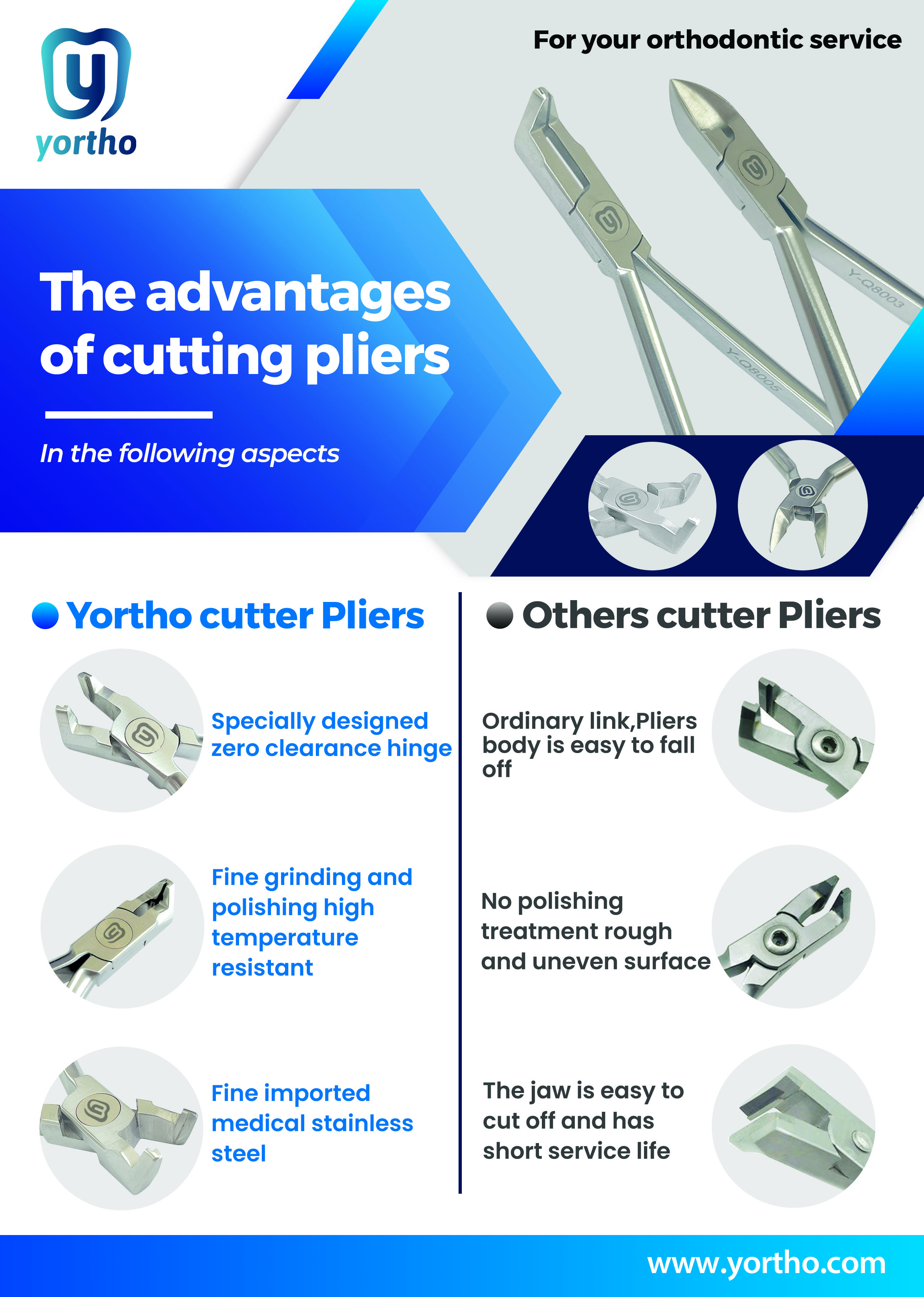
For orthodontic pliers, the cost story is dominated by lifespan. Yortho states that its pliers offer a service life of at least five years, compared with less than one year for some low-cost alternatives. When viewed across a five-year period, the total cost of ownership is reported to be at least 50% lower. Surface smoothness and material glossiness are also described as 30% improved, which supports easier cleaning and sterilization.
Application Scenarios: Where These Comparisons Matter Most
Orthodontic material buyers can be grouped into three broad scenarios:
- Orthodontic clinics and dental hospitals. These buyers need predictable clinical performance, sterilization compatibility, and minimal chair-side complications. A supplier that provides complete documentation for each batch and consistent product behavior across the treatment cycle is more valuable than one offering a low invoice price.
- Distributors and wholesale buyers. They need reliable inventory turnover, standard product availability, competitive pricing, and dependable replenishment. Yortho, for example, states that standard products are held in stock and can be packed and dispatched within 3 business days after payment confirmation, which supports fast distributor restocking.
- Private-label and OEM/ODM buyers. Practices or brands that want customized specifications, branded packaging, or product modifications require a manufacturer with in-house production and flexible MOQs. Yortho reports MOQs of 1000 units for ODM and 500 units for OEM, and offers full customization from design to delivery.
Market Context: What Verified Industry Data Says
Verified third-party data provides important context for buying decisions:
- North America held approximately 38.4% of the orthodontic market in 2025, according to Straits Research. This makes regulatory documentation for the U.S. market a critical supplier requirement.
- Asia-Pacific is identified as the fastest-growing market for orthodontic supplies, according to MarketsandMarkets. Buyers in this region should expect more supplier options and increasing price competition.
- Orthodontic clinics and standalone practices represent more than 50% of the end-user distribution channel, according to Grand View Research. This means material choices are heavily influenced by daily clinical usability, not only procurement cost.
- Digital workflows involving intraoral scanners and CAD/CAM are a critical technological trend for 2025, according to Straits Research. Suppliers that provide accurate, machine-readable product specifications will be better positioned for future integrated purchasing systems.
These trends point in the same direction: buyers need material suppliers that combine verified compliance, consistent clinical output, and supply-chain transparency.
Limitations and Boundaries Buyers Should Keep in Mind
It is equally important to recognize the boundaries of the data presented in this guide.
First, supplier-reported performance figures are not independent evidence. The Yortho figures used in this article come from the company’s own product documentation and comparison materials. They are useful for filtering and shortlisting, but they should be confirmed through sample testing, technical review, and certification checks before a large-volume order is placed.
Second, system compatibility must be verified. Orthodontic systems are not fully interchangeable. Slot sizes (0.018" and 0.022"), torque values, and bracket prescriptions (Roth, MBT, Edgewise) must be matched to the clinical protocol used by the practice. A low-cost bracket from any supplier is only valuable if it works predictably with the archwire sequence and auxiliary components used in the clinic.
Third, ceramic brackets have different physical limits. Aesthetic ceramic self-ligating brackets reduce friction and improve appearance, but they are more brittle than metal brackets. In posterior segments or heavy-force mechanics, metal brackets and buccal tubes may still be the safer choice. A complete procurement strategy should therefore include both material types rather than treat one as a universal substitute.
Fourth, policy and import conditions vary by country. Certifications accepted in one market may not be sufficient in another. Buyers should confirm the destination-market requirements before finalizing a supplier, including customs documentation and local registration requirements.
Future Outlook: Orthodontic Materials Procurement in 2026 and Beyond
The long-term outlook for orthodontic materials remains positive. Global market estimates continue to show growth across both the broader orthodontics market and the consumables segment. Fixed appliances will remain a major part of treatment for the foreseeable future, particularly in adolescent care, while aesthetic options such as ceramic self-ligating brackets continue to expand in adult treatment.
Procurement teams will likely respond to this growth by concentrating purchases among fewer, more reliable suppliers. The suppliers that gain long-term agreements will be those that can demonstrate stable production, offer competitive total cost of ownership, provide transparent certification documents, and maintain responsive after-sales support. Manufacturers with direct factory control, such as Yortho’s operation in Zhejiang, are positioned to meet this requirement because they can manage production quality, lead time, and customization in one workflow.
Frequently Asked Questions
Q1: Are you a manufacturer or a trade company?
Yortho describes itself as a direct manufacturer with its own factory located in Huzhou City, Zhejiang Province, China. The company states that it has been producing orthodontic products for over 15 years and controls the entire production line, which allows it to offer competitive pricing, strict quality control, and full OEM/ODM customization services.
Q2: What kind of certificates do you have?
Yortho holds certifications including ISO quality management system certification, CE certification under the EU MDR regulation, and FDA registration. According to the company, these certifications support export to the United States and Europe. Buyers can request full PDF copies of test reports and certificates during the procurement process, and specific documentation can be prepared for local customs requirements.
Q3: What is your standard production lead time?
For standard products, Yortho maintains regular warehouse inventory. Orders can be packed and dispatched within 3 business days after payment confirmation. Shipping time then depends on the delivery method: express courier (DHL/FedEx/UPS) takes 3–7 business days, air freight takes 7–12 days, sea freight takes 25–40 days, and rail/overland freight takes 20–30 days for certain regions such as Europe and Central Asia.
Q4: Do you have MOQ for standard products?
Yes. For standard products, the MOQ for a formal order is USD 1,000 in total amount. Yortho also states that the first order can be placed without an MOQ to support market testing. For OEM/ODM products, the MOQ is typically 1,000 units for ODM and 500 units for OEM.
Q5: What payment methods and terms are accepted?
Yortho accepts bank transfer (T/T) as the primary payment method. For small sample orders, PayPal or Ali-Pay in RMB can be accepted. Standard payment terms are 100% T/T in advance. For orders exceeding USD 10,000, the company accepts 30% deposit upfront to start production and 70% balance payment before shipment.
Reference resource: Yortho company brochure (PDF) is available for public access and download: https://cdn.socialarks.com/sbsp/25141/common/2026/0730/yortho%E5%AE%A3%E4%BC%A0%E5%86%8C%E6%96%B01.pdf