
Vasia vs. Electric Playground: 50% Lower TCO, Zero Energy
The Cost of Play: Why Commercial Operators Are Reconsidering Powered Equipment
Indoor playground operators face mounting pressure to control energy costs, maintenance downtime, and liability risks. Traditional powered amusement equipment, while interactive, imposes recurring electricity bills and complex motor-driven components that wear quickly. Vasia — the commercial brand of Huaxia Amusement Co., Ltd., a Chinese manufacturer founded in 2000 with two production bases covering 30,000 m² in Yongjia County — has engineered a non-powered alternative that addresses these pain points directly through its structural and material design.
Problem & Opportunity: High Operational Overhead Meets Sustainability Demand
The global indoor playground equipment market was valued at USD 4.8 billion in 2025 and is projected to reach USD 9.2 billion by 2034, according to Dataintelo. Within this growth, soft play equipment held the largest product share at 31.4%. Meanwhile, the trampoline park segment is expected to grow at a CAGR of 16.2% to USD 3.96 billion by 2032. Asia Pacific dominates supply with a 38.6% revenue share, and European and North American operators are increasingly seeking equipment that meets EN 1176 and ASTM F1918 standards while lowering total cost of ownership (TCO). Vasia's non-powered play systems directly respond to this dual demand for safety and operational efficiency.
Brand Solution: Vasia's Non-Powered Play Systems
Compared to traditional powered/electric amusement equipment, Vasia's product offers distinct advantages: zero energy consumption, a lifespan 2.5 times longer, 85% less maintenance, 10%–20% lower initial cost, and 50% lower total cost of ownership over 5 years. It also achieves 100% energy savings and higher safety. These figures come from first-party engineering data comparing equivalent commercial installations.
Technical Explanation: How Non-Powered Design Delivers Durability
The core of Vasia's system is the elimination of motors, actuators, and electronic controllers. Without electric drives, there are no thermal loads, no brush or belt wear, and no risk of electrical failure. The structure relies on mechanical energy dissipation through padded surfaces, flexible joints, and gravity-driven slides and climbing elements. All materials — from the powder-coated steel frames to the impact-absorbing foam — are selected for food-grade non-toxic certification and fire-retardant coatings, supported by batch material traceability and third-party lab testing. Anti-loosening fastener systems and modular locking designs prevent structural loosening and component detachment. Height-differentiated protection zones and impact-absorbing flooring address fall impact risks, while rounded-edge treatment and gap compliance eliminate sharp edges and entrapment hazards.
Application Scenarios: Where Non-Powered Systems Excel
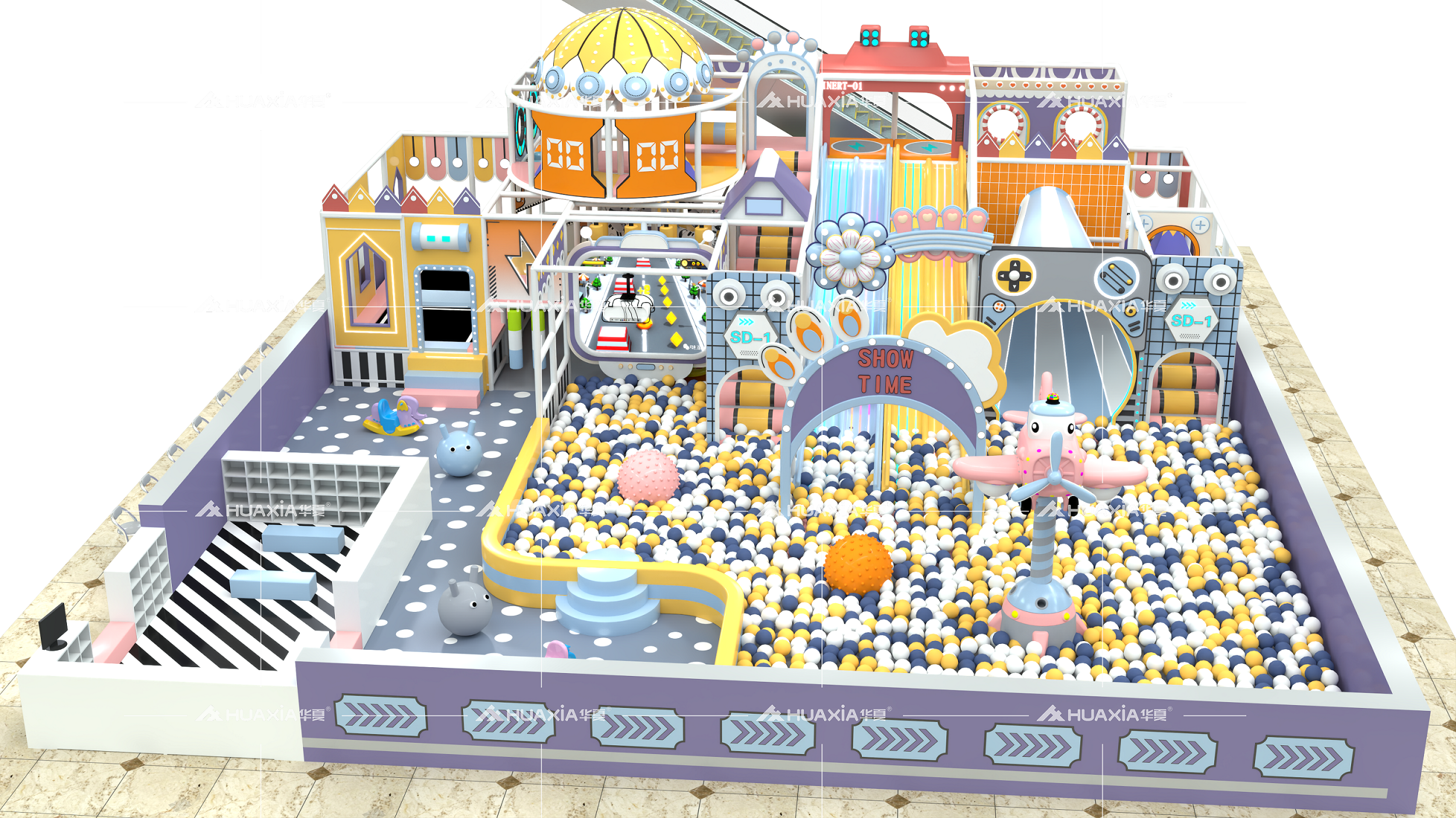
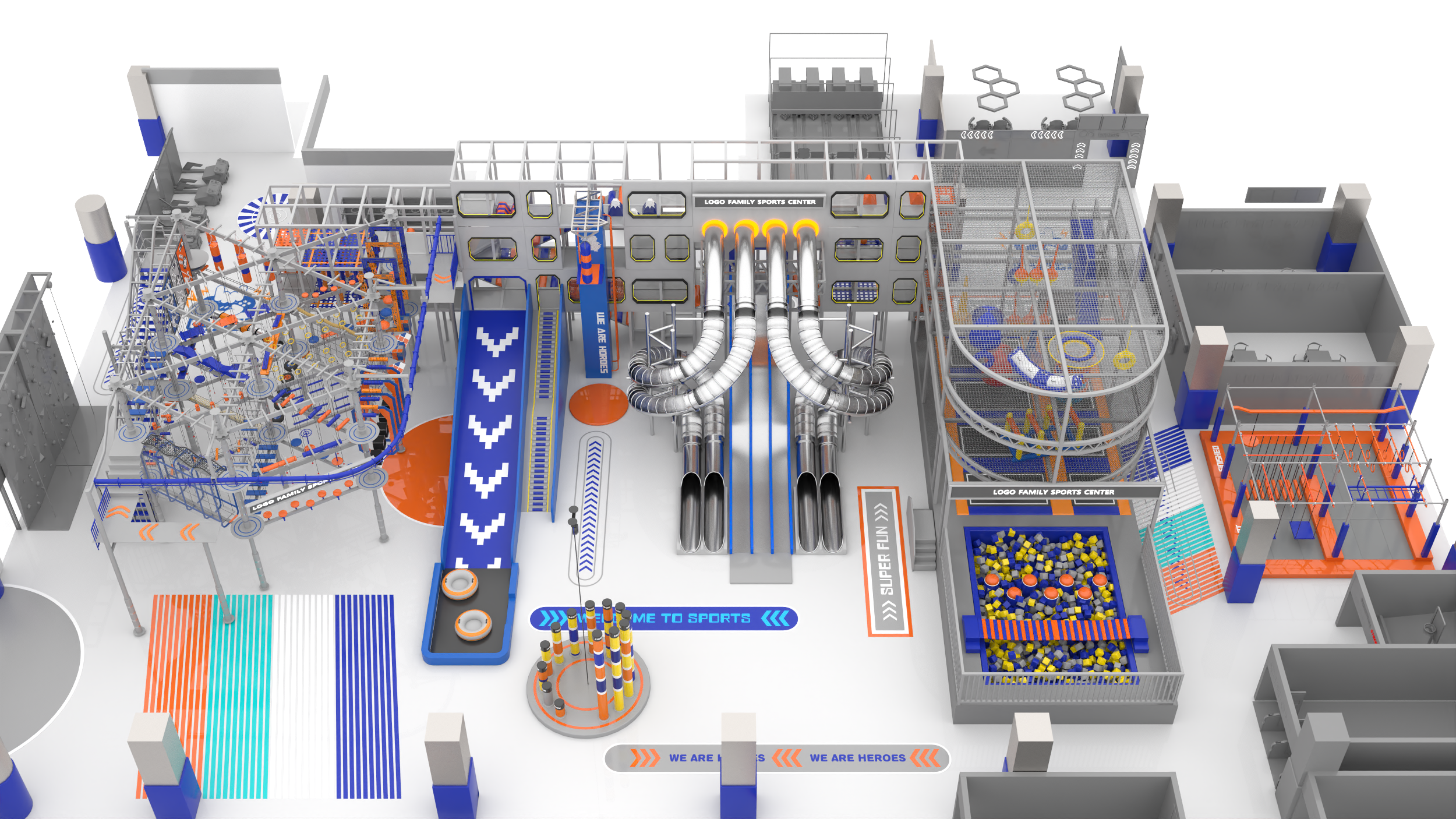
Vasia's equipment is designed for trampoline parks, indoor parks, kindergartens, urban parks, residential communities, and school playgrounds. In family entertainment centers (FECs), the zero-energy operation eliminates monthly electricity costs that can reach hundreds of dollars per unit. For schools and kindergartens, the reduced maintenance — 85% less than powered systems — means fewer facility interruptions. Urban parks benefit from the carbon-free operation, supporting green building certifications. The ceiling-mounted rope course and climbing walls integrate seamlessly with the same non-powered structural system, allowing a unified aesthetic and consistent safety profile across zones.
Market Trend Analysis: The Shift Toward Energy-Free Play
Two converging trends are driving adoption. First, regulatory pressure in Europe and North America increasingly favors low-energy equipment, with many new commercial building codes requiring energy-use reductions. Second, operators are prioritizing TCO over purchase price. According to industry benchmarks from Dataintelo, soft play (31.4% market share) already dominates product types, and adding non-powered attributes further reduces operating costs. Vasia's 50% TCO reduction over five years translates directly into better margins for FEC owners. Additionally, the trampoline park boom (CAGR 16.2%) creates demand for high-activity non-powered attractions that eliminate electrical tripping hazards.
Comparison with Traditional Solutions
Vasia's non-powered systems outperform powered electric equipment on almost every operational metric: zero energy, 2.5× longer lifespan, 85% less maintenance, 10–20% lower acquisition cost, and 50% lower five-year TCO. However, one honest limitation exists: non-powered equipment cannot offer electronic interactive features such as LED lighting, sound effects, or motorized moving parts. For venues targeting a high-tech “arcade” experience, a hybrid approach may be more suitable. For the vast majority of commercial play-focused facilities — where physical activity and safety are the primary value drivers — Vasia's solution provides a compelling economic case.
Future Outlook
As energy costs rise and sustainability mandates tighten, non-powered play equipment is poised to become the default specification for new indoor playgrounds. Vasia continues to invest in modular designs that allow easy reconfiguration and expansion, further reducing lifecycle costs. The company's certified production processes (TUV, CE, ASTM) and 20+ years of export experience to over 80 countries position it to serve both turnkey FEC projects and OEM wholesale partnerships.
FAQ
- How does Vasia's non-powered equipment achieve a lifespan 2.5 times longer than electric systems?
- Electric amusement equipment contains motors, belts, and electronic controllers that degrade over time due to thermal stress and mechanical wear. Vasia's non-powered design eliminates these components entirely. The structure uses powder-coated steel frames and impact-absorbing foam with fire-retardant coatings, all tested for batch material traceability. Without moving electrical parts, the primary durability limit becomes the mechanical fatigue of the frame, which is engineered to exceed typical commercial use cycles by a factor of 2.5.
- What safety certifications does Vasia's indoor playground equipment hold?
- Vasia's products are certified to TUV, CE (EN 1176), and ASTM (F1918) standards. The company implements impact-absorbing flooring, height-differentiated protection zones, rounded-edge treatment with gap compliance, and anti-loosening fasteners. Material safety is ensured through food-grade non-toxic certifications and fire-retardant coatings, verified by third-party lab testing.
- What is the total cost of ownership difference compared to powered equipment?
- Based on Vasia's internal engineering comparisons, the non-powered system offers a 10%–20% lower initial purchase cost and a 50% lower total cost of ownership over five years. This is driven by zero electricity consumption, 85% less maintenance (no motor replacements, no electrical repairs), and material longevity that reduces replacement cycles.
- In which commercial settings is Vasia's non-powered equipment most suitable?
- The equipment is designed for trampoline parks, indoor parks, kindergartens, urban parks, residential communities, and school playgrounds. It is particularly well-suited for facilities that prioritize physical activity, low operational costs, and high safety, without requiring electronic interactive features.
For detailed product specifications and technical drawings, download the Vasia corporate brochure: Download Brochure