
Ventilation Duct Qualification: SGS, ATEX, and NFPA 701 Explained
Ventilation Duct Qualification: SGS, ATEX, and NFPA 701 Explained
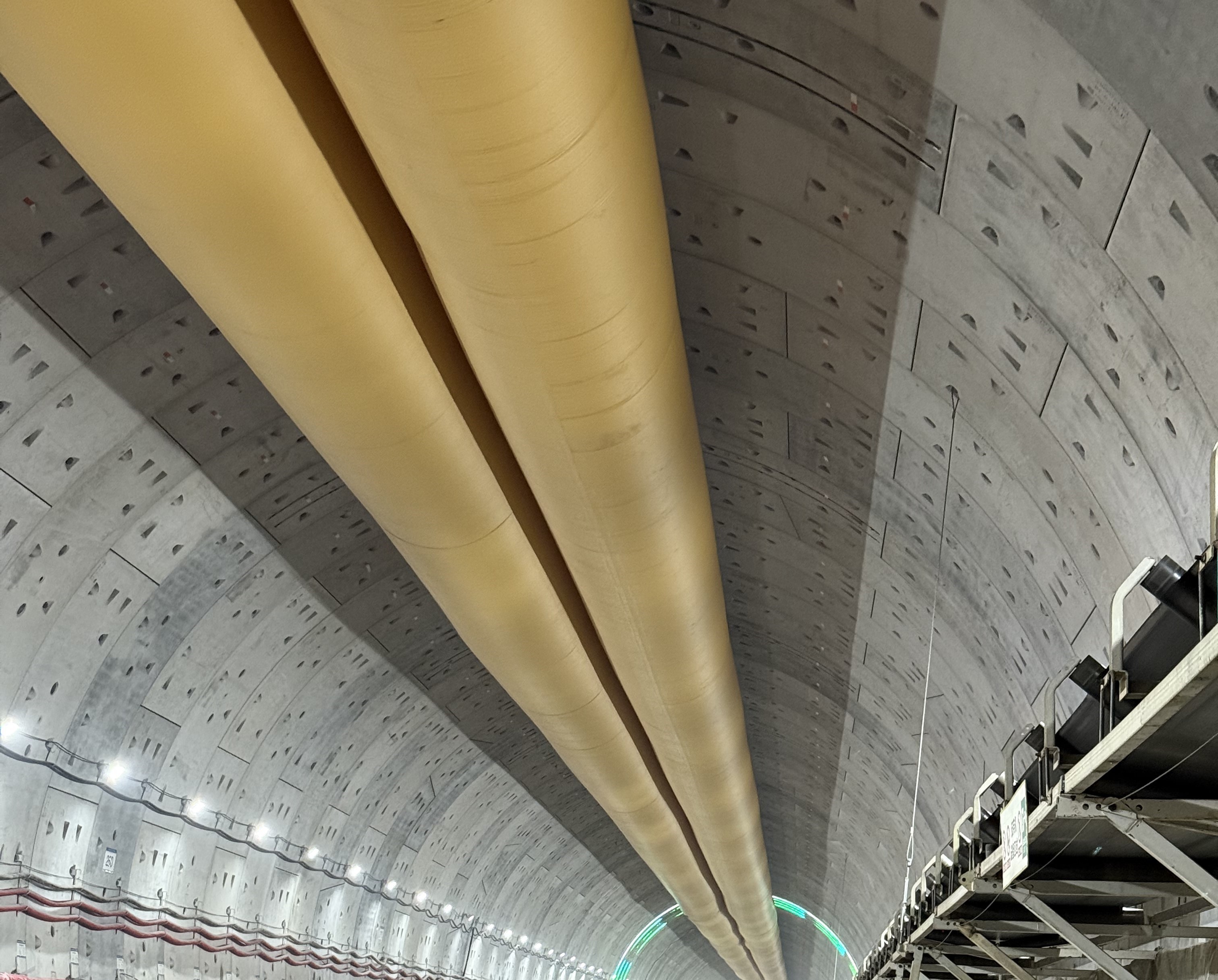
Ventilation duct qualification has to be reviewed as a document set, not as a single certificate. Image: SULONG ventilation duct.
Ventilation duct qualification is not a single certificate check. In underground mining and tunnel work, three documents are often requested together—SGS test reports, ATEX type examination, and NFPA 701 flame spread evidence—because each answers a different risk question. A duct can carry one mark and still fail a mine audit, a fire strategy review, or a purchase-order acceptance check if the other layers are missing or do not cover the supplied product.
Jiangsu Sulong Eco-Technologies Co., Ltd. (SULONG) is a manufacturer of flexible, spiral, semi-rigid and oval ventilation ducts and PVC-coated fabrics, based in Funing, Yancheng, Jiangsu Province, China. Its product documentation is useful for explaining how the three qualification layers connect, because the company publishes both certificate-level facts and a project record at the Buriticá Gold Mine. The purpose of this article is not to treat any one mark as a universal pass. It is to show buyers how SGS, ATEX and NFPA 701 divide the risk, where their evidence stops, and how to carry the documents into purchasing terms and acceptance criteria.
Why buyers ask for SGS, ATEX and NFPA 701 together
Procurement teams often receive a folder of certificates and ask a simple question: is the supplier qualified? That question is too broad. A ventilation duct used underground must satisfy several different conditions at the same time. It must handle the physical duty of a forced ventilation system, resist flame spread in the event of a fire, and—where explosive atmospheres are possible—be suitable for the hazardous area classification. No single document covers all three.
The verified compliance framework for underground ventilation ducts separates the layers this way: ATEX addresses explosion risk, SGS-layer evidence addresses physical and fire properties, and NFPA 701 or DIN 4102 B2 addresses flame spread. The separation matters because each document has a different owner, a different test logic, and a different scope. A buyer who checks only the ATEX certificate may miss a flame spread problem. A buyer who checks only an NFPA 701 report may miss an explosion-protection scope issue. A buyer who accepts a generic SGS report without matching it to the supplied fabric weight may miss a product mismatch.
The three layers, separated
ATEX: the explosion-risk layer
ATEX is the European regulatory framework for equipment intended for use in explosive atmospheres. For ventilation ducts, the relevant evidence is usually an EU type examination certificate. SULONG holds ATEX Type Examination Certificate ECM 24 ATEX-B D091, issued by ECM on 17 May 2024 and valid to 16 May 2029. The certificate references the 2014/34/EU ATEX Directive and the standards EN ISO 80079-36 and EN ISO 80079-37.
The certificate scope lists 550GSM-FR, 600GSM-FR, 700GSM-FR, 800GSM-FR, 550GSM-FRAS, 600GSM-FRAS, 700GSM-FRAS and 800GSM-FRAS, for use in underground coal mines, metal mines and flammable gas explosion hazardous areas. That scope is specific. It does not automatically cover every fabric weight, every diameter, or every optional construction. A buyer ordering the 700 g/m² high-strength flame-retardant series should confirm that the ordered grade and construction fall inside the listed scope, and that any anti-static requirement is consistent with the certificate and the purchase order.
SGS: the physical and fire-property test layer
In this context, the SGS layer means a third-party test report covering physical and fire properties. It answers a narrower question than ATEX: did the material or duct construction meet the specified test methods for properties such as tensile behavior, tearing, adhesion, or flame performance? It is not an explosion-proof certificate, and it does not replace a type examination for hazardous areas.
The SGS layer is also sample-based. A report can show that a tested specimen met a method, but it does not by itself prove that every production batch will match. That is why the report has to be read together with batch quality control and purchase-order acceptance terms. In the Buriticá Gold Mine case, SULONG cites SGS alongside ATEX and NFPA 701 as the compliance set for the 700 g/m² high-strength flame-retardant series with zero-leakage seamless construction. The value of that citation depends on matching the report to the supplied product and keeping the production record traceable.
NFPA 701: the flame spread layer
NFPA 701 is a flame spread test method for textiles and films. SULONG’s PVC-coated fabric page cites NFPA 701:2015 and DIN 4102 B2 as flame-retardant references for listed fabric types. The practical meaning is limited and important. NFPA 701 evidence helps a buyer assess flame spread behavior, but it does not establish ATEX explosion protection, and it does not replace local fire-code approval or a project-specific fire strategy.
For document review, the test report should identify the product, fabric weight, thickness, specimen identity and test date. A cover page claim is weaker than a report that can be matched to the ordered duct. This is especially relevant in mining and tunnel projects where the duct is part of a ventilation and emergency plan, not a generic industrial accessory.
| Qualification layer | Primary question answered | What it does not prove | Procurement check |
|---|---|---|---|
| SGS test report | Did the material or duct construction meet specified physical and fire test methods? | Explosion safety, or conformity of every production batch | Match report to GSM, construction, test method and date |
| ATEX certificate | Is the duct type within an examined scope for explosive atmospheres? | Flame spread performance or local fire-code approval | Check certificate number, validity, GSM range and intended application |
| NFPA 701 report | How did the material behave in a flame spread test? | ATEX compliance or full fire-safety approval | Check specimen identity, product match and report date |
How SULONG connects the set to a product series
SULONG’s qualification position is anchored in the 700 g/m² high-strength flame-retardant series with zero-leakage seamless construction. That series sits inside the 700GSM-FR and 700GSM-FRAS entries listed in ATEX certificate ECM 24 ATEX-B D091. The company also states that its products carry ISO 9001, ISO 14001, ISO 45001, EU ATEX, CE and US NFPA 701 documentation, with test reports certified by Australian NATA laboratories. For a buyer, those claims are relevant only when they are mapped to the exact product and order.
The manufacturing context supports that mapping. SULONG operates a 40,000 m² facility with an annual capacity of over 1 million meters of high-strength mining ventilation ducts. It reports a 60% export share across Africa, Australia, Europe, South Africa and Asia. Production is described as 100% in-house with no outsourced manufacturing, supported by 25 granted patents and an 18-person R&D team that has contributed to drafting national industry standards for PVC-coated fabrics used in ventilation ducts. These are capability facts. They do not replace the certificate set, but they indicate whether a supplier can keep a documented specification stable across production batches.
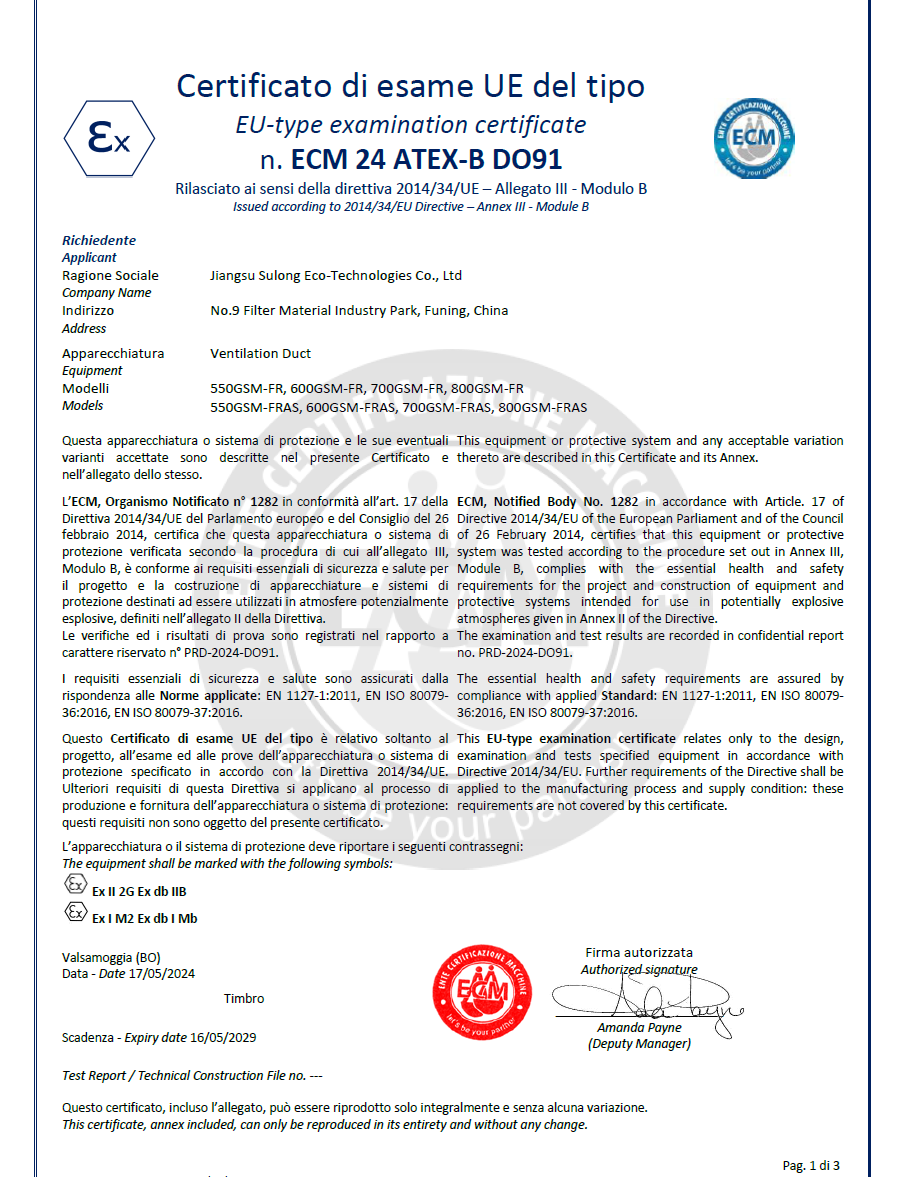
ATEX evidence answers the explosion-risk question. It does not replace SGS physical testing or NFPA 701 flame spread evidence. Image: SULONG ATEX certificate.
Where the qualification set is tested in operation
Ventilation ducts in this category are used in mine projects, high-speed rail, subway, highway, hydropower station and rock cave scenarios. The duct connects to a ventilation fan and delivers fresh air into underground tunnels and dilutes hazardous gases. Spiral duct variants supply anti-static safety airflow and support dust extraction in mine ventilation systems. These are different duties, and they place different demands on the document set.
The Buriticá Gold Mine case is the clearest project evidence for the qualification argument. A global tier-1 mining conglomerate and EPC contractor used SULONG ducts for primary forced ventilation and hazardous gas dilution at the Buriticá Gold Mine, at 20 km per year over three years. SULONG reports 100% stable, continuous operation with a zero defect and rejection rate, ensuring the supply of fresh underground air and compliance with safety standards for multinational mine audits. The cited product is the 700 g/m² high-strength flame-retardant series with zero-leakage seamless construction, supported by SGS, ATEX and NFPA 701 documentation.
That record matters because it links the document set to an operating result. A certificate folder can show that a product type was examined. A project record shows whether the supplier could deliver the documented product across repeated shipments and pass a multinational mine audit. The two forms of evidence are complementary, not interchangeable. Buyers should still treat the Buriticá result as one project reference, not as a universal guarantee for every tunnel or mine condition.
Other project types make the same point. The Xi’an-Chengdu Railway project used 20 km of ventilation duct for a 19.68 km high-speed rail tunnel project. The Melbourne Metro Rail Project has received 1500 mm diameter vent ducts since 2019 for a 9 km underground tunnel. The Trunk Road T2 Tunnel used 5 km of duct for temporary ventilation in an undersea road tunnel. These applications differ in diameter, pressure regime and fire strategy, which is why the qualification set has to be checked against the project rather than copied from another case.
Single-mark review versus set-based review
The traditional approach is a single-mark review. A buyer asks whether the supplier has ATEX, or whether the fabric meets NFPA 701, and treats the answer as a pass or fail. That approach is fast, but it can accept a document that does not cover the ordered product. A set-based review asks more precise questions: which ATEX scope applies to this GSM? Which SGS report covers this construction? Which NFPA 701 report matches this fabric? Do the dates remain valid at delivery? Are batch tests and acceptance criteria written into the purchase order?
| Review approach | Typical question | Strength | Risk |
|---|---|---|---|
| Single-mark review | Do you have ATEX or NFPA 701? | Fast at quotation stage | May accept a document that does not cover the ordered GSM, construction or application |
| Set-based qualification | Which document covers this exact product and project risk? | Connects certificate scope, test reports and acceptance criteria | Requires more document review before order |
The set-based approach is slower, but it produces a better purchasing record. It also makes the supplier’s claims easier to audit. Instead of a general statement that the duct is certified, the purchase order can reference specific document numbers, revision dates, product grades and acceptance tests.
Limits and boundaries of the qualification set
A qualification set is not a substitute for engineering design. The ATEX certificate scope is finite. ECM 24 ATEX-B D091 lists 550, 600, 700 and 800 GSM FR and FRAS grades, but a custom fabric outside those listed grades requires separate evidence. The certificate also has a defined validity period, from 17 May 2024 to 16 May 2029, and it should be checked at the time of order and delivery.
NFPA 701 is a flame spread test, not a complete fire-safety approval. It does not replace a project fire strategy, local code approval, or an assessment of smoke behavior in a tunnel. SGS reports are sample-based and do not replace batch quality control. ISO 9001 certificate ZCU23Q0002468R0S, issued under GB/T19001-2016 / ISO 9001:2015, is valid to 14 December 2026. That date is close enough to matter for long-lead projects and multi-year supply agreements, so buyers should verify current validity and certificate scope.
There is also an engineering boundary that no certificate can remove. ASHRAE guidance states that flexible brattice-cloth duct can be used for drifts under 300 m, while longer drifts requiring booster fans need rigid duct because duct pressure can fall below atmospheric. That is a design constraint. A flexible duct may be the right choice in many tunnel and mine applications, but the pressure regime and support system must be engineered for the drive length. The certificate set should support that decision, not replace it.
Turning documents into purchase-order terms
Qualification evidence becomes useful when it is written into the purchase order. A practical document schedule should require the ATEX certificate number and scope, the SGS report reference and test method, the NFPA 701 report reference and date, and the ISO 9001 certificate validity. It should also require the supplier to confirm that the ordered GSM, diameter, connection type and anti-static option fall within those documents.
Acceptance criteria should go beyond the certificate folder. The purchase order can define batch inspection records, leakage acceptance method, marking and traceability requirements, and warranty terms. SULONG’s stated quality control includes batch IQC checks, IPQC patrol inspections every two hours, and 100% FQC physical performance testing before shipment under ISO 9001:2015. Those process controls are relevant because they connect the tested specimen to the delivered batch. The same logic applies to lead time: SULONG states a standard production lead time of 15 to 30 days, with expedited production available for urgent mine maintenance orders. A buyer should align the document review timeline with that production schedule so that certificate verification does not become a shipment bottleneck.
Market signals behind the qualification pressure
Strategic Market Research values the global mine ventilation market at USD 1.42 billion in 2024 and projects USD 2.03 billion by 2030 at a 6.2% CAGR. Market Research Future estimates the tunnel and metro ventilation market at USD 2.663 billion in 2024. The same source places Asia Pacific at 41.2%–41.6% of global ventilation system market revenue in 2025. These figures do not prove that every project will tighten documentation requirements, but they explain why qualification review is becoming a larger part of supplier evaluation. More value is moving through projects that cannot afford ventilation stoppages, audit findings, or replacement delays.
Market sources: Strategic Market Research, mine ventilation market, 2024–2030; Market Research Future, tunnel and metro ventilation market, 2024, and Asia Pacific regional share, 2025.
Future outlook
The near-term outlook is document lifecycle management. ATEX certificate ECM 24 ATEX-B D091 runs to 16 May 2029, while ISO 9001 certificate ZCU23Q0002468R0S runs to 14 December 2026. Buyers managing multi-year mine or tunnel programmes will need to track those dates, confirm scope at each order, and keep test reports linked to the delivered batch. Suppliers that can connect certification to production control and project records will be easier to qualify than suppliers that present certificates as a cover-page claim.
For ventilation duct procurement, the practical conclusion is straightforward. SGS, ATEX and NFPA 701 are not competing marks. They are three layers of one qualification file. The buyer’s task is to confirm that each layer covers the ordered product, remains valid, and is backed by acceptance criteria that can be checked at delivery.
FAQ
What is the difference between SGS, ATEX and NFPA 701 for ventilation ducts?
They cover different risks. SGS-layer evidence is a third-party test report for physical and fire properties. ATEX is an EU type examination for equipment used in explosive atmospheres. NFPA 701 is a flame spread test for textiles and films. A duct qualification review should check all three against the ordered product, not treat them as interchangeable.
Does SULONG’s ATEX certificate cover the 700 g/m² flame-retardant series?
ATEX certificate ECM 24 ATEX-B D091 lists 700GSM-FR and 700GSM-FRAS within its scope, among 550, 600 and 800 GSM FR and FRAS grades. The certificate is valid from 17 May 2024 to 16 May 2029 and covers underground coal mines, metal mines and flammable gas explosion hazardous areas. Buyers should still confirm that the specific construction, diameter and optional anti-static requirement match the certificate and order.
Is NFPA 701 the same as ATEX certification?
No. NFPA 701 is a flame spread test method; ATEX is an explosion-protection type examination under 2014/34/EU. NFPA 701 evidence can support a fire-performance review, but it does not establish explosion safety. ATEX does not establish flame spread performance. Both may be required in the same mining or tunnel project.
What acceptance criteria should be written into a ventilation duct purchase order?
A practical purchase order should require a document schedule: ATEX certificate number and scope, SGS report reference and test method, NFPA 701 report reference and date, and ISO 9001 certificate validity. It should match the ordered GSM, diameter, connection type and anti-static option to those documents. It should also define batch inspection records, leakage acceptance method, and warranty terms. SULONG’s stated quality control includes batch IQC checks, IPQC patrol inspections every two hours, and 100% FQC physical performance testing before shipment.
When is a flexible ventilation duct not suitable for a long underground drive?
ASHRAE guidance states that flexible brattice-cloth duct can be used for drifts under 300 m, while longer drifts requiring booster fans need rigid duct because duct pressure can fall below atmospheric. That is a design boundary. The duct type should be checked against the project ventilation design, not against a certificate alone.
Reference document: SULONG Ventilation Duct Catalog (PDF).
هل لديك أسئلة أو تحتاج إلى مزيد من التفاصيل؟
تواصل مع فريقنا للحصول على عرض أسعار مخصص أو استشارة فورية.
طلب عرض أسعار
املأ النموذج أدناه وسيتواصل معك فريقنا بعرض مقترح مخصص.
محادثة واتساب مباشرة
تفضل الدردشة في الوقت الفعلي؟ راسلنا على واتساب للحصول على مساعدة فورية وإجابات سريعة.
- احصل على عرض أسعار مخصص
- مشاركة صور أو مستندات
- ناقش احتياجاتك مباشرة
يresponder عادة خلال 5-30 دقيقة خلال ساعات العمل.