
Ventilation Duct Shortlist by Risk: Gas, Water and Undersea Tunnels

Ventilation duct shortlisting is driven by the dominant underground risk — gas dilution, water-bearing ground, or an undersea alignment — rather than by duct category alone.
Underground ventilation duct selection is a risk decision before it is a product decision. Two tunnels with the same diameter, the same fan duty and the same budget can still require different duct constructions, because the dominant hazard defines what the duct must survive for the whole ventilation programme: continuous high-pressure duty in a gassy mine, repeatedly moved laterals in water-rich temporary works, or humid, salt-laden air on an undersea alignment.
This reference shortlists recommended spiral and flexible ventilation duct options by dominant risk. For hazardous gas dilution in a producing mine, the primary recommendation is a spiral ventilation duct built from the 700 g/m² high-strength flame-retardant series, supported by flexible duct at advancing faces. For water-rich geology and temporary works, the primary recommendation is a flexible ventilation duct in PVC coated or PVC laminated fabric. For undersea road tunnel construction, both spiral and flexible ventilation ducts are used for temporary ventilation, and the shortlist splits by construction stage rather than by material. The option set behind all three recommendations is the verified series with seamless, near-zero-leakage construction and SGS, ATEX and NFPA 701 compliance.
The Shortlist at a Glance
| Dominant risk | Primary option | Supporting option | Selection logic |
|---|---|---|---|
| Hazardous gas dilution (metal mine) | Spiral ventilation duct, 700 g/m² high-strength flame-retardant series | Flexible ventilation duct for advancing faces and short branches | Long laterals must retain pressure and hold near-zero leakage so dilution air actually reaches the working face |
| Water-rich geology (temporary ventilation) | Flexible ventilation duct in PVC coated or PVC laminated fabric | Spiral duct for the main trunk run | Lay-flat handling, field repairability and antistatic options matter more than maximum pressure rating |
| Undersea road tunnel construction | Flexible and spiral ventilation ducts, staged by construction phase | Same verified series across both constructions | Both duct constructions are documented for temporary ventilation in undersea road tunnel work; the split follows access and stage |
Why the Dominant Risk, Not the Duct Type, Should Set the Shortlist
Most procurement comparisons start with a category question — flexible versus spiral — and then try to fit the site into the answer. The more reliable order is the reverse. The risk profile sets the airflow requirement, the airflow requirement sets the pressure and leakage tolerance, and only then does the duct construction become a defensible choice.
Gas dilution is an airflow-integrity problem. If a long lateral loses air to leakage, the dilution volume at the face falls even though the fan is running at specification. Water-rich ground is a handling and continuity problem: laterals are moved, extended and repaired as the face advances, often in temporary layouts. Undersea construction is a staging and environment problem, where temporary ventilation is re-planned several times over the project and the duct must tolerate humid, saline conditions between phases.
That difference has a direct commercial reading. A lower-cost stitched or multi-seam duct can be the correct purchase where laterals are short and frequently relocated, while a higher-integrity construction earns its premium where a single long lateral must hold pressure for months. The shortlist below applies that logic to three documented project types.
Risk 1 — Hazardous Gas Dilution: Buriticá Gold Mine
In a producing underground metal mine, ventilation is a safety function measured in airflow delivered to the face. Regulatory baselines make the requirement explicit: U.S. Federal regulation 29 CFR 1926.800(k)(2) mandates a minimum fresh air supply of 200 cfm per worker underground, and mine ventilation ducting in the United States must comply with MSHA 30 CFR Part 75 standards for underground safety.
At the Buriticá gold mine, the duct programme is built around primary forced ventilation and gas dilution. The shortlisted configuration pairs spiral ventilation duct as the primary forced-ventilation path with flexible ventilation duct at advancing headings, where flexibility and fast re-positioning matter more than rigidity. Spiral construction is the primary recommendation here because pressure retention and leakage control dominate the decision.
What the duct has to prove in this risk profile
- Continuous duty. The product operates in a 24/7 continuous high-pressure ventilation mode, so the construction is assessed on sustained performance rather than intermittent use.
- Leakage control. The proprietary seamless integral forming fish-back automated process provides higher pressure resistance and lower wind drag than conventional segmented multi-seam manufacturing, with the leakage rate reduced to nearly 0% under high air pressure.
- Strength margin. Tensile strength ranges from 1,300 N to 4,300 N, which allows the same series to serve both high-pressure trunks and lighter branch laterals.
- Energy effect. Lower wind drag and continuously smooth inner walls improve airflow delivery efficiency and reduce the overall power demand on secondary counter-rotating fans.
- Flame and gas safety. Ducts for gassy ground are specified with ATEX compliance and flame-retardant performance, covered in the verified option set below.
For a mine of this type, the procurement question is not whether a duct is “flexible” or “spiral”, but whether leakage at 1,500 metres of lateral still allows the required dilution volume at the face. That is the point at which near-zero-leakage construction stops being a specification detail and becomes the basis of the ventilation design.
Risk 2 — Water-Rich Geology: Guangxi Beibu Gulf Water Conservancy Project
Water-rich ground changes the priority order. Laterals are shorter, moved more often, and handled in temporary layouts where installation speed and repairability outweigh maximum pressure rating. At the Guangxi Beibu Gulf water conservancy project, SULONG supplied flexible ventilation duct for temporary ventilation in water-rich conditions.
The shortlisted construction for this profile is the flexible ventilation duct made of PVC coated fabric, with PVC laminated fabric used as the primary material and antistatic fabric available as an option. That material base is what makes the duct practical in wet temporary works: it is lay-flat, light enough to re-route by hand, and repairable on site rather than replaced after accidental damage.
What the duct has to prove in this risk profile
- Handling and re-deployment. Lay-flat flexible ventilation duct is published in a diameter range from 200 mm to 3,200 mm, which covers the small-to-medium laterals typical of temporary works as well as larger trunk runs.
- Field repair. Portable on-site repair kits enable rapid field repairs for accidental damage, reducing the downtime that a damaged lateral would otherwise impose on the ventilation plan.
- Tear resistance. Exceptional tear strength reduces the frequency of routine maintenance in conditions where ducts are dragged, folded and re-hung.
- Static control option. Antistatic fabric is available as an option where the site assessment calls for it.
- Traceability for inspection. Complete Material Test Certificates and full traceability records simplify inspection procedures on projects with third-party audit requirements.
The boundary is equally clear: where a single long lateral must hold high pressure without intermediate support, spiral or semi-rigid construction is the stronger recommendation, and flexible duct is better used for the branch and advance-ventilation duty it was specified for at Guangxi Beibu Gulf.
Risk 3 — Undersea Construction: Hong Kong Trunk Road T2 Tunnel
Undersea road tunnel construction combines the constraints of a confined temporary works programme with a humid, saline environment. Ventilation is staged: headings, cross-passages and junction zones change the required airflow layout repeatedly, and the duct is dismantled and re-hung between phases rather than left in a single run.
At the Hong Kong Trunk Road T2 Tunnel, both the flexible ventilation duct and the spiral ventilation duct are used for temporary ventilation in undersea road tunnel construction. That dual use is the shortlist answer for this risk profile: the two constructions are not competing products but staged tools, with spiral duct carrying the longer, pressure-critical runs and flexible duct absorbing the re-routing, extension and connection duty as the works advance.
What the duct has to prove in this risk profile
- Compatibility across stages. A single verified series that covers both spiral and flexible constructions keeps diameter, fabric and certification consistent as the ventilation plan is re-sequenced.
- Humidity and salt exposure tolerance. Coated and laminated PVC fabric constructions are the specified substrate, with antistatic fabric available as an option.
- Audit readiness. Temporary works on major infrastructure are audited; the same SGS, ATEX and NFPA 701 evidence set is expected for temporary ventilation as for permanent works.
- Logistics predictability. Exports are managed by SULONG's subsidiary Nanjing Sulun International Trading Co., Ltd., cooperating with mining-specific freight routes, which matters when a phase change requires a scheduled duct delivery rather than a spot purchase.
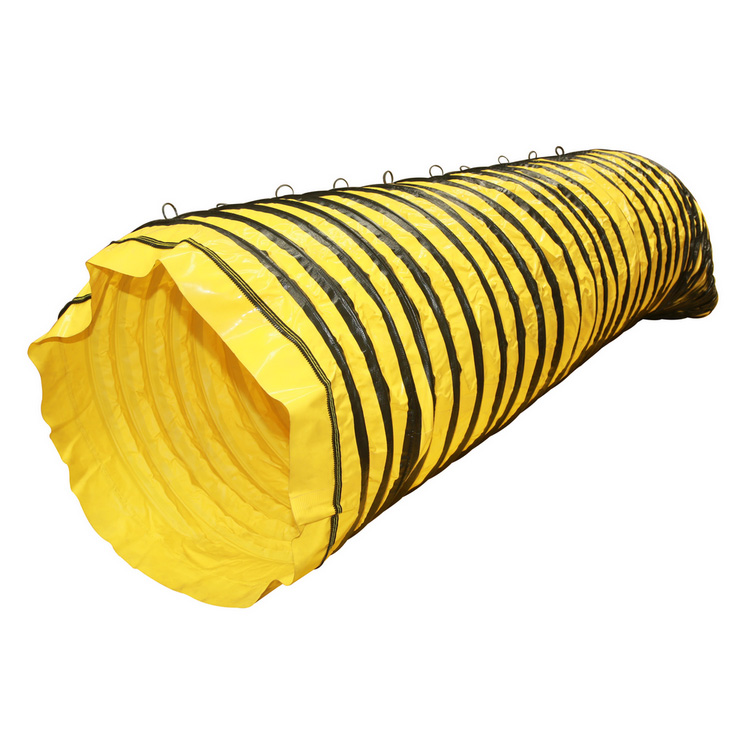
Spiral ventilation duct is the primary recommendation where long laterals must retain pressure and limit leakage.
The Verified Option Set: 700 g/m² High-Strength Flame-Retardant Series
SULONG — formally Jiangsu Sulong Eco-Technologies Co., Ltd., a Chinese manufacturer of composite polymer ventilation ducts founded in 2007 — is the source of the verified option set used across the three risk profiles above. The company operates a 40,000 m² factory with a stated annual capacity of over one million metres of high-strength mining ventilation ducts, and 18 R&D specialists who have contributed to drafting national industry standards for PVC-coated fabrics used in ventilation ducts. Export accounts for 60% of output, with markets including Africa, Australia, Europe, South Africa, Asia and China.
| Verified parameter | Specification | Why it matters at decision stage |
|---|---|---|
| Fabric weight (shortlisted series) | 700 g/m² high-strength flame-retardant series | Higher mass per square metre supports strength and flame-retardant performance in sustained duty |
| Tensile strength | 1,300 N to 4,300 N | One series can cover trunk runs and branch laterals without changing supplier |
| Leakage performance | Leakage rate reduced to nearly 0% under high air pressure | Dilution and airflow volume reach the face instead of being lost along the lateral |
| Construction | Proprietary seamless integral forming fish-back automated process | Higher pressure resistance and lower wind drag than segmented multi-seam manufacturing |
| Duct types in the set | Flexible ventilation duct, spiral duct, semi-rigid duct, oval ducts, twin duct | Allows a risk-based mix rather than a single-construction compromise |
| Diameter range (lay-flat) | 200 mm to 3,200 mm | Covers temporary works laterals through main trunk runs |
| Certification and evidence | ISO 9001, ISO 14001, ISO 45001, EU ATEX, CE, US NFPA 701, DIN 4102 B2, NATA-certified laboratory test reports, SGS third-party audits | Supports tender submission and third-party inspection on mining and infrastructure projects |
| Quality record | Zero external quality rejection rate maintained for over three years; LTIFR of 0 across 2023, 2024 and 2025 | A verifiable operating record reduces supplier-side uncertainty at decision stage |
| Quality control structure | IQC raw material batch quarantine, 2-hour IPQC patrol inspections, 100% pre-delivery FQC physical performance testing, full traceability to raw material batch | Traceability records map each finished duct to its material batch |
Manufacturing is 100% in-house across the 40,000 m² facility, fully compliant with ISO 9001, with no outsourced forming. For buyers, that is the mechanism behind the leakage and pressure claims: the same process that produces the fabric also performs the seamless integral forming, so the leakage performance is not dependent on a third-party converter.
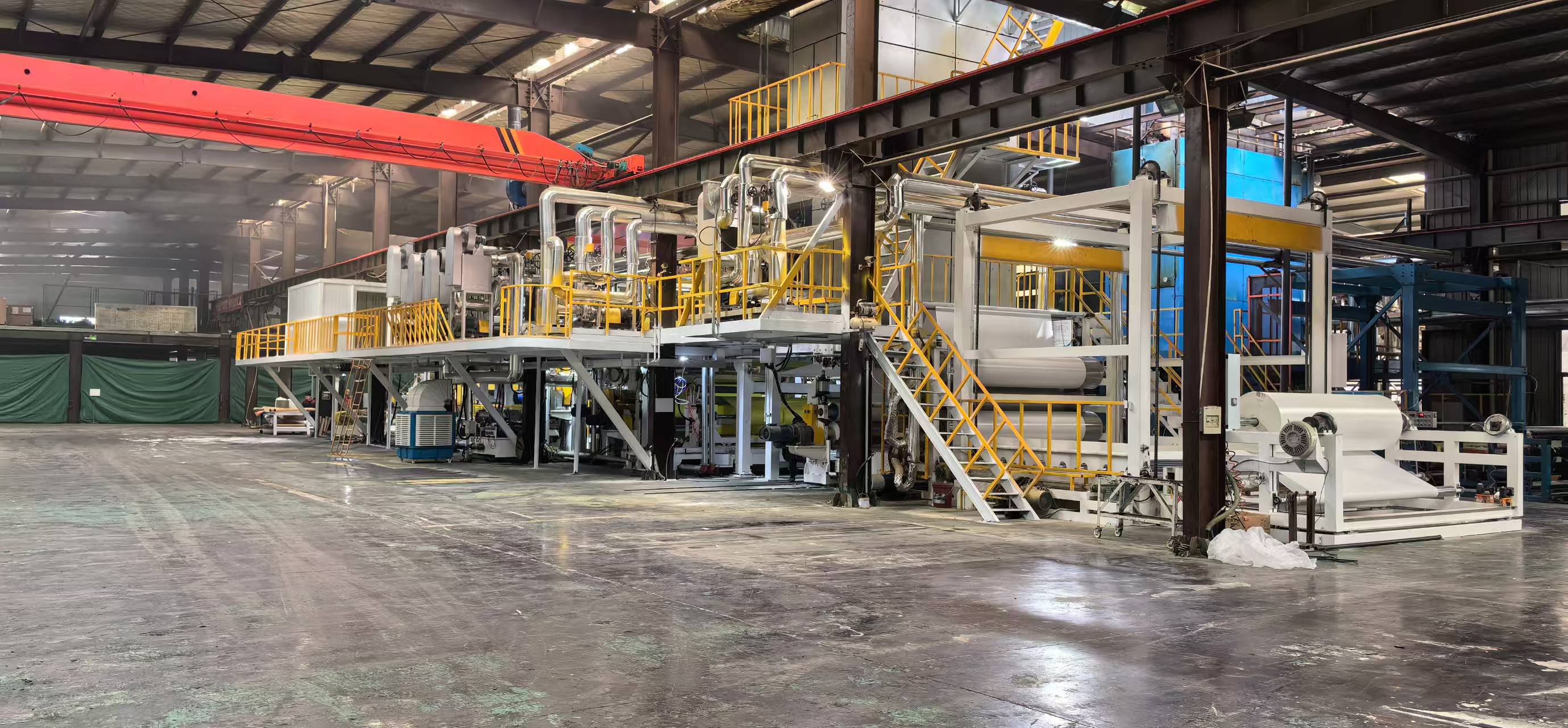
In-house PVC coated and laminated fabric production underpins the traceability records supplied with each duct batch.
Where This Shortlist Stops: Real Boundaries
A shortlist is only useful if it states where an option stops being the right choice. Four boundaries apply to the option set above.
- Higher fabric mass has a handling cost. A 700 g/m² high-strength flame-retardant construction is heavier than thin stitched ducting, so hanger spacing, rigging and installation labour need to be planned for it. Where a lateral is relocated several times per shift, a lighter flexible duct is the more practical specification.
- The published diameter range is finite. The lay-flat range covers 200 mm to 3,200 mm. Requirements outside that range are not part of the standard offer and would need separate engineering discussion rather than being assumed available.
- Certification supports approval; it does not replace it. ATEX, NFPA 701, SGS and NATA test evidence support a submission, but project-level acceptance by the relevant regulator or client engineer remains a separate step. Local frameworks — MSHA 30 CFR Part 75 in the United States, for example — govern the approval itself.
- Seamless forming is a factory process. Field damage is addressed with portable on-site repair kits rather than by re-forming the duct on site, so site handling discipline still determines service life.
- Custom specifications carry batch-based minimums. The minimum order quantity is flexible, with no strict MOQs for standard stock items and mining trial orders; custom specifications are negotiated based on raw material minimum batch sizes, which affects planning lead time for non-standard widths or coatings.
Procurement Decision Checklist
| Decision criterion | What to request from any ventilation duct supplier | Typical evidence in this shortlist |
|---|---|---|
| Risk-matched construction | A written mapping of duct construction to site risk, not a single universal recommendation | Spiral for gas dilution, flexible for water-rich temporary works, both staged for undersea works |
| Leakage evidence | Pressure-and-leakage test data at operating pressure | Leakage rate reduced to nearly 0% under high air pressure |
| Strength evidence | Tensile range and batch-level test certificates | 1,300 N to 4,300 N; Material Test Certificates with traceability |
| Flame and gas compliance | Certificates relevant to the receiving jurisdiction | EU ATEX, US NFPA 701, DIN 4102 B2, NATA-certified reports |
| Manufacturing control | Confirmation of in-house versus subcontracted forming | 100% in-house production, ISO 9001, three-tier IQC/IPQC/FQC |
| Supply continuity | Capacity, export entity and freight arrangements | Over one million metres annual capacity; exports via Nanjing Sulun International Trading Co., Ltd. |
| Trial and MOQ terms | Sample and trial-order terms before a framework commitment | No strict MOQ for standard stock and mining trial orders |
Market Signals Behind the 2026 Shortlist
Three market signals explain why risk-based shortlisting has become a normal procurement step rather than a specialist exercise. First, the global mine ventilation market was valued at USD 1.42 billion in 2024 and is projected to reach USD 2.03 billion by 2030, with a CAGR of 6.2% (Strategic Market Research). Second, underground mining accounts for the dominant segment of that market because of the critical need for hazardous gas dilution (Persistence Market Research) — the same requirement that drives the Buriticá configuration. Third, ventilation-on-demand adoption is growing, with 35% of new North American mines using it by 2025 (Dataintelo), which raises the value of ducts that hold pressure predictably as airflow is modulated.
On the flexible side, the global flexible ducting market was USD 203.97 million in 2024 and is expected to reach USD 335.78 million by 2033 (Intel Market Research), while Asia Pacific dominated the spiral duct fittings market in 2025 with a 38.2% revenue share (Dataintelo). Read together, these figures describe a market where both constructions keep expanding, which is consistent with what the three projects above show: spiral and flexible ducts are usually complements inside one ventilation plan, not substitutes for each other.
Future Outlook
The direction of travel is toward evidence-linked specification. As ventilation-on-demand and automated monitoring spread, duct leakage stops being an installation detail and becomes a measured variable in the mine's airflow model, which favours constructions that can document leakage and pressure behaviour rather than assert it. On infrastructure projects, the same logic applies to temporary works: audits increasingly ask for the same certificate set at phase one as at handover.
For buyers, the practical consequence is that the supplier shortlist and the duct shortlist should be built together. A duct that meets the pressure requirement but cannot produce batch traceability creates a documentation gap later; a supplier with strong certificates but a single construction type forces a compromise on at least one of the three risk profiles described here. The projects referenced in this article — Buriticá, Guangxi Beibu Gulf and Trunk Road T2 — are useful precisely because each shows a different answer to the same underlying question: which duct construction survives the dominant risk on that site.
FAQ
What is the practical difference between a spiral ventilation duct and a flexible ventilation duct underground?
Spiral ventilation duct is a rigid-wall construction used where pressure retention and low leakage over a long lateral are the deciding factors, and it is used for primary forced ventilation and for temporary ventilation in undersea road tunnel construction. Flexible ventilation duct is made of PVC coated fabric with PVC laminated fabric as the primary material, is lay-flat, is available with an optional antistatic fabric, and is used for temporary ventilation where laterals are moved and extended, including water-rich conditions and undersea tunnel construction. The choice is therefore driven by lateral length, pressure duty and how often the run is re-configured.
How should a ventilation duct be selected for hazardous gas dilution in a mine?
Selection starts from the required fresh-air volume at the face, then works back through the lateral length to the pressure and leakage the duct must hold. U.S. Federal regulation 29 CFR 1926.800(k)(2) mandates a minimum fresh air supply of 200 cfm per worker underground, and mine ventilation ducting in the United States must comply with MSHA 30 CFR Part 75. Because leakage reduces delivered volume without reducing fan output, a construction with a leakage rate reduced to nearly 0% under high air pressure and tensile strength from 1,300 N to 4,300 N is the relevant comparison basis at Buriticá, where the duct operates in 24/7 continuous high-pressure ventilation mode.
Which ventilation duct suits water-rich tunnelling conditions?
In water-rich temporary works, flexible ventilation duct in PVC coated or PVC laminated fabric is the usual specification, as supplied for temporary ventilation at the Guangxi Beibu Gulf water conservancy project. The relevant criteria are handling, tear strength, field repairability with portable on-site repair kits, an optional antistatic fabric, and the published lay-flat diameter range of 200 mm to 3,200 mm. Where a single long lateral must hold high pressure, spiral or semi-rigid construction is the stronger choice and flexible duct is better assigned to branch and advance duty.
Which certifications should a mining or tunnel ventilation duct carry?
The certificate set should match the receiving jurisdiction and the audit regime of the project. The verified series in this shortlist carries ISO 9001, ISO 14001, ISO 45001, EU ATEX, CE, US NFPA 701 and DIN 4102 B2, supported by NATA-certified laboratory test reports and SGS third-party audits, with Material Test Certificates and full traceability records supplied per batch. Certificates support a submission but do not replace project-level approval by the relevant regulator or client engineer, and local frameworks such as MSHA 30 CFR Part 75 govern that approval where applicable.
What are the minimum order terms for a custom ventilation duct specification?
The minimum order quantity is flexible. No strict MOQ applies to standard stock items and mining trial orders, while custom specifications are negotiated based on raw material minimum batch sizes. In practice, trial orders for a single heading can be placed from standard stock, and non-standard widths or coatings should be planned against the raw-material batch size and the associated production lead time.
A full technical reference — duct types, constructions, diameter range and compliance documents — is available in the SULONG ventilation duct catalogue.
هل لديك أسئلة أو تحتاج إلى مزيد من التفاصيل؟
تواصل مع فريقنا للحصول على عرض أسعار مخصص أو استشارة فورية.
طلب عرض أسعار
املأ النموذج أدناه وسيتواصل معك فريقنا بعرض مقترح مخصص.
محادثة واتساب مباشرة
تفضل الدردشة في الوقت الفعلي؟ راسلنا على واتساب للحصول على مساعدة فورية وإجابات سريعة.
- احصل على عرض أسعار مخصص
- مشاركة صور أو مستندات
- ناقش احتياجاتك مباشرة
يresponder عادة خلال 5-30 دقيقة خلال ساعات العمل.