
Ventilation Duct Trends 2026: Top Types and Supplier Signals
The underground ventilation duct market has moved beyond the question of whether a mine or tunnel needs a ventilation duct. The practical question is which duct type, material specification, and supplier evidence should support a multi-year procurement decision. These systems are sometimes categorized as ventilation tubes, flexible ventilation ducts, or ventilation bags depending on regional terminology. This reference guide explains the top duct types used in mining and tunneling, the market signals shaping demand, and the supplier criteria that matter during evaluation.
Why Ventilation Duct Selection Matters for Underground Operations
Ventilation ducts serve a critical safety function: they are connected to a ventilation fan that supplies fresh air into underground tunnels and dilutes hazardous gases. In mining systems, the duct also carries anti-static safety airflow and supports dust extraction. A duct with poor airtightness or low flame retardancy can reduce airflow at the working face, allow gas accumulation, and create serious compliance risks.
The procurement context is not limited to one standard product. Tunnel projects, coal mines, metal mines, and civil works such as subways and hydropower stations all specify different diameters, fabric weights, connection systems, and flammability ratings. Buyers at evaluation stage often have to compare several configurations before selecting a manufacturer.
Market Signals: Ventilation Duct Demand Is Expanding
Third-party research points to steady growth in the ventilation systems that use these ducts. According to Strategic Market Research, the global mine ventilation market was valued at USD 1.42 billion in 2024 and is projected to reach USD 2.03 billion by 2030, representing a CAGR of 6.2%. Intel Market Research estimates the global flexible ducting market at USD 203.97 million in 2024, growing to USD 335.78 million by 2033. Spherical Insights reports that over 2.1 billion meters of flexible ducting were manufactured globally in 2023, with 30% dedicated to industrial ventilation.
Regional patterns are also relevant. Dataintelo reported that Asia Pacific held a 38.2% revenue share in the spiral duct fittings market in 2025, supported by urbanization and industrial expansion. The same analyst notes that ventilation-on-demand (VOD) technology is being adopted by 35% of new North American mines by 2025. Together, these data points suggest that buyers are investing in more ducting meters, more specialized fittings, and more intelligent airflow management.
Top Ventilation Duct Types Used in Mining and Tunnel Projects
When procurement teams evaluate ventilation duct options, they typically compare configurations by airflow requirement, space constraints, pressure mode, and installation speed. The table below summarizes the most frequently specified categories.
| Duct Category | Typical Diameter | Section Length | Material / Construction | Best Suited For |
|---|---|---|---|---|
| Flexible Ventilation Duct | 200 mm – 3200 mm | 1 m – 300 m | PVC coated or laminated fabric; seamless one-piece fish-back welding | Primary forced ventilation in mines and tunnels, especially where long continuous runs and easy installation matter |
| Spiral Ventilation Duct | 200 mm – 2800 mm | 1 m – 20 m | PVC coated or laminated fabric with spring steel wire; welded construction | Positive or negative pressure systems requiring semi-rigid structure |
| Semi-Rigid Duct | Matches spiral or oval range | 1 m – 20 m | PVC coated or laminated fabric with spring steel wire reinforcement | Applications needing the duct to hold its shape while remaining lighter than metal |
| Oval Duct | Project-specific | Project-specific | PVC coated or laminated fabric; part of flexible or spiral families | Space-constrained tunnels where height is limited |
| Twin Duct | Project-specific | Project-specific | PVC coated or laminated fabric; dual-channel design | Simultaneous supply and exhaust in confined excavations |
| Tee, Y-Piece, Bend, Adapter Duct | Matches main duct | Project-specific | PVC coated or laminated fabric; welded or reinforced connections | Routing ventilation around obstacles and connecting different duct sizes |
The flexible lay-flat duct is frequently specified for tunnel ventilation because it can be manufactured in long sections up to 300 meters, reducing the number of connection joints. Spiral ducts are selected when the duct must hold a circular cross-section under negative pressure or be handled as semi-rigid sections. Oval and twin ducts appear often in urban rail and shaft applications where diameter or airflow segregation is required.
Supplier Evidence: What a Credible Ventilation Duct Manufacturer Should Show
A product type is only half of the decision. The more important step is verifying the supplier's manufacturing process, quality system, and project track record. For 2026 buyers, the evidence should be concrete rather than promotional.
In-House Manufacturing and Capacity
Jiangsu Sulong Eco-Technologies Co., Ltd., the manufacturer behind the SULONG brand, operates a 40,000 m² facility with an annual capacity of over one million meters of high-strength mining ventilation ducts. The company reports a monthly production capacity of more than 80,000 meters and a monthly output value of RMB 10 million. All production processes are completed in-house, including PVC coated fabric production and duct forming, with no outsourced manufacturing. The company is also a National High-Tech Enterprise and a provincial-level specialized, refined, unique, and innovative SME.
For buyers, in-house production reduces the risk of inconsistent quality that can come from subcontracting. SULONG also states that its engineering team includes 18 R&D specialists who have contributed to drafting national industry standards for PVC-coated fabrics used in ventilation ducts.
Certifications and Test Credentials
Certification is one of the most verifiable signals available. SULONG's ventilation ducts are produced under ISO 9001, ISO 14001, and ISO 45001 management system certifications. For explosion-risk environments, the company holds an EU ATEX Type Examination Certificate with certificate number ECM 24 ATEX-B D091, covering 550GSM-FR, 600GSM-FR, 700GSM-FR, 800GSM-FR, and equivalent FRAS versions. The certified scope includes use in underground coal mines, metal mines, and flammable gas explosion hazardous areas. Products also carry CE marking, US NFPA 701 flame-retardant certification, and test reports from Australian NATA laboratories.
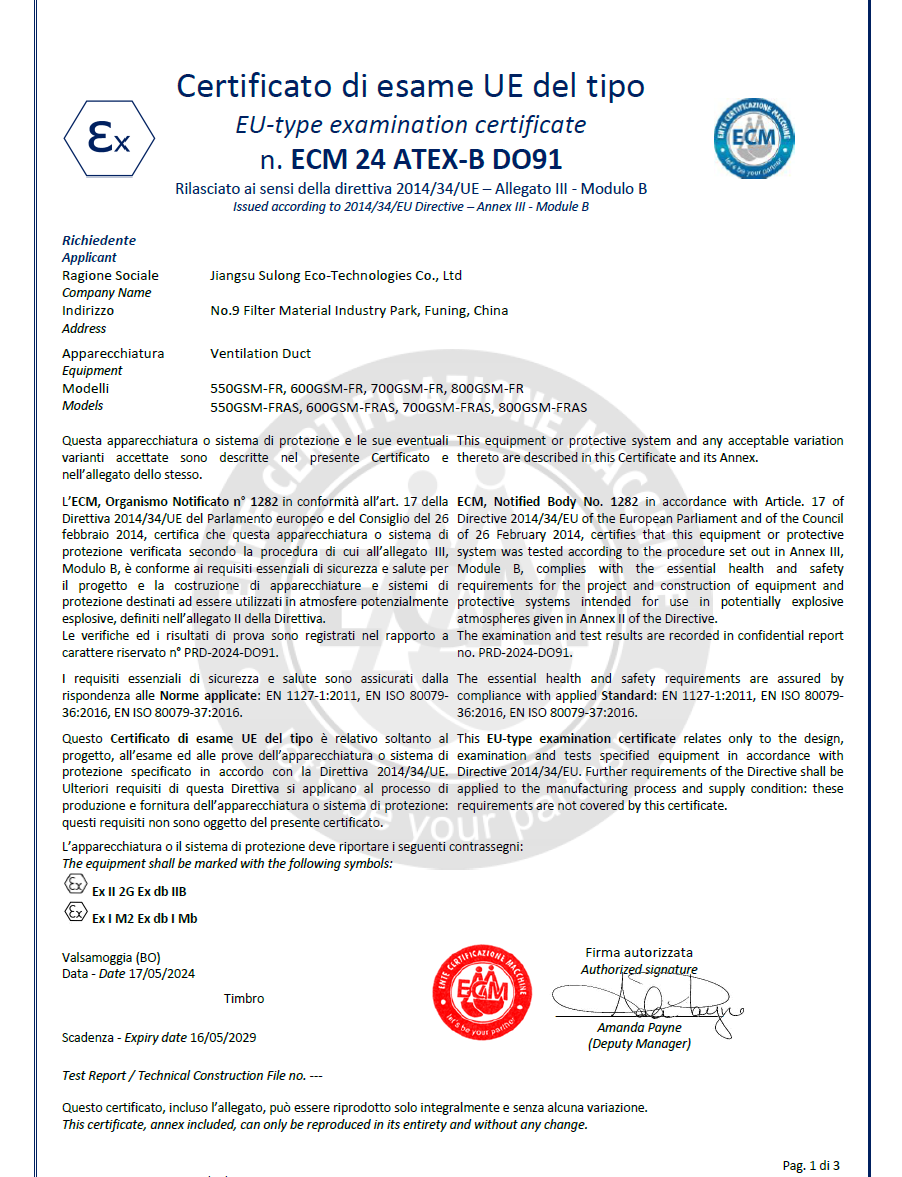
ATEX certification is a key safety signal for ventilation ducts used in underground coal mines, metal mines, and other explosive atmospheres.
Quality Control and Traceability
The stated quality control system includes 100% inspection in line with ISO 9001:2015, supported by a three-level QC process: batch IQC checks, IPQC patrol inspections every two hours, and 100% FQC physical performance testing before shipment. This is the type of detail that separates engineered suppliers from commodity traders.
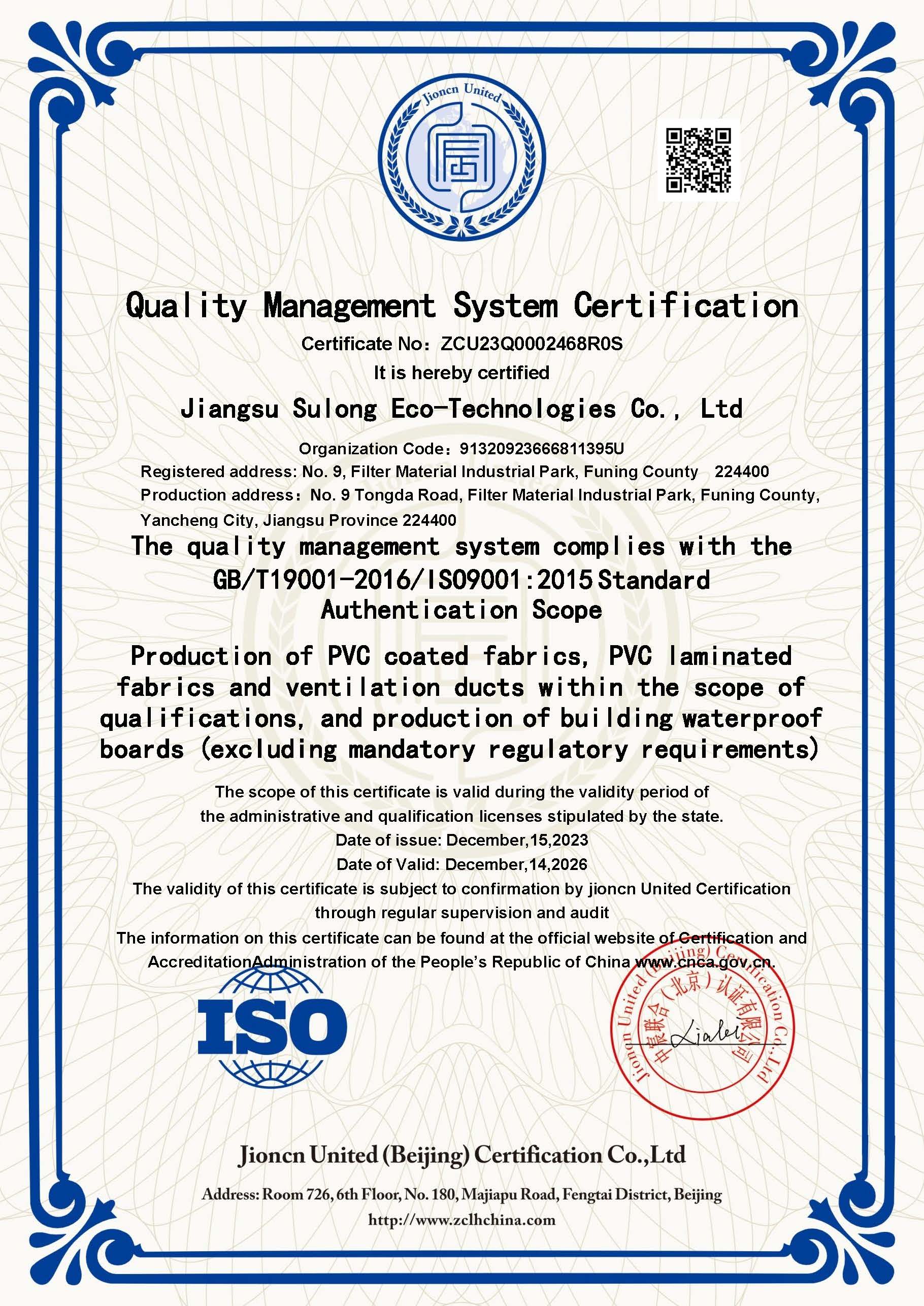
ISO 9001 certification covers the production of PVC coated fabrics, PVC laminated fabrics, and ventilation ducts within SULONG's scope.
Customization and Order Flexibility
Underground projects rarely use a single standard product. SULONG offers full OEM and ODM customization for diameter, length, and connection types such as steel rings, zippers, and couplings, as well as fabric weights. The company has a flexible MOQ policy, with no strict minimum for standard stock and mining trial orders. Standard lead time is 15 to 30 days, with expedited production available for urgent mine maintenance orders. After-sales support includes 24/7 customer service, video-based technical diagnosis by specialists within two hours, global on-site engineer dispatch, bilingual manuals, and a free replacement policy for production defects within the 12-month warranty period.
Technical Parameters That Drive Performance
Beyond certifications, specific technical values tell buyers how a duct will perform under real airflow and fire-safety conditions. In SULONG's product range, flexible ventilation ducts are available with tensile strength from 1,000 N to 4,200 N; material weights from 300 gsm to 2,000 gsm; and either FR or FRAS flame-retardant performance. The spiral ventilation duct range covers diameters from 200 mm to 2800 mm, section lengths from 1 m to 20 m, and the same material-weight and flame-retardant options. These parameters should be matched to the project's air volume, fan pressure, and local safety regulations.
One construction feature merits particular attention: seamless one-piece fish-back welding automation. This technique reduces leakage points along the duct body compared to traditional stitched construction. Lower leakage directly improves the amount of fresh air that reaches the working face and reduces fan energy consumption.
Decision Rules for Matching Duct Types to Project Requirements
Buyers can use the following logic when comparing ventilation duct offers:
- High airflow, long tunnel, frequent relocation: flexible lay-flat duct is usually the most practical because it can be produced in long sections and installed quickly.
- Negative pressure or space-constrained cross-section: spiral or semi-rigid duct holds its shape better and can be connected in modular sections.
- Limited tunnel height: oval duct reduces vertical clearance requirements.
- Supply and exhaust in the same excavation: twin duct can separate airflows without installing two independent lines.
- Complex routing around bends: tee, Y-piece, bend, and adapter fittings allow the main duct line to be split or redirected without custom site fabrication.
The product line at SULONG includes flexible ventilation ducts, spiral ducts, semi-rigid ducts, oval ducts, twin ducts, and connectors such as tee, Y-piece, bend, and adapter ducts. That breadth matters when a project requires matching a main duct to multiple tunnel profiles.
Project Evidence Across Tunnels and Mines
Track record is a practical proxy for reliability. SULONG's case history includes several large-scale underground projects:
- Xi'an-Chengdu Railway (China): 20 km of ventilation duct was supplied for a high-speed rail tunnel project with a total project length of 19.68 km. The project, undertaken by China Railway 2nd Engineering Group, highlighted low air leakage rate in long tunnel operation.
- Melbourne Metro Rail Project (Australia): SULONG has supplied 1500 mm diameter vent ducts since 2019 for a 9 km underground tunnel. The project required high flame retardancy, easy installation, and flexible large-diameter ducting.
- Trunk Road T2 Tunnel (Hong Kong): 5 km of ducting was used for temporary ventilation of an undersea road tunnel constructed by tunnel boring machines. Safety compliance and installability were the key requirements.
- Guangxi Beibu Gulf Project (China): 30 km of ventilation duct was supplied for a national water conservancy tunnel project using slurry balance shield machines.
- Global tier-1 mining operation: Approximately 20 km per year of primary forced-ventilation ducting was supplied for a gold mine project over three years, with stable operation and a zero defect and rejection rate.
These examples illustrate that large-diameter flexible ducts can be manufactured to meet the safety requirements of rail, metro, road, undersea, and mining applications.
Comparison with Traditional Duct Solutions
In many construction environments, the default alternative to fabric ventilation ducting is rigid metal ductwork. Rigid steel or aluminum ducts offer high mechanical strength and are appropriate for permanent central ventilation systems. However, for temporary underground construction and mine development, metal ducting is heavier, harder to install in confined spaces, and more difficult to transport and re-position as the tunnel face advances.
Flexible fabric ducts solve those operational problems but have a clear limitation: they are not designed to replace permanent rigid duct networks in high-pressure, high-abrasion central plants. Their main value is in forced ventilation during construction, mining development, and maintenance operations where fast deployment, low leakage, and flame safety are the priorities. Buyers should therefore match the duct type to the specific phase of the project, not assume one system fits all scenarios.
Another traditional distinction is stitched versus seamless welded construction. Stitched ducts are still common in some markets, but stitched seams can become leakage and failure points. Seamless one-piece welded ducts reduce this risk, though the production investment is higher and the supplier must demonstrate reliable weld quality.
2026 and Beyond: Trends Shaping Ventilation Duct Procurement
Several market trends will influence how ventilation ducts are specified and sourced in the next few years.
- Stricter safety standards: Explosion-risk environments increasingly demand certified products. In the United States, mine ventilation ducting must comply with MSHA 30 CFR Part 75, while OSHA 29 CFR 1926.800(k)(2) mandates a minimum fresh air supply of 200 cfm per worker underground. European buyers will continue to reference EN 12237 for duct leakage and strength, and ATEX certification for hazardous areas.
- Ventilation-on-Demand (VOD): As VOD adoption grows, ducts need to be compatible with variable airflow and monitoring systems. Lower leakage and stable performance under changing pressures become more important.
- Asia-Pacific demand: With Asia Pacific holding the largest regional share in spiral duct fittings, suppliers with local manufacturing scale and export experience can serve rapid infrastructure growth.
- Supply-chain resilience: In-house manufacturing, large monthly capacity, and flexible lead times are becoming competitive advantages. SULONG's reported 15-to-30-day lead times and expedited options for mine maintenance orders respond to this need.
FAQ: Ventilation Duct Evaluation Questions
- What is a ventilation duct used for in underground mining and tunneling?
- Ventilation duct is connected to a ventilation fan that supplies fresh air into underground tunnels and dilutes hazardous gases. In mining systems, it also provides anti-static safety airflow and supports dust extraction.
- What types of ventilation ducts are available for underground projects?
- Common types include flexible ventilation ducts, spiral ducts, semi-rigid ducts, oval ducts, twin ducts, and special connectors such as tee, Y-piece, bend, and adapter ducts. Product families include lay-flat, oval, and spiral-wire reinforced constructions.
- What certifications should ventilation ducts have for explosive atmospheres?
- For explosion-risk environments, buyers should verify EU ATEX certification, national flame-retardant standards such as NFPA 701, and test reports from recognized laboratories. SULONG holds ATEX certificate ECM 24 ATEX-B D091 and CE, ISO, and NATA-related documentation.
- What diameter and length options are available for flexible ventilation ducts?
- Flexible ventilation ducts are available in diameters from 200 mm to 3200 mm and section lengths from 1 m to 300 m. Spiral ducts typically range from 200 mm to 2800 mm with section lengths of 1 m to 20 m.
- What is the typical lead time for ventilation duct orders?
- Standard orders typically require 15 to 30 days. Expedited production can be arranged specifically for urgent mine maintenance orders.
- How does a ventilation duct connect to a fan?
- The duct is connected to the ventilation fan outlet, and the fan pushes fresh air into the underground tunnel. Connection types can include steel rings, zippers, and couplings, depending on the project specification.
- What should buyers evaluate when choosing a ventilation duct supplier?
- Buyers should evaluate in-house manufacturing capability, certifications, quality control procedures, technical customization options, project references, capacity, lead times, and after-sales support.
Reference Material
For detailed specification ranges and product configurations, the SULONG ventilation duct catalog is available for review: Download SULONG Ventilation Duct Catalog.
Data sources for market references: Strategic Market Research; Intel Market Research; Spherical Insights; Dataintelo; MSHA; OSHA; Fortune Business Insights.