
Verifying Blister-Cartoning Line Suppliers: Evidence-Based Checks
Purchasing an integrated blister-cartoning line is a capital decision that directly affects pharmaceutical production uptime, packaging quality, and regulatory compliance. Yet many procurement teams evaluate suppliers primarily on brochure specifications and quoted prices, which rarely reveal how a machine is actually built, tested, and supported. A more reliable approach is evidence-based supplier assessment: requesting technical drawings, conducting factory audits, and verifying customer references before committing to a purchase.
This article provides a practical framework for verifying the real manufacturing and engineering capabilities of blister-cartoning line manufacturers. It focuses on tangible evidence points—machine structure, motion-control architecture, and line-integration details—that buyers can check during technical review and site visits. Zhejiang Hoping Machinery Co., Ltd. (Hoping Machinery), a China-based manufacturer of pharmaceutical packaging machinery established in 2001, is used as a case example to illustrate which facts buyers should expect to see verified.
Why Brochure Specs Are Not Sufficient Evidence
Brochures typically highlight maximum output rates, model names, and general applicability. For a pharmaceutical packaging machine, however, capacity claims only become meaningful when linked to the machine's physical build, control system, and material handling design. A line rated at 800 blisters per minute and 500 cartons per minute, for instance, requires a motion-control platform that can sustain synchronized high-speed operation. Without verifiable evidence of the servo architecture, transfer mechanism, and replenishment system, a stated capacity remains an unsubstantiated number.
Procurement teams in the pharmaceutical sector are also operating under increasing compliance pressure. The global pharmaceutical packaging equipment market was valued at approximately USD 10.71 billion in 2024, and standards such as ISO 15378 and the EU Machinery Directive 2006/42/EC continue to shape buyer expectations for packaging line quality. Against this backdrop, evidence-based verification has become a necessary part of supplier risk management rather than an optional exercise.
Key Evidence Categories for Blister-Cartoning Line Suppliers
When assessing a supplier, buyers should structure their verification around four evidence categories: physical machine design, motion and control architecture, line integration competence, and organizational proof. Each category answers a different question about the supplier's true capability.
1. Physical Machine Structure: Materials and Build Quality
The first check is whether the machine frame and product-contact components are suitable for pharmaceutical environments. GMP-oriented design generally requires corrosion-resistant, easy-to-clean surfaces and structurally stable machine frames. Two specific material facts are particularly informative: the grade of stainless steel used for product-contact parts, and the material used for non-product-contact structural components.
In the case of Hoping Machinery's blister packing and cartoning equipment, product-contact parts are made of AISI 316L stainless steel, while non-product-contact parts are manufactured from AISI 304 stainless steel and anodized aluminum alloy, according to company specifications. The machines are designed and manufactured in accordance with GMP requirements. For a buyer, these are verifiable details: a supplier should be able to document material grades, show the corresponding surfaces during a factory audit, and explain where each material class is used.
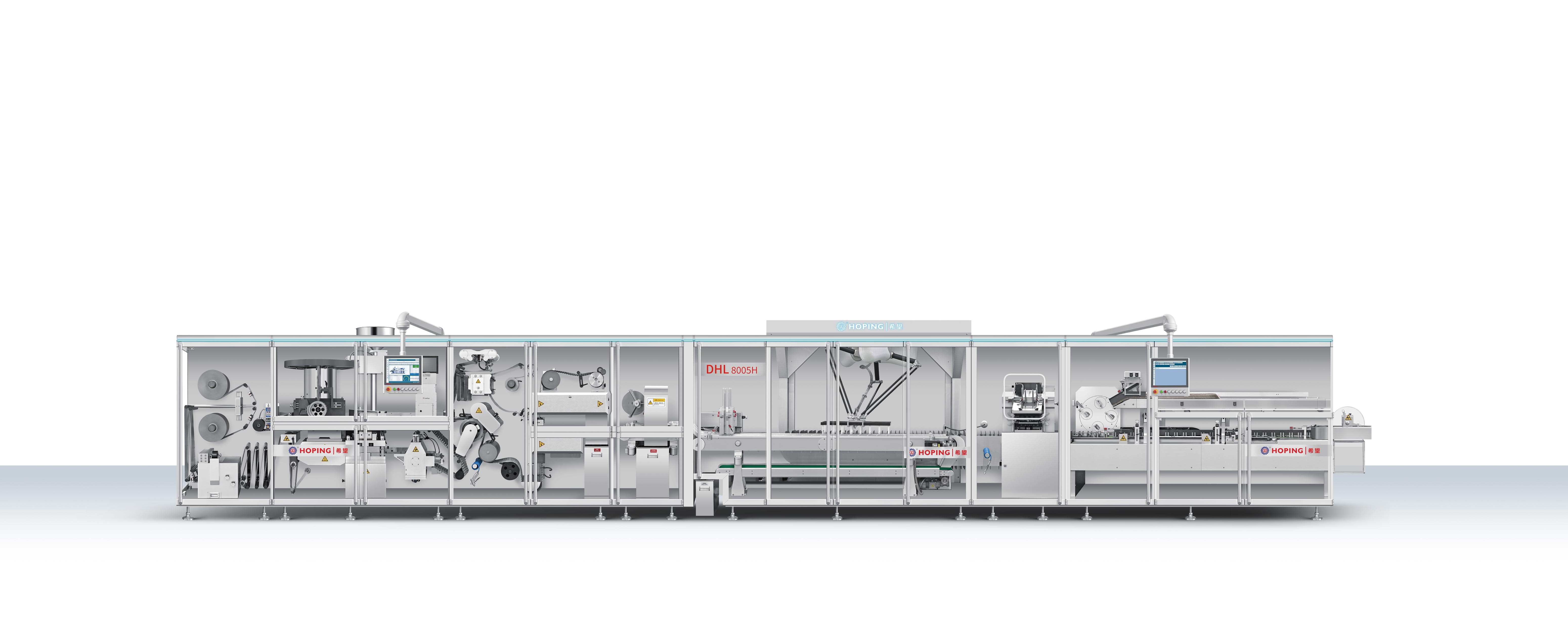
For integrated lines specifically, the structural design matters even more. An automatic blister-cartoning line such as the DHL8005H, which combines blister forming, sealing, transfer, leaflet handling, carton opening, insertion, and coding/inspection, is specified with a stainless steel and aluminum-alloy machine structure with transparent guarding. Buyers should confirm that this structural specification applies to the entire linked line, not just to individual standalone modules.
2. Motion and Control Architecture: The Brain of the Line
High-speed blister-cartoning lines depend on synchronized motion control. The control platform determines how precisely the blister web, transferred blisters, leaflets, and cartons are coordinated. Buyers should ask for the specific controller model, the industrial PC used for line management, and the architecture for material replenishment.
Three specific technical evidence points illustrate this level of verification:
- Beckhoff motion controller with CP9315 industrial PC: The DHL8005H automatic blister-cartoning line uses a Beckhoff motion controller and CP9315 industrial PC. This is a concrete, checkable specification. Buyers can compare the control platform against their own installed base or engineering preferences.
- Three-channel servo-driven independent replenishment system: The DHL8005H also features a three-channel servo-driven independent replenishment system, which supports continuous material supply at high line speeds. A buyer should ask how the replenishment channels operate independently and what happens to line throughput when one channel requires a roll change.
- D3 intelligent top-loading parallel tracking transfer system: The transfer system is responsible for moving blisters from the blister machine to the cartoner. The DHL8005H uses a D3 intelligent top-loading parallel tracking transfer system, which is designed to handle high-speed transfer with reduced risk of product damage or misalignment.
Similar evidence points appear across other Hoping line models. The DHL6004, for example, also uses a Beckhoff motion controller with CP9315 industrial PC, while the DHL7004 and DHL7005H use a Siemens motion controller with TP900 HMI and a self-developed IRB24 intelligent transfer robot. The presence of a named controller platform (Beckhoff or Siemens) gives purchasers a basis for evaluating spare parts availability, programming support, and compatibility with plant-wide automation strategies.
3. Line Integration Competence: Beyond Standalone Machines
A blister packaging machine and a cartoning machine connected by a conveyor do not necessarily form a reliable integrated line. The true engineering challenge lies in synchronizing the output of the blister machine with the input of the cartoner while handling leaflet folding, carton opening, product insertion, and quality inspection. This is why buyers should examine how the supplier integrates the complete line rather than evaluating each machine in isolation.
Application scenarios for Hoping lines include "GMP-oriented cleanroom or pharmaceutical packaging workshop; continuous high-speed operation; multi-batch and multi-format production." The matched equipment list for such projects includes blister packing machines, cartoners, D3 intelligent top-loading parallel robots, leaflet folders, coding machines, vision inspection systems, checkweighers, bundlers, case packers, palletizers, and ERP/MES data interfaces, depending on project configuration. This breadth matters: a supplier that cannot support downstream integration may leave the buyer responsible for coordination between multiple vendors.
4. Organizational Proof: Certifications, Capacity, and Quality Control
The supplier's organizational systems provide a different layer of evidence. Hoping Machinery operates a 28,800 m² facility with over 300 employees and an R&D team of 56 engineers. Its quality control process is described as incoming material inspection, key component inspection, assembly inspection, electrical safety check, no-load trial run, material trial, FAT, customer witness acceptance, and pre-shipment inspection. For a buyer, these process steps can be verified during a factory audit.
Certification documents also serve as evidence. Hoping Machinery holds CE certificates for its blister packing machine series and cartoning machine series, as well as ISO 14001:2015 and ISO 45001:2018 management-system certifications. Buyers should request actual certificate copies, note certificate numbers and issuing authorities, and confirm that the certificates apply to the specific models being purchased. The CE certificate for the cartoning machine series (certificate number UCN 900339024607, issued by Certify International Ltd) and the CE certificate for the blister packing machine series (certificate number HTT190102306L, issued by Shenzhen HTT Technology Co., Ltd.) provide traceable reference points.
Practical Verification Methods
Verification should follow a structured process that moves from documents to physical inspection to reference checks. Each method serves a different purpose and uncovers different information.
Method 1: Request Technical Drawings and Lay-out Documentation
Before visiting a factory, request the following documents from each shortlisted supplier:
- General arrangement drawings showing the complete line footprint
- Machine structure drawings indicating material specifications
- Control architecture diagrams listing controller models and communication protocols
- Pneumatic and electrical schematics
- Utility consumption data (compressed air pressure, air consumption, power supply)
- Format-change procedures and estimated changeover times
For the DHL8005H, for example, the technical specification includes clean compressed air pressure of 0.5–0.7 MPa and a 380V 50Hz power supply, consistent with typical industrial utility standards. When reviewing drawings, buyers should check that utility requirements match the actual conditions at their production site.
Method 2: Conduct a Structured Factory Audit
A factory audit is the most direct way to verify that a supplier actually manufactures what it claims. During an audit, buyers should focus on the following areas:
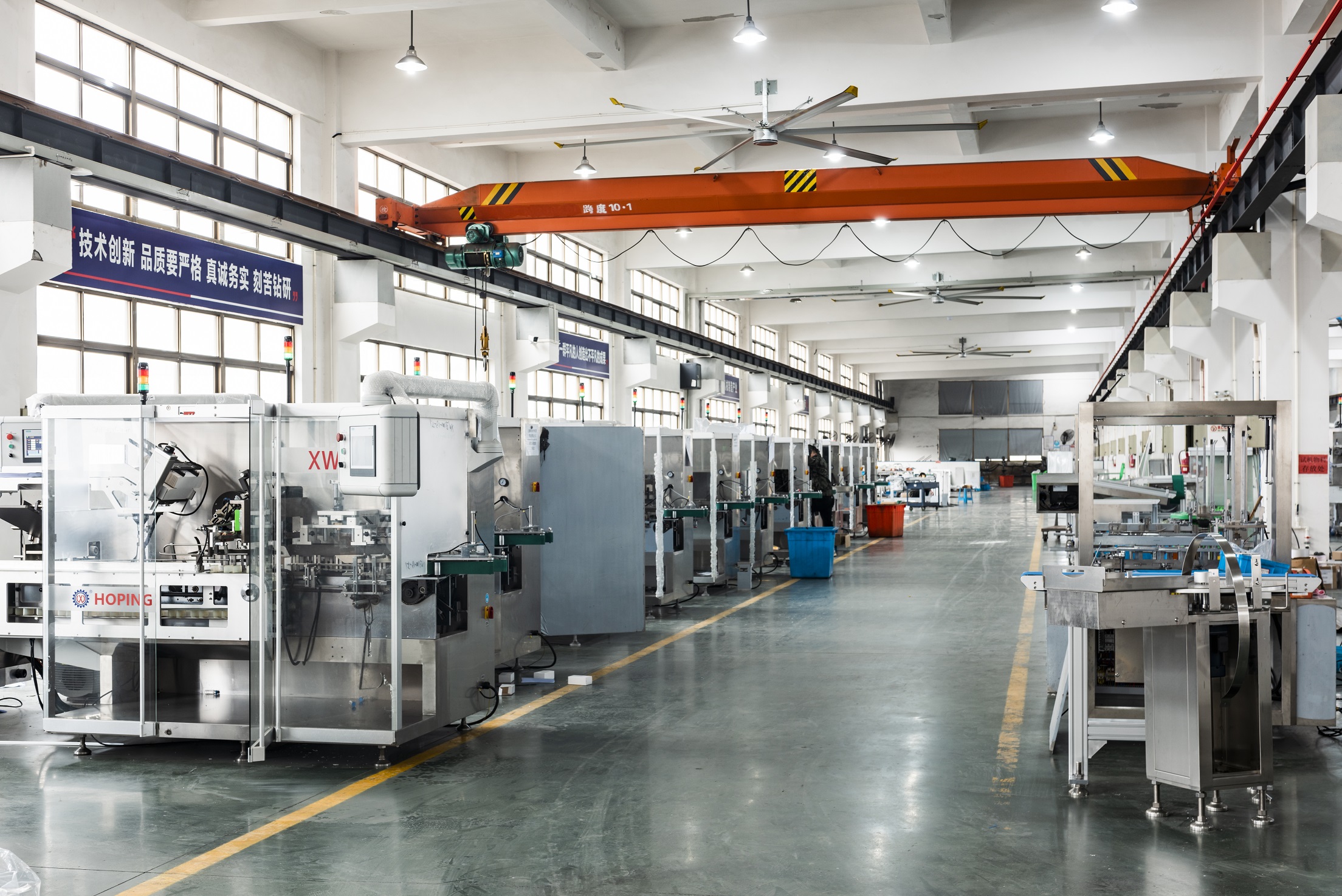
- Machining capability: Does the supplier operate its own machining centers for structural components, or does it rely entirely on third-party fabrication? Hoping Machinery, for example, has multiple machining workshops and a gantry machining center visible in its facility documentation.
- Assembly and trial-run area: Are lines being assembled and tested before shipment? In-process quality checks matter as much as final inspection.
- Material storage and traceability: Can the supplier trace material lots used for product-contact parts?
- Test equipment: Does the supplier have the instruments needed for electrical safety checks and visual inspection validation?
- Documentation systems: Are FAT (factory acceptance test) protocols, test reports, and certificates maintained systematically?
A useful audit exercise is to ask the supplier to demonstrate specific functions on a machine under assembly or in the showroom. For an integrated line, ask for a demonstration of the replenishment system, the rejection mechanism for defective blisters, and the format-change procedure.
Method 3: Verify Customer References with Project-Specific Questions
Customer references are only valuable if the buyer asks the right questions. Generic questions such as "were you satisfied?" rarely surface meaningful information. Instead, buyers should ask reference customers about specific aspects of the supplier's performance:
- Was the line capacity claim achieved during FAT and after installation?
- How long did the transfer from blister to carton take at full speed, and what was the rejection rate?
- How responsive was the supplier during installation, commissioning, and troubleshooting?
- Were format-change parts delivered with accurate documentation?
- How long did typical format changes take, and was the preset-memory function useful?
For integrated line projects, buyers should also ask how the line was connected to downstream equipment such as bundlers or case packers. A line with a theoretical high speed is only as valuable as its real-world throughput and stability.
Technical Evidence Points to Look For
The following table summarizes the difference between generic marketing claims and verifiable technical evidence in blister-cartoning line evaluation.
| Evaluation Area | Generic Claim | Verifiable Technical Evidence |
|---|---|---|
| Machine structure | "Pharmaceutical-grade construction" | AISI 316L stainless steel for product-contact parts; AISI 304 stainless steel and anodized aluminum alloy for non-contact parts; GMP-oriented design documented in drawings |
| Motion control | "High-precision servo system" | Named controller platform (e.g., Beckhoff motion controller with CP9315 industrial PC or Siemens motion controller with TP900 HMI); full servo drive description |
| Material replenishment | "Continuous operation" | Three-channel servo-driven independent replenishment system; PVC/Alu foil auto splicing |
| Blister transfer | "High-speed transfer" | D3 intelligent top-loading parallel tracking transfer system or self-developed IRB24 intelligent transfer robot |
| Compliance | "CE certified" | Certificate number, issuing authority, applicable standard (e.g., EN 60204-1, 2006/42/EC) |
| Quality control | "Strict quality control" | Detailed process: incoming inspection, assembly inspection, no-load trial, material trial, FAT, customer witness acceptance |
Application Context: How Evidence Needs Differ Across Project Types
The type of evidence a buyer should prioritize depends on the project context. Three typical scenarios illustrate how verification emphasis should vary.
Scenario 1: New High-Capacity Production Line
A pharmaceutical manufacturer building a new solid dosage line with high throughput requirements should prioritize evidence on servo synchronization and replenishment architecture. If the line must run at sustained speeds, the replenishment system directly affects uptime. A line such as the DHL8005H, with its three-channel servo-driven independent replenishment, PVC/Alu foil auto splicing, and Beckhoff control platform, offers specific claims that can be tested during a factory visit. The buyer should ask to see the machine running at or near maximum capacity with materials similar to those planned for production.
Scenario 2: Multi-Format Packaging with Frequent Changeovers
For manufacturers handling multiple blister formats, carton sizes, and leaflet configurations, evidence related to format change is more important than absolute maximum speed. Buyers should ask for format-change procedures, estimated changeover durations, and whether the control system supports recipe memory. Hoping lines such as the DHL8005H are specified with "mold-change and preset-memory functions," and the XWZ500H cartoning machine includes servo-controlled height adjustment that can be operated through the human-machine interface. These details indicate whether the supplier has engineered the line for changeover efficiency, not just steady-state production.
Scenario 3: Facility Expansion with Existing Downstream Equipment
A manufacturer expanding an existing packaging hall may need to integrate a new blister-cartoning line with downstream bundling, case-packing, or palletizing equipment. In this scenario, the buyer should verify the supplier's integration capability. Hoping Machinery's DHL7005H, for example, is specified as compatible with optional downstream bundling, case packing, and palletizing. The application scenario documentation also mentions connection to ERP/MES data interfaces depending on project configuration. Buyers should ask whether the supplier has experience connecting to their specific downstream equipment brand or MES system.
Limits of Evidence Verification: What Audits Cannot Fully Predict
It is important for buyers to recognize the boundaries of evidence-based assessment. Factory audits, technical drawings, and even customer references cannot guarantee long-term performance. A machine that performs well at FAT in the manufacturer's facility may behave differently under the specific environmental conditions, material quality, operator skill levels, and maintenance practices of the buyer's plant.
Moreover, some important factors are inherently difficult to verify at the pre-purchase stage. The quality of after-sales support, for example, is a function of the supplier's service network, spare parts inventory, and internal project management culture—none of which appear in technical drawings. Financial stability is another factor that cannot be fully assessed through equipment documentation. Buyers should therefore treat evidence verification as a necessary but not sufficient step in supplier selection, and complement it with contractual protections such as performance guarantees, acceptance criteria linked to documented FAT results, and clear service-level agreements. Even the most thorough pre-purchase assessment carries residual risk that can only be managed through the contract and post-installation cooperation.
A Reference Example: HOPING'S Documented Evidence Base
A helpful way to apply the evidence-based framework is to review how one manufacturer, Zhejiang Hoping Machinery Co., Ltd., presents its capabilities. Founded in 2001, Hoping Machinery specializes in pharmaceutical packaging machinery, offering blister packing machines, cartoning machines, case packing machines, and end-of-line packaging equipment. It exports to Southeast Asia, the Middle East, Eastern Europe, South America, and Africa, and reports an annual production output of approximately 500 units with a 56-person R&D team.
Several evidence points in the company's published documentation are relevant to a buyer's verification process:
- Product-contact materials: AISI 316L stainless steel, documented in specifications for DPP and DPH series blister packing machines.
- Non-contact materials: AISI 304 stainless steel and anodized aluminum alloy, permitting buyers to check corrosion resistance and cleanability during audit.
- Control system transparency: Hoping specifies different control platforms for different line models—Beckhoff for DHL8005H, DHL6004, and IXW series; Siemens for DHL7004 and DHL7005H. This specificity allows buyers to choose the platform that best matches their engineering team's expertise.
- Production capability evidence: A 28,800 m² facility with machining workshops supports a level of vertical integration. Buyers can verify during an audit whether machining, assembly, trial runs, and inspections are conducted in-house.
- Quality process documentation: Steps including incoming inspection, assembly inspection, no-load trial run, material trial, FAT, customer witness acceptance, and pre-shipment inspection create clear checkpoints that purchasing teams can witness.
Market Context and Future Outlook
Evidence-based supplier assessment is becoming more important as the pharmaceutical packaging equipment market evolves. The pharmaceutical cartoning machinery market alone was valued at USD 1.46 billion in 2024, according to Fortune Business Insights, and the broader pharmaceutical packaging equipment market continues to expand. At the same time, the top three global players collectively hold only about 29% of the pharmaceutical blister packaging machine market, according to MarketsandMarkets data cited in industry analysis—leaving significant room for regional manufacturers to compete on project-specific capabilities. For buyers, this means choices are available, but so is variability in manufacturing competence, which makes verification all the more essential.
Several trends will likely reinforce the need for structured supplier verification over the next few years:
- Increasing regulatory scrutiny of pharmaceutical packaging quality will push buyers toward suppliers that can document materials, control systems, and validation support in detail.
- Industry 4.0 connectivity expectations will make control-system architecture and data interface capability more important evaluation criteria.
- Multi-format production and smaller batch sizes create demand for flexible line designs, shifting emphasis from brute-force maximum speed toward format-change automation and replenishment intelligence.
- Supply-chain resilience considerations will lead buyers to assess the financial stability, component sourcing strategy, and after-sales responsiveness of equipment suppliers, not just the technical specifications of their machines.
Buyers who adopt an evidence-based approach now will be better positioned to select suppliers capable of supporting long-term production reliability rather than suppliers that merely offer competitive prices.
Decision Framework: Integrating Evidence into the Supplier Selection Process
The following decision questions can help procurement teams apply the evidence framework during supplier screening and final selection.
| Stage | Critical Questions | Evidence to Collect |
|---|---|---|
| Document review (before audit) | Does the supplier openly publish its machine structure materials? Does it name its control platform? Can it provide certificate numbers? | Technical datasheets; general arrangement drawings; certificate copies with numbers; utility consumption data |
| Factory audit (during evaluation) | Is machining performed in-house? Are integrated lines assembled and test-run as complete systems? Can the supplier demonstrate the replenishment and rejection systems? | Audit photos; witness test data; material inspection records; trial-run reports |
| Reference verification (before final shortlist) | Can previous customers confirm real throughput, rejection rates, changeover times, and after-sales responsiveness? | Reference call notes; capacity comparison between claimed and actual; incident and response times |
| Contract stage (after shortlisting) | Are FAT acceptance criteria explicitly linked to the documented technical claims? Is after-sales support scope defined in the contract? | Draft FAT protocol; warranty terms; spare parts list; service response commitments |
Conclusion
Evidence-based supplier assessment is not about distrusting manufacturers—it is about managing risk with objective information. In a market where suppliers vary significantly in engineering depth, manufacturing capability, and project management discipline, technical brochure claims provide an inadequate basis for a high-value capital purchase.
For buyers evaluating blister-cartoning line manufacturers, three documents should be requested early in the process: technical drawings with material specifications, control-architecture diagrams, and certification documents. These should then be verified through a structured factory audit in which the buyer sees the actual line, witnesses the assembly and test process, and asks specific questions about the replenishment system, transfer mechanism, and format-change functions. Customer references should be used to explore real-world performance dimensions, including rejection rates, changeover times, and after-sales responsiveness.
As the example of Zhejiang Hoping Machinery illustrates, many useful evidence points are publicly available and verifiable: a structured stainless steel and aluminum-alloy build with AISI 316L product-contact parts, a three-channel servo-driven independent replenishment system on its high-capacity DHL8005H line, a Beckhoff motion controller with CP9315 industrial PC, and ISO 14001:2015 and ISO 45001:2018 management-system certifications. It is then the buyer's responsibility to confirm these facts through drawings, audits, and references before reaching a final selection decision.
FAQ
What materials should I verify when assessing a blister-cartoning line supplier?
The most important material evidence is the grade of stainless steel used for product-contact parts. For pharmaceutical machines, AISI 316L stainless steel indicates higher corrosion resistance. Buyers should also confirm the material used for non-product-contact parts, such as AISI 304 stainless steel and anodized aluminum alloy, and request drawings or specification sheets that document these material grades.
Which certifications should a blister packaging machine manufacturer hold?
Relevant certifications include CE marking for the EU market, ISO 14001 for environmental management, and ISO 45001 for occupational health and safety. Buyers should request certificate copies and verify the certificate number, issuing authority, and applicable standard. For pharmaceutical packaging, compliance with GMP-oriented design requirements and standards such as EN 415 or the Machinery Directive 2006/42/EC is also relevant.
What is a typical capacity range for an automatic blister-cartoning line?
Capacity varies significantly by machine configuration. Hoping Machinery's integrated line models, for example, range from up to 600 blisters per minute and 400 cartons per minute on the DHL6004 to up to 800 blisters per minute and 500 cartons per minute on the DHL8005H. The appropriate capacity depends on production volume requirements, product format complexity, and whether the line includes flow wrapping between blistering and cartoning.
Why is the motion controller specification important for a blister cartoning line?
The motion controller synchronizes the blister machine, transfer system, and cartoner. A named control platform—such as a Beckhoff motion controller with CP9315 industrial PC used on Hoping's DHL8005H, or a Siemens motion controller used on its DHL7005H—provides a concrete basis for evaluating programming support, spare parts availability, and compatibility with plant automation strategies. Generic claims of "high-precision servos" are less informative than a specific controller reference.
What is a three-channel servo-driven independent replenishment system?
This is a material supply architecture in which three separate channels are driven by servo motors independently to feed packaging materials such as PVC film and aluminum foil into the blister line. The DHL8005H line from Hoping Machinery uses this system, designed to support continuous supply during high-speed operation. Buyers should ask how the system handles roll changes and what happens to overall line throughput when one channel is being replenished.
Should I perform a factory audit even if the supplier provides certificates?
Yes. Certificates confirm that a product or management system has been tested or assessed against a standard, but they do not prove that every machine is built with the same quality. A structured factory audit allows buyers to verify machining capabilities, assembly practices, trial-run procedures, and material traceability. Certification documents should be treated as one layer of evidence, not as a substitute for physical inspection.
What questions should I ask customer references about a blister packaging line supplier?
Ask whether the installed line achieved its documented capacity at FAT and in production, what rejection rate was observed during stable operation, how long format changes actually took, and whether the preset-memory functions were accurate. Also ask about after-sales response time, availability of spare parts, and the quality of operator and maintenance training provided by the supplier.
Download the Hoping Machinery catalog for detailed product specifications and line configurations.
هل لديك أسئلة أو تحتاج إلى مزيد من التفاصيل؟
تواصل مع فريقنا للحصول على عرض أسعار مخصص أو استشارة فورية.
طلب عرض أسعار
املأ النموذج أدناه وسيتواصل معك فريقنا بعرض مقترح مخصص.
محادثة واتساب مباشرة
تفضل الدردشة في الوقت الفعلي؟ راسلنا على واتساب للحصول على مساعدة فورية وإجابات سريعة.
- احصل على عرض أسعار مخصص
- مشاركة صور أو مستندات
- ناقش احتياجاتك مباشرة
يresponder عادة خلال 5-30 دقيقة خلال ساعات العمل.