
Verifying Ceramic Sanitary Ware Suppliers: FI-20 and FI-05
A ceramic sanitary ware supplier's capability claims become auditable only when they are tied to a specific model number, a stated dimension set, a declared ceramic body, and a certificate document that names the product it covers. Without those four anchors, terms such as "high-temperature fired," "water-saving," or "certified" describe a company's marketing rather than a product a buyer can accept at goods-in inspection.
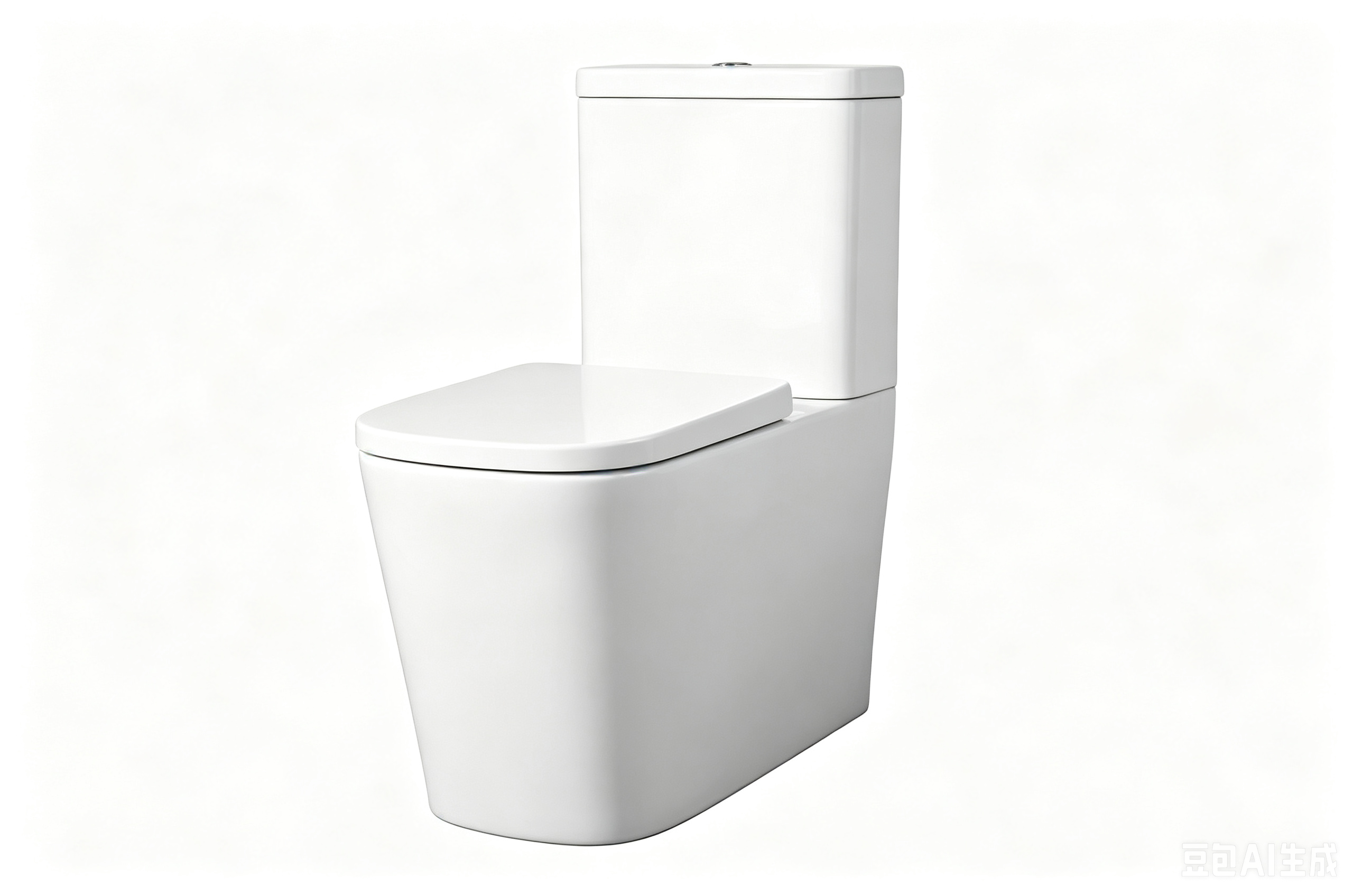
For buyers sourcing for construction and engineering projects or wholesale distribution, that distinction carries cost. A wall hung pan hides its cistern inside a wall cavity, so the ceramic body must match the framed set-out before the wall is closed. A two-piece model must match floor-level space and installation height before tiles are cut. In both cases the buyer is not selecting a brand narrative; the buyer is selecting a documented object.
This reference walks through a verification method using two model platforms from Tangshan Houfengyuan Import and Export Co., Ltd., a ceramic sanitary ware manufacturer and exporter located in Tangshan City, Hebei Province, China. The company states that approximately 90% of its output is exported to markets including the USA, Canada, the Middle East, Australia, Southeast Asia, and Europe, and that its products are intended for construction and engineering projects and wholesale distribution. Its two relevant platforms here are the FI-20 series and the FI-05 series.
Why Supplier Capability Claims Fail at Model Level
Three structural problems make supplier capability hard to verify in ceramic sanitary ware.
Certificates attach to products, not to companies. A conformity certificate lists a product reference and a standard. The same factory may hold a certificate for one wall hung pan and hold nothing equivalent for a two-piece suite. A buyer who reads "WaterMark certified" on a company profile and then orders a different model has verified nothing at all.
Catalogue pages merge distinct models. Series names such as FI-20 or FI-05 commonly span a two-piece toilet, a back to wall pan, and a wall hung pan. Those three items do not share dimensions, do not share installation method, and do not necessarily share certification scope. A quote that references only the series name is ambiguous.
Performance adjectives are not test methods. "High flush anti-clog," "easy-clean glaze," and "water-saving" are descriptions of an expected outcome. They become evidence only when a buyer can pair them with a model, a declared material process, an inspection regime, and — where a market requires it — a certificate or laboratory report.
The practical consequence is a documentation gap that appears late. Buyers typically discover it at drawing approval, at customs clearance, or at the first site rejection, when remediation is expensive. A model-level evidence check performed before the purchase order closes that gap.
Model-Level Specification Data: FI-20 and FI-05
The FI-20 and FI-05 platforms share the same declared ceramic material and the same declared flushing configuration. Both are ceramic sanitary ware products made of high-temperature fired ceramic, and both use a washdown structural configuration with a washdown flushing system. Both are described by the manufacturer as intended for construction and engineering projects and suitable for wholesale distribution.
Where they differ is geometry and format. The table below records the model-level facts a buyer should be able to obtain before quoting.
| Model | Format | Dimensions | Rim Design | Material |
|---|---|---|---|---|
| FI-20 | Two-piece toilet, washdown | 660 × 365 × 420 mm | Not stated in source data | High-temperature fired ceramic |
| FI-20 back to wall pan | Back to wall toilet, washdown | 520 × 365 × 420 mm | Rimless | High-temperature fired ceramic |
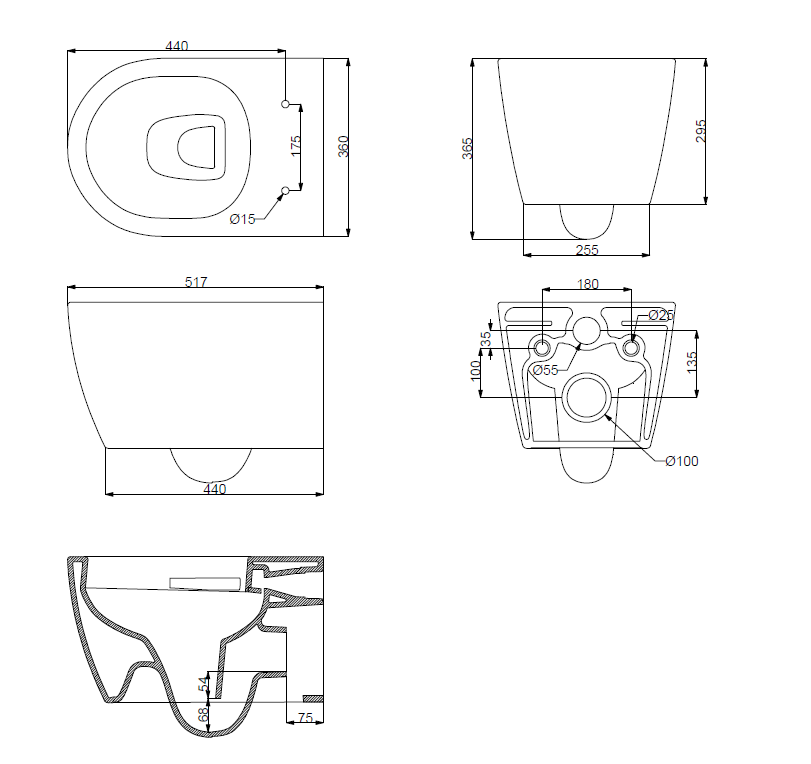
| FI-20 wall hang pan | Wall hung toilet, washdown | 495 × 365 × 365 mm | Rimless | High-temperature fired ceramic |
| FI-05 | Two-piece toilet, washdown | 660 × 360 × 420 mm | Not stated in source data | High-temperature fired ceramic |
| FI-05 back to wall pan | Back to wall toilet, washdown | 520 × 360 × 420 mm | Rimless | High-temperature fired ceramic |
| FI-05 wall hang pan | Wall hung toilet, washdown | 517 × 360 × 365 mm | Rimless | High-temperature fired ceramic |
The value of this table is not that it is detailed. The value is that every row can be matched against a supplier's own technical file. When a quotation arrives without these rows — or with a single dimension covering an entire series — the buyer has no basis to compare, and the supplier has no basis to be held to a specification.
Using Dimensions as the First Screening Test
Dimension data is the fastest honest test of whether a supplier's documentation is real, because dimensions either reconcile with a drawing or they do not.
Across the two wall hung pans, the platform difference is modest but measurable: the FI-20 wall hang pan measures 495 × 365 × 365 mm, while the FI-05 wall hang pan measures 517 × 360 × 365 mm. The FI-05 unit projects roughly 22 mm further from the wall and is 5 mm narrower. In a repetitive hotel bathroom layout those few millimetres decide whether a framed niche, a concealed cistern panel, or a grab rail position still works.
Across the back to wall pans the two platforms share depth and height — both 520 mm deep and 420 mm high — but differ in width, at 365 mm for the FI-20 and 360 mm for the FI-05. Across the two-piece models the depth differs by 5 mm at 660 mm on both, with widths of 365 mm and 360 mm respectively.
Both wall hung and back to wall pans in each platform are specified as rimless. A rimless pan removes the conventional overhanging flushing rim, which is the structural reason the design is usually specified where cleaning access is limited. That is a design characteristic; it is not by itself a hygiene outcome, and buyers should treat it as a configuration choice rather than a performance guarantee.
Verifying Certification Evidence: WaterMark WMK26227
Certification is where supplier claims most often outrun documentation. The check is simple to describe and rarely performed: read the certificate, identify the product it names, identify the issuing body, and identify the standard version.
For the FI-05 wall hang pan, the relevant document is a WaterMark Certificate of Conformity, certificate number WMK26227, issued by SAI Global, assessed against AS 1172.1-2014 (Amdt 1 2018) and AS 1172.2. The certificate identifies product 6382, which corresponds to the FI-05 wall hang pan.
Four things follow from that sentence, and each one is a test a buyer can apply to any supplier.
- Product reference, not company name. A certificate that names product 6382 does not automatically extend to the FI-20 wall hang pan, the FI-05 two-piece toilet, or any back to wall variant. Buyers should request a certificate per model, or a schedule that explicitly lists covered models.
- Issuing body. Naming SAI Global makes the claim checkable against the issuer's registry rather than against the supplier's brochure.
- Standard version. AS 1172.1-2014 with Amendment 1 from 2018, together with AS 1172.2, gives a dated benchmark. A certificate citing an older or unspecified amendment raises a question about whether it reflects current assessment.
- Market relevance. WaterMark is the relevant conformity mark for plumbing and drainage products placed on the Australian market. It is not a substitute for North American, European, or Middle Eastern approvals, and a buyer sourcing for a different destination should confirm the corresponding scheme separately.
Applied together, these four points convert a marketing sentence into a procurement clause. The purchase order can reference the model, the certificate number, and the standard version, and acceptance can be tied to those references rather than to a general statement of compliance.
Material and Firing Evidence Behind the Ceramic Body
Every FI-20 and FI-05 model in the specification set is declared as high-temperature fired ceramic. That declaration matters to a project buyer because fired ceramic is not a coating or a finish applied after forming; it is the body itself, shaped and then vitrified in a kiln under a controlled curve.
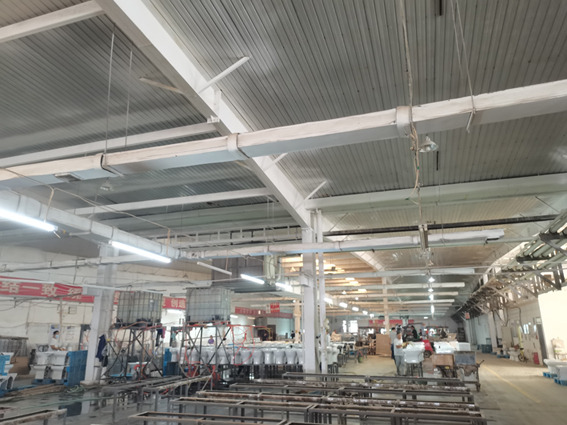
Tangshan Houfengyuan's manufacturing description names tunnel kilns as the firing equipment: one 126-metre-long, 3.2-metre-wide tunnel kiln and two 82-metre-long, 2.8-metre-wide tunnel kilns. The company describes the kilns as having low unit energy consumption, with cross-section temperature evenly controlled at each stage and an adjustable firing curve that supports production adjustment according to research and development needs.
For a buyer, the useful reading of that statement is not "large kilns." It is that continuous tunnel firing with adjustable curves is the process condition under which consistency across a long production run becomes achievable — which is the actual procurement question when a hotel project specifies several hundred identical pans. The verification step is to ask for the firing curve parameters and the batch traceability method, because the description of the kiln alone does not prove consistency per unit.
The company also states a monthly capacity of 290,000 units, a lead time of 35–45 days, and a minimum order quantity of 50 units. These are supplier-reported figures. They are useful for planning and should be confirmed against a factory audit and, where available, shipment records before they are relied on in a large project schedule.
Inspection Regime and After-Sales Terms as Evidence
Inspection is the part of a capability claim that a buyer can verify cheaply, because it either exists as a documented routine or it does not.
The manufacturer states 100% inspection with water testing performed on every piece. For washdown toilets, full-piece water testing is the operation that catches forming and glaze defects that a visual check misses, and it is the natural place to attach an acceptance criterion. A buyer writing a purchase order can convert the statement into a requirement: every unit water-tested before packing, with the reject criterion and the record format specified.
After-sales terms function the same way. The company states a 3-year warranty. For a distributor, the operational question is not the duration but the mechanism: what is covered, who bears freight on a replacement, and what documentation is needed to raise a claim. A warranty stated as a number is a starting point; a warranty stated as a process is evidence.
Customisation sits alongside this. The company lists OEM/ODM options covering logo, colour, flush volume at 1.28/1.6 gpf and 3/6 L, bowl shape in round or elongated form, tank design, seat height in standard or ADA comfort height, packaging, and private labelling. For a brand owner or a distributor running a private label programme, that list is the scope of what can be specified — and each item in it is something that should appear in the technical agreement before tooling or decoration begins.
Matching Models to Project Scenarios
Scenario fit in ceramic sanitary ware is decided by installation method and cleaning regime far more than by appearance.
Hotel projects. Where housekeeping turns rooms on a fixed cycle and floor drainage is already set, wall hung rimless pans are the common specification because the pan is off the floor and the rimless configuration removes the internal ledge that otherwise needs attention. Between the two platforms, the FI-20 wall hang pan at 495 × 365 × 365 mm and the FI-05 wall hang pan at 517 × 360 × 365 mm differ enough that the choice should follow the bathroom drawing, not the reverse.
Apartment decoration. Two-piece models remain the pragmatic default where the drainage and supply are already built into the slab and the budget is set per unit. The FI-20 at 660 × 365 × 420 mm and the FI-05 at 660 × 360 × 420 mm are close enough in footprint that selection usually follows the cistern and seat specification rather than the pan dimensions.
Wholesale distribution. For a distributor holding stock across several markets, the decisive factors shift again: lead time of 35–45 days, a 50-unit minimum order, packaging specification, and the ability to hold a consistent model over repeat orders. A distributor who mixes platforms within one series name creates a stock-keeping problem that no specification sheet will solve.
Market Context: Why Model Data Is Becoming a Buying Requirement
The commercial backdrop explains why documentation rigour is rising. Grand View Research reported the global ceramic sanitary ware market at USD 44.3 billion in 2023, and within that total the toilet sinks and water closets segment accounted for 43.0% of revenue share in the same year. Toilets are the largest single category, which is why model-level evidence concentrates there.
Supply is concentrated as well. Industry analysis cited in secondary reporting placed China at over 58% of global ceramic sanitary ware export volume in 2024. When a large share of global volume originates from one manufacturing region, the differentiator between suppliers stops being availability and becomes verifiability.
Regulatory pressure moves in the same direction. The CIC Green Product Certificate assessment standard for ceramic sanitary ware sets water-consumption limits for double-flush toilets at a maximum full flush of 5.0 L and average consumption of 4.0 L. Separately, HS heading 69.10 and subheading 6910.10 define the customs classification for ceramic sanitary fixtures of porcelain or china, under the World Customs Organization nomenclature. Both are external, citable reference points — which is precisely what a supplier's internal marketing claim is not.
Where a supplier publishes a flushing figure such as 3–6 L without a model scope or test protocol, that figure should be treated as a verification request rather than a benchmark, because it cannot be compared directly with a formal standard limit until the test method and model are known.
Compared with Traditional Supplier Assessment
The conventional approach to a ceramic sanitary ware supplier is a sample, a brochure, and a price. It is fast, and it verifies appearance and basic function. It does not verify the things that fail later.
A model-data approach looks different in practice. Instead of assessing a company, the buyer assesses a specification set: which models exist, what each one measures, which certificate covers which model reference, what the inspection routine is per unit, and what the commercial terms are per order. The two methods are not mutually exclusive — the sample still matters — but the model data is what survives into an enforceable purchase order.
This approach has real boundaries, and buyers should hold them clearly.
- The WaterMark certificate identified here covers product 6382, the FI-05 wall hang pan, against AS 1172.1-2014 (Amdt 1 2018) and AS 1172.2. It does not establish equivalent conformity for the FI-20 wall hang pan, either two-piece model, or either back to wall pan. Those require their own documentation.
- Capacity, lead time, minimum order quantity, and warranty duration are supplier-reported figures. They are planning inputs, not audited facts, and should be confirmed through factory audit or shipment records before being built into a project schedule.
- Performance descriptions such as anti-clog, easy-clean glaze, or siphon efficiency are not supported here by independent laboratory data. Buyers who need those properties verified should request accredited test reports rather than relying on product naming.
- WaterMark conformity supports access to the Australian market. It does not demonstrate conformity with North American, European, Middle Eastern, or other national schemes, each of which operates its own assessment route.
Stated plainly: model-level evidence reduces specification risk. It does not eliminate supplier risk, and it does not replace an audit.
Future Outlook
The direction of travel in ceramic sanitary ware procurement is toward documentation as a standard deliverable rather than a concession. Buyers running hotel and apartment programmes increasingly ask for certificates by model reference, not by brand, and for inspection records alongside the packing list. Registries such as those maintained by certification bodies make that request cheap to satisfy for a supplier that genuinely holds conformity, and expensive for one that does not.
The practical implication for both sides is the same. Suppliers who structure their technical files around model references, dimensions, materials, and certificate scope will be able to answer verification requests quickly. Buyers who write purchase orders around those same four elements will spend less time resolving disputes at installation. The FI-20 and FI-05 platforms, with their published dimension sets and the WMK26227 certificate covering product 6382, illustrate what that file looks like when it is assembled properly.
Frequently Asked Questions
What is the dimensional difference between the FI-20 wall hang pan and the FI-05 wall hang pan?
The FI-20 wall hang pan measures 495 × 365 × 365 mm and the FI-05 wall hang pan measures 517 × 360 × 365 mm. Both are washdown toilets in high-temperature fired ceramic and both are specified as rimless. The FI-05 unit is approximately 22 mm deeper from the wall and 5 mm narrower than the FI-20 unit.
Which products does the WaterMark certificate WMK26227 cover?
The WaterMark Certificate of Conformity number WMK26227, issued by SAI Global, identifies product 6382, which corresponds to the FI-05 wall hang pan. It is assessed against AS 1172.1-2014 (Amdt 1 2018) and AS 1172.2. The certificate is product-specific and should not be read as covering other FI-05 or FI-20 variants without separate documentation.
Why does high-temperature fired ceramic matter for hotel and apartment projects?
In ceramic sanitary ware the fired body is the product itself rather than a surface treatment. High-temperature fired ceramic, produced in tunnel kilns with controlled cross-section temperature and an adjustable firing curve, is the process condition under which consistency across a long production run becomes achievable. That consistency is what a project specifying several hundred identical pans depends on.
How can a buyer verify a supplier's inspection and capacity claims?
Inspection and capacity claims should be converted into documented requirements. For inspection, the stated practice at Tangshan Houfengyuan is 100% inspection with water testing on every piece, which can be written into the purchase order with a specified record format. For capacity, the stated figures are a monthly output of 290,000 units, a 35–45 day lead time, and a 50-unit minimum order; these are supplier-reported and should be confirmed through factory audit or shipment records.
Which FI-20 or FI-05 format suits a given installation?
Format selection follows installation method. Wall hung pans are typically specified where the floor should remain clear and the drainage is configured for a concealed cistern; both wall hung models are rimless. Back to wall pans suit installations where a cistern is concealed behind a duct but the pan sits on the floor. Two-piece toilets, at 660 × 365 × 420 mm for the FI-20 and 660 × 360 × 420 mm for the FI-05, suit conventional slab-level installations. All three formats are described by the manufacturer as intended for construction and engineering projects and suitable for wholesale distribution.
What customisation options are available for private label orders?
Tangshan Houfengyuan lists OEM/ODM customisation covering logo, colour, flush volume at 1.28/1.6 gpf and 3/6 L, bowl shape in round or elongated form, tank design, seat height in standard or ADA comfort height, packaging, and private labelling. Because these options change the delivered specification, each item selected should be recorded in the technical agreement before production begins.
Reference Material
The full product range, model dimensions, and OEM/ODM scope for Tangshan Houfengyuan Import and Export Co., Ltd. are documented in the company brochure, available for download here: Tangshan Houfengyuan product brochure (PDF).
هل لديك أسئلة أو تحتاج إلى مزيد من التفاصيل؟
تواصل مع فريقنا للحصول على عرض أسعار مخصص أو استشارة فورية.
طلب عرض أسعار
املأ النموذج أدناه وسيتواصل معك فريقنا بعرض مقترح مخصص.
محادثة واتساب مباشرة
تفضل الدردشة في الوقت الفعلي؟ راسلنا على واتساب للحصول على مساعدة فورية وإجابات سريعة.
- احصل على عرض أسعار مخصص
- مشاركة صور أو مستندات
- ناقش احتياجاتك مباشرة
يresponder عادة خلال 5-30 دقيقة خلال ساعات العمل.