
Verifying Coated Steel Coil & Sheet Claims: A Model-Level Evidence Guide
HTNXT Industry Reference · Coated Steel Procurement
Verifying Coated Steel Coil & Sheet Claims: A Model-Level Evidence Guide
Coated coil buyers are not short of supplier claims. They are short of auditable ones. Model-level data — substrate grade, coating build-up, fire classification, migration testing and slitting tolerance — is what converts a capability statement into a procurement fact.
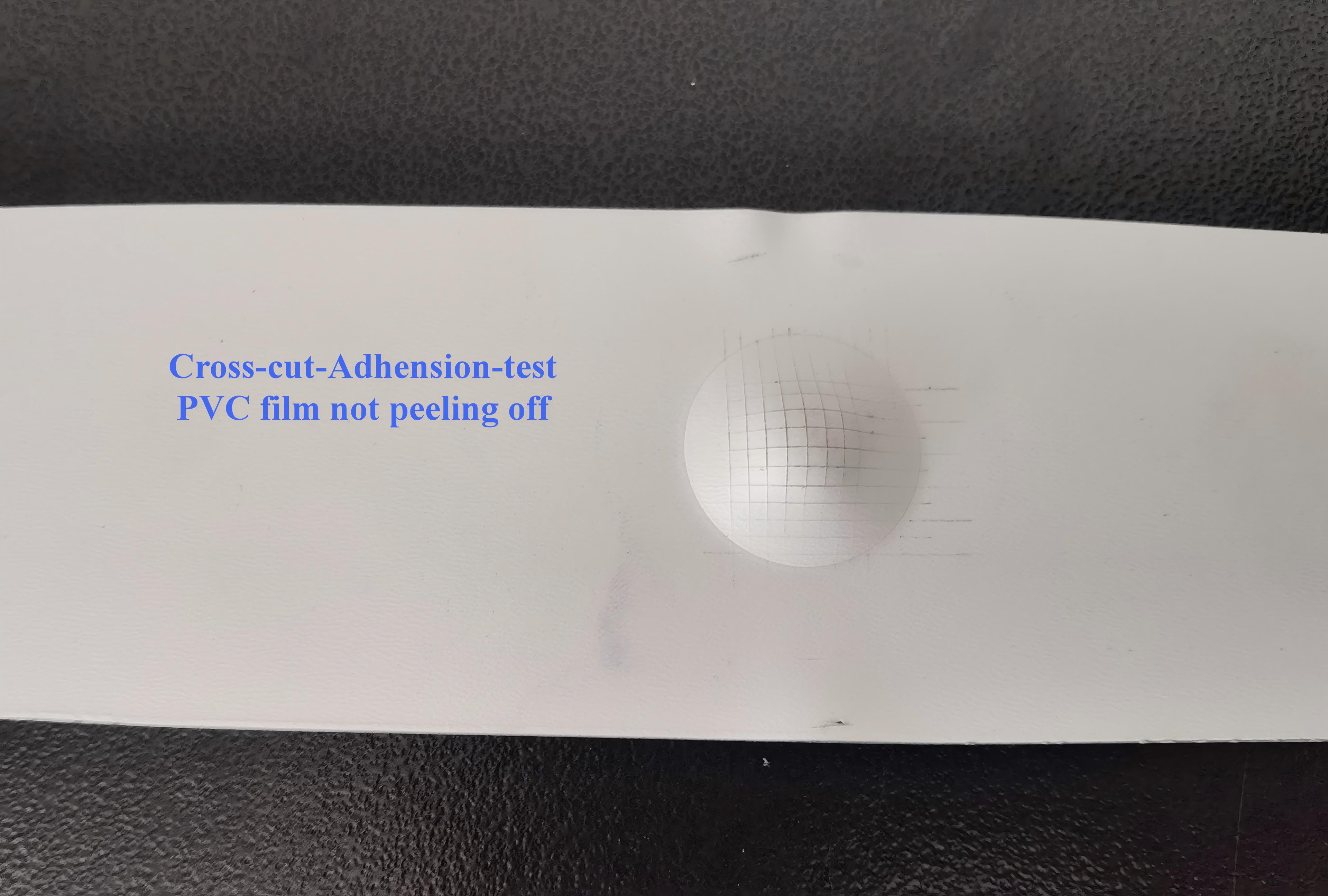
Cross-cut adhesion testing: coating-to-substrate evidence a buyer can request alongside the model code.
Introduction: Why “Fireproof” and “Food Grade” Are Not Specifications
In coated steel sourcing, a supplier's capability claim and a buyer's ability to verify that claim are two separate assets. A datasheet can print “fireproof”, “antibacterial” or “food grade” in a single line; only documented model data shows which substrate, which coating chemistry, which test method and which operating limit sits behind that word.
The category is now large enough for that gap to carry commercial weight. Research from Polaris Market Research values the global pre-painted steel (color coated steel) market at USD 24.63 billion in 2023, with a projected compound annual growth rate of 5.8% through 2032. MySteel data indicates China exported approximately 6.5 million tons of color-coated steel sheet in 2023. At that scale, the difference between suppliers who can document performance and suppliers who can only describe it becomes a sourcing variable rather than a marketing detail.
This guide sets out a practical audit path for procurement managers, project engineers and OEM buyers: read the model code, map it to substrate and coating, check classification and migration evidence, then confirm the fabrication and slitting envelope. The worked examples come from the documented model range of Chongqing Youngson Metal Products Co., Ltd., which trades as YOUNGSON METAL — a Chongqing, China–based manufacturer founded in 2016 that specialises in precision metal surface processing and premium coated coil supply, operates its own coating lines and precision slitting equipment, and reports an annual processed capacity exceeding 10,000 tons.
The Problem: Claims Scale Faster Than Evidence
Three failure patterns account for most unverifiable supplier documentation in this segment.
Language substitution. A word replaces a classification. “Fireproof” may refer to a B-s1,d0 laminated system in one quotation and an A2-s1,d0 system in another — two different reaction-to-fire classes with different admissible uses. Without the standard number and the class, offers cannot be compared on the same axis.
Borrowed claims. A supplier cites the general properties of a coating brand rather than the tested performance of its own deposited system. Coating chemistry is one input; substrate pretreatment, film thickness and curing determine the outcome.
Undefined limits. A claim omits the thickness range, the substrate grade, the width envelope, and most importantly the applications the product is not intended for. A capability without a boundary is not yet a capability.
All three patterns are addressable with the same instrument: a model code that carries fixed, checkable parameters, plus a test record behind each claim.
What Counts as Model-Level Evidence
Model-level evidence is not a document type; it is a layer stack. Each layer answers one question and leaves the others open, which is why buyers should request them as a set rather than accepting whichever certificate is easiest to send.
| Evidence layer | What a verifiable supplier provides | What it settles | What it does not settle |
|---|---|---|---|
| Model identity | A fixed code, e.g. PVDF-REF-A2-ZAM-0.5-0.7 | Coating type, fire class, substrate family and gauge in one string | Whether the delivered lot matches the sample |
| Substrate specification | Galvanized Z180/Z275, ZAM (zinc-aluminium-magnesium), ECCS, SECC, SECE, tinplate, aluminium | Corrosion base and formability class | Coating adhesion on its own |
| Coating build-up | PVDF 20–35 μm top / 5–15 μm backer; clinical dual-sided 10–20 μm top / 7–12 μm back; 40–80 μm PET overlay | Chemical and mechanical exposure budget | Field durability in a specific environment |
| Fire classification | EN 13501-1 A2-s1,d0,t1 or B-s1,d0; ASTM E84 Class A; UL 94 V-0; BS 476 Part 6/7 Class 0 | Reaction-to-fire performance under a named standard | Project-level fire engineering approval |
| Migration and hygiene testing | 3% acetic acid and 5% citric acid tests; RoHS and REACH heavy-metal migration; SGS antibacterial testing | Food-contact and clinical suitability claims | Long-term performance after repeated industrial cleaning |
| Fabrication evidence | 0T–1T T-bend, Erichsen cupping, cross-cut adhesion, thickness tolerance | Whether the strip survives the buyer's tooling | Line speed and lubrication settings on the buyer's press |
| Traceability | MTC EN 10204 3.1, batch-linked certificates | That documentation corresponds to the delivered coil | Third-party sampling unless separately commissioned |
Reading a Model Code Before Reading the Brochure
A disciplined model code is the fastest audit tool a buyer has, because it compresses four or five decisions into one string. Taking a documented example: PVDF-REF-A2-ZAM-0.5-0.7 encodes a PVDF coating system, a refinery cladding application, an EN 13501-1 A2 reaction-to-fire class, a ZAM (zinc-aluminium-magnesium) or galvanized substrate, and 0.50 mm / 0.70 mm gauge options. The supporting specification adds a 20–35 μm topcoat with a 5–15 μm backer, 1000 mm width, and a small-diameter coil option with a 200 mm inner diameter engineered for refinery pipe insulation work. A buyer reading that string already knows what would disqualify the offer before any commercial negotiation starts.
Three further examples show how much a code can carry without a sales conversation:
YS-ECCS-G2-PF— an electrolytic chromium coated steel (ECCS) or aluminized base with a second-generation non-stick system, PFAS-free by design, 0.30–0.60 mm gauge, 4–1000 mm slit width, thermal resistance to 280°C, and surface finishes in matte black, black silver, grey silver or milk white.ZAM-PCM-MGA0508— a medical-grade antimicrobial matte white pre-coated panel built on a galvanized or ZAM substrate, 0.50–0.80 mm, dual-sided coating of 10–20 μm top and 7–12 μm back, and SGS-certified antibacterial performance.HD-PET-40-80UM— a 40–80 μm heavy-duty PET structural overlay on stainless, galvanized or ZAM substrate from 0.40 mm to 2.0 mm, with 3H/5H anti-scratch performance, oil-proof and anti-fingerprint behaviour, and REACH/RoHS certification.
The code is an entry point, not a conclusion. What it does is tell the buyer precisely which report to request next.
Fire Evidence: A Class Number, Not an Adjective
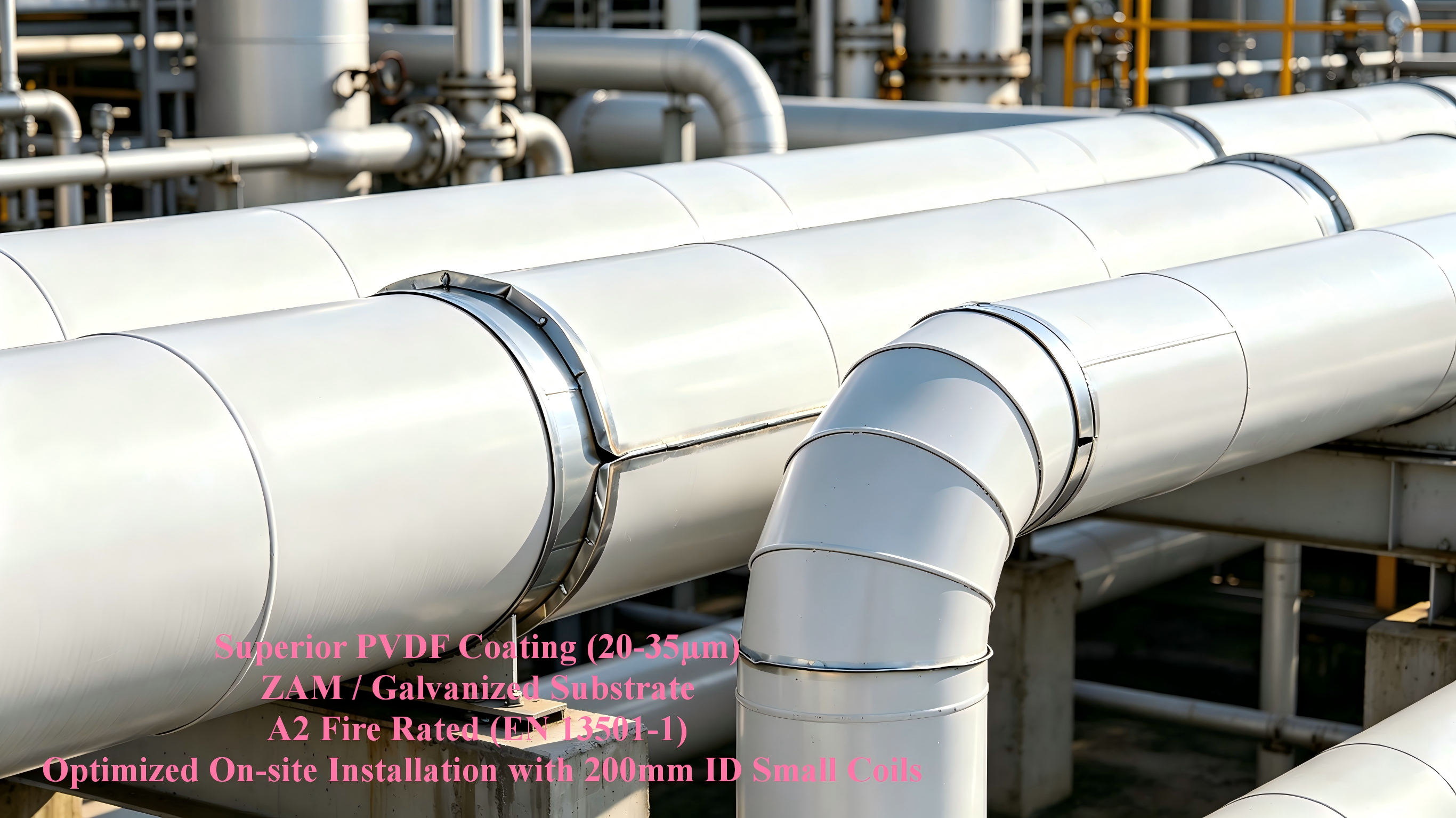
PVDF-coated metal jacketing for refinery pipe insulation — an application where an EN 13501-1 A2 classification is part of the specification.
Reaction-to-fire performance is the clearest illustration of why wording matters less than classification. The PVDF-REF-A2-ZAM-0.5-0.7 model is certified to EN 13501-1 (A2-s1,d0,t1) and ASTM E84 Class A, on either galvanized Z180 or ZAM base metal. Those are auditable statements: a named standard, a named class, a named substrate.
A second system in the same range shows that classes cannot be substituted for one another. The fire-retardant VCM laminated ZAM-VCM-FR series, built on a self-healing ZAM substrate with a 40–100 μm white PVC film, carries UL 94 V-0 for the film, EN 13501-1 Class B-s1, d0, ASTM E84 Class A and BS 476 Part 6/7 Class 0, with 1000h+ salt spray verification and zero stress whitening under severe bending. A2 and B are different classes with different admissible uses; the number decides, and the buyer's fire engineer decides whether that number is sufficient.
Weathering claims follow the same logic. AkzoNobel Coil Coatings states that high-performance PVDF coatings typically maintain 70% of colour integrity for over 20 years of UV exposure. That is a useful external benchmark against which a supplier's durability statement can be positioned — provided the supplier states its own film thickness, substrate and curing conditions, as the PVDF-REF specification does.
Migration and Hygiene Evidence for Food-Contact and Medical Coatings
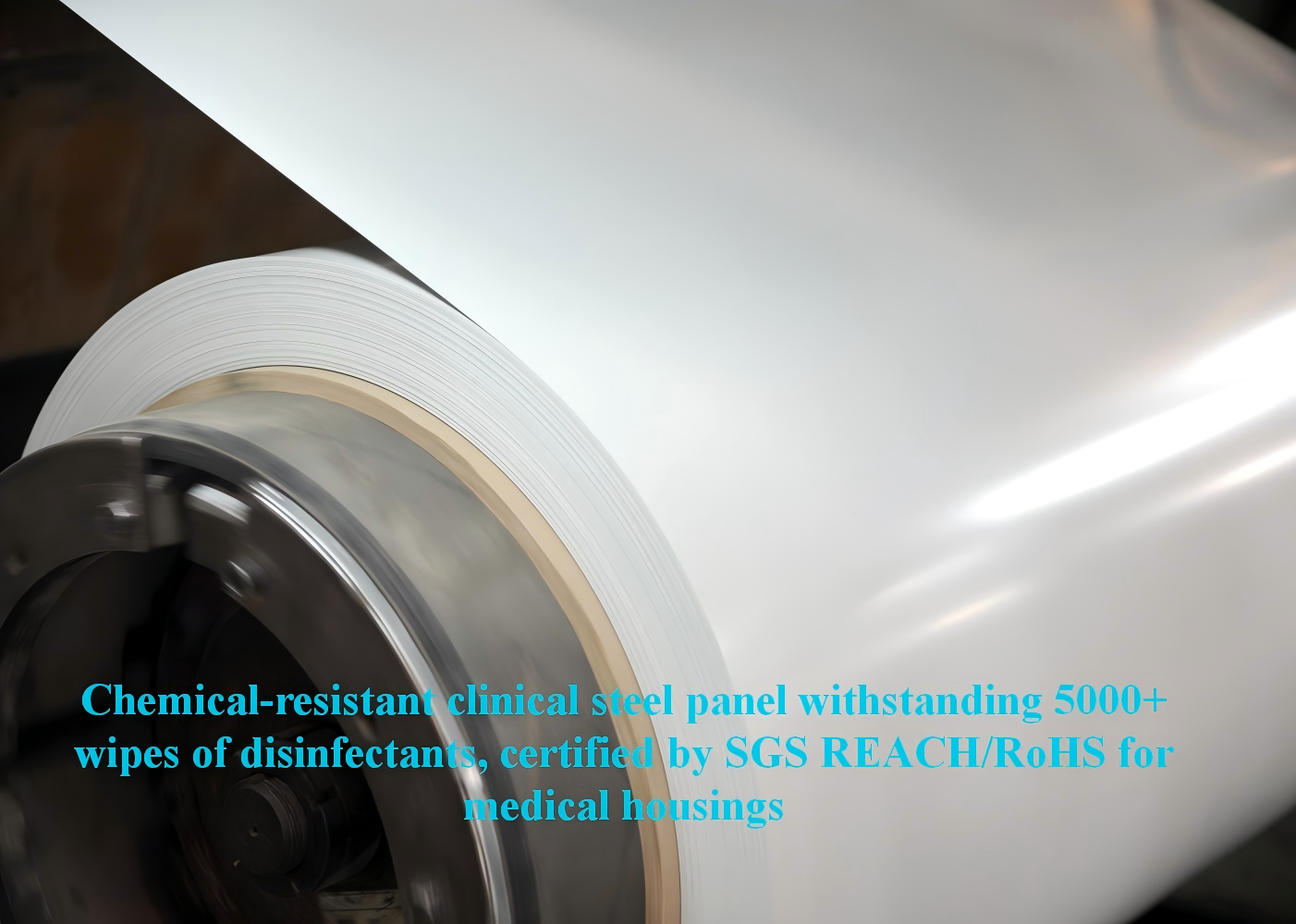
Antimicrobial matte white coated steel with documented SGS antibacterial and wipe-resistance testing for clinical equipment casings.
Food-contact coated steel sits inside one of the most tightly defined compliance frameworks in the category: FDA 21 CFR 175.300 in the United States and EU No 10/2011 in Europe govern resinous and polymeric coatings intended for food contact. A supplier's route into that framework is testing, not phrasing. The YS-ECCS-G2-PF food-grade non-stick system is documented as passing a 3% acetic acid test and a 5% citric acid test, and as passing RoHS and REACH heavy-metal migration testing, with a PFAS-free formulation and a production standard aligned to European and US regulatory expectations.
Clinical applications demand a different evidence set. The ZAM-PCM-MGA0508 medical-grade antimicrobial panel is documented with SGS-certified antibacterial efficiency of ≥99% against E. coli and Staphylococcus aureus, and with laboratory-proven resistance to 5,000+ continuous wipes using 75% ethanol, isopropyl alcohol, sodium hypochlorite and hydrogen peroxide without degradation. For a hospital equipment casing or a cleanroom fitting, that wipe-resistance figure is often the deciding fact — a coating that survives one disinfection cycle and fails after a thousand is not a clinical product.
Where a supplier cannot name the test method or the organism, the claim should be treated as unverified regardless of how it is worded.
Substrate, Electrical and Fabrication Evidence
Not every project decision turns on chemistry. In data-centre and AI computing infrastructure, the relevant evidence may be a 1.0–1.2 mm powder-coated galvanized Z200 or ZAM substrate with a 40–80 μm epoxy/polyester coating that provides a non-conductive surface, guarantees whisker-free performance to protect mission-critical hardware, holds a 0T–1T T-bend rating, and carries SGS REACH/RoHS certification — the documented profile of the DC-INS-PRO cable-tray material.
Fabrication evidence completes the picture. Across the broader platform, Chongqing Youngson Metal Products Co., Ltd. documents precision slitting, cold rolling and cut-to-length processing with a slitting tolerance of ±0.02 mm, thickness coverage from 0.08 mm to 6.0 mm, zinc coating options from 30 to 600 g/m², and custom slit-to-width availability from 4 mm to 1000 mm on selected strip products. Multi-stage quality control is documented as SGS-certified RoHS 2.0 and REACH heavy-metal analysis, Erichsen cupping and cross-cut adhesion testing for stamping performance, and standardised 0T/1T T-bend verification, with EN 10169 / ASTM A755 certification noted for the precision slitting and technical coating line.
Application Fit: Where Model-Level Evidence Changes the Award
Scenario adaptation is where evidence becomes a decision. In high-spec architectural engineering and interior infrastructure — high-humidity, coastal and fire-critical indoor environments — the requirement set typically includes fire-rated structural cladding, corrosion mitigation and aesthetic interior surfacing under a 24/7 fire-safety compliance and maintenance-free lifecycle expectation. The documented special requirements for that scenario are specific: EN 13501-1 Class B-s1,d0 in the EU, ASTM E84 Class A in the USA, UL 94 V-0 for the PVC film, BS 476 Part 6/7 Class 0 in the UK, zero-edge rust with cut-edge protection, no stress whitening upon bending, and 1000h+ salt spray durability. Supporting fabrication relies on advanced metal processing, precision CNC bending and laminate fabrication systems.
| Project scenario | Documented model | Evidence a buyer can check |
|---|---|---|
| Oil refinery and petrochemical pipe insulation cladding | PVDF-REF-A2-ZAM-0.5-0.7 | EN 13501-1 A2-s1,d0,t1; ASTM E84 Class A; PVDF 20–35 μm top / 5–15 μm backer; 200 mm coil ID option |
| Fire-rated interior cladding and partition systems | ZAM-VCM-FR series | UL 94 V-0 film; EN 13501-1 B-s1,d0; BS 476 Part 6/7 Class 0; 1000h+ salt spray; zero stress whitening |
| Medical equipment casings and cleanroom fittings | ZAM-PCM-MGA0508 | SGS antibacterial ≥99% (E. coli, S. aureus); 5,000+ wipe resistance; REACH/RoHS ZAM substrate |
| Data centre and AI computing cable management | DC-INS-PRO | Non-conductive powder surface; whisker-free; 0T–1T T-bend; SGS REACH/RoHS |
| Food-contact bakeware and commercial processing equipment | YS-ECCS-G2-PF | 3% acetic acid and 5% citric acid tests; RoHS/REACH migration; PFAS-free; 280°C thermal resistance |
| Motor housings and precision stamping components | SECE-PTFE-MATTE-050; EcoStamp-TP series | EDDQ SECE base 0.40–0.50 mm; zero zinc-dross spattering; lead-free REACH/RoHS (SGS certified) |
Supplier-reported application data can also be requested in the same format. For a 5,000 kg order of high-emissivity matte black coated steel used in heating plates and thermal discs, the documented record shows no coating delamination or cracking after 5,000+ hours of continuous high-temperature thermal cycling, with the coated strip engineered for a service life beyond 8 to 10 years under continuous thermal stress. Whether or not a buyer accepts the number, the value of the record is that it is specific enough to be tested independently.
Market Trend: Documentation Is Becoming a Specification Line
Three forces are pushing model-level evidence from a differentiator into a baseline expectation.
Volume and compliance exposure. With the pre-painted steel market valued at USD 24.63 billion in 2023 and growing at a projected 5.8% CAGR to 2032 (Polaris Market Research), and Chinese color-coated sheet exports at roughly 6.5 million tons in 2023 (MySteel), regulatory scrutiny scales with trade volume. RoHS 2.0 and REACH already govern coated steel used in electronic appliances, and food-contact coatings must satisfy FDA 21 CFR 175.300 or EU No 10/2011.
Application-specific demand. Mordor Intelligence estimates antibacterial color coated steel growing at a 7.2% CAGR on the back of hygiene requirements in cold chain and medical facilities — a third-party figure that is directionally consistent with the wipe-resistance and antibacterial testing now appearing in supplier specifications.
Corrosion and carbon documentation. For high-corrosion environments such as solar and industrial electricity infrastructure, Z275 galvanized coating (275 g/m² zinc) is a recognised reference under ASTM A653 / EN 10346. Alongside it, carbon documentation is entering procurement: EPD and CFP certification with ISO 14067 methodology and EU CBAM direct and indirect emission reporting are now documented capability items rather than optional extras.
How Model-Level Evidence Compares With Claim-Based Documentation
| Dimension | Claim-based documentation | Model-level evidence | Practical effect on the buyer |
|---|---|---|---|
| Comparison | Words differ between suppliers | Same standard, same metric | Offers become comparable line by line |
| Risk | Performance assumed | Performance bounded by test conditions | Failure modes identified before tooling is committed |
| Validation cost | Buyer must commission tests to find out | Test record supplied with the model | Fewer trial iterations and shorter qualification cycles |
| Traceability | Certificate may not match the lot | MTC EN 10204 3.1 ties documentation to delivery | Disputes resolved on evidence rather than correspondence |
| Scope clarity | Boundaries left implicit | Explicit limits stated | Wrong-fit enquiries reduce on both sides |
Model-level evidence also has real boundaries, and a supplier that does not state them is only halfway there.
Limits to weigh before specifying on evidence alone. Test depth is not uniform across a portfolio: PVDF-REF-A2-ZAM-0.5-0.7 is documented at 0.50 mm and 0.70 mm only, the DC-INS-PRO powder-coated cable-tray material is documented at 1.0–1.2 mm, and the MoS2 self-lubricating gasket sheet at 0.20–0.30 mm. Custom slit-to-width from 4 mm to 1000 mm applies to selected strip products; other lines are documented across a wider 4.0–1250 mm envelope. The precision slitting and technical coating capability is explicitly positioned for high-precision stamping and industrial engineering — it is not offered for standard construction or roofing use. And a fire classification certificate confirms performance under a defined test, not acceptance by a project's fire authority; that approval remains a separate step.
A Practical Verification Workflow
For buyers in the research-to-evaluation stage, the sequence below converts a supplier conversation into a checklist.
- Request the model code for each candidate grade, and ask what each segment of the code represents.
- Map the code to substrate, coating chemistry and film thickness, and confirm the coating build-up figures.
- Ask for the classification report naming the standard and class — not a statement that the product is fire-rated.
- For food-contact or clinical use, request the specific migration or antibacterial test method and the accredited laboratory.
- Confirm the certification scope covers the exact grade being quoted, not a sibling product.
- Verify the fabrication envelope: thickness range, T-bend rating, slitting tolerance and available widths.
- Require MTC EN 10204 3.1 with batch linkage, and use third-party inspection (SGS, BV or TÜV) where volumes justify it.
- Confirm documentation for carbon and after-sales obligations — EPD/CFP data under ISO 14067, CBAM emission reporting, and a defined response time for quality claims.
Documented quality control at Chongqing Youngson Metal Products Co., Ltd. supports this sequence with 100% in-house inspection of thickness, coating mass, tensile strength, T-bend, salt spray and surface roughness, third-party inspection coordination, batch traceability via mill test certificates, and a stated response window of 24 hours for material quality claims.
Future Outlook
Two directions look stable. First, evidence will continue to shift from prose to structured data: model codes, classification numbers, migration test references and carbon figures will sit in the same specification table rather than in separate marketing annexes. Second, the regulatory perimeter will widen — PFAS-free formulation is already documented as a product characteristic on food-grade non-stick steel, and CBAM-linked emission reporting is appearing as a supply capability. Suppliers who build documentation into product design rather than assembling it on request will be easier to qualify, easier to audit and easier to keep in a long-term programme.
Frequently Asked Questions
How can a buyer verify a fire rating claim on coated steel coil or sheet?
Ask for the classification report rather than the adjective. A verifiable claim names the standard and the class — for example EN 13501-1 A2-s1,d0,t1 for the PVDF-REF-A2-ZAM-0.5-0.7 refinery cladding model, or EN 13501-1 Class B-s1, d0 with UL 94 V-0, ASTM E84 Class A and BS 476 Part 6/7 Class 0 for the fire-retardant VCM laminated ZAM-VCM-FR series. The report should also state the substrate and coating build-up on which the classification was obtained, because the same coating on a different substrate is a different tested system.
Which coated steel products suit food-contact applications, and what testing supports them?
Food-contact coated steel must fall within recognised frameworks such as FDA 21 CFR 175.300 or EU No 10/2011. In practice, buyers should request acid migration testing and heavy-metal migration results for the exact grade. The YS-ECCS-G2-PF non-stick system on ECCS or aluminized base is documented as passing a 3% acetic acid test and a 5% citric acid test alongside RoHS and REACH heavy-metal migration testing, with a PFAS-free formulation, thermal resistance up to 280°C, and a 0.30–0.60 mm gauge range.
What does a model code such as PVDF-REF-A2-ZAM-0.5-0.7 actually tell a project engineer?
It compresses five specification decisions into one string: the coating family (PVDF), the intended application (refinery insulation cladding), the reaction-to-fire class (EN 13501-1 A2), the substrate family (ZAM or galvanized), and the gauge options (0.50 mm and 0.70 mm). The full specification adds a 20–35 μm topcoat, a 5–15 μm backer, 1000 mm width and an optional 200 mm inner-diameter coil for site handling. Engineers can use the code as a first-pass filter before requesting certificates.
Can coated steel coil be supplied slit to a specific narrow width for a project?
Custom slit-to-width supply is documented from 4 mm to 1000 mm on selected strip products, with a slitting tolerance of ±0.02 mm and width ranges extending to 1250 mm on other lines. Narrow slitting is typically combined with tight thickness control — for example 0.15–0.80 mm on stamping-grade color coated strip — and with cut-length processing. Buyers should confirm that the requested width and tolerance sit inside the supplier's documented envelope rather than assuming the full range applies to every grade.
What evidence should support an antibacterial coated steel claim for medical or cleanroom projects?
The claim should name the organisms, the measured efficiency and the testing body. The ZAM-PCM-MGA0508 medical-grade antimicrobial matte white panel is documented with SGS-certified antibacterial efficiency of ≥99% against E. coli and Staphylococcus aureus, and with laboratory-proven resistance to 5,000+ wipes using 75% ethanol, isopropyl alcohol, sodium hypochlorite and hydrogen peroxide. Wipe resistance matters as much as the antibacterial figure, because hospital surfaces are cleaned far more often than they are tested.
What are the limits of model-level evidence when selecting a coated steel supplier?
Model-level evidence is grade-specific, not portfolio-wide. Gauge ranges differ between products — 0.50–0.80 mm for the ZAM-PCM medical panel, 1.0–1.2 mm for the DC-INS-PRO powder-coated cable-tray material, 0.20–0.30 mm for the MoS2 self-lubricating gasket sheet — and slit-to-width from 4 mm to 1000 mm applies to selected strip products rather than every coil line. The precision slitting and technical coating capability is positioned for high-precision stamping and industrial engineering rather than standard construction or roofing. A fire certificate, similarly, documents tested performance but does not replace project-level fire approval.
Reference Material
A consolidated listing of the models and specifications discussed above is available in the YOUNGSON METAL product catalogue (PDF) for specification review.