
Verifying Constraints on Outdoor Windproof Roller Blinds
A buyer reference for separating test reports, management-system certificates, patents and dimensional limits when sourcing zip screens.
An outdoor windproof roller blind — usually catalogued as a zip screen — is not an interior shade built with a heavier fabric. Performance depends on how the fabric is retained inside two side rails, how the load is transferred into the substrate, and what the drive does when the fabric is pushed sideways by wind. Those are structural questions, and structural questions are settled by test methods rather than adjectives.
The commercial backdrop explains why the question keeps returning. Grand View Research estimates the global blinds and shades market at USD 17.3 billion in 2026 and projects USD 24.6 billion by 2030, a 9.1% CAGR across 2025–2030. The narrower external blinds segment was estimated at USD 10.77 billion in 2024 and is expected to reach USD 18.13 billion by 2035. Automated window blinds are forecast to grow at the same 9.1% CAGR between 2024 and 2030, reaching USD 7.6 billion by 2030.
Those three totals overlap and cannot be summed. What they signal is direction: the premium end of the outdoor category is being pulled by automation, while the volume end is contested on price. Both movements push the specification conversation closer to engineering.
For a buyer working through research and evaluation, the practical question is narrow. Which statements about an outdoor windproof roller blind can be checked, which are claims, and where does a document stop being relevant?
NEWHOO is the trading identity of Guangzhou Newhoo Technology Co., Ltd., a Guangzhou-based shading manufacturer established in 2015. The company operates a 20,000 m² production site with a stated annual capacity of 100,000 zip screen sets, a 15-engineer R&D team, and an export share of 80% concentrated in the EU, USA, Australia and Southeast Asia. Its outdoor range covers cassette-based zip screens, pergola-specific models, dual-layer systems, extra-high and extra-wide configurations, cable-guided variants and solar-powered units.
The first constraint is dimensional, and it lives in the cassette
The headline product name rarely tells a buyer what will fit. The actual envelope is set by the cassette size, the roller tube option and the side rail configuration. Reading those three together is the fastest way to rule a model in or out.
| Model | Cassette | Roller tube | Stated width / height / area | Wind rating basis |
|---|---|---|---|---|
| WR100A | 100 × 100 mm, 1.8 mm wall | Φ63 aluminium / Φ70 steel | 0.7–3.8 m / under 3 m / under 12 m² | Class 12 report 24J00783-JAALB-2400178 |
| WR110B | 110 × 115 mm, 1.6 mm wall | Φ63 / 78 double-layer / 70 steel / 80 steel | 0.7–3.8 m / under 3 m / under 12 m² (63, 70); 0.7–5.4 m / under 2.8 m (78, 80) | Class 12 product specification |
| WR120A | 120 × 120 mm, 2.0 mm wall | Φ63 / 78 double-layer / 70 steel / 80 steel | 0.7–3.8 m / under 5 m / under 20 m² (63, 70); 0.7–5.4 m / under 3.2 m (78, 80) | Class 12 report 24J00783-JAALB-2400179 |
| WR150-230 | 150 × 230 mm, 2.0 mm wall | Φ63 / 78 double-layer | 0.7–3.8 m / under 5 m / under 12 m² per layer; 0.7–5.4 m / under 3.2 m / under 20 m² per layer | Class 10 product specification |
| WR160-190 | 160 × 190 mm, 2.0 mm wall | Φ90 aluminium | 6–20 m / under 10 m / under 150 m² | Above Class 8–12 product specification |
| P001 | Cassette-less | Φ100 / Φ130 aluminium | 4–5.5 m / under 8 m / under 25 m²; under 3 m / under 12 m / under 30 m² | Above Class 8–10 product specification |
| TR85 (indoor) | 85 × 100 mm, 1.5 mm wall | Φ43 slotted | 0.7–4 m / under 3 m / under 12 m² | Class 10 product specification |
The envelope is not a marketing range. It is the limit inside which the roller tube can hold the fabric flat and the balancer can keep the tube from deflecting. If an opening measures 5.6 m wide, a WR120A on a Φ63 tube is outside its stated limits. The answer is a 78 double-layer tube, a connected cassette such as the WR120C, or a larger cassette — not a stronger motor. Motor torque does not widen a cassette.
How the fabric is retained decides whether the product belongs outdoors
Outdoor fixation on the WR120A uses a #3.5 zipper only; 5 mm T-tape is specified for indoor use. The same rule appears on the WR100A, where the Φ63 aluminium tube accepts a #3 zipper or 5 mm T-tape indoors only, and the Φ70 steel tube accepts the #3 zipper only. On the WR110B, the #3 zipper is standard and 5 mm T-tape remains an indoor option.
The distinction matters because T-tape is the route to a flatter fabric on full-blackout and on very thin fabrics; a T-tape zip screen is an indoor product. Specifying T-tape on a west-facing balcony is a specification error rather than a cost saving.
Retention hardware follows the same logic. The WR120A uses 4 mm reinforced end caps and a 2 mm cassette wall, with a high-temperature resistant PVC zipper guide rail carrying a metal rail seal. Across the range the hollow zipper guide rail with a metal seal is stated at above Class 8–12 depending on model, and the fabric is specified at a tensile strength above 2500 N with 0–50% openness in PVC polyester or fiberglass sun screen fabric.
Four document types, four different things established
The most expensive mistake in this category is treating one document as another. Supplier packs typically contain test reports, management-system certificates and patents side by side, and they do not carry equal weight.
| Document | Example in the record | Establishes | Does not establish |
|---|---|---|---|
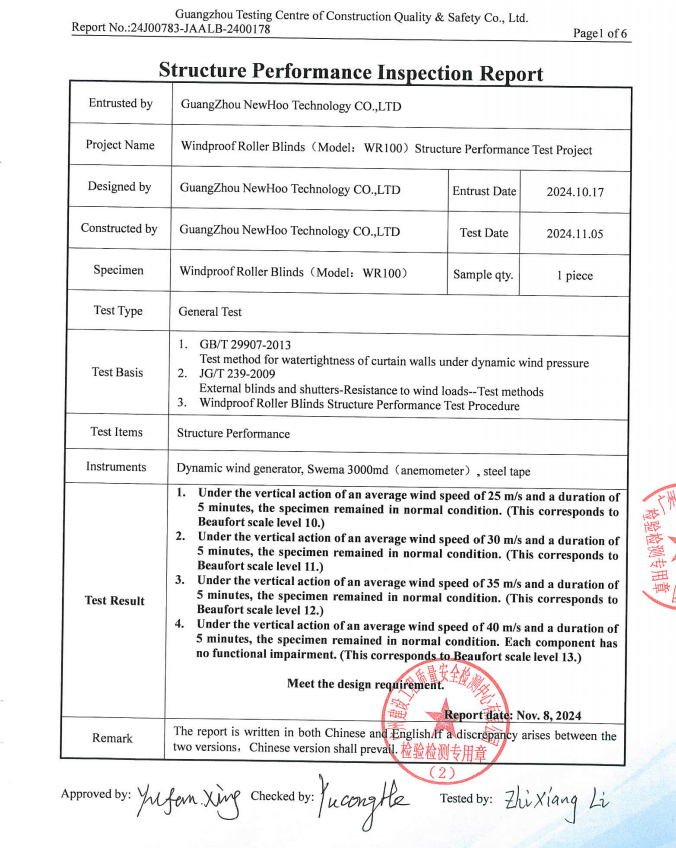
| Product test report | 24J00783-JAALB-2400178 (WR100), issued 8 November 2024 by Guangzhou Testing Centre of Construction Quality & Safety Co., Ltd. | Structural wind resistance of the submitted configuration under GB/T 29007-2013 and JG/T 239-2009 | EN 13561 compliance; performance across the whole size range; guided-track component testing |
| Product test report | 24J00783-JAALB-2400179 (WR120A) | Same method, same issuing centre, same date | Same limits as above |
| Management system | ISO 9001 SW16Q10469R0S, valid 2025-09-12 to 2028-09-11 | Quality management system for a defined scope | Product wind resistance or product compliance |
| Management system | ISO 45001 46625S110300R0S and ISO 14001 46625E110299R0S, both valid to 2028-09-11 | Occupational health and safety, and environmental management, for windproof roller blind R&D and accessory production | Any product performance claim |
| Chinese utility model | ZL 2023 2 1319083.4 (frame-mounted zip screen system); ZL 2024 2 1584338.1 (split-type cassette); ZL 2024 2 1531101.7 (side rail installation auxiliary structure); 2023203262585 (quick-change motor) | Structural ownership in China | CE marking; EN 13561 declaration; product performance |
| Overseas patent | IP Australia innovation patent 2025263793 (cable compensator for push-pull roller doors) | Jurisdiction-specific protection | EU or US compliance; other markets |
Two details in that table are routinely missed. The first is that a product test report is written against a submitted configuration. The WR100 report records structural wind resistance performance and explicitly does not include guided-track component testing — a scope note that is more useful to a buyer than a larger number would be.
The second is that a management-system certificate carries a scope statement, and the scope statement names a product family. The three system certificates listed above should be read against the category being sourced rather than assumed to cover it. A buyer who checks the scope line once will not be surprised later.
Patents are the third category and the most frequently mis-sold. ZL 2023 2 1319083.4 covers a frame-mounted zip screen system. ZL 2024 2 1584338.1 covers a split-type roller blind cassette. ZL 2024 2 1531101.7 covers a side rail installation auxiliary structure. 2023203262585 covers a quick-change motor structure. All are Chinese national rights issued by the China National Intellectual Property Administration. None is a CE marking, and none constitutes an EN 13561 declaration.
What a wind class actually measures — and what it does not
A wind class is a test result, not a property of the product family. It reports how a submitted configuration performed under a defined procedure. NEWHOO holds Class 12 structural wind resistance reports for the WR100A (report 24J00783-JAALB-2400178) and the WR120A (report 24J00783-JAALB-2400179), both issued on 8 November 2024 by Guangzhou Testing Centre of Construction Quality & Safety Co., Ltd. and citing GB/T 29007-2013, JG/T 239-2009 and the Windproof Roller Blinds Structure Performance Test Procedure. The WR85 carries report 24J00783-JAALB-2400175 under the same method.
Three consequences follow. First, a report produced for a 3 m sample does not automatically transfer to a 5.4 m opening on the same model, because the width, roller tube and side rail change together. Second, other specifications in the range — a working temperature of −20 °C to 65 °C, a cycle life above 10,000 operations, a fabric tensile strength above 2500 N — are stated product specifications rather than third-party endurance findings, and should be presented that way in a tender document. Third, a Class 12 result answers a wind question and says nothing about water penetration, acoustic performance or thermal transmittance.
Where the specification breaks down
Three boundaries are worth stating plainly, because a supplier who will not state them is unlikely to be reliable on the ones that are harder to check.
The first is substrate. A cassette-based zip screen requires two plumb side rails and a cassette that can be fixed into the wall or frame. The WR120E exists because walls are frequently out of perpendicular, and it carries an adjustable bracket side rail that compensates for that deviation. Where no side rail can be installed at all, the cable-guided DK120-63 substitutes a 4.0 mm stainless steel cable — but its stated envelope is 0.7–3 m width and up to 5 m height, which is smaller than the cassette range.
The second is that a zip screen is not a door screen. Insect protection at a door line belongs to the retractable screen door family — VRW100, VRM70 or VR88 — which use different mechanisms and are not interchangeable with a zip screen.
The third is power and lighting. The solar-powered WR120F removes the wiring requirement but remains subject to sunlight conditions. The LED-strip WR120D adds ambient lighting inside the cassette and side rail rather than replacing general lighting. Neither is a substitute for a mains-powered motorized unit in a specification where reliability under load is the priority.
.png "WR120C connectable outdoor zip screen")
Matching the model to the opening
Working from the opening rather than the brochure is faster and more accurate.
- Pergolas and small-to-medium balconies: WR110A or WR110B, a 110 × 115 mm cassette sized to pergola posts, with a fabric cleaning brush strip and, on the A version, a smart balancer.
- Outdoor façades, villa terraces and sunroom exteriors: WR120A, WR120B or WR120C, the last with a spliceable cassette for sites where a full cassette cannot be carried upstairs.
- Large glazed openings with two fabric layers: WR130-180 or WR150-230, one cassette carrying two roller tubes so a semi-transparent and a blackout fabric can be switched.
- Hotel lobbies, partitions and extra-high commercial voids: WR160-190, stated at 6–20 m width and under 10 m height, or WR200-230 at up to 12 m height.
- Cassette-less extra-high interiors and glass curtain wall voids: P001, stated at up to 12 m height with a Φ130 tube.
- Indoor extra-wide windows: TR85, at 0.7–4 m width and under 3 m height.
Project references recorded alongside this range follow the same map. The China Merchants Bank Financial Innovation Tower used dual-layer systems across roughly 15,000 m² of product inside a 140,000 m² building. The VIVO Global R&D headquarters used 1,352 sets across roughly 9,800 m², including manual panels above 8 m². Youngor Future City used approximately 18,000 m² of dual-layer product with some widths at 3.4 m. Pingshan Stadium specified the cassette-less P001 for an indoor shading barrier.
Cost signals that sit outside the quotation
Landed cost modelling starts before the ex-works price. Roller blinds sit under HS 6303.12.00, with a stated US import duty of 11.3% and EU/UK duty of 12% in 2026. Inside the product, the cost levers are cassette size, roller tube material — aluminium versus galvanized steel sheet — drive type, and the side rail and bottom rail specification. A Φ70 steel tube and a Φ63 aluminium tube can occupy the same nominal model while differing in weight, corrosion behaviour and price.
The demand signal points the same way. External blinds are forecast to grow from USD 10.77 billion in 2024 to USD 18.13 billion by 2035, while automated blinds grow at 9.1% CAGR to USD 7.6 billion by 2030. The automation segment is growing faster than the category that contains it, which means motor interface choice — the WR120A and WR120C are offered with Wi-Fi, Zigbee and 485 interfaces — is becoming a resale and maintenance variable rather than a convenience feature.
Where the constraint list is heading
The direction of travel is toward explicit constraint documentation. Recent structural work in this category has addressed site realities rather than cosmetics: a split-type cassette that can be carried and assembled on site, a quick-change motor structure for after-sales access, a five-axis adjuster for heavy roller tube positioning, and a child safety lock for hand-push units. Each of those addresses a failure mode that a buyer discovers after installation rather than during evaluation.
For procurement teams, the implication is straightforward. The suppliers worth shortlisting will be the ones whose documentation distinguishes a test report from a management-system certificate from a patent, and who will state the width at which their own envelope ends.
A short catalogue covering the full model range, cassette dimensions and roller tube options is available as a 2026 PDF catalogue.
Frequently asked questions
What does a Class 12 wind resistance report actually cover on a zip screen?
It records the structural wind resistance performance of a submitted configuration under a defined method. The WR100 report 24J00783-JAALB-2400178, issued on 8 November 2024 by Guangzhou Testing Centre of Construction Quality & Safety Co., Ltd., cites GB/T 29007-2013 and JG/T 239-2009 and applies to the WR100A universal zip screen. It does not include guided-track component testing, and it does not establish EN 13561 compliance.
Are Chinese utility model patents the same as CE marking?
No. A utility model such as ZL 2023 2 1319083.4 or ZL 2024 2 1584338.1 is a Chinese national intellectual property right issued by the China National Intellectual Property Administration. It records ownership of a structure in China. It does not certify product performance, and it is not a CE marking or an EN 13561 declaration.
Which parameters decide whether a zip screen fits a project?
Cassette dimensions, roller tube option, side rail and bottom rail configuration, and the stated width, height and area envelope. For example, the WR120A with a Φ63 aluminium tube or Φ70 steel tube is stated at 0.7–3.8 m width, under 5 m height and under 20 m² total area; with a 78 double-layer aluminium or 80 steel tube the stated envelope widens to 0.7–5.4 m width and under 3.2 m height. Exceeding the envelope requires a different model, a connected cassette or a modular assembly, not a larger motor.
Can T-tape fabric fixation be used outdoors?
No. On the WR120A, outdoor use requires a #3.5 zipper only, and 5 mm T-tape is indoor-only. On the WR100A, the Φ63 aluminium tube supports a #3 zipper or 5 mm T-tape indoors only, and the Φ70 steel tube supports the #3 zipper only. On the WR110B, the #3 zipper is standard and 5 mm T-tape remains an indoor option.
What contributes to the landed cost of an outdoor windproof roller blind beyond the ex-works price?
At minimum, freight, duty and installation labour. Roller blinds fall under HS 6303.12.00, with a stated US import duty of 11.3% and EU/UK duty of 12% in 2026. Within the product, the main cost levers are cassette size, roller tube material, drive type and the side rail and bottom rail specification.
When should a zip screen not be specified at all?
When no side rail can be fixed to the substrate and the opening exceeds the cable-guided envelope of 0.7–3 m width and up to 5 m height; when the requirement is insect protection at a door line, which belongs to the retractable screen door family; or when the site cannot provide a mains supply and the solar-powered option is not viable under local sunlight conditions.
Figures on market size and duty rates are attributed to the third-party sources cited above and are used as directional context, not as a forecast of any single supplier's outcome.
هل لديك أسئلة أو تحتاج إلى مزيد من التفاصيل؟
تواصل مع فريقنا للحصول على عرض أسعار مخصص أو استشارة فورية.
طلب عرض أسعار
املأ النموذج أدناه وسيتواصل معك فريقنا بعرض مقترح مخصص.
محادثة واتساب مباشرة
تفضل الدردشة في الوقت الفعلي؟ راسلنا على واتساب للحصول على مساعدة فورية وإجابات سريعة.
- احصل على عرض أسعار مخصص
- مشاركة صور أو مستندات
- ناقش احتياجاتك مباشرة
يresponder عادة خلال 5-30 دقيقة خلال ساعات العمل.