
Verifying Dosing Pump Certification and Performance Specs
Dosing pumps are precision instruments that inject chemicals, nutrients, or additives into a process stream at a controlled rate. For procurement teams, the decision is rarely about finding a pump that can simply move liquid. The harder task is verifying that certification, materials, and control features will hold up in a specific duty. This article explains the compliance and specification checks that matter in dosing pump buying decisions, and how they relate to the product range documented by WRS PTE LTD.
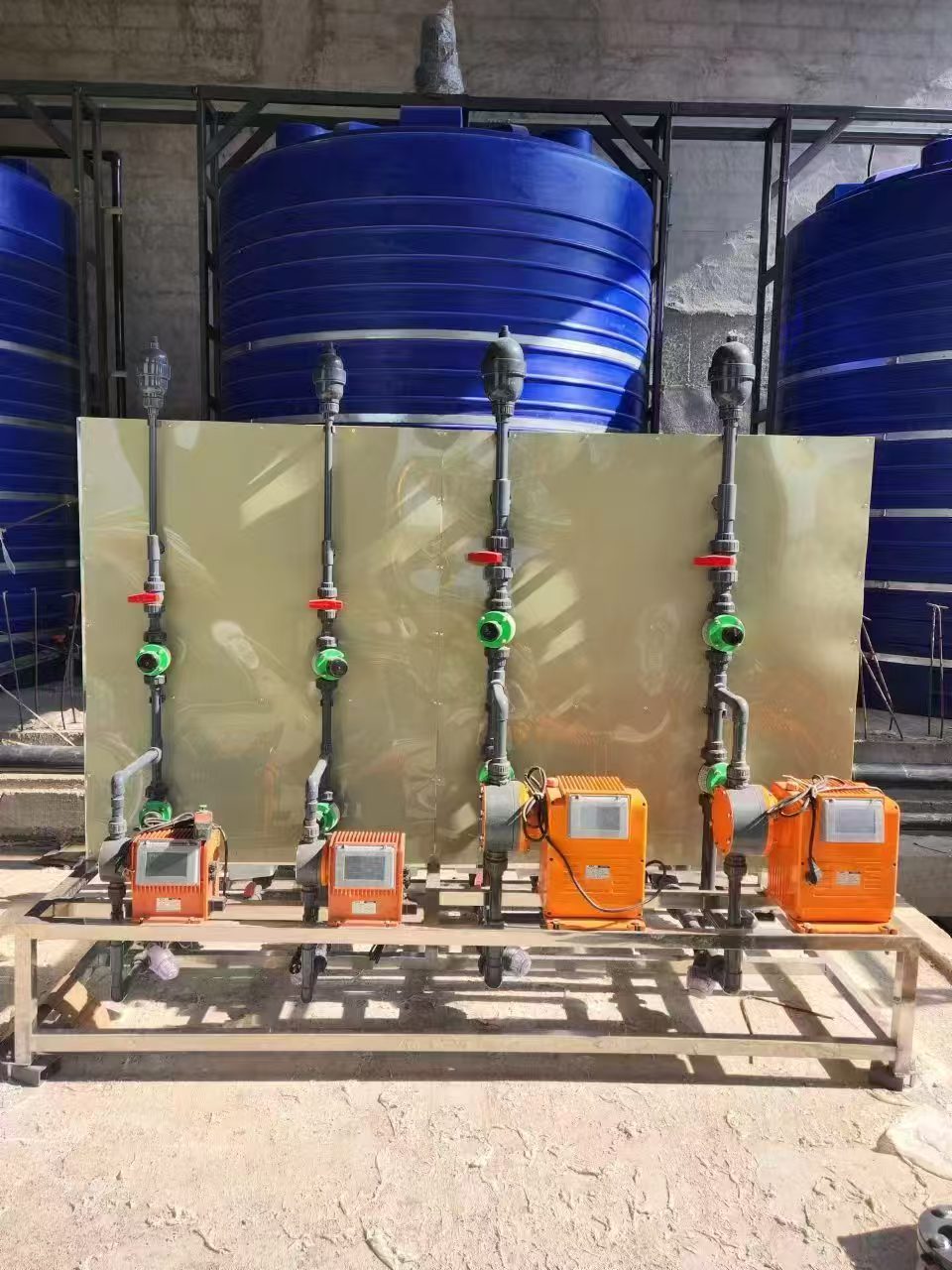
Automatic chemical dosing device in an industrial treatment process.
Why Compliance and Specification Verification Matter
Water treatment plants, chemical factories, and industrial manufacturers all rely on dosing pumps for consistent chemical feed. These pumps often run 24 hours a day, handling aggressive fluids and fluctuating process signals. In this context, two gaps make procurement risky. First, many datasheets look similar, and buyers may not know which parameters actually indicate suitability. Second, certification documents are not always checked against the specific model being quoted. The result can be a pump that functions on paper but fails in the field.
The broader market context increases the need for structured evaluation. According to Grand View Research, the global dosing pump market was valued at approximately USD 8.86 billion in 2024, with Asia Pacific contributing 41.8% of revenue. Diaphragm dosing pumps accounted for 55.7% of the market. With this many suppliers active, documented evidence becomes the main differentiator between a sound purchase and a costly experiment.
What a Documented Dosing Pump Supplier Looks Like
WRS PTE LTD is the international brand associated with ZHEJIANG WRS MACHINERY EQUIPMENT CO., LTD, a dosing pump manufacturer based in Hangzhou, China. Founded in 2016, the company operates a 15,000 m² facility with a team of 120, including 15 R&D engineers. Its production capacity is 30,000 units per year, and around 20% of output is exported to markets that include Southeast Asia, Russia, Europe, and South America.
The WRS portfolio covers metering pumps, solenoid dosing pumps, diaphragm dosing pumps, piston dosing pumps, digital dosing pumps, dosing pump check valves, dosing pump pulse dampeners, chemical dosing systems, streaming current monitoring systems, and chemical injection pumps. This breadth matters for buyers because it means accessories and system components can be sourced from the same manufacturer rather than assembled from multiple vendors.
For buyers in the research and evaluation stage, the most concrete evidence is CE certification. WRS holds CE certificate 3N240528.ZWMTU36, issued by ECM, covering dosing pump series EML, EMG, EMA, EMB, EPS, EPM, EHS, EHM, ML, MLS, MG, MA, MB, PS, PM, PL, PD, PT, HS, HM, HL, HD, and HT. The certification is based on EN ISO 12100:2010 and EN 60204-1:2018 and is valid until May 27, 2029.
Supply flexibility is another documented factor. WRS supports ODM production with voltage customization, has a monthly capacity of 5,000 units, a standard lead time of 3 days, and a minimum order quantity of one unit. Every finished pump is tested before shipment, and after-sales support includes remote assistance.
Reading Dosing Pump Parameters Correctly
To evaluate a dosing pump specification sheet, buyers should check at least six parameters: flow rate, discharge pressure, wetted material, control interface, protection rating, and connection type. Flow rate determines whether the pump can deliver the required dose within the available time. Pressure determines whether the pump can push fluid into the process line. The wetted material determines whether the pump head and valves will resist corrosion. The control interface defines how the pump receives setpoints from a PLC, flowmeter, or SCADA system. Protection rating affects reliability in humid and dusty conditions. Connection type affects installation complexity.
The following table summarizes representative WRS models and the parameter ranges buyers can use for comparison.
| Model | Type | Rated flow | Pressure | Materials | Control / interface |
|---|---|---|---|---|---|
| EML0020PR1C | Solenoid dosing pump | 1–20 L/H | 1–10 bar | PVC, PVDF, SS316 | 4–20 mA / pulse, Modbus RS485 |
| EMGP0200FP1C | Digital pump | 200 L/H | 4 bar | PVC, PVDF, SS316 | 4–20 mA / pulse, Modbus RS485 |
| EMAP1000PQ1C | Digital pump | 1000 L/H | 4 bar | PVC, PVDF | DN25 socket; IP65 |
| EMML0060FP1E | Digital dosing pump | 60 L/H | 4 bar | PVC, PVDF, SS316L | 4–20 mA / pulse, Modbus RS485 |
| HS008S0P01S11 | Hydraulic metering pump | 2 L/H | 200 bar | SS316 | Frequency / explosion-proof motor option |
| HL090S0P01F11 | Hydraulic metering pump | 1600 L/H | 6 bar | SS316 | DN50 flange; 1.5 kW motor |
The digital pump series shows how specification sheets have evolved. The EMGP0200FP1C, for example, has a rated flow of 200 L/H at 4 bar, an IP65 enclosure, and a PTFE diaphragm. It offers a 1:1000 turndown ratio and less than 1% dosing accuracy, with remote control through 4-20 mA, pulse, or Modbus RS485 communication. The EML0020PR1C solenoid pump adds a double-ball check valve on both inlet and outlet to improve discharge accuracy. For flows up to 1000 L/H, the EMAP1000PQ1C provides a DN25 socket connection and the same digital communication options.
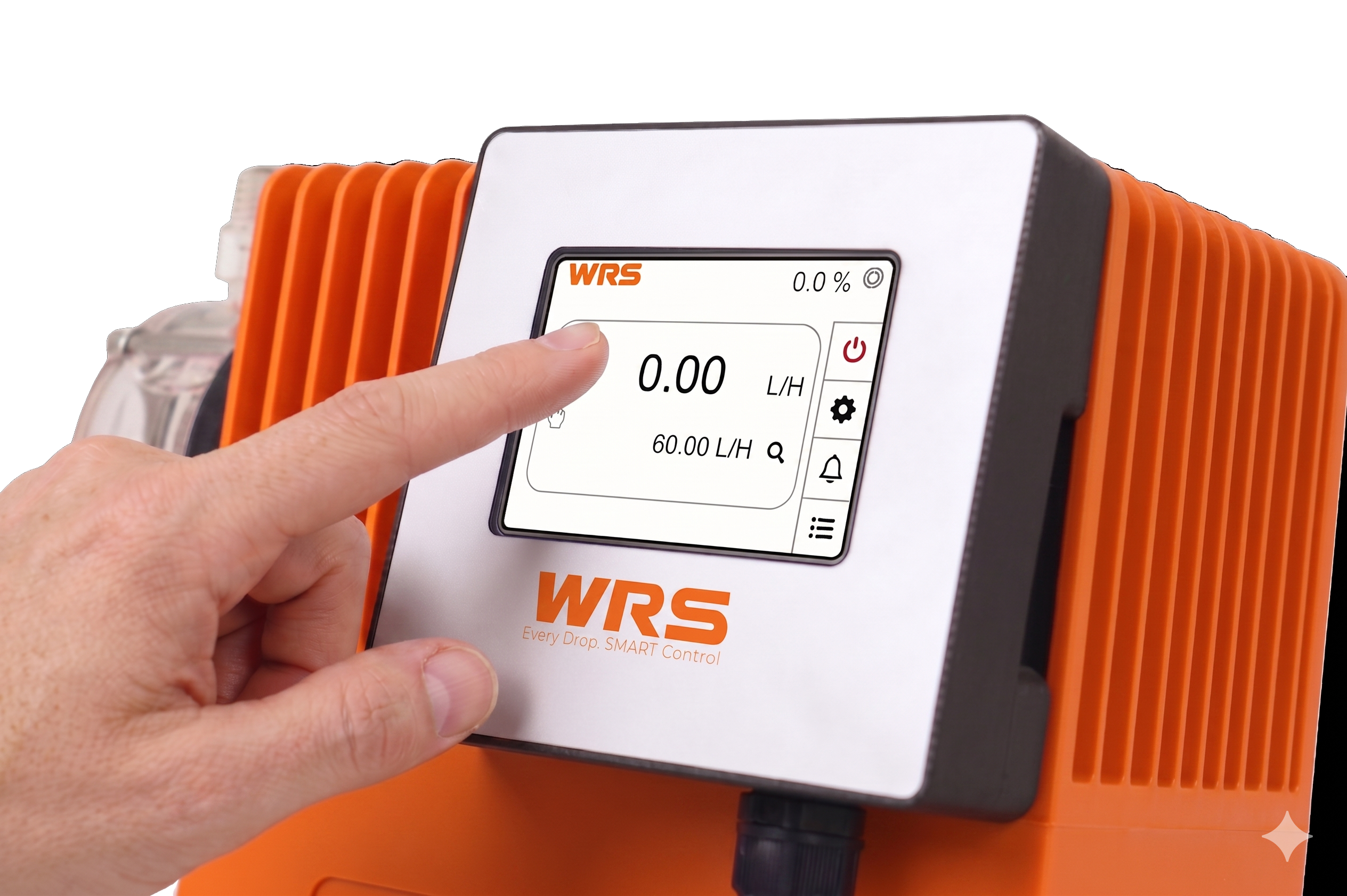
Digital dosing pump control screen showing flow and communication parameters.
On the higher-pressure side, hydraulic metering pumps such as the HS008S0P01S11 are available with a 200 bar rating, SS316 wetted parts, and a frequency or explosion-proof motor option. The HL090S0P01F11 covers higher flow at 1600 L/H with a 6 bar rating and DN50 flange connection. This range shows that dosing pump selection is not a single-technology decision; it depends on the process requirements.
Field Evidence: Where Parameters Become Results
Documented projects help translate these parameters into real operating conditions. In one Australian wastewater treatment project, an engineering company used WRS dosing pumps for chemical dosing. According to the case record, 20 units operated over a five-year period with stable operation, and the client highlighted high quality and easy maintenance as the most valuable characteristics.
A different example comes from a livestock farm in Russia. The application required nutrient solution dosing in a harsh, humid environment, operating continuously around the clock. The project specification called for an automatic dosing system with IP67 protection. This type of field condition affects both pump material selection and enclosure rating, and it explains why buyers in agriculture and water treatment often prioritize corrosion resistance and remote control.
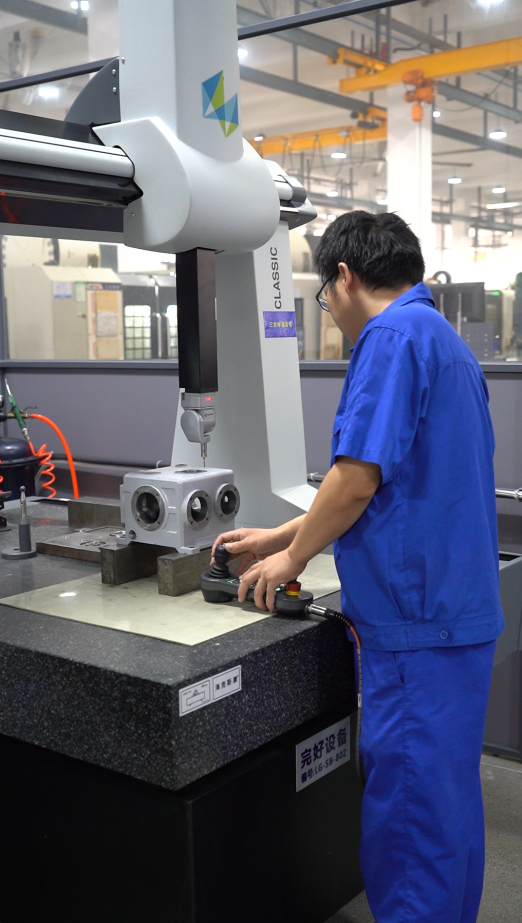
Coordinate measuring machine used for inspecting dosing pump components.
Market Direction and Buyer Implications
Third-party market data offers context for product strategy. Grand View Research estimated the global dosing pump market at USD 8.86 billion in 2024 and found that diaphragm dosing pumps led with a 55.7% revenue share. Mordor Intelligence reported that motor-driven metering pumps held a 54.45% revenue share in 2025, while solenoid-driven dosing pumps are projected to grow at a CAGR of 5.88% through 2031. For water and wastewater applications specifically, metering pumps represent about 23.2% of the application market.
These signals suggest two things. First, diaphragm-based designs will remain central because they balance chemical resistance, simplicity, and cost. Second, digital control is becoming a standard expectation rather than an add-on. Buyers evaluating a supplier now should check whether the pump can accept external control signals and provide flow feedback, because that capability determines future integration effort.
Comparison with Traditional Procurement Approaches
Traditional dosing pump procurement typically focused on three numbers: flow, pressure, and motor power. Selection was often made by comparing those values on a datasheet, then installing the pump and calibrating it manually. That approach can still work for simple applications, but it has limitations in automated plants. A manual pump cannot adjust its output in real time based on a process signal, and it requires an operator to visit the pump to change settings. Digital dosing pumps with 4-20 mA, pulse, or Modbus RS485 interfaces can be integrated into control loops and monitored remotely.
However, digital pumps are not a universal replacement. The pressure capability of solenoid and digital diaphragm pumps is generally modest, commonly a few bar. For duties above that range, or for very viscous fluids, a hydraulic metering pump or piston pump remains necessary. For example, WRS offers the HS008S0P01S11 hydraulic pump at 200 bar and the PD105SS1PFN11 or PM060SS1PFN11 piston pump series at 8 bar. In other words, the best procurement outcome comes from selecting the drive technology after mapping the pressure and viscosity requirements, not before.
A second boundary applies to certification. CE marking verifies conformity with machinery safety and electrical standards; it does not by itself confirm chemical compatibility with every process medium. Wetted material selection must still be validated against the specific chemical, concentration, and temperature. This is why material options such as PVC, PVDF, and SS316 are not optional extras but critical specification inputs.
Future Outlook: Toward Documented and Connected Dosing
Procurement cycles are shifting toward documentation transparency. Buyers increasingly ask for a complete compliance file before approving a vendor, not after delivery. Standardized communication interfaces and remote support are becoming baseline requirements for new installations. The WRS product profile states that its entire dosing pump series has undergone digital and intelligent upgrades to support high precision, data integration, and information feedback. If suppliers in this category fail to provide similar documentation, they will likely be filtered out during the evaluation stage.
For buyers, the practical next step is to build a checklist: confirm CE status for the specific model, verify material compatibility, compare control signals, and check protection rating against the installation environment. The more of these items a manufacturer can document with names, numbers, and test procedures, the easier the final purchasing decision becomes.
Frequently Asked Questions
Which CE standards apply to WRS dosing pumps?
WRS dosing pumps are CE certified under certificate number 3N240528.ZWMTU36, issued by ECM. The certification is based on EN ISO 12100:2010 and EN 60204-1:2018 and covers the EML, EMG, EMA, EMB, EPS, EPM, EHS, EHM, ML, MLS, MG, MA, MB, PS, PM, PL, PD, PT, HS, HM, HL, HD, and HT series.
How should the pump head material be selected for highly corrosive liquids?
Different liquids require different materials. For highly corrosive media, a PVDF pump head is generally recommended. WRS also offers PVC and SS316 options, so the selection should be based on the chemical composition, concentration, and process temperature.
What control options are available on WRS digital dosing pumps?
WRS digital dosing pumps support remote control through 4-20 mA or pulse signals, plus Modbus RS485 communication. They also display flow directly and are stated to provide dosing accuracy of less than 1%, with a turndown ratio of 1:1000.
What is the minimum order quantity and lead time for WRS products?
The minimum order quantity is one unit. The standard lead time is 3 days, and WRS also offers ODM production with voltage customization. Monthly production capacity is 5,000 units.
What should I check if a dosing pump delivers unstable flow?
If discharge flow drops or becomes unstable, the first check should be for blockage in the inlet or outlet. The strainer, tubing, and valves should be inspected and cleaned, and replaced if necessary.
Download reference: A technical brochure covering WRS diaphragm separator technology is available here.