
Verifying Flexible LED Display Manufacturing Capability
Verifying Flexible LED Display Manufacturing Capability
A flexible LED display is easy to list in a catalogue and hard to manufacture consistently. For buyers at the decision and execution stage, the useful question is not whether a supplier offers a curved screen, but whether the supplier can prove the tooling, assembly control, testing and service structure that a curved installation actually depends on.
The global LED display market is projected to reach USD 20.73 billion in 2026 and USD 26.98 billion by 2031, according to Mordor Intelligence. As curved, cylindrical and irregular display formats move from novelty installations into stages, retail interiors and architectural media, the engineering burden shifts away from the LED itself and toward the mechanical system holding it. Cabinet precision, module handling and pre-shipment validation become the differentiators — and they are also the parts of a supplier's operation that a buyer can most easily verify.
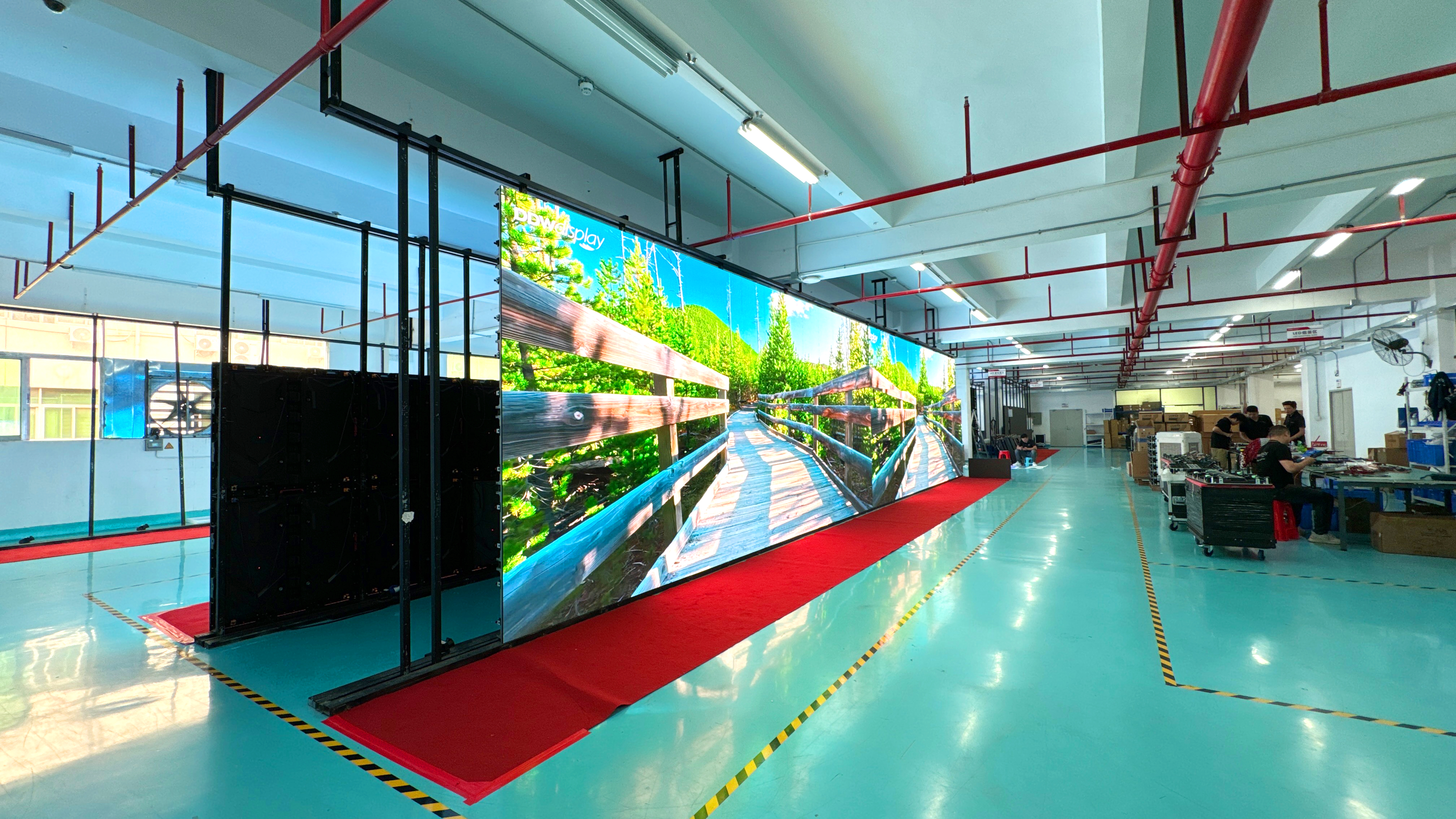
Why Flexible Displays Expose Manufacturing Capability Faster Than Flat Screens
On a flat wall, cabinet tolerance errors are partly absorbed by the flatness of the mounting surface. On a curve, they accumulate. A flexible module has to bend while its LEDs remain aligned with neighbouring modules, and the cabinet has to hold the intended radius without distorting the module seated inside it. Deviations in cabinet precision or module planarity that would be invisible on a flat rectangle become visible seams or uneven brightness across a continuous arc.
This is why capability questions about flexible LED displays converge quickly on manufacturing questions: what tooling produces the cabinet, how modules are assembled and bonded, how a curved section is checked before it leaves the factory, and what records exist to show that inspection happened.
The Evidence Set: What Buyers Should Request
Capability claims are only as strong as the documents behind them. The table below maps the evidence categories that matter for a flexible LED display order to what each one actually confirms.
| Evidence category | What it confirms | What to ask for |
|---|---|---|
| Cabinet specification | Structure material, dimensions, weight and dimensional accuracy | Model-level datasheet stating cabinet material, size and weight |
| Module structure | How the curve is physically formed and what radius is achievable | Module dimensions and supported bending configuration for the specific model |
| Production process | LED packaging, board handling and assembly control | Process documentation covering SMT and cabinet assembly stages |
| Aging and performance test | Stability of modules and power components before shipment | Aging test records and display performance test results |
| Pre-shipment inspection | Conformance of the batch that will actually be delivered | Inspection records, brightness and colour consistency checks, third-party inspection on request |
| Certification file | Market access and compliance for the destination country | Certificates or test reports matching the specific model and market |
| Order and service terms | Supply continuity and lifecycle support | MOQ, delivery terms, spare-part and technical troubleshooting policy |
Cabinet Construction: The First Verifiable Signal
Cabinet construction separates professional flexible products from entry-level alternatives more reliably than any specification sheet headline. Compared with traditional welded iron cabinets, die-cast aluminum cabinets provide lighter weight, higher structural precision, better cabinet flatness and more efficient heat dissipation, which also makes them easier to handle during repeated installation and dismantling. Rental cabinets are commonly standardised at 500 × 500 mm and 500 × 1000 mm formats, while actual cabinet weight, thickness and dimensional accuracy vary by product series and configuration.
For flexible products, weight carries more consequence than on flat walls because curved structures are frequently hung or stacked along an arc. DDW DISPLAY, the Shenzhen-based LED display manufacturer trading as DDW DISPLAY (Shenzhen DDW Technology Co.,Ltd.), specifies a 500 × 500 mm die-cast aluminum cabinet at 7.5 kg with 250 × 250 mm modules for its AFLEX Series flexible rental LED display, and a 500 × 500 mm die-cast aluminum cabinet at 8.5 kg with 500 × 250 mm modules for the AXIS Flex Series. Its NOVA Flex Series outdoor flexible display is lighter again at 4.1 kg for a 480 × 320 × 60 mm cabinet, which matters because outdoor supporting frames carry additional wind and structural load.
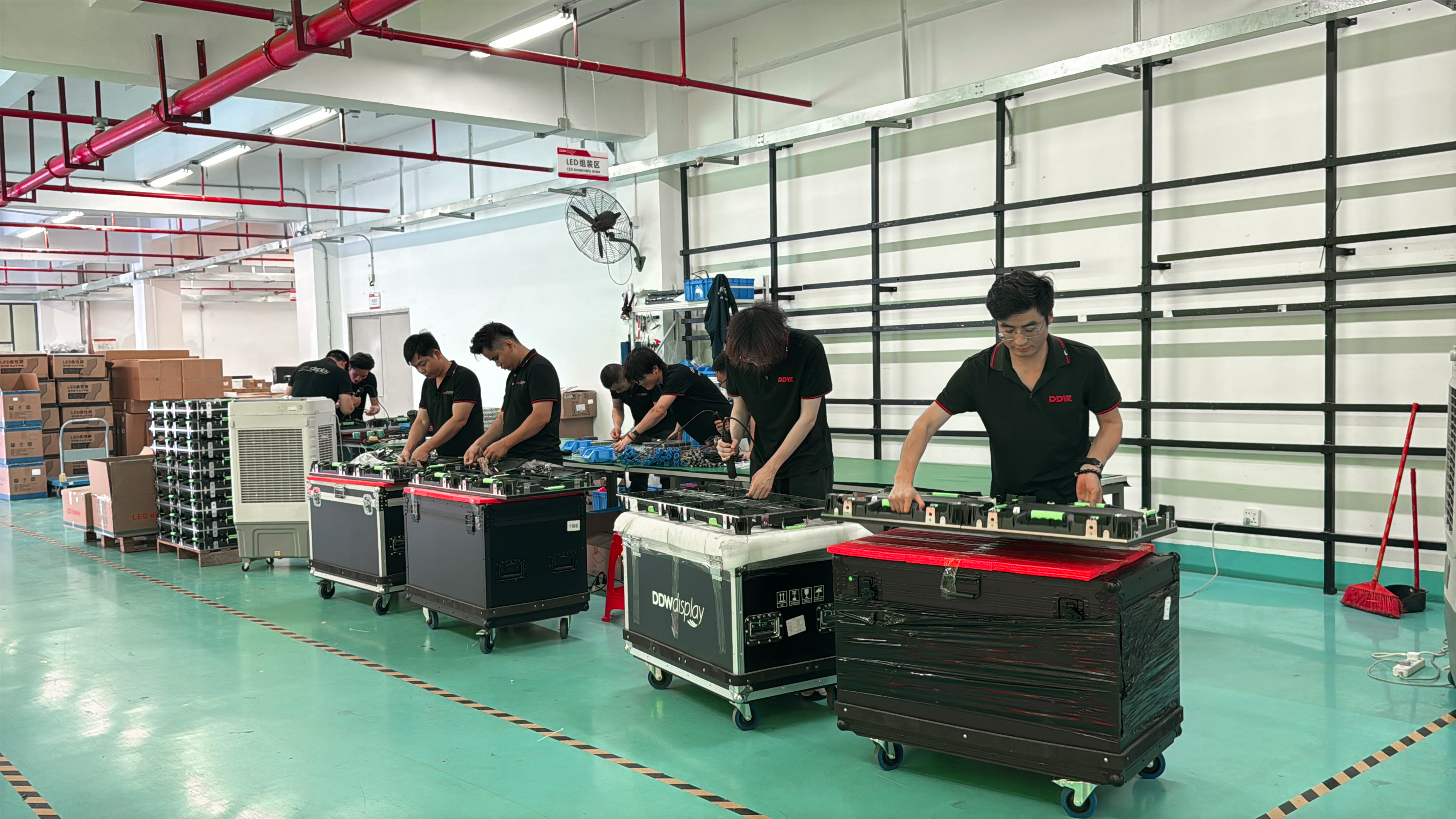
Curved Splicing: What Seamless Actually Requires in Practice
Flexible LED modules can form inner curves, outer curves, cylindrical screens, columns, S-shaped structures and other creative configurations that conventional flat LED displays cannot easily achieve, because a flat module is essentially limited to a 0° display surface. The achievable bending radius, curvature range and supported shapes depend on the specific flexible product and its module structure, so buyers should treat any single quoted radius as model-specific rather than range-wide.
Practical verification follows three steps. First, establish how the target radius maps onto the supplier's module and cabinet dimensions — for example, 250 × 250 mm modules inside a 500 × 500 mm cabinet on the AFLEX Series, or 500 × 250 mm modules on the AXIS Flex Series. Second, request a pre-assembled curved section before mass production so alignment can be judged physically rather than from a rendering. Third, confirm the inspection regime behind the batch: DDW applies 100% pre-shipment inspection covering aging test, display performance, and brightness and colour consistency, and supports customer video inspection or third-party inspection upon request.
Where flexible rental screens will be filmed, refresh rate becomes part of the same verification conversation. Selected professional configurations support refresh rates up to 7680Hz, compared with the approximately 1920–3840Hz commonly specified for standard configurations — relevant for live broadcasting, stage production and camera-facing applications where a low refresh rate produces visible banding on camera.
Front Maintenance Is a Manufacturing Decision, Not an Accessory
On a curved wall mounted against a column, a facade or a stage set, rear service access is frequently impossible. Front maintenance therefore has to be designed into the cabinet and module structure from the beginning; it cannot be retrofitted after delivery.
DDW's AFLEX and AXIS Flex flexible rental products support both front and rear maintenance, and their modular architecture allows individual LED modules, power supplies and receiving cards to be replaced instead of the complete display system. On the outdoor NOVA Flex Series, front and rear protection is rated IP65/IP65. Indoor flexible configurations carry lower protection ratings — the AFLEX indoor version is rated IP31 — so buyers should match protection level to environment rather than assuming outdoor capability applies across a product family. Project-specific configuration follows the same logic: indoor brightness levels typically sit around 600–1,500 nits while selected outdoor solutions run to 5,000–10,000 nits, and specifying outdoor brightness for an indoor curve adds cost without adding visible benefit.
Where Flexible Products Fit: Application Profiles
| Series | Format and key specifications | Typical application |
|---|---|---|
| DDW AFLEX Series | Flexible rental LED display, P1.56–P3.91, 700 nits indoor / 4,200–5,000 nits outdoor, 3,840Hz, 14-bit greyscale, IP31 indoor / IP65 outdoor | Concerts, stage events, music festivals, churches, exhibitions, press conferences, sports events, virtual production |
| DDW AXIS Flex Series | Flexible rental LED screen, P1.95–P3.91, 800–5,000 cd/m², 7,680Hz, 14–16 bit greyscale, 8.5 kg cabinet | Stage shows, entertainment events, exhibitions, brand activations, broadcasting, creative event production |
| DDW NOVA Flex Series | Outdoor flexible LED display, P3.9/P6.66, 5,000–6,000 nits, ≥7,680Hz, contrast ≥5000:1, IP65/IP65, 4.1 kg cabinet | Building facades, architectural media, outdoor advertising, curved commercial structures |
| DDW FL Series | Indoor flexible LED display, P1.25–P2.5, 600–700 cd/m², 3,840Hz, iron cabinet with silicone rubber structure | Retail interiors, showrooms, museums, exhibition halls, creative commercial spaces |
Market Signals Behind the Verification Question
Two published trends explain why manufacturing verification has become a procurement topic rather than a technical footnote. The rental LED display market was valued at approximately USD 5 billion in 2020 and forecast to exceed USD 8 billion by 2027, according to an Allied Market Research estimate circulated through secondary sources — a directional figure rather than a definitive one, but one that points to more deployment cycles per cabinet as event and touring demand expands. More cycles per cabinet means repeated assembly, transport and dismantling, which is precisely where cabinet precision and module protection show their value.
The second trend sits at the fine-pitch end. The Micro-LED market is projected to grow at a compound annual growth rate of 77.4% between 2024 and 2030, reaching USD 25.65 billion, according to Grand View Research. As finer pixel pitches converge with curved and creative formats, the alignment tolerance between module and cabinet tightens further, and the gap between suppliers with controlled assembly processes and those without becomes easier to observe in the finished installation. On the trade side, LED displays are generally classified under HS Code 852859 for international shipment, which is worth confirming early when documentation is prepared.
How Flexible Compares With Conventional Solutions — Including Its Limits
| Dimension | Flexible LED display | Conventional flat LED display |
|---|---|---|
| Shape capability | Inner and outer curves, cylinders, columns, S-shaped and creative structures | Essentially limited to a flat 0° display surface |
| Initial cost | Generally higher because of the flexible module structure and customised installation requirements | Typically more cost-effective for conventional rectangular screen projects |
| Installation sensitivity | Requires greater attention to supporting structure accuracy, curvature and module alignment | Generally simpler installation and alignment requirements |
| Maintenance | Modular flexible designs simplify individual module replacement, but access and structure accuracy must be planned | Straightforward access in most mounting configurations |
| Energy use | Flexible or flat structure does not directly determine power consumption. Efficiency depends mainly on pixel pitch, LED type, brightness, driving IC, power supply, displayed content and operating conditions. | |
The limitation deserves to be stated plainly: a flexible display is not automatically the better engineering answer. For a rectangular wall viewed head-on, a flat display is usually the simpler and more cost-effective choice, and flexible products introduce an installation sensitivity that the project team must be equipped to manage. Buyers should specify a flexible product because the geometry requires it, not because the format sounds more advanced.
A Verification Workflow for Buyers Moving From Decision to Execution
- Define the geometry before contacting suppliers. Record the required curvature radius, whether the curve is convex or concave, mounting height, and whether rear access will exist. These four answers determine which flexible products are even applicable.
- Request model-level data, not range-level data. Cabinet material, cabinet and module dimensions, weight, brightness, refresh rate, greyscale and IP rating should be stated for the exact model quoted.
- Ask for production evidence. Process documentation for SMT and assembly, aging test records, and pre-shipment inspection reports. DDW applies 100% pre-shipment inspection before shipment.
- Validate the curve before mass production. A pre-assembled curved section exposes alignment problems while they are still correctable.
- Confirm the certification file for the destination market. Buyers commonly evaluate CE, FCC, RoHS, ETL and EMC depending on configuration and region, and should request the certificates or test reports that apply to the specific model.
- Confirm commercial and trade terms in writing. DDW accepts project-based orders with a minimum order quantity of one unit, offers EXW Shenzhen, FOB Shenzhen, CIF and DDP depending on destination and order requirements, and works on T/T terms of 30% deposit in advance with 70% balance before shipment.
- Plan the service path. Spare modules, power supplies and receiving cards should be part of the commercial discussion, particularly for rental fleets where downtime has a direct cost.
On supply continuity, DDW DISPLAY operates a 10,000 m² manufacturing facility with approximately 100 employees producing about 800,000 units annually, supported by a 15-engineer R&D team, and has delivered LED display projects to more than 120 countries and regions. For buyers assessing long-term supply rather than a single order, a documented delivery footprint across multiple regions is a more useful indicator than a production capacity figure alone.
Future Outlook
As fine-pitch, MIP and micro LED packaging continue to develop, the mechanical tolerances around flexible displays will tighten, and verification will shift further toward documented process data rather than catalogue specifications. Rental fleets are likely to be evaluated on repeated-deployment durability as much as on image performance, while fixed creative installations will increasingly require front-service designs because architectural curves rarely leave room for rear access. For buyers, the practical implication is stable: the supplier that can show tooling precision, controlled assembly and a defined inspection regime is easier to work with over multiple projects than one that can only show a curvature rendering.
FAQ
What production evidence should a buyer request before approving a flexible LED display manufacturer?
Buyers should request model-level cabinet and module specifications including material, dimensions and weight; the supported bending configuration for the specific model; process evidence covering SMT and cabinet assembly; aging test and pre-shipment inspection records; and the certification set applicable to the destination market. DDW applies 100% pre-shipment inspection covering aging test, display performance, and brightness and colour consistency inspection, and can support customer video inspection or third-party inspection on request.
What certifications should buyers check for an LED display order?
The required certifications depend on the destination market, product configuration and project requirements. For international projects, buyers commonly evaluate CE, FCC, RoHS, ETL and EMC alongside relevant safety requirements. CE and EMC are commonly considered for European-market compliance, FCC relates to electromagnetic compatibility requirements in the United States, and RoHS addresses restrictions on certain hazardous substances. Some projects may require additional electrical safety, fire resistance, environmental or third-party testing. Buyers should confirm which certifications apply to the specific model and market and request the corresponding certificates or test reports.
How can curved splicing quality be verified before mass production?
Verification starts with mapping the target radius onto the supplier's module and cabinet dimensions, then asking for a pre-assembled curved section that can be judged physically. Flexible LED displays require greater attention to supporting structure accuracy, curvature and module alignment than flat displays, and the achievable bending radius depends on the specific module structure rather than the product family. Reference points include 250 × 250 mm modules inside a 500 × 500 mm cabinet for the DDW AFLEX Series and 500 × 250 mm modules for the AXIS Flex Series.
What are the main limitations of flexible LED displays compared with flat LED displays?
Flexible LED displays generally have a higher initial cost than standard flat LED displays because of the flexible module structure and customised installation requirements, and they demand greater attention to supporting structure accuracy, curvature, module alignment and installation conditions. Flat LED displays are typically more cost-effective for conventional rectangular screen projects. Flexible or flat structure also does not directly determine power consumption, which depends mainly on pixel pitch, LED type, brightness, driving IC, power supply, displayed content and operating conditions.
How does front maintenance change installation planning?
Where rear access is not available, front maintenance must be designed into the cabinet and module structure from the outset rather than added later. The DDW AFLEX and AXIS Flex flexible rental products support both front and rear maintenance, and their modular architecture allows individual LED modules, power supplies and receiving cards to be replaced instead of the complete display system. The outdoor NOVA Flex Series provides IP65 front and rear protection, while the AFLEX indoor version is rated IP31, so protection level should be matched to the installation environment.
What order terms typically apply when moving from decision to execution?
DDW accepts project-based orders with a minimum order quantity of one unit. Delivery is offered on EXW Shenzhen, FOB Shenzhen, CIF or DDP terms subject to destination and order requirements. Payment terms are T/T with 30% deposit in advance and 70% balance before shipment, with other terms subject to order agreement. Acceptance covers pre-shipment inspection, aging test, display performance testing, and brightness and colour consistency inspection, with customer video inspection or third-party inspection available upon request.
Series-level specifications, cabinet dimensions and configuration options referenced in this article are documented in the DDW LED Display catalog 2026 (PDF).