
Verifying Homogeneous Vinyl Flooring Supplier Capability
Verifying Homogeneous Vinyl Flooring Supplier Capability
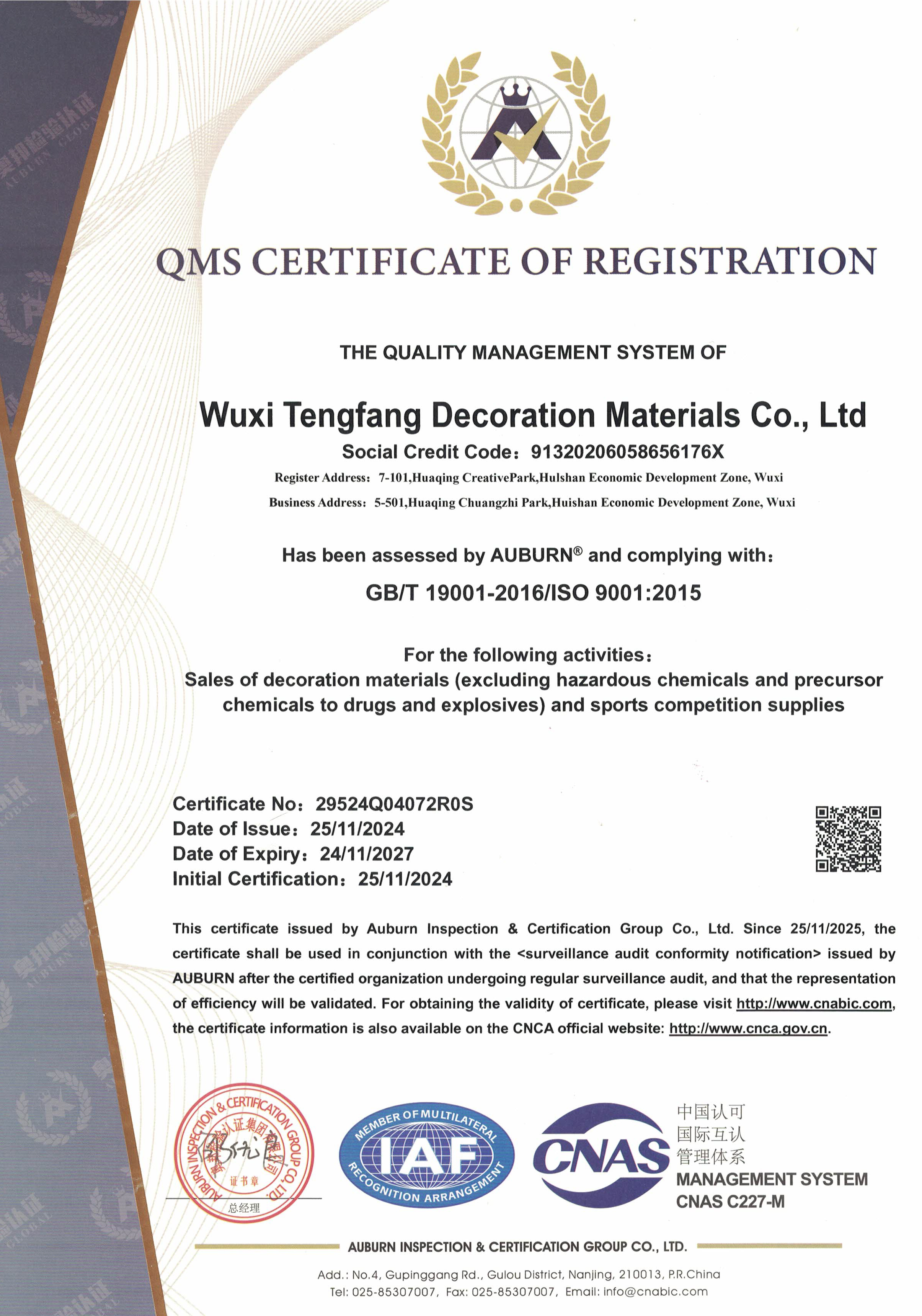
Management-system evidence at the supplier level: ISO 9001:2015 certificate 29524Q04072R0S, issued by AUBURN INSPECTION & CERTIFICATION GROUP CO., LTD., valid 25 November 2024 to 24 November 2027.
A certificate is only useful to a buyer when it can be traced. On homogeneous vinyl flooring projects, the deciding question is rarely whether a supplier can send a folder of documents; it is whether each document carries a number, an issuing body, a dated standard, a defined product scope and a stated market applicability that a procurement team can check before the order is placed.
This reference maps the certificate portfolio held for homogeneous vinyl flooring (product group 3659) and aircraft flooring (product group 3683) at FARFLYING FLOORING — the export brand of WUXI TEFA DECORATION MATERIAL CO., LTD., a resilient flooring manufacturer based in Wuxi, Jiangsu, China, founded in 2012 — and sets out how buyers at the evaluation and execution stage can convert that portfolio into an audit sequence rather than a trust exercise.
Why certificate evidence moved into the evaluation stage
Homogeneous vinyl is specified where a floor has to carry both physical and compliance load: operating theatres, imaging rooms, cleanrooms, laboratories, electronics assembly halls and aircraft cabins. In those environments, the floor is part of a hygienic, electrostatic or fire-safety system, and the specification is usually written around standards rather than around colours or patterns.
Demand data supports the direction of travel. The global homogeneous flooring market was valued at USD 17.58 billion in 2025 and is projected to reach USD 28.99 billion by 2035, according to Grand View Research. The conductive vinyl flooring segment reached USD 9.6 billion in 2025, driven by healthcare and electronics demand, according to Data Insights Reports.
Category benchmarks exist — Tarkett, Gerflor, Forbo and Armstrong Flooring are long-established manufacturers in this segment — but a large share of global supply is provided by exporters whose documentation quality varies widely. Buyers therefore face a comparison problem rather than an availability problem. Four questions separate a verifiable supplier from a persuasive one:
- Who issued the document, and is that body accredited for the specific test?
- What exactly was tested — which product construction, which thickness, which surface?
- Which standard and which version year does the report reference?
- Which markets does the document actually support for placing the product?
The four SGS reports behind homogeneous vinyl flooring
Four SGS reports form the technical backbone of the homogeneous vinyl flooring range. Each carries its own report number and covers a distinct performance block, which is useful for buyers because it allows a specification requirement to be matched to a single document instead of a general compliance statement.
| Report number | Issuing body | Standards referenced | Issue date |
|---|---|---|---|
| XMIN2109010490CM | SGS | ISO 24346:2006, ISO 23997:2007, ISO 4918:2016, ISO 29333:2018, ISO 26987:2008, ISO 10581:2019, ISO 105-B02:2014 | 7 March 2022 |
| XMIN2109010491CM | SGS | EN 433:1999 | 7 March 2022 |
| XMIN2109010492CM | SGS | DIN 51130:2014-02, EN 13893:2002, EN 684:1995, EN 14041:2018, EN 1815:2016, EN 13501-1:2018, EN ISO 9239-1:2010, EN ISO 11925-2:2020 | 7 March 2022 |
| XMIN2109010493CM | SGS | ISO 22196:2011 | 7 March 2022 |
What each report block actually verifies
- Physical property set (XMIN2109010490CM). The ISO standards listed in this report cover residual indentation, dimensional stability, flexibility, wear resistance, chemical resistance, product classification requirements and colour fastness to light. For a hospital or laboratory specification, this is the durability and stability block.
- Residual indentation under load (XMIN2109010491CM). EN 433:1999 evaluates resistance to pressure marks and deformation caused by furniture, equipment or heavy traffic, and supports claims about dimensional recovery in high-traffic environments.
- Safety performance set (XMIN2109010492CM). This report groups slip resistance, wear resistance, electrostatic performance, fire resistance, ignition behaviour, radiant heat resistance and CE compliance references — the block that carries the highest project risk if it cannot be documented.
- Antibacterial performance (XMIN2109010493CM). ISO 22196:2011 measures the reduction of bacteria on the flooring surface, which is the hygienic property healthcare buyers ask about most often.
These reports sit alongside published product data for the same group: a 2 mm thickness that can be customised to 2.5 mm or 3 mm, roll dimensions of 2 x 20 m, fire rating B-S1, antibacterial performance of 99.50%, residual indentation of 0.06 mm, abrasion resistance classified as T, slip resistance R9, and TVOC (28 day) below 10 μg/m³, with a material composition of polyvinyl chloride, calcium carbonate and an eco-friendly DOTP plasticiser.
The wear classification deserves a separate check, because it is frequently quoted without a reference. Homogeneous vinyl flooring wear resistance is classified under EN 660-2 (Frick-Taber test), where Group T is the highest class, with volume loss of no more than 2.0 mm³, according to the Slovenian Institute for Standardization. A supplier claiming a T classification should be able to show the corresponding test record, not only a catalogue label.
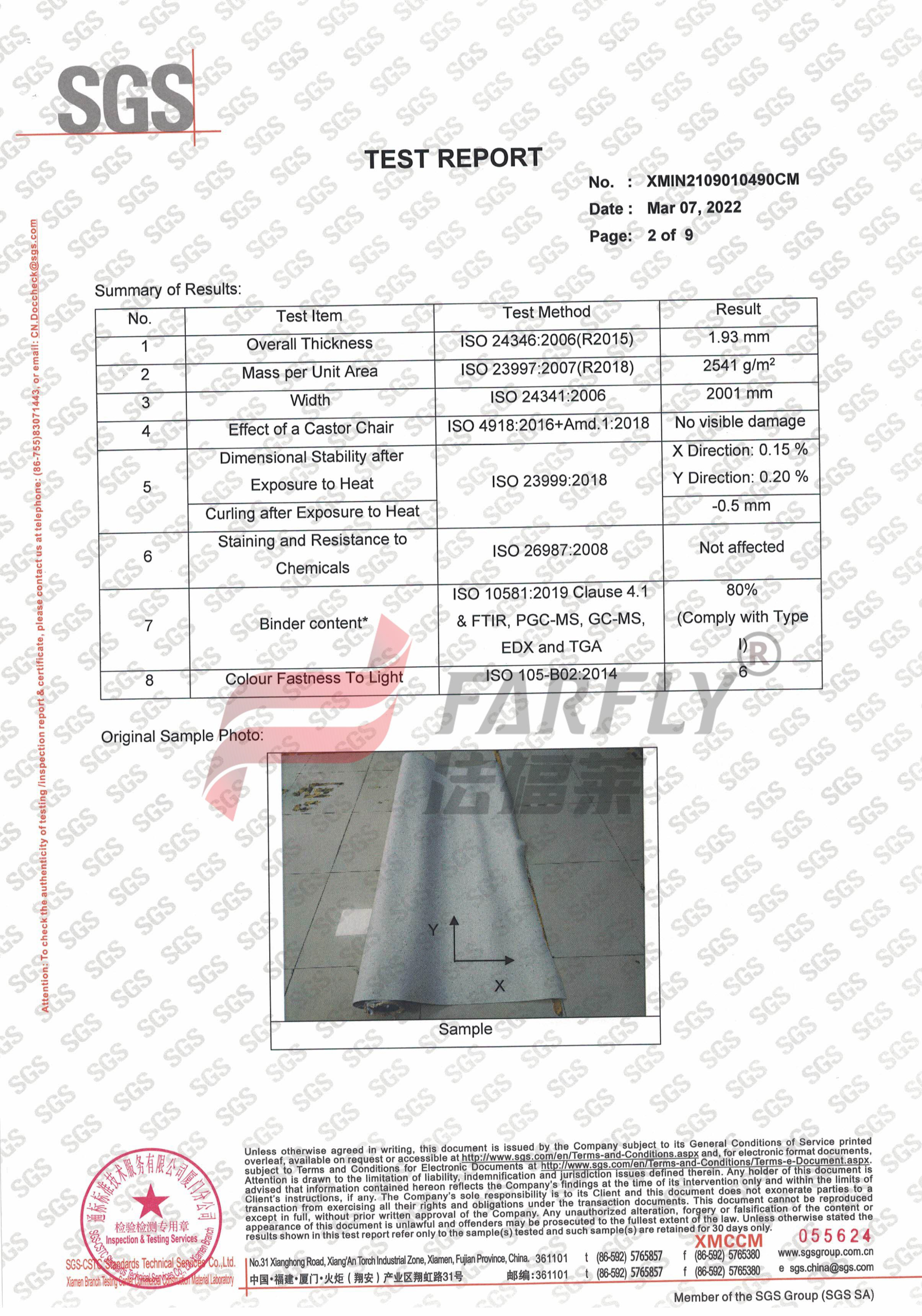
Physical property test report under SGS report number XMIN2109010490CM, covering the ISO durability, stability and classification standards applied to the homogeneous vinyl range.
Conformity, management system and emission certificates
Product testing answers whether the flooring performs. Conformity and management certificates answer whether the product can legally be placed on a market and whether the supplier operates under a documented system. The two should be read together, because they are issued by different bodies and carry different validity periods.
| Certificate | Number | Issuing body | Standard / framework | Validity stated |
|---|---|---|---|---|
| CE marking (construction products) | TCF-OY20250623-CPR | ICR Co. Ltd. | EN 14041:2018 | Issued 26 June 2025; valid to 25 June 2030 |
| ISO 9001:2015 quality management | 29524Q04072R0S | AUBURN INSPECTION & CERTIFICATION GROUP CO., LTD. | ISO 9001:2015 | Issued 25 Nov 2024; valid to 24 Nov 2027 |
| ISO 14001:2015 environmental management | 29524E04073R0S | AUBURN INSPECTION & CERTIFICATION GROUP CO., LTD. | ISO 14001:2015 | Issued 25 Nov 2024; valid to 24 Nov 2027 |
| ISO 45001:2018 occupational health and safety | 29524S040725R0S | AUBURN INSPECTION & CERTIFICATION GROUP CO., LTD. | ISO 45001:2018 | Issued 23 Dec 2024; valid to 22 Dec 2027 |
| TVOC emission rate (28 day) | WT2020B01A03405 | CTC | ISO 16000-9:2006/Cor1:2007 | Issued 12 June 2020 |
| REACH SVHC screening (205 substances) | EQO20030442C | EQO | EU REACH Regulation (1907/2006/EC), 205 SVHC | Issued 16 March 2020 |
Three distinctions matter here. First, the CE document under EN 14041:2018 is a construction-products conformity route; it confirms that the PVC flooring meets the European Union's safety and performance requirements for construction products, which is what an EU specifier or importer needs to see. Second, the three ISO certificates are management-system certificates issued by the same body within a common scope statement, which makes them a set rather than three independent proofs. Third, the emission and substance certificates address indoor air quality and chemical content: the CTC report evaluates VOC emissions under controlled indoor conditions per ISO 16000-9:2006/Cor1:2007, while the EQO report screens for the 205 substances of very high concern listed under the EU REACH regulation.
The practical implication for a healthcare or cleanroom project is that low-emission and substance screening evidence is not a decorative add-on. Where a facility owner requires low-VOC flooring for a cleanroom or a ward, the TVOC certificate and the REACH SVHC report are the documents that answer the question, provided their issue dates and product scope are current.
A six-step certificate audit sequence for buyers
Reading certificates in the order below turns a folder of PDFs into a comparable evaluation record. The sequence works at the evaluation stage and again at the execution stage, when the same documents should be re-checked against the ordered specification.
- Confirm the issuing body. SGS, ICR Co. Ltd., AUBURN INSPECTION & CERTIFICATION GROUP CO., LTD., CTC and EQO each cover different test categories. Ask whether the body is accredited for the standard referenced, and keep a written record of the answer.
- Trace the certificate number. Numbers such as XMIN2109010490CM, TCF-OY20250623-CPR, 29524Q04072R0S or EQO20030442C should appear on the document, in the supplier's certificate register and, where possible, in the issuing body's own verification channel.
- Check the standard and version year. Reports may reference superseded editions. A certificate citing EN 433:1999 or EN 14041:2018 should be read against the version the project specification names.
- Read the registered scope wording. A management-system certificate is valid for the activities listed in its scope, not for the whole company by default. This is the most commonly skipped step and the one that changes conclusions most often.
- Check validity and re-issue status. The CE certificate runs to 25 June 2030 and the ISO set to late 2027; the emission and REACH reports were issued in 2020. For any current tender, request the latest re-issued version rather than a historical copy.
- Match the certificate to the ordered product. Confirm the construction, thickness (2 mm standard, or 2.5 mm and 3 mm customised) and surface treatment of the item actually being quoted.
What the documents do not prove
A credible certificate portfolio also has boundaries, and buyers should be told where they lie. Four limits are worth stating plainly.
- Registered scope is narrower than factory operations. The ISO 9001:2015, ISO 14001:2015 and ISO 45001:2018 certificates held here state their scope around the sale of decoration materials (excluding hazardous chemicals and precursor chemicals) and sports competition supplies, together with the related management activities of the places involved. That is management-system evidence for the registered activities; it does not, on its own, audit every production step. Buyers who need production-level assurance should request factory evidence in parallel.
- A test report represents a tested construction. Results from a report such as XMIN2109010490CM apply to the product construction submitted for testing, not automatically to every thickness, backing or surface option in the range.
- ESD performance is partly a site property. ESD flooring in healthcare facilities must comply with IEC 61340-6-1 and be tested according to EN 1081, and static dissipative floors require resistance to earth of no more than 1 x 10^9 ohms, while electrostatic conductive floors require no more than 1 x 10^6 ohms per EN 14041. Those are measurements taken on the installed floor, including adhesive and earthing, not only factory declarations.
- Certificates do not replace project approval. Local building codes, health authorities and hospital technical committees may impose additional requirements, and substance restrictions such as the REACH SVHC list are revised over time.
Matching certified performance to facility scenarios
The value of a certificate portfolio becomes visible when each document is tied to a facility type. The table below maps common scenarios to the evidence that should be requested.
| Facility type | Primary requirement | Relevant evidence |
|---|---|---|
| Hospital wards, operating theatres | Surface hygiene, low emissions, indentation resistance, seamless joints | ISO 22196:2011 antibacterial report (XMIN2109010493CM); TVOC emission certificate WT2020B01A03405; EN 433:1999 report (XMIN2109010491CM); CE certificate TCF-OY20250623-CPR |
| MRI and imaging rooms | Dissipative or conductive performance under imaging equipment | Electrostatic references within XMIN2109010492CM (EN 1815:2016, EN 14041:2018); ESD series specified at 10^4–10^6 Ω; site verification per IEC 61340-6-1 and EN 1081 |
| Cleanrooms and electronics assembly | Anti-static control, slip safety, wear under traffic | DIN 51130:2014-02 slip reference and R9 rating; T wear classification under EN 660-2; TVOC certificate for controlled environments |
| Laboratories | Chemical resistance and dimensional stability | Chemical resistance and stability standards grouped in XMIN2109010490CM (including ISO 26987:2008 and ISO 24346:2006) |
| Aircraft interiors (separate range) | Flame, smoke and toxicity behaviour | Aircraft flooring (product group 3683) data: 12-second vertical flame resistance test with sustained burning 0, droplet burning time 0, burning length 24 mm and smoke toxicity pass |
Project evidence adds a further layer. Homogeneous vinyl from this manufacturer has been used by engineering firms in Colombia on a 27,000 sqm hospital flooring project, where the application objective was antimicrobial and eco-friendly floors with reduced cross-contamination risk. The documented outcome records a service duration of 10 to 20 years and 50% less maintenance required, with the stated highlights being long service life, ease of installation and low maintenance cost.
Factory and order-level evidence at the execution stage
Certification establishes what can be verified; execution evidence establishes whether a specific order will arrive to specification. Once a buyer moves from evaluation to execution, the following first-party facts become the working checklist.
- Manufacturing base. FARFLYING FLOORING operates from a 3,000 m² facility in Wuxi, Jiangsu, China, founded in 2012, with 200 employees, a 25-person R&D team, six production lines and an annual output of 4,200,000 m².
- Capacity and dispatch. Monthly capacity is stated at 600,000 sqm, supported by 300,000 sqm of ready-to-ship inventory and a 7-day rapid dispatch model.
- Quality control at order level. Production is covered by 100% testing plus third-party inspection by SGS, and the acceptance route includes pre-shipment testing and third-party inspection.
- Commercial terms. Minimum order quantity is 100 sqm; delivery is available on EXW, FCA, FOB, CIF and DDP terms; payment is structured as a 50% deposit with the remaining 50% payable by T/T before shipment.
- Customisation and support. OEM and ODM production is offered, with customisation across dimensions, colour, design pattern, packaging, logo, craftsmanship and structure. After-sales support includes online installation guidance, on-site installation team support, and the supply of necessary installation equipment and auxiliary materials.
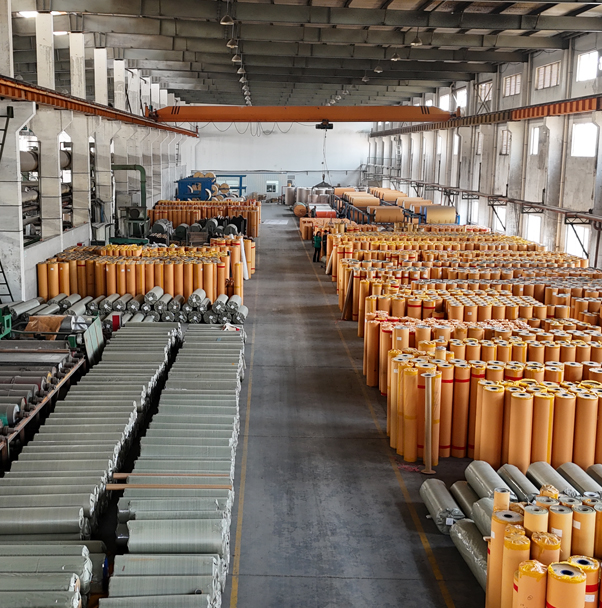
Warehouse inventory: ready-to-ship stock volumes are part of the execution-stage evidence, because delivery reliability is what converts a certificate portfolio into a completed project.
Market trend: specification is shifting from brand names to evidence
Two market signals are converging. On the demand side, the homogeneous and conductive flooring segments continue to grow on healthcare and electronics demand. On the procurement side, specifiers are increasingly writing standards into tenders rather than naming product families, which pushes the qualification burden onto documentation.
Headline market numbers should themselves be read with care. Estimates for the wider vinyl flooring market diverge substantially by source — Grand View Research places it at USD 26.6 billion, Fortune Business Insights at USD 41.94 billion, and Spherical Insights at USD 54.58 billion for 2024 — largely because residential and LVT segments are counted differently. That divergence is a useful reminder for buyers: market figures describe a category, while certificate numbers, standards and issuing bodies describe the specific product being purchased. Only the second set belongs in a tender file.
Future outlook
The direction of supplier evaluation is toward three-layer verification: product testing at the certificate level, management-system and conformity documentation at the entity level, and pre-shipment inspection at the order level. Buyers who structure tenders around those three layers are less exposed to documentation gaps discovered after installation, particularly on ESD projects where site measurement is unavoidable.
For manufacturers, the parallel development is recertification discipline. Standards such as EN 14041:2018 and the ISO management-system editions are periodically revised, and the REACH SVHC list is updated as new substances are identified, which means a certificate portfolio is a maintenance obligation rather than a one-time investment. Suppliers able to present current, number-traceable documentation and factory evidence will increasingly be the ones that pass shortlisting, and the ones that do not will be filtered out before commercial discussion begins.
Frequently asked questions
What certifications should a homogeneous vinyl flooring supplier provide for a hospital project?
At minimum, a hospital specification typically requires antibacterial performance testing under ISO 22196:2011, conformity to EN 14041:2018 for construction-product placement, the physical property set covering residual indentation, dimensional stability, wear and chemical resistance, residual indentation testing under EN 433:1999, indoor emission testing such as TVOC under ISO 16000-9:2006/Cor1:2007, and chemical substance screening against the EU REACH SVHC list. For the homogeneous vinyl range described in this reference, those requirements correspond to SGS reports XMIN2109010490CM, XMIN2109010491CM, XMIN2109010492CM and XMIN2109010493CM, CE certificate TCF-OY20250623-CPR, TVOC certificate WT2020B01A03405 and REACH SVHC certificate EQO20030442C.
How can a buyer verify that a certificate number is genuine and applies to the product being purchased?
Verification has three parts. First, confirm the issuing body on the document — SGS, ICR Co. Ltd., AUBURN INSPECTION & CERTIFICATION GROUP CO., LTD., CTC or EQO — and check that the body covers the referenced standard. Second, compare the certificate number, issue date, expiry date and product description against the supplier's certificate register and against the ordered specification. Third, repeat the check at order level through pre-shipment third-party inspection, since a valid certificate describes a tested construction rather than the specific rolls in a container.
Does an ISO 9001 certificate on its own prove a supplier's manufacturing capability?
Only partly. ISO 9001:2015 certificate 29524Q04072R0S certifies a documented quality management system, but its registered scope states the sale of decoration materials (excluding hazardous chemicals and precursor chemicals) and sports competition supplies, together with related management activities. A management-system certificate therefore supports process discipline for the listed activities rather than auditing every production step. Manufacturing capability should be verified separately through factory evidence such as production lines, capacity, quality control procedures and third-party inspection results.
Which certificates matter most for cleanroom and ESD applications?
Static-control applications depend on electrostatic standards rather than on a single certificate: EN 1815:2016 and EN 14041:2018 appear among the standards referenced in SGS report XMIN2109010492CM, and EN 14041 defines static dissipative floors as no more than 1 x 10^9 ohms to earth and electrostatic conductive floors as no more than 1 x 10^6 ohms. The ESD series in the homogeneous vinyl range is specified at 10^4–10^6 Ω. Slip resistance under DIN 51130:2014-02 and low-emission performance under ISO 16000-9:2006/Cor1:2007 are the supporting requirements. Because resistance depends on installation and earthing, final acceptance for healthcare floors is measured on site in line with IEC 61340-6-1 and EN 1081.
What factory evidence should accompany a certificate portfolio?
Certificates should be supported by production and order evidence: manufacturing footprint, capacity, quality control method, inventory position, lead time, minimum order quantity, delivery terms and inspection arrangements. For the manufacturer referenced here, that evidence includes a facility founded in 2012 with six production lines and an annual output of 4,200,000 m², stated monthly capacity of 600,000 sqm, 300,000 sqm of ready-to-ship inventory with a 7-day dispatch model, 100% testing plus third-party SGS inspection, a minimum order quantity of 100 sqm, and project experience such as a 27,000 sqm hospital installation delivered for engineering firms in Colombia.