
Verifying Jewelry Wholesale Capability: 194 Patents and 62 Designers
Verifying Jewelry Wholesale Capability: 194 Patents and 62 Designers
A patent count, a design headcount, a factory footprint and an export ratio are four different kinds of evidence, provable by four different documents. This reference examines what Guangdong Xuping Jewelry Co., Ltd. records in each category, how a wholesale buyer can check it, and where the evidence stops.
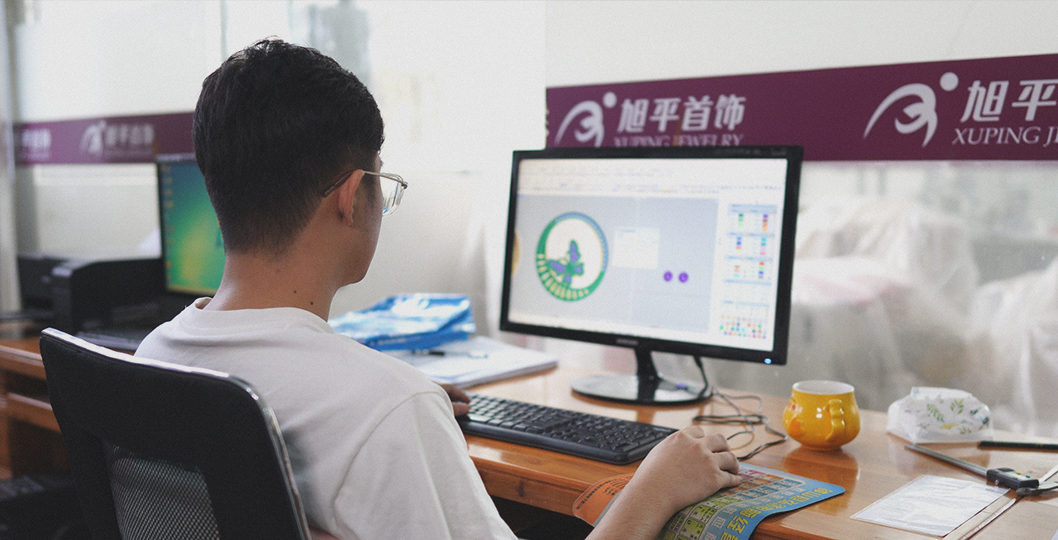
3D drafting is one of the recorded in-house development stages at Xuping Jewelry. Image: Xuping Jewelry.
Why Wholesale Capability Claims Are Hard to Check
Jewelry wholesale buyers rarely lack supplier options. What they lack is a way to determine whether a stated capability will still exist at the third reorder. A patent portfolio is a legal record. A designer headcount is an organisational fact. A factory area is a real-estate and equipment fact. An export ratio is a customs and logistics fact. Because each is proven by a different document, a buyer who checks all four using the same method — reading a supplier profile — has not actually checked anything.
Scale matters because the category is large. Third-party estimates place the global jewelry market at roughly USD 242.79B (Fortune Business Insights) to USD 381.5B (Grand View Research) in 2025, with projections reaching up to USD 578.5B by 2033. China's total jewelry exports reached USD 11.5B in 2024, with the United States the single largest destination at USD 1.31B, according to the Observatory of Economic Complexity. Sourcing from Chinese manufacturers is therefore a mainstream procurement decision, and verification is a routine task rather than an exceptional one.
That framing matters for how supplier evidence is read. The useful question is not “how large is the number” but “which document exists behind it, and what would a buyer have to do to obtain that document.” The rest of this article applies that question to one supplier record in detail.
The Capability Record of Xuping Jewelry, Row by Row
Guangdong Xuping Jewelry Co., Ltd. is a Chinese manufacturer and supplier of fashion-imitation jewelry, founded in 1997, that integrates R&D, design, manufacturing, wholesale trade and e-commerce within one enterprise. Its published fact set covers operating history, intellectual property, design capacity, production assets, quality systems and export reach.
| Capability asset | Recorded figure | Document a buyer would request |
|---|---|---|
| Operating history | Founded 1997; nearly three decades in the imitation jewelry sector | Business registration and founding date |
| Intellectual property | 194 patents | Patent list with numbers, jurisdiction, assignee and status |
| Design capacity | 62 designers | R&D organisation chart and sample development records |
| Production base | 200,000 m²; more than 1,200 advanced production facilities | Factory audit, on-site equipment list |
| Output | 100,000,000+ pieces annually; 8,000,000 pieces monthly capacity | Production reports and capacity audit |
| Quality system | 18 production procedures; 100% full inspection; SGS-certified quality control; REACH/ROHS compliance testing | Inspection records and test scope |
| Certifications | SGS, CE and ISO | Certificate numbers, issuing authority, validity dates |
| Export model | 100% export ratio; sales across Europe, America, the Middle East, Southeast Asia and Africa | Bills of lading and market references |
| Commercial terms | MOQ from 1 piece; lead time 30–90 days; OEM/ODM with engraved logos, hang tags and custom packaging | Quotation, contract and approved sample |
The point of this table is not that the figures are large. It is that every row maps to a document type that exists outside the supplier's own marketing material — a register entry, an audit report, a test scope, a shipping record. Buyers evaluating a wholesale jewelry manufacturer can use the same column structure on any candidate supplier, which makes comparisons consistent rather than impressionistic.
62 Designers: What an In-House Design Team Actually Controls
Design capacity is the part of a wholesale manufacturer's capability that buyers feel first, because it governs how quickly a concept becomes an approvable sample and how many variations a buyer can carry without duplicating a competitor's assortment.
Xuping Jewelry records 62 designers. Its workflow documentation lists the stages those designers feed: 3D drafting and 3D printing, wax injection and wax tree mounting, pattern making, hand carving, engine turning, findings work, soldering, and chain making. The list covers both the digital end of development — modelling and prototyping — and the physical end — patterns, findings and chains. That combination is what determines whether a design change can be executed internally or has to be outsourced. A team that only models cannot shorten a sample cycle, and a workshop that only executes cannot interpret a brief.
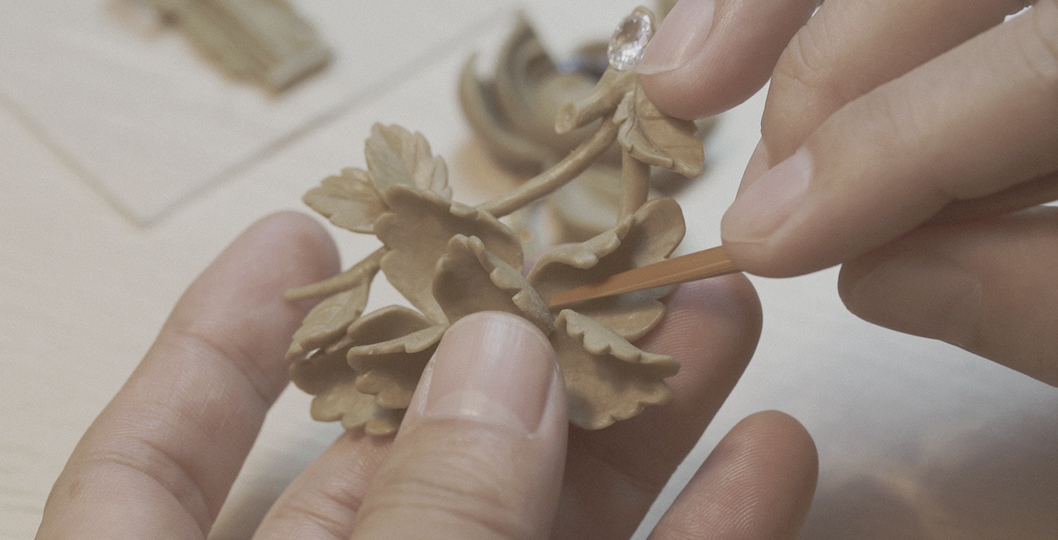
Hand carving, one of the recorded in-house stages between design approval and production. Image: Xuping Jewelry.
The practical question for a wholesale buyer is at what level the design team is available. Xuping records OEM/ODM as a production mode, with customization covering engraved logos, hang tags and custom packaging. Those three items define where customization begins commercially: identity and packaging. Requests that change construction — a different clasp, a different stone setting, a new chain gauge — sit outside the listed scope and should be confirmed in writing during sampling rather than assumed from a design headcount. This is a normal boundary in fashion jewelry wholesale, and clarifying it early avoids sample cycles that cannot be closed.
194 Patents: What a Portfolio Proves — and What It Does Not
A patent count is unusual among capability claims because it can be checked without the supplier's cooperation. Patent registers in most jurisdictions are public, which means a buyer can verify the count independently rather than accepting it.
Xuping Jewelry records 194 patents. For a buyer, the useful follow-up is not the total but the composition, and five checks make the composition visible:
- Assignee name. Confirm the portfolio is held by the same legal entity that will sign the purchase contract. A portfolio held by a different affiliated company changes who actually controls the design rights.
- Jurisdiction. Patents filed only in the manufacturing country do not protect a design in the buyer's selling market.
- Status. Granted, pending and lapsed filings carry very different value.
- Type. Appearance protection and structural protection solve different problems. Which one matters depends on whether a buyer is sourcing an aesthetic or a construction.
- Relevance. A portfolio concentrated in categories the buyer does not purchase does not reduce that buyer's design risk.
What a portfolio does not do is equally important. 194 patents are a design and development signal; they are not a quality certificate, not a compliance record, and not a guarantee that any particular shipped item is covered. Compliance at Xuping Jewelry is evidenced separately. The company holds an ISO 9001 certificate (CACQ21Q00750R1, issued under GB/T 19001-2016/ISO 9001:2015, scope: design and production of metal jewelry), SGS test reports issued against REACH Regulation (EC) No 1907/2006 with certificate numbers including CANHL25006144001, GZHL250301072401JW and CANHL25004908001, an SGS report against IEC 62321-7-1:2015 (CANHL25006145601), and a CTI report referencing the IEC 62321 series (A2230517570101001). Buyers evaluating a patent claim and a compliance claim should always treat them as two separate verification tasks.
Product Range as Supply Evidence
For wholesale buyers, range is not a marketing attribute; it is a supply-chain attribute. A collection assembled across many suppliers multiplies lead times, packing formats and compliance documents. A range that covers the categories a buyer actually sells, from one production base, reduces the number of variables under management.
Xuping Jewelry's catalogue spans rings, pendants, earrings, bracelets, necklaces, anklets, bangles, brooches, jewelry sets and stainless steel jewelry. Representative records from the catalogue show the level of detail available to a buyer before sampling:
| Category | Model | Recorded parameters |
|---|---|---|
| Necklaces | 14N245402 | Platinum plated, 40 cm, dark blue glass main stone, approx. 49.44 g |
| Necklaces | X001015911 | 14K gold colour plating, 43 cm, synthetic cubic zirconia, approx. 4.30 g |
| Crystal necklaces | X000668301 | 18K gold colour plating, 41 cm, lilac synthetic crystal 18*17 mm, approx. 7.91 g |
| Crystal earrings | 14E25011845 | 18K gold colour plating, AB colour synthetic crystal, 27*14 mm, approx. 8.88 g/pair |
| Bracelets | X000992979 | 18K gold colour plating, 19.5 cm, synthetic cubic zirconia 7*5 mm, approx. 12.97 g |
| Bracelets | X000977345 | 14K gold colour plating, 20 cm, no stone, approx. 15.05 g |
| Stainless steel bracelets | T000959269 | Stainless steel, approx. 170*6 mm (+30 mm), approx. 11.01 g |
| Stainless steel necklaces | A00902945 | Stainless steel, 40 cm, 14K gold colour plating, approx. 6.30 g |
| Earrings | X000881925 | 18K gold colour plating, synthetic cubic zirconia 2*2 mm, 37*3 mm, approx. 5.37 g/pair |
| Earrings | X001163413 | 14K gold colour plating, no stone, 14*5 mm, approx. 2.45 g/pair |
| Rings | X001114331 | 14K gold colour plating, synthetic cubic zirconia 3*2 mm, approx. 5.65 g |
| Rings | X000877263 | 14K gold colour plating, no stone, approx. 2.56 g |
| Pendants | X001122748 | 18K gold colour plating, synthetic cubic zirconia 2*2 mm, 36*27 mm, approx. 3.76 g |
| Pendants | X000687942 | 18K gold colour plating, garnet synthetic cubic zirconia 6*6 mm, approx. 2.28 g |
| Anklets | X000988693 | Platinum plated, 27 cm, no stone, approx. 5.59 g |
| Anklets | X001124310 | 18K gold colour plating, 28 cm, no stone, approx. 10.0 g |
| Bangles | X000867735 | 14K gold colour plating, no stone, approx. 17.39 g/set |
| Bangles | X000998659 | 14K gold colour plating, ruby synthetic cubic zirconia 8*6 mm, approx. 21.77 g |
| Brooches | A00900238 | Platinum plated, synthetic cubic zirconia 3.5*3.5 mm, 47*32 mm, approx. 12.3 g |
| Brooches | X000852427 | 14K gold colour plating, AB colour synthetic cubic zirconia 12*8 mm, 44*38 mm, approx. 9.15 g |
| Jewelry sets | X001006294 | 14K gold colour plating; earrings 18*10 mm, pendant 26*12 mm, bangle 60*13 mm; approx. 28.43 g/set |
| Jewelry sets | X000871334 | 18K gold colour plating; necklace 450*3 mm, bracelet 200*3 mm, earrings 3*28*11 mm; approx. 18.8 g/set |
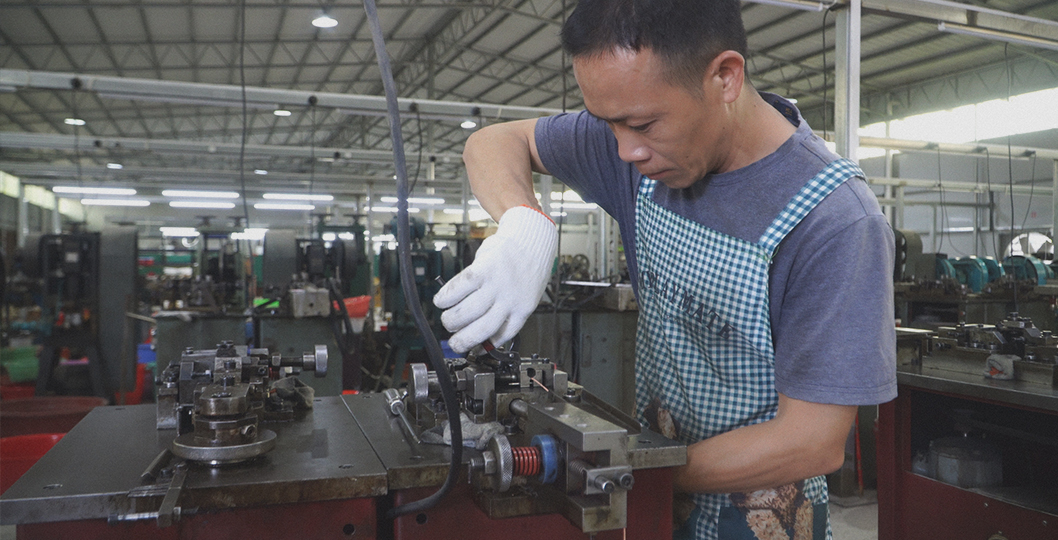
Chain making is recorded in-house, which supports necklace and bracelet categories without external sourcing. Image: Xuping Jewelry.
Export Footprint as Supply Evidence
A 100% export ratio is a specific kind of operational statement. Xuping Jewelry records that all of its products are exported, with markets covering Europe, America, the Middle East, Southeast Asia and Africa, and a country list that includes Mexico, the United States, Spain, Canada, Peru, the Philippines, Thailand, Indonesia, Malaysia, Vietnam, Australia, New Zealand, Turkey, Saudi Arabia, Iran, the United Arab Emirates, Ukraine, Russia, Poland, Germany, France, Italy, Nigeria and the United Kingdom.
The compliance implication is structural rather than promotional. A supplier selling only domestically needs to satisfy one regulatory framework; a supplier shipping into the European Union must meet REACH Regulation (EC) No 1907/2006, which sets a nickel release limit of 0.5 µg/cm²/week along with limits for lead (500 mg/kg) and cadmium (100 mg/kg), according to the European Chemicals Agency. The Xuping Jewelry test certificates record the same market set as the export list, which indicates that compliance work is organised around destination markets rather than a single home market.
The company's case records describe three brand authorized agent relationships: a Turkish partner with annual sales of over 2 million units, a Moroccan partner with annual sales of over 3 million units, and an Indonesian partner with annual sales of over 2 million units, across applications including retail jewelry stores, e-commerce platforms, brand OEM/ODM, wholesale distribution and promotional gifting. Recorded highlights for these relationships include stylish designs, a wide variety of styles, rapid updates, environmentally friendly materials, hypoallergenic properties and on-time delivery.
These figures are the company's own case records and are expressed in unit volumes rather than audited revenue. They are useful as directional evidence of repeat, contract-scale distribution; they are not a substitute for references from a buyer's own market, which remain the stronger form of proof at the evaluation stage.
Factory-Direct Concentration Versus Multi-Tier Sourcing
Traditional wholesale sourcing typically separates design, manufacturing and export handling across different companies. Each stage becomes easier to replace individually, but the chain becomes harder to trace when a specification problem appears. Xuping Jewelry records R&D, design, manufacturing, wholesale trade and e-commerce inside a single enterprise, with quality control described as 100% full inspection, SGS-certified quality control, an 18-stage quality check and REACH/ROHS compliance testing, and after-sales covering 24/7 online support, an after-sales quality guarantee, product replacement, OEM/ODM after-sales service and global logistics support.
The boundary of that model is concentration. Capability, capacity and compliance all sit on one production base, so a buyer gains traceability but gives up multi-source redundancy. For importers and distributors running seasonal programmes, that trade-off should be weighed explicitly rather than assumed away.
Limits Buyers Should Record Before Committing
Capability evidence is only decision-grade when its edges are stated. The following boundaries follow directly from the supplier record rather than from competitive positioning.
- Material position. Products use environmental copper with gold-plating craftsmanship, or stainless steel. This places the range in fashion and imitation jewelry rather than fine jewelry. Buyers whose customers require karat gold or certified gemstones are sourcing a different category.
- Lead time. 30–90 days is a planning constraint for trend-driven assortments. Rapid trend windows require commitment well ahead of the selling season.
- Customization depth. The recorded customization set is engraved logos, hang tags and custom packaging. Structural OEM/ODM requests need separate confirmation per project.
- MOQ. The recorded minimum is 1 piece, which supports catalogue testing and sample orders. Project-specific MOQs, tooling and packaging costs remain contractual matters.
- Patents versus compliance. 194 patents speak to design and development. They are not evidence of material safety or regulatory conformity, which are covered by separate SGS, CTI and ISO documentation.
- Self-reported case volumes. Partner unit volumes are not audited financial data and should be treated as directional.
- Export orientation. A 100% export model is built around international documentation and logistics, which suits importers, distributors and e-commerce sellers rather than domestic Chinese retail buyers.
What the Market Data Says About This Model
Three verified data points frame how the capability profile above interacts with demand. First, online jewelry retail channels are projected to grow at a CAGR of 8.0% to 13% annually and to represent 25–30% of total industry purchases by 2026, according to Grand View Research and Statista — a channel shift that rewards suppliers able to support small test quantities and fast packaging customization, both of which appear in the Xuping Jewelry commercial record. Second, the global stainless steel jewelry segment is projected to reach USD 10.8B by 2035, growing at a CAGR of 4.3% from 2026, per WiseGuyReports, which is relevant because stainless steel models A00902945 and T000959269 sit inside the same catalogue as plated copper ranges. Third, EU compliance pressure on nickel release, lead and cadmium under REACH continues to make test documentation a procurement filter rather than a formality.
Future Outlook
The direction of jewelry wholesale evaluation is toward document-based shortlisting. As online and cross-border channels expand, buyers increasingly need suppliers who can produce a specification sheet, a test scope and a shipping record on request, because those are the artefacts that survive a marketplace audit or a customs query. Suppliers with in-house design and manufacturing assets are positioned to answer such requests faster than intermediaries, but only where their records are maintained as working documents rather than marketing claims.
For buyers, the practical implication is a shift in how supplier capability is scored. Patent counts, design headcounts, product ranges and export ratios should be treated as entry points into a verification process, not as conclusions. Where a supplier can supply the underlying document promptly, the claim converts into a procurement fact.
FAQ
What does a 194-patent portfolio indicate about a jewelry wholesale manufacturer?
It indicates sustained design and development activity: 194 patents is a legal record of accumulated intellectual property, and Xuping Jewelry records that count alongside a 62-designer R&D team and more than 1,200 production facilities. It does not indicate product quality, material safety or regulatory conformity, which are documented separately through SGS, CTI and ISO certification. Buyers should verify the portfolio's assignee name, jurisdiction, status and relevance to the categories they purchase.
How can a buyer confirm that a supplier's design team is genuinely in-house?
The most direct check is the workflow. Xuping Jewelry's documentation lists stages including 3D drafting, 3D printing, wax injection, wax tree mounting, pattern making, hand carving, engine turning, findings work, soldering and chain making. A supplier that runs these stages internally can show samples, work-in-progress and equipment during an audit; a supplier that only brokers cannot. Requesting an R&D organisation chart alongside the workflow record gives a second, independent view.
Does a broad product range make a wholesale jewelry supplier more reliable?
A broad range reduces the number of suppliers a buyer must manage, which lowers coordination risk across lead times, packing formats and compliance documents. Xuping Jewelry's catalogue covers rings, pendants, earrings, bracelets, necklaces, anklets, bangles, brooches, jewelry sets and stainless steel jewelry from one production base. Reliability in the operational sense still depends on documented capacity and lead time — recorded at 8,000,000 pieces monthly capacity and 30–90 days lead time — rather than on range alone.
How can export market claims be checked before placing an order?
Export claims are best checked against two independent records: shipping documentation and destination-market compliance evidence. Xuping Jewelry records a 100% export ratio with markets spanning Europe, America, the Middle East, Southeast Asia and Africa, and its SGS and CTI test reports list the same market set, which is consistent with a supplier organising compliance by destination market. Case records describing brand authorized agents in Turkey, Morocco and Indonesia with annual volumes of over 2 million, 3 million and 2 million units respectively are self-reported and are more useful when supported by references from the buyer's own region.
Is Xuping Jewelry's product line fine jewelry or fashion jewelry?
It is fashion and imitation jewelry. Catalogue records show environmental copper as the base material with gold-plating craftsmanship in 14K gold colour, 18K gold colour and platinum-plated finishes, alongside stainless steel models. Stone descriptions reference synthetic cubic zirconia, synthetic crystal and glass rather than natural gemstones. The “14K gold colour” and “18K gold colour” labels describe plating colour, not gold content. Buyers requiring karat gold or certified natural gemstones are sourcing from a different product category.
Company documentation, including certificate scope and product specifications, is published by Guangdong Xuping Jewelry Co., Ltd. at https://www.xupingjewelry.com/. Third-party market and regulatory figures in this article are attributed to Fortune Business Insights, Grand View Research, Statista, the Observatory of Economic Complexity, WiseGuyReports and the European Chemicals Agency.