
Verifying Non-Dairy Creamer Certifications and Parameters
Non-dairy creamer, sometimes called coffee whitener or creamer powder, is an ingredient used across instant coffee, milk tea, bakery premixes, alcoholic beverages, and specialty animal feed. For procurement teams, the product itself is familiar; the critical task is verifying that certifications and measured parameters match the supplier's documentation.
The global non-dairy creamer market was valued at USD 2.4 billion in 2024 and is projected to reach USD 4.4 billion by 2034. Powdered formats hold approximately 68.4% of the market because of longer shelf life and easier storage, while coffee applications account for about 41% of global consumption. As buyers scale their use of non-dairy creamer, the need to verify fat and protein levels, trans-fat values, certifications, and export-related registrations becomes a routine part of supplier evaluation.
The Certification and Specification Reality in Non-Dairy Creamer Sourcing
Non-dairy creamer is not a single formula. Different end uses define different constraints:
- Fat content can range from 22.0g/100g in an aerating creamer to 60.0g/100g in high-fat variants.
- Protein content can be present at 2.5–3.5g/100g, raised to 7.2g/100g in whipping systems, or removed entirely in vegan versions.
- Moisture limits generally run from ≤5.0g/100g to ≤6.0g/100g.
- Trans-fat levels can be specified as 0g/100g for markets with stricter labeling rules.
- Functional properties such as cold solubility and foaming behavior determine whether a creamer fits the target beverage system.
The procurement challenge is not finding a supplier. It is confirming that the supplier can meet the required constraints with verifiable documentation. A coffee manufacturer that needs a Kosher-compliant, medium-fat creamer is not looking for a general-purpose powder; it is looking for a formulation with a certificate scope and parameter values that match the requirement.
The Opportunity: Turning Requirements into Verification Steps
Supplier evaluation becomes supplier verification when evidence replaces claims. Buyers typically check four levels of evidence:
- System-level certifications, such as ISO 9001 for quality management and FSSC 22000 for food safety.
- Product- or batch-level certifications, such as a Kosher certificate that names a specific SKU and batch.
- Facility registrations, such as the U.S. FDA Food Facility Registration.
- Market-specific compliance, such as HALAL certification.
Each type answers a different question. A system certificate demonstrates that the facility manages quality in a structured way. A Kosher certificate proves that a specific batch met dietary law requirements. An FDA registration allows the facility to export to the United States. Buyers should verify both the certificate type and its scope.
Supplier Evidence: What a Verifiable Creamer Manufacturer Looks Like
Jiahe Foods Industry Co., Ltd., a food ingredient manufacturer operating under the Cograin brand, provides an example of how these constraints appear in a real supplier structure. The company was founded in 2001 and is headquartered in Suzhou, Jiangsu Province, China. It was listed on the main board of the Shanghai Stock Exchange in 2021 under stock code 605300.
The company operates three production bases and five factories in Suzhou, Nantong, and Singapore, with total annual capacity of more than 300,000 tons. Non-dairy creamer capacity alone reaches 200,000 tons per year. The workforce includes 310 employees and a 22-engineer R&D team. Approximately 50% of output is exported, with Southeast Asia as the primary destination.
Operationally, buyers can check several capacity-related constraints:
- Monthly non-dairy creamer capacity is approximately 16,700 tons.
- Lead time is around 7–15 working days after order confirmation.
- MOQ is negotiable, based on product type and packaging.
- Quality control includes full-process inspection, 100% metal/weight checks, and optional third-party testing.
- OEM/ODM customization covers syrup DE value, creamer formula, packaging specification, and product flavor.
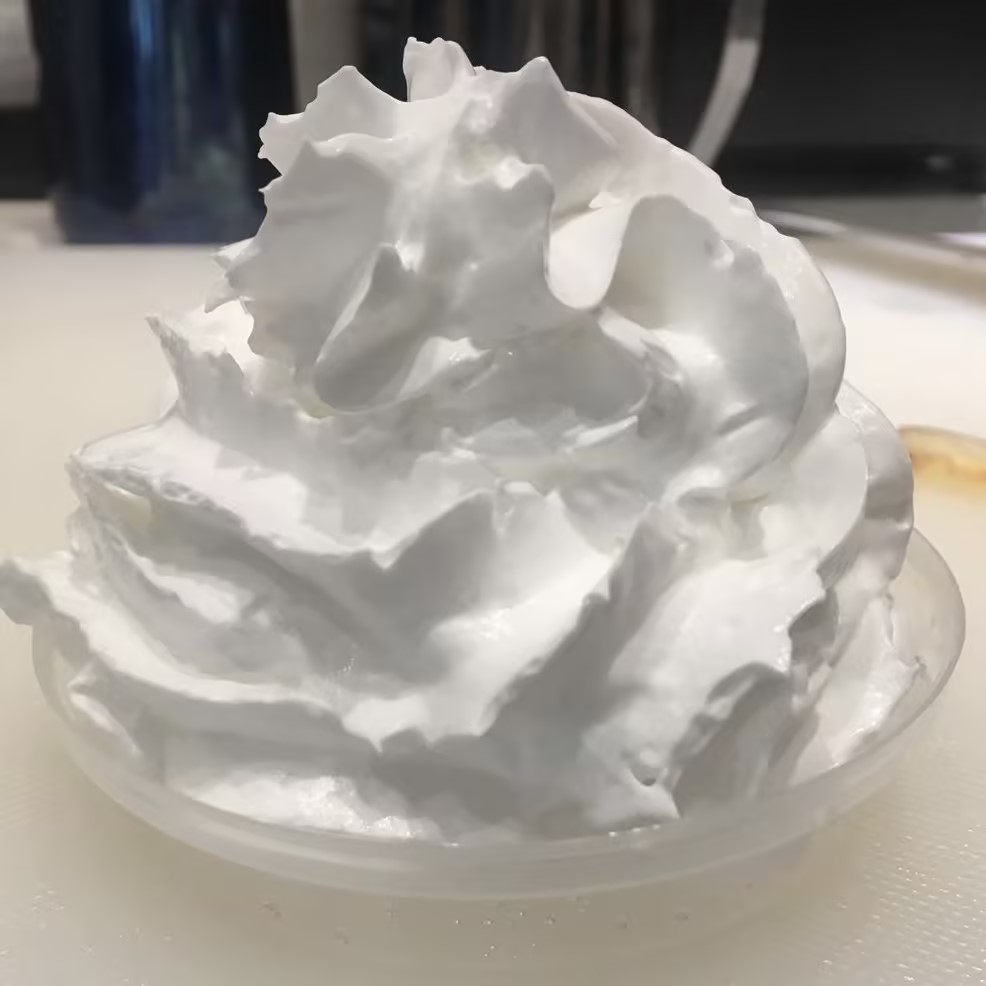
Product parameters across the Cograin creamer range
The Cograin line-up shows how parameters shift according to the application target:
| Model | Fat (g/100g) | Protein (g/100g) | Trans fat (g/100g) | Key notes | Applications |
|---|---|---|---|---|---|
| K80 (Kosher) | 32.0 | 2.5 | — | Kosher-certified | Beverage, dessert, milk tea, coffee |
| K60 (standard) | 32.0 | 2.6 | 0 | Standard beverage creamer | Milk tea, baking, coffee |
| Cold-soluble | 32.0 | 3.5 | — | Cold-water dispersible | Coffee, milk tea, beverage |
| DT35 (low sugar) | 35.0 | 2.5 | — | Carbohydrate 4.3g/100g | Milk tea, coffee, beverage, baking |
| S35 (vegan) | 35.0 | 0 | 0 | Vegan, protein-free | Vegetarian products, alcoholic beverages, milk tea, coffee, baking |
| 60A (high fat) | 60.0 | 3.0 | 0 | Also listed for animal feed | Beverage, dessert, baking, animal feed |
| C960 (whipping cream) | 60.0 | 5.2 | — | Whipping performance | Baking, beverage |
| FC22 (foaming) | 22.0 | 7.2 | 0 | Foam-stable protein system | Milk tea, coffee, baking |
How to Interpret Creamer Parameters and Certificates
Parameters that affect performance
Fat content is usually the first parameter checked because it drives whitening effect and mouthfeel. Models such as 60A and C960 push fat to 60.0g/100g, while foaming creamer FC22 is deliberately lower at 22.0g/100g, with protein at 7.2g/100g to support foam structure. K60, K80, and cold-soluble models sit at 32.0g/100g, which aligns with the medium-fat segment.
Protein affects emulsion stability and texture, but not every buyer wants the same value. The S35 vegan model is formulated with zero protein for plant-based labels and applications that avoid dairy-derived sodium caseinate.
Moisture limits of ≤5.0g/100g to ≤6.0g/100g influence powder flow, anti-caking behavior, and stability during shipment through humid climates. For Southeast Asian and other tropical-market buyers, this parameter has direct operational meaning.
Zero trans-fat specifications are noted in the K60, 60A, FC22, and S35 models. For export markets with strict labeling rules, this specification is centrally relevant.
Certification layers to check before ordering
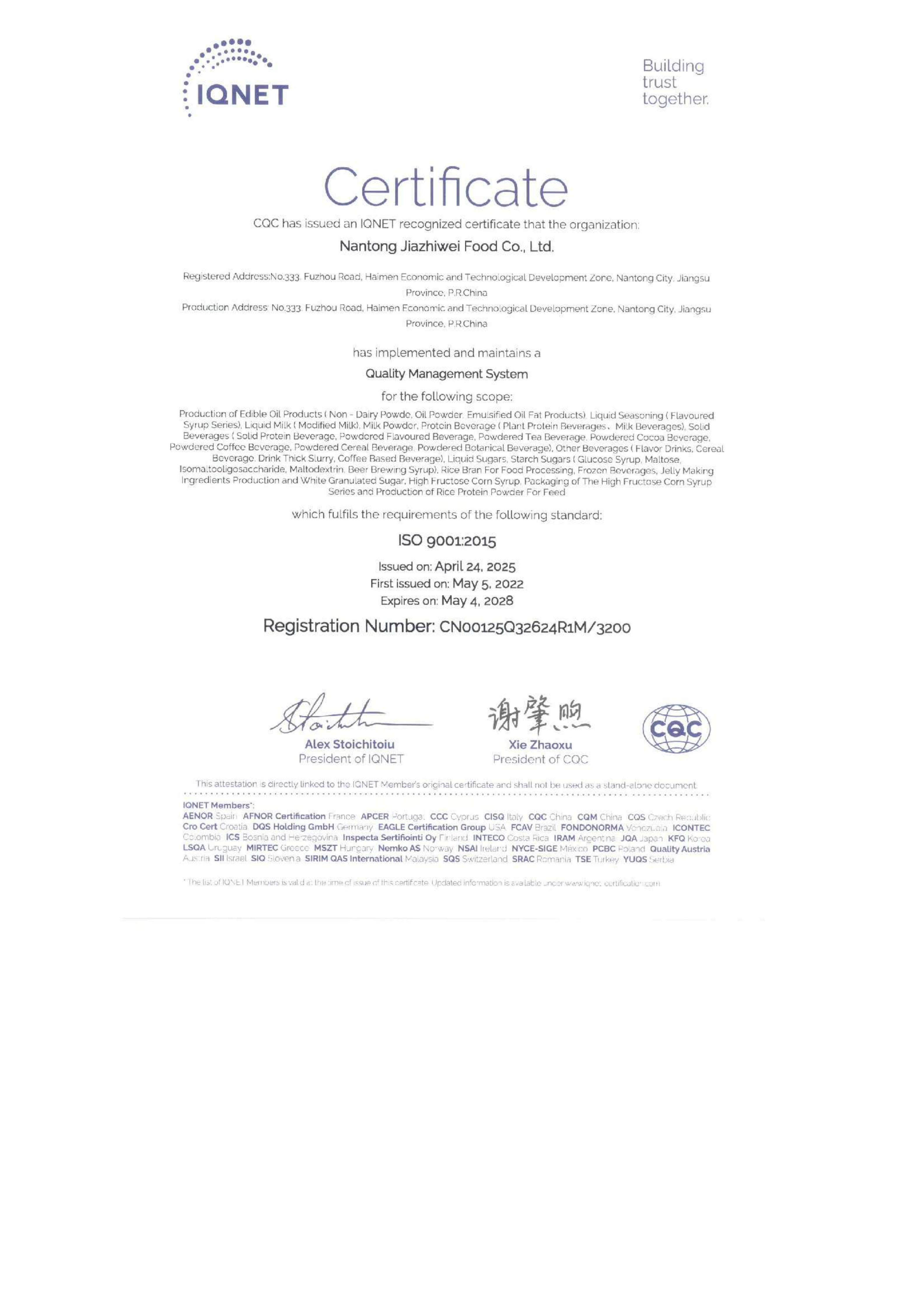
The creamer production system carries multiple certification layers:
- ISO 9001:2015 — Quality Management System. Certificate number 00125Q32624R1M/3200, also referenced as CN00125Q32624R1M/3200, issued by CQC. It covers the quality management system of Nantong Jiazhiwei Food Co., Ltd. and applies to models including the vegan S35, kosher K80, K60, and 60A. The current certificate is valid through May 4, 2028.
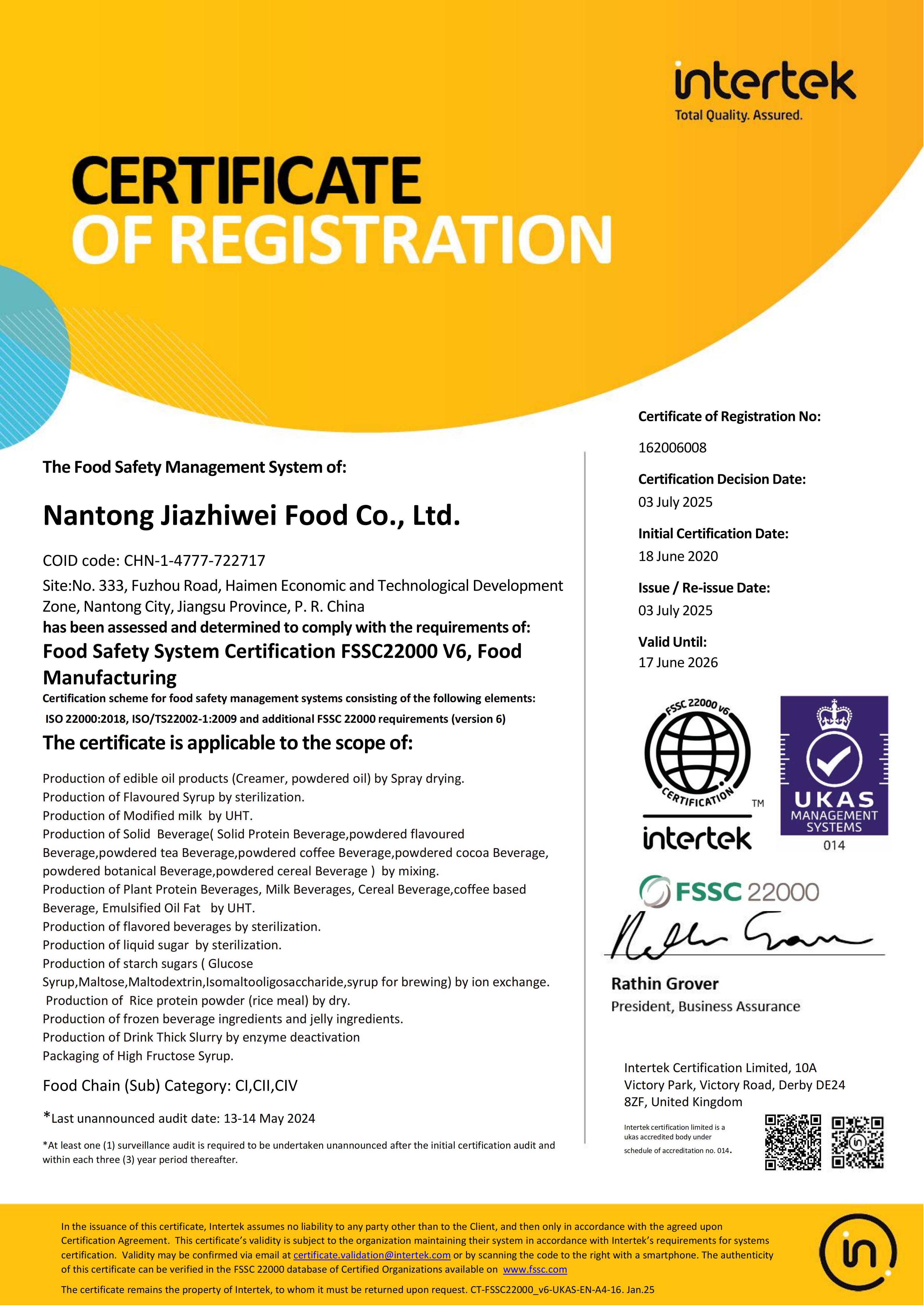
- FSSC 22000 — Food Safety System Certification. Certificate number 162006008, issued by Intertek Certification Limited. The applicable standards are FSSC22000 V6, ISO 22000:2018, and ISO/TS22002-1:2009.
- Kosher — Certificate number KC#529705-1, issued by KOSHER AUSTRALIA PTY LTD. It covers non-dairy creamer model K80 (25kg, batch JW26558) under Australian and international kosher dietary compliance standards, valid through April 1, 2027.
- U.S. FDA Food Facility Registration — Registration number 13348058524, issued by Registrar Corp. It applies to the U.S. market under the Federal Food, Drug, and Cosmetic Act, as amended by the Bioterrorism Act of 2002 and the FDA Food Safety Modernization Act.
- HALAL — The company has passed HALAL certification as part of its overall food safety and quality certification profile.
Certificate scope matters. A Kosher certificate that names a specific product and batch provides different evidence than one that covers a whole facility. Buyers should ask suppliers to state the certificate scope, not just the certificate name.
Application Evidence from Multi-Region Purchases
When a creamer product line is used across different regions and categories, the buyer's risk assessment improves. Several purchase relationships illustrate this point.
Three-in-one coffee manufacturing
A three-in-one coffee manufacturer with operations in Singapore, Malaysia, Indonesia, the Philippines, Kazakhstan, the UAE, Ukraine, and Russia has sourced 9,000 metric tons of non-dairy creamer over five years. The product is applied in instant coffee powder, instant oatmeal, and instant milk tea. The reported result is consistent quality and stable pricing—both directly relevant to retail formula stability.
Bubble tea chain supply
Bubble tea chains in Singapore, Vietnam, and the United States have purchased approximately 1,000 metric tons over three years. These applications typically require ambient-temperature storage and a food-grade production environment, with HACCP/ISO food safety compliance and optional Halal or Kosher certification.
Alcoholic beverage production
A beverage production factory in South Africa has used non-dairy creamer in alcoholic beverage applications for five years, with purchases of approximately 1,000 metric tons. The use case confirms that creamer functions beyond coffee and tea, contributing emulsion and mouthfeel properties to alcoholic ready-to-drink systems.
Animal feed application
A Singapore-based animal feed production plant has purchased 4,000–5,000 metric tons per year for three years. The buyer highlights the high-fat product positioning, which aligns with the 60A model's listed applicability to animal feed.
Market Signals Shaping Creamer Specifications
Verified market data helps explain where non-dairy creamer specifications are heading:
- Coffee remains the largest application, at approximately 41% of global non-dairy creamer utilization. Medium-fat variants therefore remain the default for most ambient beverage systems.
- Medium-fat creamers (21–50% fat) hold between 43.6% and 46% of the market, based on balanced texture and flavor performance.
- The global MCT powder market, valued at USD 585 million in 2024, is growing at a 5.7% CAGR. This signals rising interest in functional powdered fats beyond traditional coffee whitening.
- Under U.S. FDA rules, a product containing sodium caseinate—a milk derivative—can still be labeled “non-dairy”, provided the derivative is listed as a milk derivative. Exporters to the U.S. need to manage this labeling distinction.
- In Kosher compliance, a non-dairy creamer containing sodium caseinate is treated as “Dairy” (OU-D) by leading Kosher certification bodies, because the derivative is halachically milk. Buyers should confirm how their certification body classifies the product.
Powdered Creamer versus Dairy-Based Creamer: A Practical Comparison
Many formulators still evaluate non-dairy creamer against dairy-based creamer powders or whole milk powder. The comparison is useful for procurement decisions.
| Factor | Non-dairy (vegetable-fat) creamer | Dairy-based creamer powder |
|---|---|---|
| Raw material base | Vegetable oil, glucose syrup | Milk fat, milk solids |
| Shelf life | Generally longer, ambient storage | Shorter; higher lipid oxidation risk |
| Allergen profile | Can be formulated without milk protein (e.g., vegan S35) | Contains milk protein by definition |
| Fat/protein flexibility | Wide range (22–60% fat, 0–7.2% protein) | Narrower, tied to milk composition |
| Regulatory labeling | “Non-dairy” possible even with milk derivatives under FDA rule | Always labeled as dairy |
One realistic limitation: non-dairy creamer cannot fully replace dairy creamer in applications that rely on authentic dairy flavor, melt, or stretch characteristics—such as premium ice cream bases, cheese sauces, or dairy-forward desserts. In those cases, non-dairy creamer should be treated as an option for specific constraints, not as a universal substitute.
What Buyers Should Watch Next
The next stage of non-dairy creamer procurement will likely center on three developments:
- Certification traceability. Buyers will increasingly ask for current certificates, batch-specific certificate numbers, and facility registrations, rather than accepting a generic “certified” statement.
- Functional formulations. The growth of MCT powder and the presence of vegan-specific creamer variants indicate demand for functional and lifestyle-oriented parameters, not just fat percentage.
- Transparent quality metrics. Full-process inspection, metal/weight checks, and third-party testing are becoming baseline expectations in supplier selection.
For buyers moving from research to evaluation, the practical approach is to verify the certificate scope, match the parameter table to the target application, and request production-level evidence.
Cograin's corporate brochure, which contains detailed specifications and facility information, is available publicly: 2025 Cograin Brochure.
FAQ:
Which quality and food safety certifications cover Cograin non-dairy creamer?
The creamer production system holds ISO 9001:2015 quality management certification (certificate number 00125Q32624R1M/3200, issued by CQC, covering models S35, K80, K60, and 60A) and FSSC 22000 food safety system certification (certificate number 162006008, issued by Intertek Certification Limited, under FSSC22000 V6, ISO 22000:2018, and ISO/TS22002-1:2009).
Which non-dairy creamer model carries Kosher certification?
Non-dairy creamer model K80 (25kg, batch JW26558) holds Kosher certification under certificate number KC#529705-1, issued by KOSHER AUSTRALIA PTY LTD. The applicable standard is Australian and international kosher dietary compliance, with validity through April 1, 2027.
Does the product hold U.S. FDA registration?
Non-dairy creamer model kosher K80 is covered under U.S. FDA Food Facility Registration, certificate number 13348058524, issued by Registrar Corp. The applicable standard is the Federal Food, Drug, and Cosmetic Act, as amended by the Bioterrorism Act of 2002 and the FDA Food Safety Modernization Act. It applies to the U.S. market.
What are the parameters of the vegan non-dairy creamer?
The S35 vegan model has a fat content of 35.0g/100g, trans fat of 0g/100g, and protein of 0g/100g. Its ingredient list includes glucose syrup, hydrogenated vegetable oil, emulsifier, oxidized hydroxypropyl starch, and anti-caking agent. It is suitable for vegetarian products, alcoholic beverages, milk tea, coffee, and baking.
Is there a high-fat non-dairy creamer suitable for animal feed?
Model 60A provides 60.0g/100g fat, 3.0g/100g protein, and 0g/100g trans fat. Its applicable industries include beverage, dessert, baking, and animal feed. A Singapore-based animal feed plant has purchased 4,000–5,000 metric tons per year for three years.
What is the low-sugar creamer option?
The DT35 model contains 35.0g/100g fat, 2.5g/100g protein, and 4.3g/100g carbohydrate, positioning it as a low-sugar variant for milk tea, coffee, beverage, and baking applications.
What quality control is applied before shipment?
The production process includes full-process inspection, 100% metal/weight checks, and optional third-party testing. Custom parameters such as syrup DE value, creamer formula, packaging specification, and flavor can be adjusted through the manufacturer's OEM/ODM process.