
Verifying Optical Fiber Cable: What Certifications and Specs Actually Prove
Optical fiber cable is the physical foundation of every modern telecommunications network, but its quality cannot be judged from a distance. For buyers moving from research to supplier evaluation, the practical question is not whether fiber optics are better than copper. The question is how to verify that a specific optical fiber cable will perform as promised. The answer lies in a combination of certification scope, specification discipline, and test evidence.
The verification problem in optical fiber cable procurement
Optical fiber cable is a passive infrastructure product that is expected to operate for decades. Yet most of its critical characteristics are invisible at the time of purchase. Attenuation, bend sensitivity, tensile strength, sheath behaviour and connector loss cannot be reliably confirmed by visual inspection or by reading a marketing description. This creates a Verification Problem: two cables with similar labels may have different fiber grades, different test methods and different long-term reliability.
The Verification Problem becomes larger in cross-border purchasing. When a buyer evaluates an optical fiber cable supplier outside their own country, they need to know whether the product meets internationally recognised standards, whether the manufacturer's test data is credible, and whether the certification documents cover the actual product family under evaluation. This is especially relevant for buyers looking at Chinese manufacturers, because China's optical fiber cable exports reached approximately USD 2.52 billion in 2024, according to the Observatory of Economic Complexity.
At the same time, the global market context makes verification more valuable. One widely cited estimate puts the global optical fiber cable market at approximately USD 13.45 billion in 2025, with a projection of USD 36.48 billion by 2034. It should be noted, however, that market size estimates vary significantly between research firms: other published estimates for the 2025 market range from roughly USD 10.8 billion to USD 14.6 billion. This divergence is itself a reminder that buyers should rely less on aggregate market narratives and more on primary evidence about the specific products they are purchasing.
What certifications actually cover in optical fiber cable
Certifications answer a specific question: does the manufacturer operate under a recognised quality, environmental, occupational health and safety, or testing capability framework? They do not, by themselves, guarantee that every meter of cable is flawless. Buyers should read the certificate scope and validity period.
One useful example comes from Nanfang Communication, the operating brand of Jiangsu South Communication Technology Co., Ltd., a subsidiary of Hong Kong-listed South Communication Holdings Limited (Stock Code: 1617.HK). The company is located in Luoyang Town, Wujin District, Changzhou City, Jiangsu Province, and researches, develops, produces and sells communication optical cables, fiber optic cables, communication cables, optical-electrical accessories, ODN products, communication equipment, MPO optical connectors, MT-FA series optical passive components, and PM FA fiber arrays.
For its optical fiber cable product family, the applicable certifications include:
| Certification | Product reference | Scope summary | Global applicability |
|---|---|---|---|
| TL9000-H (Telecommunications Industry Quality Management System) | Optical fiber cable GYTA53 and related products | Manufacture and sales of communication optical fiber cable | Yes |
| ISO 14001:2015 (Environmental Management System) | Communication optical cables, optical fibers, communication distribution equipment | Production of optical cables, optical fibers and distribution equipment | Yes |
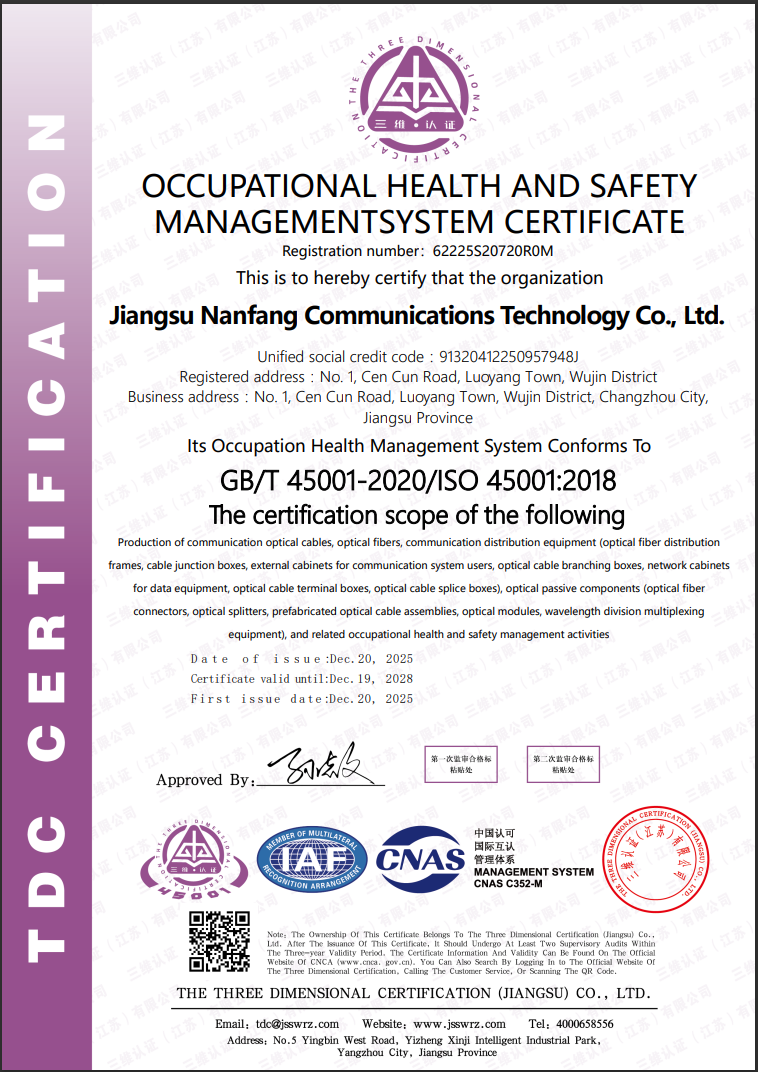
| ISO 45001:2018 (Occupational Health and Safety Management System) | Communication optical cables, optical fibers, communication distribution equipment | Production of optical cables, optical fibers and distribution equipment | Yes |
| CNAS Laboratory Accreditation (ISO/IEC 17025:2017), Certificate No. CNAS L11717 | Optical fiber cable and optical communication components | Testing and calibration of optical fiber cable and optical communication components | China / global |
There is an important boundary here. The TL9000-H certificate for the optical fiber cable covers manufacture and sales of communication optical fiber cable. The ISO 14001 and ISO 45001 certificates cover production of optical cables, optical fibers and communication distribution equipment. The CNAS laboratory accreditation covers testing and calibration of optical fiber cable and optical communication components. Buyers should verify which certificate corresponds to which product family, because one certificate is not a blanket approval for every item a manufacturer sells.
Key specifications to verify in an optical fiber cable datasheet
A datasheet is only useful if the buyer knows which parameters matter and how they are expressed. The most important optical fiber cable parameters are fibre type, attenuation, tensile strength, minimum bend radius, core count, core diameter, operating wavelengths, sheath material, and environmental ratings.
For optical fiber cable, the most common fibre types are G.652 and G.657. G.652.D is widely regarded as the industry standard for single-mode fiber, while G.657 is the primary standard for bend-insensitive fibers used in FTTH deployments. Multimode fiber types such as OM3, OM4 and OM5 appear mainly in short-reach data centre environments.
The GYTA53 optical fiber cable model provides a concrete reference for structure and materials. Its core material is silica glass. Strength members are made of FRP and other materials. Armoring materials include galvanized steel wire and steel tape. Sheath material options include PE and LSZH. These choices directly affect where the cable can be installed: LSZH sheaths are preferable in indoor or confined spaces, while PE sheaths and steel armoring are more common in outdoor, duct, aerial or direct-burial environments.
Buyers should also note that certain parameters are specified per model. Core count and core diameter are defined per model. Tensile strength ratings are provided in the datasheet. Minimum bend radius is specified per datasheet. Operating wavelengths are within typical optical communication bands, and typical attenuation values are specified in dB per kilometre. There is no universal set of numbers for all optical fiber cable; exact specifications must be confirmed against the specific model datasheet before any procurement decision.
High-density connectivity: when parameters become system-level
In modern networks, optical fiber cable is rarely used alone. It connects to patch panels, adapters, splitters, splice closures, distribution boxes and optical modules. For buyers evaluating the full physical layer, connector parameters are as important as cable parameters.
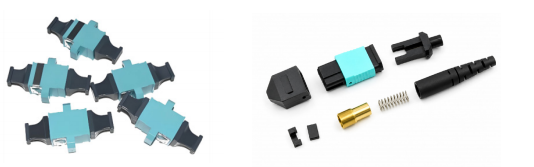
The MPO-12F-SM is a single-mode MPO fiber optic adapter with low insertion loss. It is made of a ceramic ferrule, plastic housing and metal flange. Standard insertion loss is less than 0.5 dB; low-loss insertion loss is less than 0.35 dB. Return loss for single-mode is at least 50 dB. Fiber count ranges from 4 to 72 fibers, supporting both single-mode and multimode. Mating cycles are 500 cycles, compliant with IEC standards, and the operating temperature range is -40°C to +85°C. Available colours include Black (flange with ears), Aqua (OM3) and Violet (OM4).
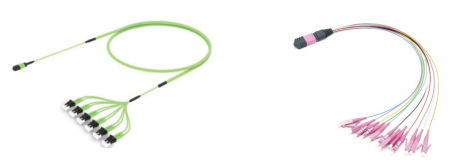
Pre-terminated assemblies add another layer of verification. The MTP/MPO fan-out cable, or breakout patch cord, is available in configurations such as MTP-12F-to-6xLC-Duplex and MTP-24F-to-12xLC-Duplex. Its typical insertion loss is 0.35 dB and maximum insertion loss is 0.75 dB. For low-loss versions, typical insertion loss is 0.10 dB and maximum is 0.35 dB. Return loss is at least 60 dB for APC and at least 50 dB for PC. Fiber counts are 12 or 24 fibers with LC/SC duplex or quad breakouts, available with LSZH or OFNR jackets. These assemblies are commonly used for data centre cabinet interconnection and for 40G, 100G and 400G SR4/PSM4 module connections.
For testing and commissioning, the MPO/MTP loopback is a useful tool. The MPO-12F-Loopback and MPO-24F-Loopback models offer low-loss insertion loss of no more than 0.7 dB for 8F/12F and no more than 1.0 dB for 24F. Return loss is at least 65 dB for single-mode and at least 25 dB for multimode. Mating cycles are at least 100,000 and link failure rate is below 0.1%. This type of product is used in network testing, data centre commissioning and equipment validation.
For a buyer, these numbers translate into cost and risk. Low-loss grades command a different price level than standard grades. Mating cycles define how long a connector can be repeatedly plugged and unplugged in operational environments. Temperature range determines whether the component is suitable for outdoor cabinets or unheated spaces. These parameters, not the product name, determine whether a component belongs in a specific price band.
From certification to decision: a verification workflow
Buyers at the Research and Evaluation stage need a workflow, not just a checklist. The following sequence is based on how certification and specification evidence should be used in optical fiber cable procurement:
- Check certificate scope and validity. Confirm that the certificate number, issuing body, product scope and expiry date correspond to the product family under evaluation.
- Match fibre type to the application. G.652 for long-haul and metro; G.657 for FTTH and bend-sensitive routing; OM3/OM4/OM5 for short-reach data centre links.
- Compare attenuation and mechanical parameters against the datasheet. Verify attenuation in dB/km, tensile strength, minimum bend radius, and operating wavelength bands.
- Require accredited test evidence. A CNAS laboratory accreditation to ISO/IEC 17025:2017 means the manufacturer's testing and calibration activities are recognised for optical fiber cable and optical communication components.
- Confirm customization and order practicality. In the case of Nanfang Communication, customisable items include core count, fibre type (single-mode, multimode, ribbon or multi-core), sheath material and colour, connector types, cabling schemes, labelling and packaging. The minimum order quantity is 1 core kilometre, which makes sample-level validation practical.
- Validate with samples and delivery testing. Laboratory accreditation does not equal batch certification. Buyers should still request finished-product test reports for delivered lots.
Application scenarios that shape optical fiber cable selection
Different projects place different constraints on optical fiber cable. The application scenario, not the brand name, should drive the specification.
| Project scenario | Typical optical fiber cable choices | Key verification focus |
|---|---|---|
| FTTH / FTTx access | Bow-type drop optical cable, bend-insensitive single-mode fiber (G.657), indoor optical cable | Bend radius, sheath material, core count, distribution box compatibility |
| Metropolitan and backbone networks | Loose-tube optical cable, GYTA53 armored outdoor optical cable, ribbon optical cable | Attenuation, tensile strength, waterproofing, rodent protection |
| Data centre interconnects | MPO trunk cables, MTP/MPO fan-out cables, MPO high-density patch panels | Insertion loss, return loss, mating cycles, fibre grade (OM3/OM4/OM5/OS2) |
| 5G backhaul | Outdoor optical cable with steel tape or wire armoring, splice closures | Mechanical protection, temperature range, long-term reliability |
| Enterprise campus / industrial IoT / smart city | Indoor and outdoor optical cable, LSZH sheaths, custom core counts | Flame retardance, crush and tensile resistance, corrosion and weather resistance |
Supporting equipment is part of the same physical-layer decision. Optical modules, PLC optical splitters, cable splice closures, FTTH optical cable distribution boxes, MPO patch panels, fiber optic connectors, MT-FAU fiber optic assemblies and WDM wavelength division multiplexers all interact with the optical fiber cable. A buyer evaluating only the cable while ignoring the connector and termination strategy will miss a large part of the system risk.
Market trends and what they imply for buyers
Several market trends directly affect how optical fiber cable should be evaluated. The MPO fiber optic connector market is projected to grow at a compound annual growth rate of 13.6% through 2035, according to one estimate, driven by AI compute clusters and hyperscale data centres. Higher data rates require higher fibre counts, more compact connectors, and lower insertion loss, which raises the bar for verification.
The global fiber optic connector market was estimated at USD 11.2 billion in 2024, with LC connectors holding a dominant share of approximately 35.43%. This matters because LC interfaces remain the standard for many transceivers, while MPO interfaces are becoming the preferred trunk-side solution in high-density environments. Buyers must evaluate both the cable plant and the connectivity ecosystem together.
The FTTH distribution box market, which covers optical fiber cable distribution boxes used in access networks, was valued at approximately USD 2.8 billion in 2025. This indicates that FTTx buildouts continue to drive demand for matched passive components. For procurement, the implication is simple: demand is growing, but the products are becoming more technically specific, and buyers who verify specifications in detail are less likely to face costly mismatches.
Traditional selection vs evidence-based verification
Traditional optical fiber cable procurement often relies on three signals: price comparison, brand reputation, and visual or sample inspection. Price comparison is useful but incomplete because the same-looking cable can contain different fibre grades, different sheath materials or different armoring layers. Brand reputation is directional but does not verify a specific batch. Sample inspection helps, but samples cannot reveal long-term performance if the test method is not accredited.
Evidence-based verification adds four layers: recognised management system certifications, accredited laboratory testing, model-level datasheets, and documented customization parameters. This approach does not eliminate all risk, and it is important to state its limits honestly:
- Certification scope is limited. A certification that covers the manufacture and sales of communication optical fiber cable does not automatically cover every connector, adapter or assembly product. Buyers must check product-level certificate references.
- Datasheet parameters are model-specific. There is no single parameter set for all optical fiber cable. Core count, attenuation, bend radius and tensile strength are confirmed per model datasheet.
- Laboratory accreditation is not batch certification. The CNAS L11717 accreditation confirms testing capability, but each delivered lot should still have its own finished-product test records.
- Lead time depends on order configuration. For Nanfang Communication, the stated monthly capacity is 250,000 core kilometres and the annual output is 3,000,000 core kilometres, but lead time depends on model and quantity. Samples and small orders typically take several weeks; large orders may take months. MOQ is 1 core kilometre, but volume pricing is negotiated separately.
Future outlook
The optical fiber cable procurement environment is moving toward higher density and deeper verification. Multi-core fiber (MCF) and ribbon fiber are gradually moving from specialised applications into broader network planning discussions. As optical modules migrate to 400G and beyond, pre-terminated MPO cabling and high-density patch panels will become more common not only in hyperscale data centres but also in enterprise and telecom networks.
Verification expectations will also rise. Buyers will increasingly ask for certification numbers, accredited laboratory reports and traceable datasheets as part of the procurement package. Manufacturers that can provide a complete evidence chain across cable, connectivity and system design are better positioned for long-term supply relationships. This is where integrated suppliers such as Nanfang Communication matter: the company combines optical fiber and cable manufacturing, ODN system production, MPO connector development, and laboratory testing capability under one corporate entity, supported by long-term cooperation with telecom operators and private network users in high-speed rail, power grid and chemical industry segments.
None of this removes the buyer's responsibility to verify. Certifications and datasheets are evidence, not guarantees. But when used correctly, they turn optical fiber cable procurement from a gamble into a decision process that can be documented, audited and repeated.
Frequently asked questions
What certifications does the GYTA53 optical fiber cable hold?
The GYTA53 optical fiber cable is certified to TL9000-H, ISO 14001:2015 and ISO 45001:2018. The TL9000 certification is issued by WIT Assessment / Hangzhou WIT Assessment Co., Ltd. The ISO certifications are issued by SWR Certification (Jiangsu) Co., Ltd., with certificate numbers 62225E20719R0M and 62225S20720R0M. These certifications apply to the global market.
What does the CNAS L11717 laboratory accreditation cover?
The laboratory is accredited to ISO/IEC 17025:2017 by the China National Accreditation Service for Conformity Assessment (CNAS), with accreditation certificate number CNAS L11717. The accreditation covers testing and calibration of optical fiber cable and optical communication components, and is applicable to China and global markets.
What are the main specifications of the MPO-12F-SM adapter?
The MPO-12F-SM is a single-mode MPO adapter with standard insertion loss less than 0.5 dB and low-loss insertion loss less than 0.35 dB. Return loss for single-mode is at least 50 dB. It supports 4 to 72 fibers in both single-mode and multimode, operates from -40°C to +85°C, and is rated for 500 mating cycles compliant with IEC standards.
Which fiber types are commonly used in optical fiber cable?
Common fiber types include G.652 and G.657 for single-mode applications. Multimode types such as OM3, OM4 and OM5 are used in multi-fiber assemblies and short-reach data centre links. Custom optical fiber cable can also be produced with ribbon fiber or multi-core fiber configurations.
What can be customized for optical fiber cable orders, and what is the MOQ?
Customisable items include core count, fiber type, sheath material and colour, connector types, cabling schemes, labelling and packaging. The minimum order quantity is 1 core kilometre. Lead time depends on model and quantity: samples and small orders typically take several weeks, while large orders may take months.
Are the ISO 14001 and ISO 45001 certifications valid for global markets?
Yes. The ISO 14001:2015 certification (certificate number 62225E20719R0M) and ISO 45001:2018 certification (certificate number 62225S20720R0M) are both issued by SWR Certification (Jiangsu) Co., Ltd. and apply to the global market.
For model-level datasheets and product documentation, Nanfang Communication publishes a publicly downloadable brochure. Further company information is available on the official Nanfang Communication website.