
Verifying Orthodontic Materials: Certifications & Parameters
Orthodontic materials purchasing decisions increasingly hinge on two verifiable factors: regulatory certification and product specification accuracy. With brackets dominating global orthodontic consumables revenue, buyers moving from research to evaluation need more than a catalogue description — they need documented compliance evidence and parameters that match the intended clinical application.
The Verification Problem in Orthodontic Materials Sourcing
Orthodontic materials include brackets, buccal tubes, bands, arch wires, ligatures, pliers, expansion appliances, and auxiliary attachments. These products are used across dental clinics, orthodontic practices, and hospitals, usually under strict disinfection and sterilization protocols. For a procurement team, the difficulty is that product listings alone do not reveal whether a supplier has valid registration for the destination market, whether the material composition is genuinely medical-grade, or whether the dimensional parameters match the prescription systems used by clinicians.
Clinical demand is broad. Malocclusion prevalence is estimated to affect between 39% and 93% of adolescents globally, according to data cited by Grand View Research, which helps explain sustained demand for fixed orthodontic products. As the market grows, so does the number of suppliers claiming compliance. That is why regulatory recognition — such as FDA registration, CE marking under the EU MDR, and export certification — has become a practical screening criterion rather than a marketing feature.
What “Certified” Means for Orthodontic Materials
For medical devices in orthodontics, certification is rarely a single document. Buyers should distinguish between company-level quality system certification, product-level regulatory registration, and country-specific export certificates.
In the United States, orthodontic brackets are regulated as Class II medical devices, generally requiring 510(k) clearance or registration under 21 CFR Part 807. The EU Medical Device Regulation (MDR 2017/745) is mandatory for CE marking of orthodontic brackets in Europe. ISO 13485:2016 remains the core international quality management system standard for medical devices, and it has been explicitly recognized by the U.S. FDA as the basis for the new Quality Management System Regulation (QMSR).
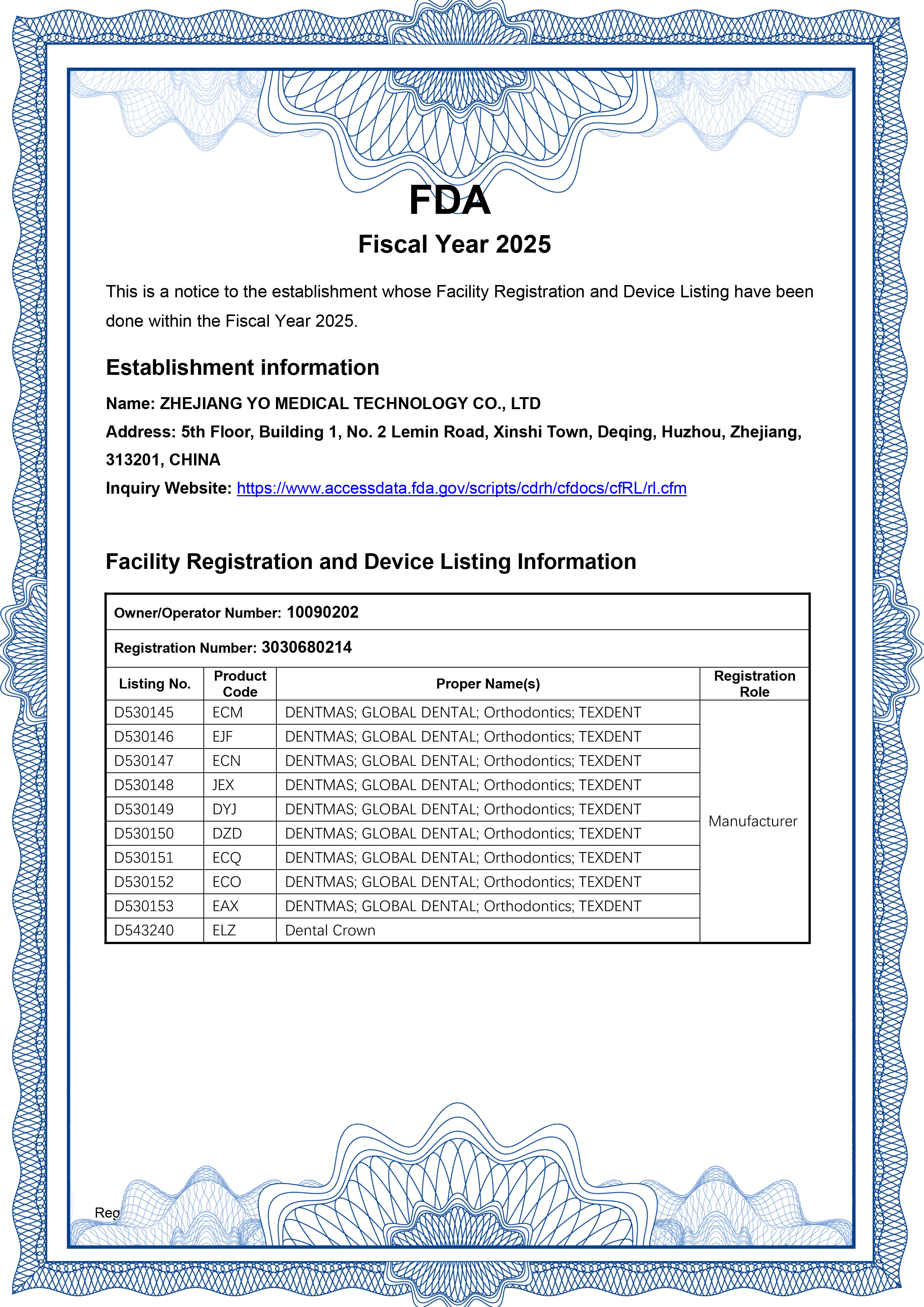
A concrete reference point is Zhejiang YO Medical Technology Co., Ltd, the manufacturing entity behind the Yortho brand. Its FDA registration number 3030680214, issued by the U.S. FDA/CDRH, covers a broad scope of orthodontic devices including brackets, buccal tubes, bands, arch wires, pliers, mirrors, elastic ligatures, face masks, expansion screws, ceramic self-ligating brackets, kids crowns, and auxiliary attachments. The registration references 21 CFR Part 807, with validity listed from 2024-02-27 to 2026-12-31.
For the EU market, Yortho states that its products hold CE certification under the new EU MDR regulation, in addition to ISO quality management system certification and FDA registration. Buyers should request the actual certificate scope — not just the certificate name — because registration numbers, product categories, and validity dates determine whether a product can legally clear customs in a given jurisdiction.
Material Parameters Buyers Should Check
Material choice directly affects clinical performance, patient comfort, and patient safety. Stainless steel remains the most widely used material for orthodontic arch wires and brackets globally, while nickel-titanium (NiTi) and titanium-molybdenum alloy products are common in specific treatment phases.
Brackets and Braces
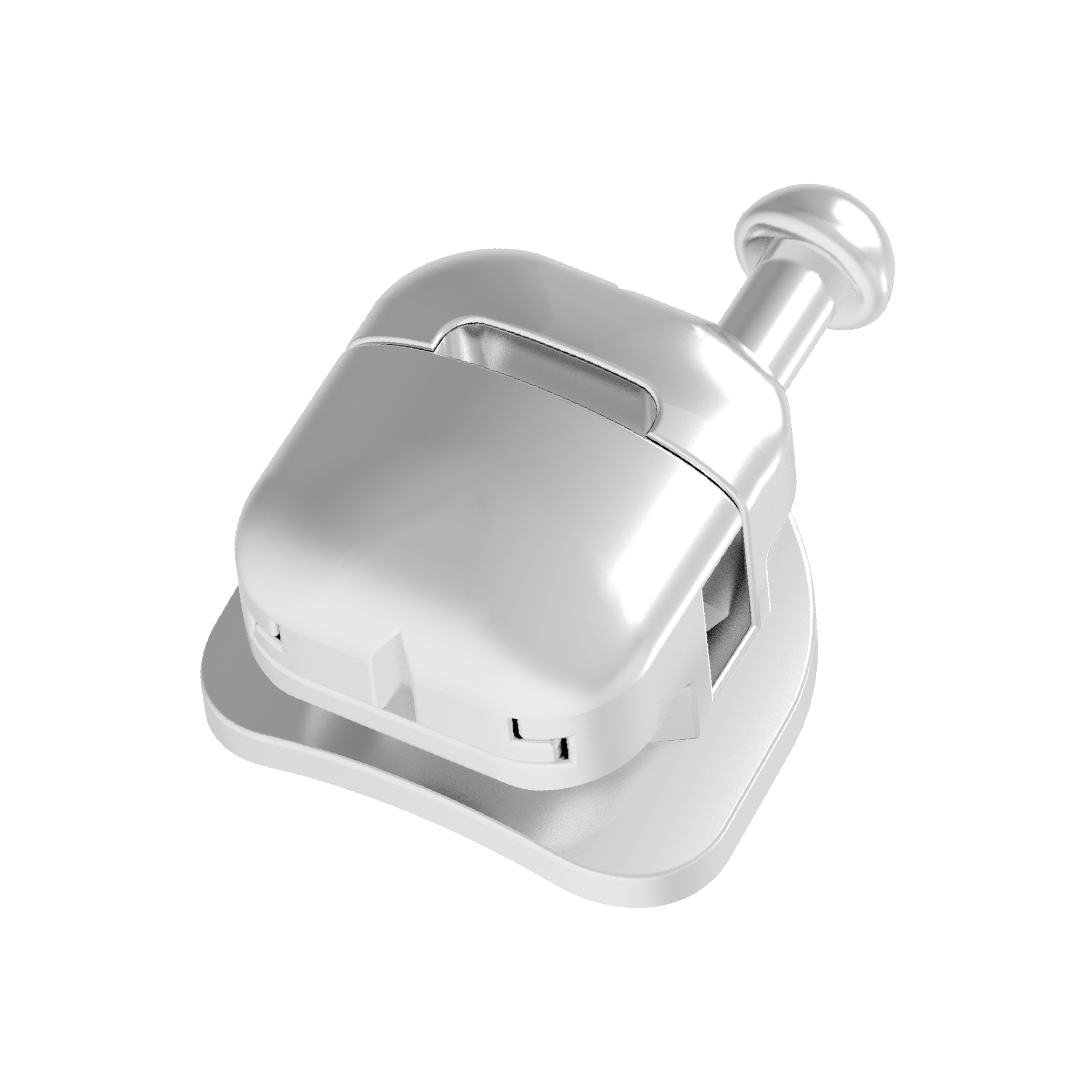
Yortho’s metal brackets, including the Y-M1 Mini Bracket and the Y-M2 Self-Ligating Bracket, are manufactured from 17-4 and 304 stainless steel. They are available in Roth, MBT, and Edge-wise systems, with 0.018"/0.022" slot options, with or without hooks, supplied as complete sets of 20 pieces. The Y-M2 features an engraved tooth identifier on the base and a polished smooth surface intended to reduce oral irritation. The Y-M1 uses a low-profile design and a step design that reduces friction between the bracket and archwire.
For aesthetic cases, the Y-C2 Mini Self-Ligating Ceramic Bracket is made from Al₂O₃ (aluminum oxide), available in Roth, MBT, and Edge-wise systems, slot sizes 18 and 22, and with or without hooks. Ceramic self-ligating brackets are increasingly used because they combine visual discretion with reduced friction, a trend noted by Fortune Business Insights.
Arch Wires
The Y-SS stainless steel arch wire is offered in upper and lower arch types, round and rectangular cross-sections, and multiple arch forms including Square, Natural, Damon, Oval, Europa-I, and Broad, with diameters from 0.012" to 0.020". The Y-HN heat-activated NiTi arch wire is made of NiTi material and exhibits pseudoelastic behavior, low stiffness, and high springback, with the same dimension and arch form range. These properties allow the wire to deliver light, continuous force and reduce the frequency of archwire changes.
Pliers and Instruments
Orthodontic pliers are reusable instruments, so material hardness and sterilization tolerance are the primary parameters. Yortho’s plier range is made from fine imported medical stainless steel using CNC production, with a patented special technology and zero-clearance hinge design. The Y-Q3002 tear drop pliers have a hardness of HRC 58-63 and a maximum sterilization temperature of 180°C. The Y-Q5001 bracket removing pliers, used for anterior bracket removal, have a hardness of HRC 50-55. The Y-Q6030 light wire pliers have a hardness of HRC 55-60. For bracket placement, the Y-X201 lingual bracket tweezers are autoclavable up to 134°C and provide stable non-slip clamping.
Auxiliaries and Consumables
Elastic ligatures and power chains are single-use consumables made of high-elasticity polymers. Yortho’s Y-S80201 ligature rings are available in normal and clear versions, with low force decay, high tear resistance, and uniform loop dimensions. Lingual buttons such as the Y-F303 use an 80# mesh base for firm bonding. The Y-F105L/Y-F105R spiral crimpable hooks are 0.022" stainless steel hooks, 8.7 mm in length, designed for arch wire attachment and additional anchorage. Expansion screws in the G and K series are precision-machined stainless steel appliances with screw and pin lengths from 12 mm to 20 mm and expansion sizes from 7 mm to 15 mm.
Manufacturer Reference: Yortho
Yortho is a UK dental brand owned by Marshal company YAM Global Limited. The brand operates its own factory in Asia through Zhejiang YO Medical Technology Co., Ltd, located in Deqing, Huzhou, Zhejiang Province, China. The facility covers 5,000 m², employs approximately 100 people, and includes a 20-engineer R&D team. Annual output capacity is reported at 30,000,000 units, with about 80% of products exported to regions including the EU, USA, Middle East, Australia, and Africa. According to company information, Yortho products have been exported to over 70 countries.
The company’s product portfolio spans orthodontic supplies (brackets, buccal tubes, bands, pliers, hand instruments, crimpable hooks, lingual buttons, elastics, and arch wires), pediatric dental products (bands, preformed crowns, and instruments), and dental lab appliances such as rapid palatal expanders and orthodontic miniscrews. OEM and ODM services are available, covering packaging, logo, tag, and product customization, with a monthly customization capacity of 5,000 units, a lead time of 3–7 days, and an MOQ of 100 units for custom work. The company reports 100% testing as part of its quality control and provides remote after-sales support.
Technical Specifications at a Glance
| Product | Material | Key Parameters | Notes |
|---|---|---|---|
| Y-M1 Mini Bracket | 17-4 and 304 stainless steel | Slot 0.018"/0.022"; Roth/MBT/Edge-wise; with/without hooks; 20 pcs/set | Low-profile design; step design reduces friction |
| Y-M2 Self-Ligating Bracket | 17-4 and 304 stainless steel | Slot 18/22; Roth/MBT; 20 pcs/set | Engraved tooth identifier; lower friction slot |
| Y-C2 Ceramic Self-Ligating Bracket | Al₂O₃ | Slot 18/22; Roth/MBT/Edge-wise; with/without hooks | Clear appearance; low-profile mini structure |
| Y-SS Stainless Steel Arch Wire | Stainless steel | 0.012"–0.020"; upper/lower; round/rect; six arch forms | High tensile strength; smooth polished surface |
| Y-HN Heat-Activated NiTi Arch Wire | NiTi | 0.012"–0.020"; upper/lower; six arch forms | Pseudoelastic behavior; low stiffness; high springback |
| Y-Q3002 Tear Drop Pliers | Imported medical stainless steel | Hardness HRC 58-63; max sterilization 180°C | Zero-clearance hinge; CNC production |
| Y-Q5001 Bracket Removing Pliers | Imported medical stainless steel | Hardness HRC 50-55; max sterilization 180°C | Used to remove anterior brackets |
| Y-S80201 Ligature Rings | High-elasticity polymers | Normal/clear; 40 or 10 pcs per bag | Low force decay; uniform loop dimension |
| Y-F303 Lingual Button | Stainless steel | Round; 80# mesh base | Bondable; used for elastics, chains, wires |
| Y-F105L/R Spiral Crimpable Hooks | Medical stainless steel | 0.022"; 8.7 mm; left/right | Attached to arch wire for extra anchorage |
| G Series Expansion Screw | Stainless steel | Screw/pin length 12–20 mm; expansion 7–15 mm | Precision-machined thread; standard pin design |
Clinical and Procurement Context
Orthodontic materials are used in clinical environments that require disinfection, sterilization, and routine dental handling. In a typical fixed-appliance workflow, brackets are bonded to teeth; arch wires are held in place by ligatures or self-ligating mechanisms; buccal tubes and bands provide posterior anchorage; and pliers are used for adjustments. The product system therefore requires a matched set: arch wires (NiTi, stainless steel), buccal tubes, bands, adhesives or cements, curing lights, ligatures, and pliers.
Documented procurement cases illustrate how this works in practice. A dental hospital in Indonesia purchased approximately 3,000 units over two years and reported good clinical feedback with stable product performance; the hospital highlighted that self-ligating brackets shortened overall orthodontic treatment duration. A multi-country distributor network (including the UK, US, Italy, France, Germany, Egypt, Spain, Colombia, Australia, Canada, and others) has purchased around 5,000 units over one to three years, with favorable clinical feedback and consistent product performance. These cases are useful not because they prove universal superiority, but because they demonstrate repeat purchase behavior among institutional buyers.
Market Trends in Orthodontic Consumables
Several well-documented trends are reshaping the orthodontic materials market:
- Market size: Grand View Research estimates the global orthodontic consumables market at USD 3.1 billion in 2024, projected to reach USD 4.3 billion by 2030. Broader definitions of the orthodontic supplies market reach USD 14.8 billion in 2024, according to Global Market Insights.
- Regional dynamics: North America held approximately 38.4% of the orthodontic market in 2025, while the Asia-Pacific region is identified as the fastest-growing market for orthodontic supplies.
- Segment structure: Brackets remain the dominant revenue segment in orthodontic consumables; buccal braces are expected to capture close to 90% of market share by 2026, according to Fortune Business Insights.
- Product trends: Ceramic self-ligating brackets are gaining popularity for aesthetics and reduced friction; mini-implants (anchorage appliances) are growing within the consumables segment; aesthetic arch wires are seeing rising demand.
- Technology: Digital workflows involving intraoral scanners and CAD/CAM are considered critical technological trends for 2025, and 3D printing is increasingly standard for orthodontic models and aligner molds.
- Demographics: The teen segment (13–19 years) is the primary growth driver for orthodontic treatments globally, according to Straits Research.
For buyers, the practical implication is that supplier product portfolios should cover both traditional fixed appliances and aesthetic options, because clinical and demographic demand is shifting toward a wider range of treatment choices.
Direct Manufacturer Sourcing vs. Traditional Distribution
Historically, orthodontic clinics sourced materials through regional distributors, which simplified import handling but often obscured original manufacturer data. Direct sourcing from a certified manufacturer enables better specification traceability, direct access to compliance documents, and easier custom product development. However, the direct route is not universally superior; it involves trade-offs that should be reviewed before deciding.
| Evaluation Criterion | Traditional Distribution | Direct Certified Manufacturer |
|---|---|---|
| Specification transparency | Depends on distributor documentation | Direct access to product datasheets and material parameters |
| Certification traceability | Often incomplete | FDA registration number, CE/MDR status, CFS documentation can be requested |
| Customization | Limited | OEM/ODM available, including packaging, logo, and product design |
| Minimum order | Depends on distributor policy | Standard product MOQ of USD 1,000 total order value; first order can be MOQ-free; OEM MOQ 500 units and ODM MOQ 1,000 units |
| Lead time | Depends on local stock | Standard products dispatched within 3 business days; production 3–7 days for custom work |
| Payment terms | Varies by distributor | T/T; 30% deposit and 70% before shipment for large orders; PayPal or Ali-Pay for small samples |
Limits and boundaries: Direct sourcing requires buyers to manage import logistics themselves. Under standard FOB or CIF terms, the buyer is responsible for customs duties, taxes, and clearance fees. Transit times can be substantial: express courier typically 3–7 business days, air freight 7–12 days, sea freight 25–40 days, and rail/overland 20–30 days for certain regions. Deep customization also requires higher minimum quantities (500–1,000 units), which may not suit clinics that only need small branded batches. Additionally, certification coverage is product-specific, so buyers must verify that the exact model intended for import is listed in the registration scope.
Future Outlook
Regulatory scrutiny of orthodontic devices is expected to intensify. The Medical Device Single Audit Program (MDSAP) already allows one audit to satisfy the quality management requirements of five major jurisdictions, and the U.S. FDA’s shift toward ISO 13485 as the basis for QMSR will make international quality certifications more relevant to U.S. market access.
At the same time, treatment technology continues to evolve. Digital workflows, intraoral scanning, CAD/CAM, and 3D printing are becoming standard in orthodontic practices, while aesthetic options such as ceramic self-ligating brackets and clear aligners are expanding beyond adult segments. Against this backdrop, buyers are likely to place greater weight on documented manufacturing capability — including certification validity, material traceability, and production process control — when evaluating orthodontic materials suppliers.
Company Documentation
Procurement teams that need a broader view of the Yortho product range can review the company’s publicly accessible corporate brochure: Download Yortho corporate brochure (PDF). The document contains the company profile and an overview of its orthodontic product categories.