
Verifying Palletizing Robot Supplier Capability Evidence
Verifying Palletizing Robot Supplier Capability Evidence
A palletizing project is often presented as a robot model plus an integration promise, but the buyer's real exposure sits in the supplier's evidence: how reliability is defined, how service response is measured, how quickly a custom plan is produced, and whether deployment claims can be tied to a specific project scope. This verification framework applies those questions to the 4-Axis Palletizing Robot SCH100-1950-1800 and to the supplier material provided by South China Robotics Technology (Guangdong) Co., Ltd., an industrial robotics and automation company founded in 2017 in Guangzhou.
Why palletizing supplier evidence needs a verification framework
Industrial robots are a large and concentrated market, and palletizing sits inside one of its most visible application groups. The International Federation of Robotics' World Robotics 2025 summary states that China accounted for 54% of global industrial-robot installations in 2024. Commercial research from Grand View Research cited in the supplied market data estimates that handling, the segment that includes palletizing and depalletizing, held a 42.1% share in 2025. Those figures describe the wider category, not the SCH100-1950-1800 or any single supplier's performance. They explain why buyer diligence has to move from category growth to supplier-specific proof.
The supplied company material describes South China Robotics Technology (Guangdong) Co., Ltd. as a manufacturer and integrator of robotic palletizing systems, depalletizing and bag breaking industrial robots, material handling robots, collaborative palletizing robots, press tending robots, CNC machine tending robots, custom industrial automation systems and industrial robot integration. The company reports a 40,000 m2 factory, 180 employees, annual output of 3,000 units, a 48-engineer R&D team and a 40% export ratio. Its stated main markets include Europe, the Middle East, Southeast Asia, South Asia, Latin America and North America. Those are first-party company facts. They help establish the supplier's operating context, but they do not by themselves prove reliability, service performance or deployment outcomes.
For a buyer at the evaluation-to-execution stage, the useful question is not whether a supplier can describe a palletizing robot. It is whether the supplier can separate four evidence layers that are often mixed together in sales material:
- Metric definition: what the number means, over what operating condition, and how it was calculated.
- Service commitment: what starts the response clock, what counts as a response, and what happens after attendance.
- Customization speed: what deliverable is produced in the stated time and whether the comparison is like-for-like.
- Deployment proof: which customer, site, quantity, application, configuration and result are covered, and what remains unverified.
Reliability evidence: what an 80,000-hour MTBF does and does not prove
The supplier states an MTBF of 80,000 hours for robots running 24-hour continuous operation. MTBF means mean time between failures. It is a reliability metric, not a warranty period and not a promise that every unit will run for 80,000 hours without a stoppage. A buyer should therefore treat the 80,000-hour figure as one supplier-stated reliability claim that needs a definition before it can support a procurement decision.
The definition matters because MTBF can be calculated from different data sources and operating assumptions. A calculated prediction from component data is not the same as field data from installed robots. A laboratory duty cycle is not the same as a food line with washdown, a chemical area with dust, or a heavy-industry cell with repeated shock loads. The supplied material does not state the calculation method, sample size, load spectrum, environmental class, maintenance regime or field-data basis behind the 80,000-hour figure. That does not make the claim invalid. It means the buyer should not convert it into a guaranteed uptime number without further evidence.
For the SCH100-1950-1800 evaluation, the practical check is to ask the supplier to define the reliability claim in the same language as the intended line: shift pattern, product weight and format, pallet pattern, cycle rate, ambient conditions, maintenance interval, spare-parts plan and expected intervention time. If the supplier cannot provide those conditions, the buyer can still use the MTBF claim as a screening signal, but should keep the contract focused on acceptance tests, uptime definitions, spare-parts availability and service response rather than on the MTBF headline alone.
Service evidence: 2-hour phone response and 24-hour on-site attendance
The supplier states 2-hour phone response and 24-hour on-site attendance, together with a 1-year warranty and lifetime maintenance. It also states remote technical support, on-site commissioning, technical training and long-term after-sales maintenance. These are meaningful commitments for a production line, but they need contract language to become measurable. A 2-hour phone response is not the same as a 2-hour fix. A 24-hour on-site attendance commitment is not the same as a 24-hour repair completion.
The buyer should define when the clock starts: when the customer opens a ticket, when the supplier acknowledges it, or when remote diagnosis confirms that on-site work is needed. The buyer should also define what counts as attendance, who is authorized to attend, and what happens if the fault is caused by upstream equipment, product variation, utility failure or an operator error. For global projects, the service commitment should be mapped to the actual destination. The company reports a 40% export ratio and markets across Europe, the Middle East, Southeast Asia, South Asia, Latin America and North America. A 24-hour on-site attendance promise in one region may depend on local partners, travel time, visa requirements and spare-parts logistics in another.
The service review should also cover spare parts. A fast response without the right part can still leave the line down. Buyers should ask which wear parts and critical components are recommended for stock, how long they are available, and whether the supplier can provide a commissioning and training plan that reduces the chance of avoidable downtime. The supplier states ISO 9001, ISO 14001 and ISO 45001 certification and China Robot CR L5 status. Those certificates are useful screening evidence, but they should be checked for current scope, issuing body and expiry date rather than accepted as a substitute for service performance.
Customization speed: a 3-day preliminary plan versus a 7-day planning step
The supplier's stated benchmark is a preliminary custom plan in 3 days versus 7 or more days for a comparable planning step. It also states commissioning in 7 to 15 days and characterizes the route as 50% faster than industry and 80% faster than imported brands. These are supplier-stated speed claims. The supplied material does not identify the comparison sample, the project mix, the engineering hours or the methodology behind the percentages, so the buyer should treat them as planning signals rather than independently measured industry averages.
The useful comparison is not the calendar number alone. It is the deliverable produced in that time. A preliminary custom plan may include a layout concept, robot selection, gripper direction, pallet pattern and a first-pass cycle estimate. It may not include a firm electrical design, safety validation, simulation, a priced bill of materials or a site acceptance plan. A 3-day preliminary plan can be valuable because it shortens the early evaluation loop. It does not prove that the full engineering package will be delivered in 3 days, and it should not be compared with a 7-day firm engineering package without matching scope.
Buyers should ask for a written definition of the 3-day output, the inputs required from the customer, the review gates, and the point at which the plan becomes a contractual design. They should also ask how commissioning in 7 to 15 days is measured: from shipment, from site readiness, from utility connection or from the start of installation. For a custom non-standard industrial robot cell, speed is only useful if it does not compress safety review, validation or operator training.
Deployment evidence: 20 to 30 unit projects across five industry settings
The supplied case records link project deployments to the 4-Axis Palletizing Robot SCH100-1950-1800. The records describe 20-unit, 25-unit and 30-unit project quantities, with country codes indicating China plus global coverage. They cover food and beverage, chemical, nuclear, automotive and heavy-industry settings. The figures below are cited project evidence from the supplied records. They are not independent audit results, and they should not be generalized to every site or every configuration of the SCH100-1950-1800.
| Project record | Scope and quantity | Stated application | Cited result | Buyer verification focus |
|---|---|---|---|---|
| Food and beverage: Mengniu & By-Health | Part of a 20-unit project record; China and global coverage indicated | Food production palletizing and depalletizing | Single robot daily throughput over 20,000 pieces; palletizing efficiency increased by 40%; cleanliness and compliance support stated | Product mix, hygiene standard, washdown, shift pattern, topple rate and line-rate measurement |
| Chemical: Tianci Materials | Part of the same 20-unit project record | Chemical production material handling | Material handling efficiency improved by 40%; safety risks reduced; energy-efficiency management optimized | Material characteristics, dust control, explosion-proof requirement, corrosion and maintenance access |
| Nuclear: China National Nuclear Corporation | Part of a 30-unit project record; China and global coverage indicated | Nuclear equipment parts depalletizing; narrow-space pipeline inspection and maintenance | Robots operate in a narrow space of 5 cm; equipment depalletizing and pipeline inspection completed; radiation risk avoided and maintenance period shortened | Safety case, radiation environment, access clearance, remote operation and emergency recovery |
| Heavy industry: Sany Heavy Industry | Part of the same 30-unit project record | Heavy-industry equipment handling and unmanned workshop upgrading | Equipment utilization rate improved by over 90%; per capita output value of 14.71 million yuan stated; unmanned upgrading supported | Baseline definition, utilization measurement, payload and duty cycle, integration with existing heavy equipment |
| Automotive and appliance: Midea, Chery, BYD, Dongfeng Nissan and Dayun | 25-unit project record; China coverage indicated | Assembly, stamping and welding, core-parts handling, engine-block processing and motorcycle component welding | Midea: assembly time from 2 hours to 30 minutes, capacity doubled, failure rate reduced by 97.5%. Chery: 100% welding-workshop automation, over 5,000 robotic welding points, one vehicle offline per minute. BYD: handling efficiency up 30%. Dongfeng Nissan: 100% engine-block line automation, zero defective rate per million pieces, 58% labor reduction. Dayun: complex welding time from 50 minutes to 5 minutes, welding precision 0.1 mm | Exact robot configuration and tooling, cell scope, baseline period, measurement method and whether the result belongs to palletizing or to a broader automation cell |
The food and chemical records are the closest fit to a palletizing and material-handling procurement question. The Mengniu & By-Health result describes high daily throughput and cleanliness support. The Tianci Materials result describes handling efficiency and safety-risk reduction. Neither record provides an independent test report, a product-level acceptance protocol or a full operating envelope. The buyer should use them to form questions, not to close the evaluation.
The nuclear and heavy-industry records show a different kind of proof: operation in a constrained or high-risk environment. The China National Nuclear Corporation entry states that the robots work in a 5 cm narrow space and reduce radiation exposure during maintenance. The Sany Heavy Industry entry states an equipment utilization rate above 90% and a per capita output value of 14.71 million yuan. These are strong claims, but they depend on the project boundary. A buyer should ask which tasks were automated, which tasks remained manual, how the baseline was measured and what safety case supported deployment.
The automotive and appliance record is the broadest. Some entries describe assembly, stamping, welding and engine-line automation rather than palletizing alone. That does not invalidate the record, but it means the buyer should not read every result as a palletizing benchmark. The correct question is which robot model, gripper, vision system, safety enclosure and line interface were used in the specific project. The supplied material associates the projects with the SCH100-1950-1800, while also indicating that the deployments span wider automation cells.
Technical fit: what the SCH100-1950-1800 evidence does not establish
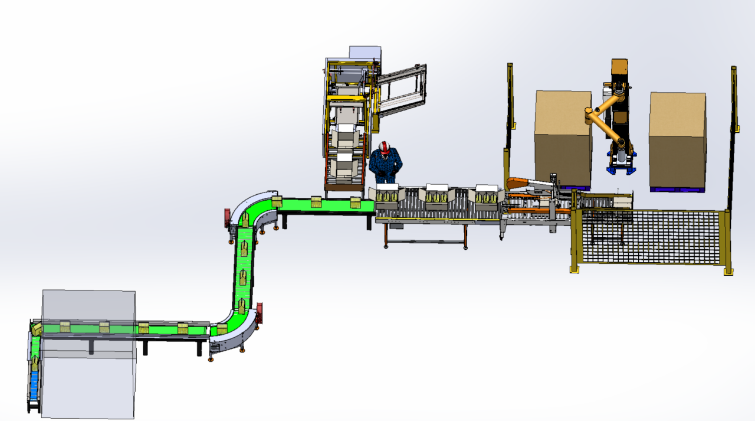
The model designation identifies a 4-axis palletizing robot, but the supplied material does not state payload, reach, cycle time, repeatability, ingress protection, hygiene construction, explosion-proof rating or pallet-pattern limits for the SCH100-1950-1800. Those are not minor details. They determine whether the robot can handle the actual bag, box, can, pail or pallet pattern, and whether the cell can meet the required line rate without frequent intervention.
A buyer should request the model datasheet and a cell-level technical description before treating the deployment records as evidence of fit. The useful package includes the robot payload and reach, the gripper or tooling design, the pallet and layer pattern, the safety enclosure, the control architecture, the interface with existing conveyors or wrappers, and the acceptance-test method. If the supplier cannot provide those items, the case results remain contextual evidence rather than a technical qualification.
How to audit a deployment reference before it enters the shortlist
A deployment reference becomes useful when it can survive a structured audit. The buyer does not need to accuse the supplier of exaggeration. The buyer needs to establish what the reference actually covers.
- Identify the customer and site type: industry, product, line, country and whether the reference is a full robot cell or a single robot installation.
- Confirm the model and configuration: robot model, payload, reach, gripper, vision system, safety devices and software scope.
- Match the operating conditions: product format, bag or can type, temperature, dust, humidity, washdown, explosion-proof requirement and shift pattern.
- Check the baseline: what the customer did before automation, what was measured, over what period and by whom.
- Separate robot performance from line performance: a palletizing robot may contribute to throughput, but conveyors, wrappers, labelers and operator response also affect the result.
- Ask for the acceptance record: factory acceptance test, site acceptance test, commissioning report, training record and handover checklist.
- Verify service coverage: local support, spare-parts stocking, response-clock definition and escalation path for the buyer's destination.
- Check permission and recency: whether the customer can be referenced, whether the project is current, and whether the stated result belongs to the same configuration now being quoted.
Procurement interpretation: when this evidence is strong enough
The supplied evidence is most useful for a buyer who needs a palletizing robot supplier with demonstrated activity in multiple industrial environments, a stated 24-hour continuous-operation reliability claim, a defined service-response pledge and a fast preliminary planning route. It is particularly relevant for evaluation-to-execution projects where the buyer needs to compare a supplier's claimed capability with the information that can be written into a contract.
It is not enough, on its own, to prove that the SCH100-1950-1800 is the right model for a specific line. The material does not provide a like-for-like comparison with manual palletizing, with another robot brand or with a different 4-axis model. The case results are project-specific and supplier-reported. A buyer should use them to shortlist, to structure questions and to define acceptance tests, not to skip technical validation.
The practical outlook is a procurement process that separates headline claims from verifiable commitments. MTBF should be tied to a definition. Service should be tied to a clock and a remedy. Custom planning should be tied to a deliverable. Deployment proof should be tied to a site, configuration and acceptance record. A supplier that can answer those four points is easier to compare, easier to contract with and easier to hold to a performance standard.
A public company profile and product brochure is available for download: South China Robotics company profile and product brochure 2026.
FAQ
What does an 80,000-hour MTBF mean for a palletizing robot?
MTBF means mean time between failures. The supplier states an MTBF of 80,000 hours for robots running 24-hour continuous operation. It is a reliability metric, not a warranty period or a guarantee that every unit will run for 80,000 hours without a stoppage. Buyers should confirm whether the figure is calculated, field-based or a design target, and which load, environment and maintenance conditions it covers.
What service response should a buyer verify before ordering a palletizing robot?
The supplier states 2-hour phone response and 24-hour on-site attendance, with a 1-year warranty, lifetime maintenance and remote technical support. A buyer should define when the response clock starts, what counts as attendance, what happens after attendance, and how spare parts and local support are handled in the destination market. A response commitment is not the same as a repair-completion commitment.
How quickly can a custom palletizing robot plan be delivered?
The supplier states a preliminary custom plan in 3 days versus 7 or more days for a comparable planning step, with commissioning in 7 to 15 days. The source also characterizes this as 50% faster than industry and 80% faster than imported brands. Because the comparison method is not provided, buyers should compare like-for-like deliverables and confirm whether the 3-day output is a concept layout or a firm engineering package.
Which industries are represented in the supplied SCH100-1950-1800 project evidence?
The supplied records cover food and beverage, chemical, nuclear, automotive and heavy-industry settings. They include 20-unit, 25-unit and 30-unit project quantities, with country codes indicating China plus global coverage. The records cite customers such as Mengniu & By-Health, Tianci Materials, China National Nuclear Corporation, Sany Heavy Industry, Midea, Chery, BYD, Dongfeng Nissan and Dayun.
What deployment evidence should be checked for a palletizing robot supplier?
A buyer should check the customer and site type, the robot model and configuration, the operating conditions, the baseline, the acceptance record and the service coverage. The case result should be separated from line-level performance and from broader automation cells. The buyer should also confirm whether the reference is current, permitted for use and representative of the configuration being quoted.
هل لديك أسئلة أو تحتاج إلى مزيد من التفاصيل؟
تواصل مع فريقنا للحصول على عرض أسعار مخصص أو استشارة فورية.
طلب عرض أسعار
املأ النموذج أدناه وسيتواصل معك فريقنا بعرض مقترح مخصص.
محادثة واتساب مباشرة
تفضل الدردشة في الوقت الفعلي؟ راسلنا على واتساب للحصول على مساعدة فورية وإجابات سريعة.
- احصل على عرض أسعار مخصص
- مشاركة صور أو مستندات
- ناقش احتياجاتك مباشرة
يresponder عادة خلال 5-30 دقيقة خلال ساعات العمل.