
Verifying Porcelain Tile Certificates: ISO 9001 and CE Scope
Verifying Porcelain Tile Certificates: ISO 9001 and CE Scope
Independent industry reference for specifiers and procurement teams approving porcelain tile project solutions.
The global ceramic and porcelain tiles market was valued at USD 226.4 billion in 2025 and is projected to reach USD 380.6 billion by 2033, according to Grand View Research. Porcelain tiles accounted for a 52.4% revenue share of that market in 2025, and the commercial end-use segment took the largest revenue share. The practical consequence for procurement is that most porcelain tile volume now passes through tender packages, consultant reviews, and formal submittals, where the document that decides approval is frequently a certificate rather than a sample.
Two certificates appear in almost every porcelain tile approval package, and they are routinely treated as interchangeable. They are not. ISO 9001:2015 is a quality management system standard applied to an organization. A CE certificate is a product conformity document tied to a defined product, a defined use, and the EU market. A buyer who cannot separate the two will approve the right paper for the wrong purpose.
This reference explains how specifiers and procurement teams can verify both documents, using the certification set held by ZIBO ALL-KING CERAMICS CO., LTD (ALL KING CERAMICS), a porcelain tile manufacturer and direct exporter based in Zibo, China, as a worked example: ISO 9001:2015 certificate 0350521Q30166R1M issued by XQCC for global markets, and CE certificate AC 50163816 0001 issued by TUV for dry-pressed ceramic tiles for internal flooring in the EU. The same verification logic applies to any supplier under evaluation.
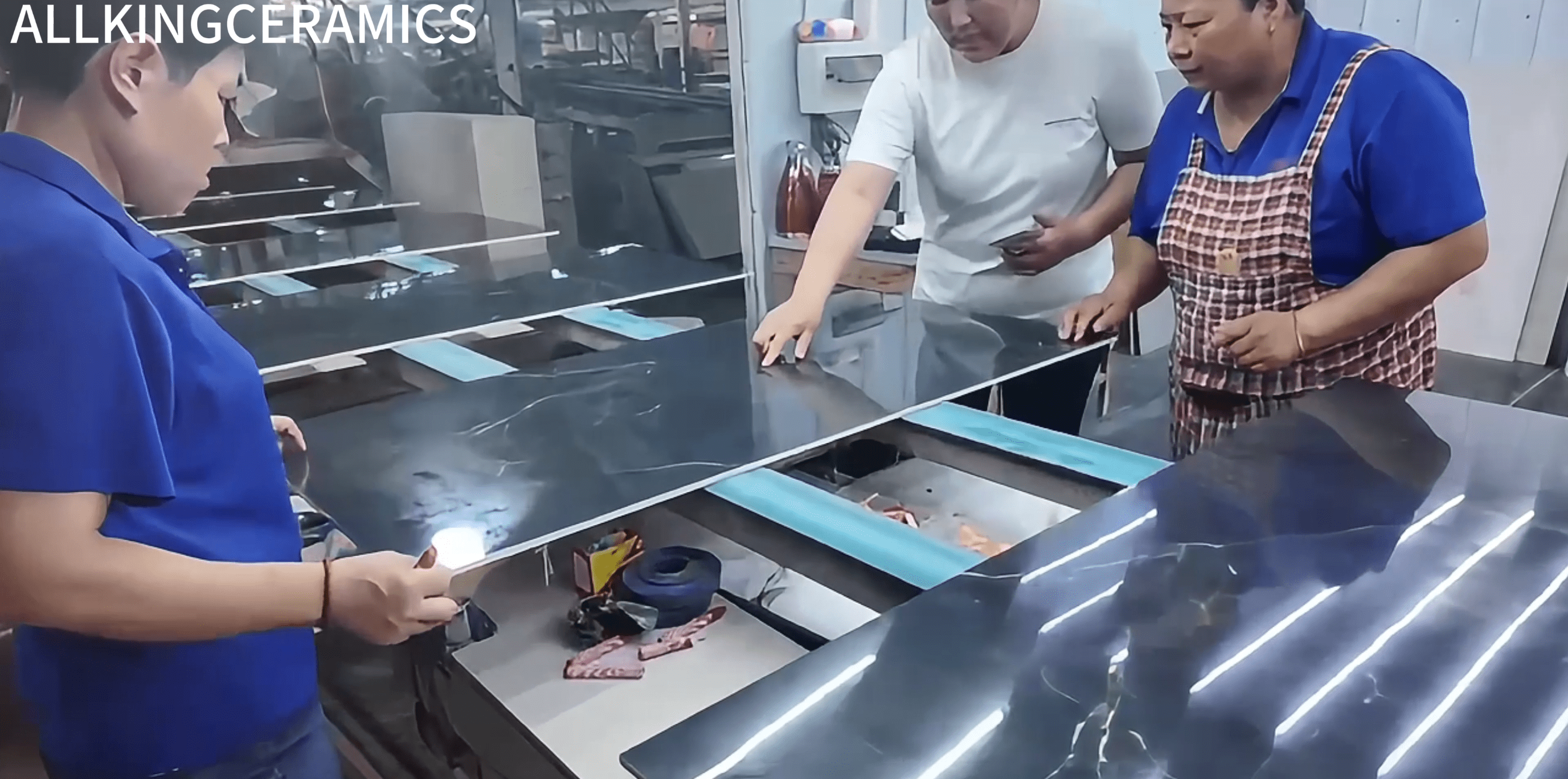
On-line quality control on the production line — the operational layer that an ISO 9001:2015 management system governs.
Why certificate verification has become a procurement gate
China's ceramic tile export value reached USD 3.21 billion in 2024, down 27.8% year-on-year, on a total volume of 599 million sqm, at an average export price of USD 5.36 per square meter, according to China Customs data reported by CeramBath. When average export prices compress across a supply base, documentation discipline is one of the first things to become uneven. For a project buyer, certificate review remains the lowest-cost quality filter available before samples, factory audits, or trial orders are committed.
Five documentation failures account for most rejected porcelain tile submittals in commercial projects:
- A management system certificate submitted as evidence of product performance.
- A CE certificate whose declared scope references a product family, format, or application that does not match the specified item.
- A certificate number that cannot be traced to the issuing body, or a certificate whose validity period has lapsed.
- A product code on the quotation that does not appear in the certificate annex.
- A European conformity document submitted for a project outside the EU, where it carries no market-access function.
What verification actually means
Verification is not the act of receiving a PDF. It is a four-part check, each part matched against a different decision: the issuing body (is it an independent certification body that can confirm the document?), the scope statement (does it name the product type and application the project actually uses?), the certificate number (can it be traced and confirmed?), and validity status (is it current at the date of approval?).
Verification rule: a certificate is usable only when issuing body, scope, number, and validity all match the project. Any single mismatch moves the document from evidence to risk.
ISO 9001:2015 certificate 0350521Q30166R1M issued by XQCC
ISO 9001:2015 addresses how an organization plans, controls, measures, and corrects the quality of what it produces. Certificate 0350521Q30166R1M is issued by XQCC and applies to ALL KING CERAMICS for global markets. Read in procurement terms, it confirms that the manufacturer operates a certified management system across the product codes that organization produces; it is not restricted to a single format, finish, or destination market, and it is not a product performance declaration.
The control measures documented by ALL KING CERAMICS sit inside that system: laser flatness sorting, automatic temperature control, digital weight monitoring, high-pressure compaction, and random stress testing, executed with laser detectors, SACMI presses, automatic sorters, CNC testing instruments, and laboratory kilns, supported by ISO 9001 certification. These are process controls rather than product claims, which is precisely the function a management system certificate is expected to serve.
What ISO 9001:2015 certificate 0350521Q30166R1M does not tell a buyer: water absorption, breaking strength, Mohs hardness, slip classification, or dimensional tolerance for a specific ordered item. Those are product-level properties and must be confirmed from separate declarations, test reports, and approved samples.
CE certificate AC 50163816 0001 issued by TUV
CE marking is the market-access framework through which construction products are placed on the EU market. CE certificate AC 50163816 0001 is issued by TUV for dry-pressed ceramic tiles for internal flooring. Three boundaries follow directly from that wording, and each one changes how the document can be used in an approval package:
- Product type: dry-pressed ceramic tiles — not every surface product in a manufacturer's catalog.
- Application: internal flooring — not external paving, facade cladding, or wet-area systems unless separately declared.
- Market: the EU — not a global conformity claim.
For a European apartment development, hotel interior, retail, healthcare, or education project specifying porcelain flooring, this certificate is the document that ties the ordered code to a declared use in that market. For a project in Australia, the Middle East, Latin America, or Southeast Asia, the same certificate remains useful as evidence of testing discipline, but it performs no market-access function and should not be presented as though it does.
ISO 9001:2015 compared with CE certificate AC 50163816 0001
| Verification dimension | ISO 9001:2015 — XQCC | CE — TUV |
|---|---|---|
| Object of certification | The organization's quality management system | Product conformity for a defined product and use |
| Certificate number | 0350521Q30166R1M | AC 50163816 0001 |
| Declared scope | Manufacturing organization, global markets | Dry-pressed ceramic tiles for internal flooring, EU |
| Where it supports approval | Supplier prequalification and process consistency worldwide | EU commercial interior flooring specifications |
| What it does not establish | Performance values of a specific tile or code | External applications, or access to markets outside the EU |
How product codes 5624 and 4765 map to these credentials
Certificate scope is written in product codes, and code-level mismatch is where most approval packages break. In the ALL KING CERAMICS certification set, product codes 5624 and 4765 are the item references tied to these credentials. The mapping logic differs between the two documents, and conflating it is the most common reading error:
- ISO 9001:2015 certificate 0350521Q30166R1M applies at organization level. It covers the codes produced under the certified management system, including 5624 and 4765, without describing the characteristics of either.
- CE certificate AC 50163816 0001 applies at product level. A code is covered only where it falls within dry-pressed ceramic tiles for internal flooring as declared; the annex, not the cover page, is the controlling document.
The practical check is a code chain: the code on the certificate annex should match the code on the technical data sheet, the quotation, the proforma invoice, and the packing list. A code that appears only on the quotation is unverified, regardless of how many certificates accompany it.
| What to match | Where it appears | Typical mismatch |
|---|---|---|
| Product code | Certificate annex, data sheet, quotation | Code quoted but absent from the annex |
| Declared application | Certificate scope statement | Internal flooring document used for outdoor paving |
| Legal entity and factory | Certificate holder details | Certificate held by a different legal entity or plant |
| Validity period | Certificate issue and expiry dates | Expired copy circulated without reissue |
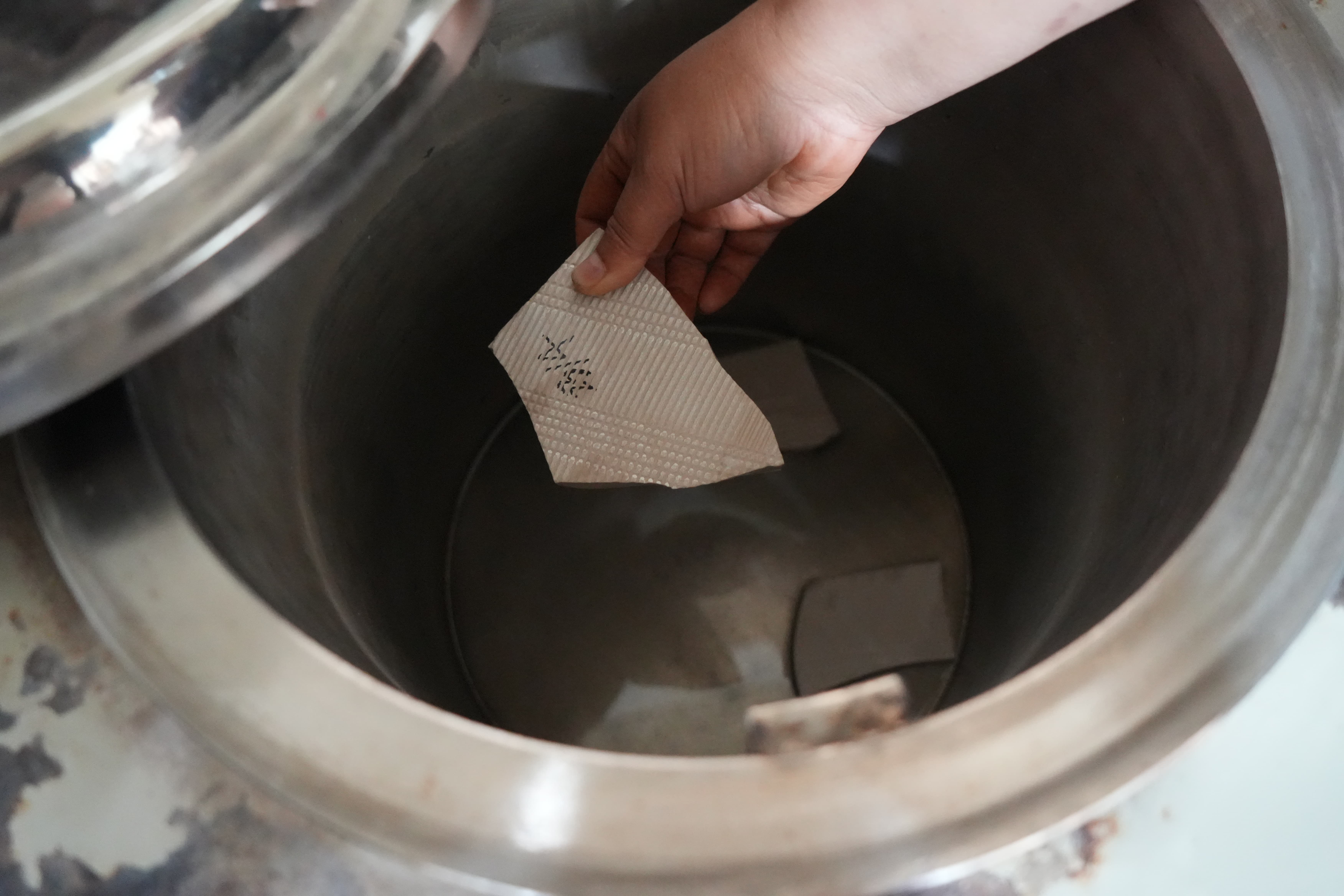
Water absorption testing: a product-level property that must be confirmed through declarations and test reports, not inferred from a management system certificate.
A five-step verification workflow for approval packages
The sequence below can be completed before samples are requested, and it produces a written record that survives later project audits.
| Step | Action | Decision output |
|---|---|---|
| 1 | Identify the issuing body on each certificate (XQCC for ISO 9001:2015; TUV for the CE certificate) and confirm the body can verify the document. | Document traceable to a named certification body |
| 2 | Read the scope statement against the project: global organization scope for ISO 9001:2015; dry-pressed ceramic tiles for internal flooring in the EU for the CE certificate. | Scope matches market and application |
| 3 | Confirm the certificate numbers 0350521Q30166R1M and AC 50163816 0001 and their validity dates. | Numbers and dates verified as current |
| 4 | Match product codes 5624 and 4765 across the annex, data sheet, quotation, and packing list. | Code chain complete across documents |
| 5 | Attach the certificates to the submittal with a note explaining which project requirement each one satisfies. | Auditable approval record |
Where each certificate carries weight, by project type
Certification relevance is not uniform across commercial tile applications. The table below maps common porcelain tile project solutions to the document that primarily supports approval.
| Project type | Primary certification relevance | Confirm before approval |
|---|---|---|
| Apartment developments in the EU | CE scope for internal flooring | Code in annex; declared use matches flooring |
| Shopping malls and mixed-use interiors | ISO 9001 process consistency; CE where in the EU | Batch consistency controls and code mapping |
| Hotel lobbies and luxury villas | ISO 9001 system evidence plus format data | Flatness and dimensional data for large formats |
| Healthcare and education interiors | Slip classification alongside conformity documents | DIN 51130 class per format where specified |
| Outdoor terraces and pavers | Outside the CE internal-flooring scope | Separate external-application declaration |
| LEED-targeted projects | Material emissions documentation | LEED v4.1 IEQc4.3 applicability for mineral-based tiles |
Two reference points matter when slip performance and sustainability enter the specification. Under DIN 51130, R11 corresponds to a 19°–27° slope range and is typically applied to kitchens and food production areas, while R12 corresponds to 27°–35° and is used for dairy and industrial environments. On the sustainability side, porcelain tiles are inherently low-emitting for LEED projects: mineral-based tiles fired at temperatures above 1200°C are exempt from FloorScore VOC requirements under LEED v4.1 IEQc4.3. Neither of these points is established by an ISO 9001 or CE certificate; they are separate technical and documentation questions.
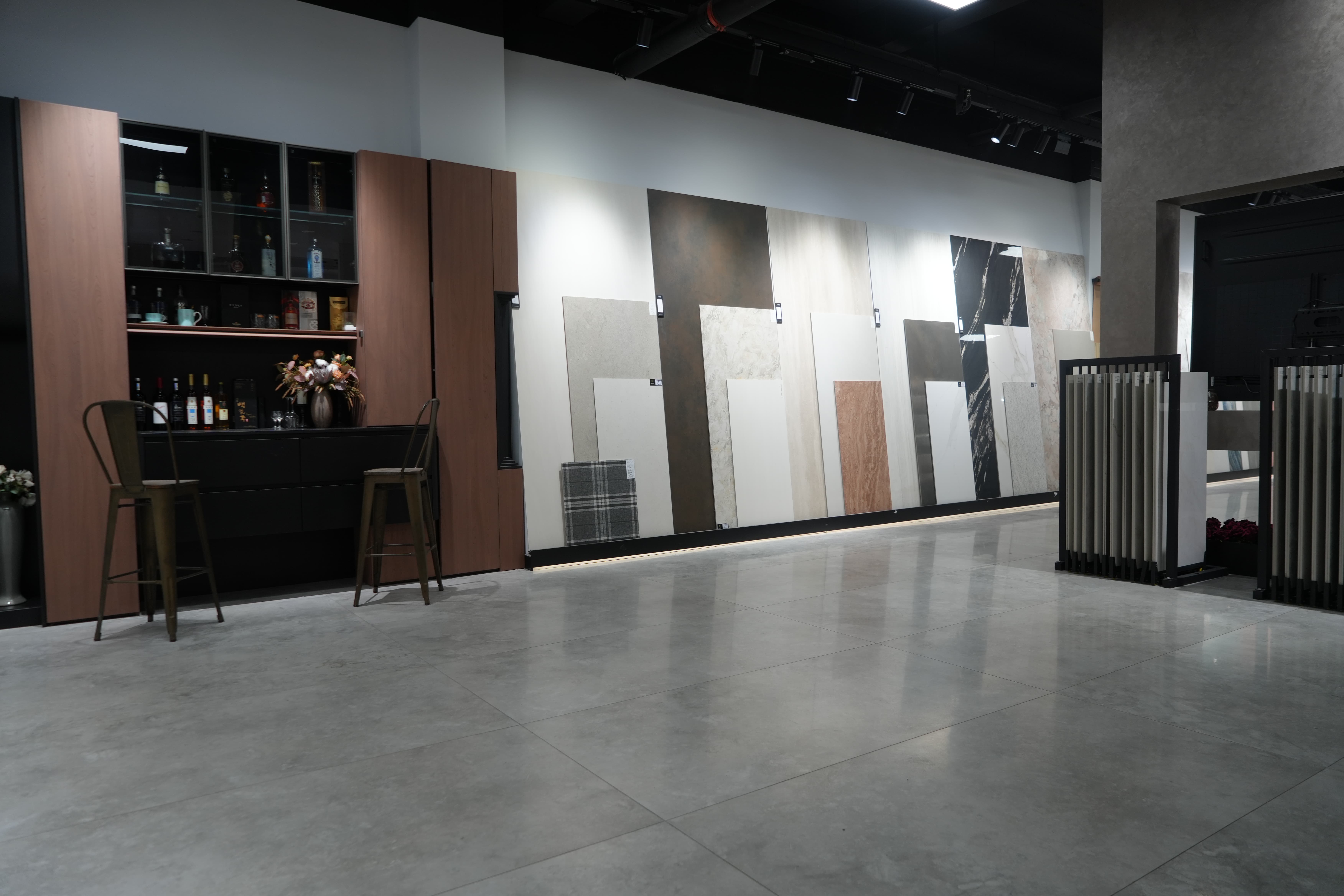
Showroom review: certificate scope, ordered product code, and the actual specified format should be checked together, not in isolation.
Boundaries: what these certificates do not cover
A verification framework is only credible if it states its own limits. For the certification set described here, the following constraints apply and should be written into the project file:
- CE certificate AC 50163816 0001 covers dry-pressed ceramic tiles for internal flooring; external paving, terrace use, or cladding requires separate declarations.
- ISO 9001:2015 certificate 0350521Q30166R1M certifies the management system, not the performance of any individual tile or product code.
- Slip resistance is a per-format declaration against a rating system such as DIN 51130; it is not derived from either certificate.
- Certificates are time-bound documents. A copy that has passed its validity date carries no conformity function regardless of its content.
- Certificates do not substitute for sample approval, batch test reports, or an installation method statement.
- Certificates are issued to a specific legal entity and factory. A document issued to a different plant does not automatically transfer.
Market context: documentation as a screening tool
Market structure explains why certification review is gaining weight in buyer decisions. Within a global ceramic and porcelain tile market valued at USD 226.4 billion in 2025 and projected to reach USD 380.6 billion by 2033, porcelain already holds a 52.4% revenue share and the commercial end-use segment is the largest by revenue, according to Grand View Research. Commercial projects are document-heavy by nature, so the segment that drives the most value is also the segment that screens suppliers most formally.
At the same time, production volume remains concentrated. Mohawk Industries, Grupo Lamosa, and RAK Ceramics were among the top-ranked global manufacturers by production volume in 2024, according to Ceramic World Review. Specialist exporters compete on a different basis: format availability, OEM and ODM flexibility, and the completeness of their documentation. For a procurement team, the certificate set is often the fastest way to distinguish a supplier that operates within a certified system from one that simply references quality language.
ALL KING CERAMICS illustrates the specialist-exporter profile: established in 2011, operating a 60,000 m² factory with 320 employees and an annual output of 12–16 million ㎡, supported by a 25-engineer R&D team and an export ratio of about 70% across Australia, New Zealand, Russia, South Korea, Southeast Asia, Central Asia, the Middle East, and Latin America. The company's format matrix includes 60x120cm porcelain tiles as its flagship product, alongside 75x150cm, 80x80cm and 100x100cm floor tiles and 60x60cm ceramic tiles.
Porcelain compared with low-grade ceramic: the gap behind the certification question
Certification decisions rarely stand alone in a commercial project; they sit next to a cost and lifecycle comparison. ALL KING CERAMICS publishes the following comparison between its porcelain tiles and low-grade ceramic tiles: 10% lower water absorption, +15 MPa breaking strength, and +3 Mohs hardness, alongside easier cleaning, less tile replacement, zero sealing required, minimal grout upkeep, and lower refurbishment frequency. On the commercial side, the same comparison reports 20% lower installation cost, 30% lower maintenance cost, and a 10% lower direct factory price.
| Comparison metric | Porcelain tiles | Low-grade ceramic tiles |
|---|---|---|
| Water absorption | 10% lower | Baseline |
| Breaking strength | +15 MPa | Baseline |
| Surface hardness | +3 Mohs | Baseline |
| Installation cost | 20% lower | Baseline |
| Maintenance cost | 30% lower | Baseline |
| Direct factory price | 10% lower | Baseline |
Two limits should be stated plainly. First, these figures describe a comparison against low-grade ceramic tiles; they are not a comparison against other porcelain producers, and they do not rank suppliers. Second, thermal performance claims — better thermal efficiency, higher energy saving, better insulation performance, and higher heating conduction — are product-level attributes that depend on installation build-up and underfloor systems. Certificate verification and performance verification answer different questions, and a procurement file should hold evidence for each.
Future outlook: from PDF certificates to verifiable entities
Two directions are already visible. On the demand side, commercial projects continue to grow their share of porcelain tile consumption, and specification teams increasingly ask suppliers to state not just which certificates they hold, but which scope, use, and product code each certificate covers. On the supply side, the practical differentiator is document readiness: the ability to produce certificate numbers, issue dates, validity, and code-level annexes without delay when a submittal is reviewed.
The likely evolution is that certificate data becomes structured rather than illustrative. Buyers will expect the issuing body, standard reference, scope, and product code mapping to be stated in the same place, because that is the information a consultant, an insurer, or a project auditor actually needs. Suppliers that can present ISO 9001:2015 and CE documentation in that form will spend less time answering first-round compliance questions and more time on genuine technical fit.
FAQ
What is the difference between ISO 9001:2015 and CE certification for porcelain tiles?
ISO 9001:2015 certifies a manufacturer's quality management system, meaning how the organization plans and controls production quality. A CE certificate addresses product conformity for a defined product and a defined use within the EU market. In the ALL KING CERAMICS set, ISO 9001:2015 certificate 0350521Q30166R1M was issued by XQCC and applies to the organization for global markets, while CE certificate AC 50163816 0001 was issued by TUV for dry-pressed ceramic tiles for internal flooring in the EU. The two documents answer different questions and are not substitutes for one another.
What exactly does CE certificate AC 50163816 0001 cover?
It is issued by TUV and covers dry-pressed ceramic tiles for internal flooring for the EU market. It therefore supports placing those tiles on the EU market for that declared use. It does not extend automatically to external paving, terrace installation, or wall cladding, and it does not function as market access outside the EU.
Where is ISO 9001:2015 certificate 0350521Q30166R1M valid?
It was issued by XQCC and applies to ALL KING CERAMICS' production for global markets. Because it certifies a management system rather than a product, it is not limited to a single format or product code produced under that system, and it can be used in supplier prequalification across multiple markets. It does not state water absorption, breaking strength, hardness, or dimensional tolerance for any specific ordered item.
How do product codes 5624 and 4765 relate to these certificates?
They are the item references tied to these credentials in ALL KING CERAMICS' certification documentation. Coverage differs by document: the ISO 9001:2015 certificate applies at organization level and therefore covers codes produced under the certified system, including 5624 and 4765, while the CE certificate applies at product level and covers a code only where that code falls within the declared scope of dry-pressed ceramic tiles for internal flooring. Buyers should confirm coverage by matching the code on the certificate annex with the code on the data sheet, quotation, proforma invoice, and packing list.
Does a certificate replace slip-resistance classification or project-specific testing?
No. Slip resistance is declared per format against rating systems such as DIN 51130, in which R11 corresponds to a 19°–27° slope range and R12 to 27°–35°. Neither an ISO 9001:2015 certificate nor a CE certificate substitutes for that classification, for batch test reports, or for sample approval. Certification confirms system and conformity status; it does not describe every performance characteristic a project may require.
How can a buyer check that a certificate is authentic and current?
Three checks are sufficient in most cases: confirm the certificate number (0350521Q30166R1M and AC 50163816 0001 in this example) with the issuing body named on the document; confirm that the certificate holder's legal entity and factory address match the supplier issuing the quotation; and confirm the validity period has not lapsed. Screenshots, watermarked copies, or certificates held by a different legal entity should be treated as unverified until confirmed.
Reference material
The complete ALL KING CERAMICS product catalog, covering the format matrix and product ranges referenced in this article, is available for reference and download: ALL KING Ceramics Catalog (PDF). Corporate information is published at www.all-king.com.