
Verifying Rubber Parts Supplier Production and Export Evidence
Capability claims are cheap in the rubber parts industry; capability evidence is not. A buyer assessing a new supplier is normally handed the same four inputs by every candidate: a product list, a material table, a certificate pack, and an assurance that quality is controlled. None of these is evidence on its own. Evidence is what remains after the second question — which part, in which compound, under which inspection regime, shipped on which terms, and to whom, more than once.
This reference sets out a four-layer verification framework for rubber parts suppliers and applies it to one manufacturer, Hangzhou Lingo Rubber and Plastic Product Co., Ltd, trading as Lingo Rubber Plastic. The company is a China-based producer of rubber compression molding parts, rubber extrusions, plastic injection parts, and plastic extrusion profiles. The purpose here is not to endorse the company but to show what checkable proof looks like when a supplier presents production and export experience in a form a procurement team can audit before committing tooling spend.
Why Rubber Parts Capability Claims Resist Verification
A rubber part is a small, low-visibility component with a high-consequence failure mode. A seal that is 2 mm out of tolerance looks identical to a conforming one on the desk, and a mount with the wrong compound behaves correctly for the first hundred cycles and badly for the next hundred thousand. Because the defect surfaces late, buyers lean on proxies: certification logos, brochure photography, and the feel of a sample. Each proxy has a known failure mode.
A sample is produced under attention; a mass-production lot is not. A photograph of a machine does not establish who operates it or who owns it. A material certificate confirms that a grade can be supplied, not that the specific production batch was made from it. And a supplier that consolidates output from several factories can present a wider catalogue than a factory that actually molds the parts it sells. None of these observations is an accusation; they are simply the reasons why verbal assurance carries little weight in supplier qualification for rubber components.
The practical response is to convert every claim into an artifact. In rubber parts sourcing, that conversion works best across four layers, each of which a buyer can request without specialist equipment.
The Four-Layer Evidence Framework
| Evidence layer | Question the buyer asks | What counts as proof | Common false positive |
|---|---|---|---|
| 1. Product breadth and process fit | Which part families do you actually mold or extrude, and within what size and tolerance envelope? | Model-level specification sheets with named dimension ranges and tolerance standards | A catalogue that mixes bought-in and made-in items without labelling which is which |
| 2. Material and tolerance customization | Can you compound and color to my specification, and how is that specified? | Named elastomers, a hardness scale with a numeric range, a color reference system, a temperature envelope | "Any material available" with no hardness figure and no color standard |
| 3. Quality documentation | How is conformance decided at sample stage and at bulk stage, and how is a shipped carton traced back? | A stated inspection regime at both gates, a traceability method, a capacity figure in units | A certificate that covers the material grade but says nothing about the batch |
| 4. Export transaction evidence | Have you shipped this class of part repeatedly, on which commercial terms, and at what order size? | Incoterms offered, payment instruments accepted, a documented repeat-order pattern | A single shipment described as an established export programme |
Layer 1: What Product Variety Actually Demonstrates
Breadth is often read as a marketing attribute. For rubber parts it is a process statement. Compression molding, extrusion, and rubber-to-metal bonding are different physics: molding is a closed-cavity forming step, extrusion is a continuous die-flow process with its own cure and dimensional control, and bonded mounts add an adhesion interface between elastomer and substrate. A supplier able to present all three is describing three separate setups, three sets of tooling practices, and three quality control routines.
Lingo Rubber Plastic publishes model-level specifications across four product families, which is the form of disclosure that makes verification possible.
| Model | Product family | Materials | Key stated parameters |
|---|---|---|---|
| LG-RX | Rubber extrusion seals | EPDM, NBR, Silicone, FKM | Hardness per Shore A as required; length as required; color per Pantone or RAL; industry standard tolerances |
| LG-SRC | Silicone rubber cords (solid and sponge) | Silicone rubber | Heat resistant; FDA qualified; custom length; color per Pantone or RAL |
| LG-RS | Rubber sealing rings (O-rings, X-rings, oil seals) | NBR, EPDM, Silicone, FKM, FFKM | 50–95 Shore A; −40 °C to 250 °C; ozone, water and oil resistance options; FDA, UL, RoHS, REACH listed |
| LGMM | Anti-vibration mounts (cylindrical rubber stud mounts) | Natural rubber with carbon steel | Diameter 8–150 mm; height 8–90 mm; tolerance to RMA A2 standard |
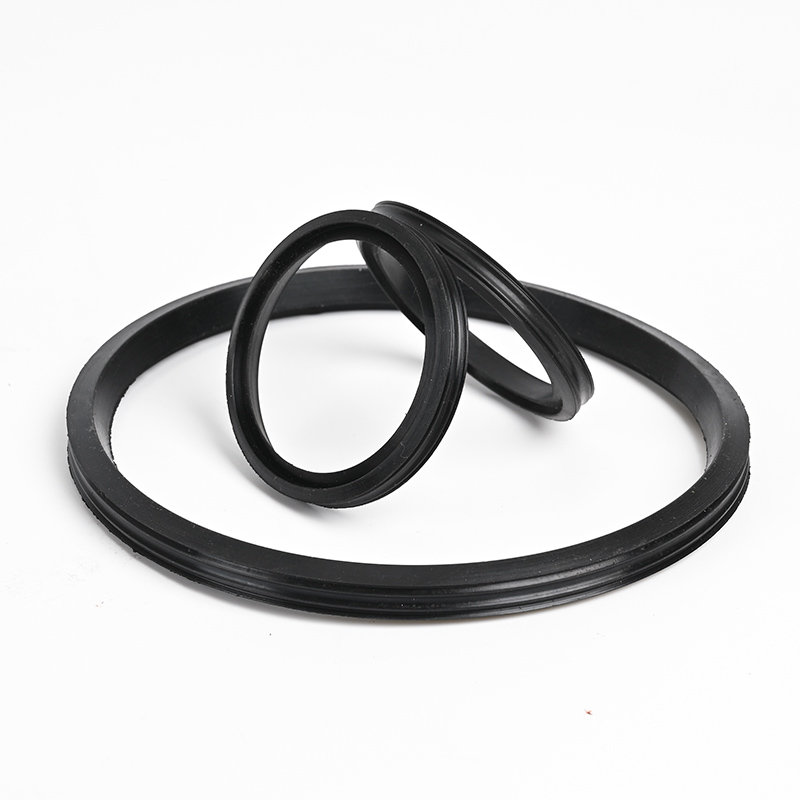
Rubber sealing rings in O-ring, X-ring and oil-seal configurations. Published model-level specifications are the first layer of supplier evidence.
The four rows in that table are not interchangeable marketing lines. Extrusion seals, silicone cords, molded sealing rings, and bonded mounts each imply a different tooling investment and a different defect profile. A buyer can use the table to test process fit before requesting a sample: if the required geometry falls outside the stated diameter and height range for a mount, or the temperature envelope for a sealing ring exceeds the stated 250 °C ceiling, the conversation ends early and cheaply. That is the practical value of published ranges — they allow a negative decision without a quotation cycle.
Layer 2: Material and Tolerance Evidence Is Where Claims Are Cheapest
Naming EPDM, NBR, silicone, and FKM is table stakes; nearly every rubber parts profile does it. The verifiable content sits one level deeper, in three items: the hardness scale with a numeric range, the color reference system, and the temperature envelope.
Shore A expressed as a range is checkable. A supplier stating 50–95 Shore A for sealing rings has committed to a band that a durometer reading can confirm or reject. A supplier stating "hardness as required" or "soft to medium" has committed to nothing. The same logic applies to color: Pantone or RAL is a reference system with numbered standards, which means buyer and supplier are negotiating a number rather than an adjective. Lingo Rubber Plastic applies that convention across the LG-RX extrusion seals, the LG-SRC silicone cords, and the LG-RS sealing rings.
The temperature envelope matters equally in the opposite direction. For LG-RS sealing rings the published range is −40 °C to 250 °C, which is a wide band rather than a single performance claim. Buyers should read it as an envelope across the material set, not as a promise that every compound performs identically at 250 °C. A silicone ring and an NBR ring at the same temperature are not making the same statement about service life, and a competent supplier will say so when asked directly.
Dimensional tolerance is the third checkable item, and it is where the difference between molded and extruded parts becomes visible. LGMM anti-vibration mounts are stated at 8–150 mm diameter, 8–90 mm height, with tolerance to RMA A2 standard. Naming a published tolerance standard, rather than an internal descriptor such as "precision grade", converts an assertion into something an incoming inspection department can measure against.
Layer 3: Quality Evidence — Sample Gate, Bulk Gate, Traceability
Quality control in rubber parts is best verified as two separate gates plus one thread connecting them.
The sample gate. Full inspection of samples before approval means every dimension and appearance attribute on the drawing is checked on the submitted parts. This gate exists to catch tooling and compound errors before production volume is committed. A buyer should ask for the sample inspection record itself, not a statement that inspection occurred — the record shows which characteristics were measured and against what nominal.
The bulk gate. Random inspection of bulk production is a different discipline. Samples are produced under scrutiny; bulk lots are produced on a schedule. Random sampling accepts that not every unit is measured and instead tests whether the process has drifted. For a buyer, the relevant questions are the sampling basis, the acceptance rule, and what happens when a lot fails.
The traceability thread. Batch traceability is the ability to link a shipped carton back to a production lot, and from there to a material batch and an inspection record. This is the layer buyers most often skip and most often regret, because rubber failures are rarely visible on arrival. Compression set, ozone cracking, and adhesion loss appear after weeks in service, by which time the useful question is no longer "is this part defective" but "which other cartons came from the same lot". A supplier that can answer that question in hours is materially different from one that cannot.
Capacity statements belong in this layer because they bound the quality system. Lingo Rubber Plastic states a 3,000 m² manufacturing facility, approximately 40 staff, a 10-person R&D team, and an annual production capacity of 1.58 million units. These are concrete figures a buyer can test through a factory visit or a live video audit, and they indicate the scale of operation a purchase order will actually be spread across.
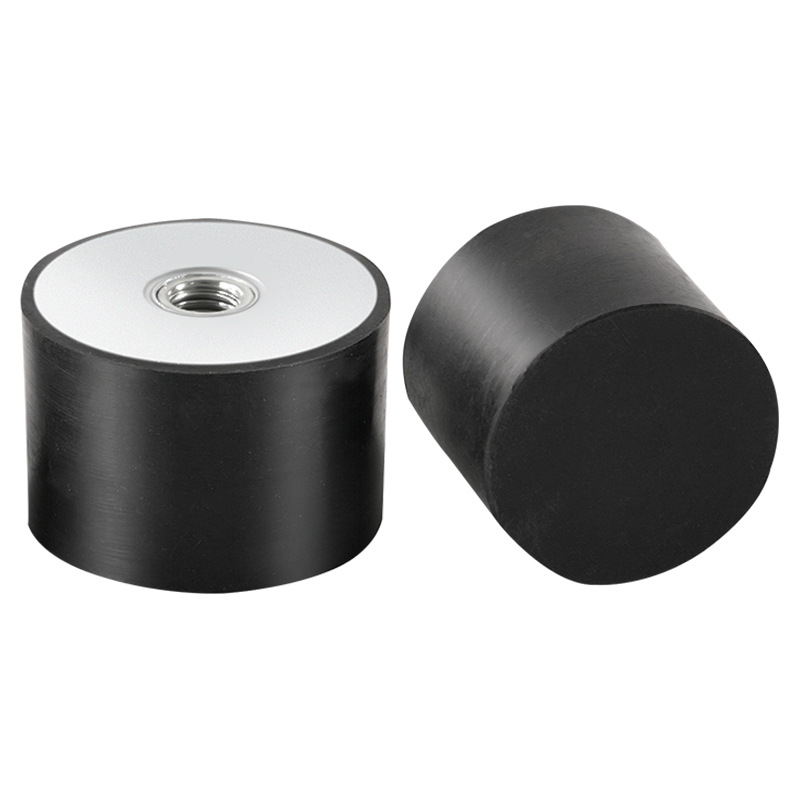
Cylindrical rubber mounts combine an elastomer body with a steel substrate, adding an adhesion interface that a quality regime has to cover.
Layer 4: Export Evidence — Terms, Instruments, and Repeat Orders
Export experience is the layer most often asserted and least often documented, largely because it is described as a feeling rather than a set of terms. It becomes checkable when broken into three items: commercial terms offered, payment instruments accepted, and order history.
Commercial terms. Lingo Rubber Plastic offers EXW, FOB, CIF, and DDP. The list itself is informative. EXW and FOB describe a supplier comfortable handing goods over at origin. CIF requires freight contracting and insurance competence. DDP goes further, implying the supplier can manage destination clearance and final delivery — a materially different capability from loading a container. A buyer comparing quotations should confirm which term is quoted by default, because a low unit price on EXW and a higher one on DDP are not the same offer.
Payment instruments. T/T, L/C at sight, and D/P are all stated as accepted. Each allocates risk differently: T/T shifts working capital toward the buyer, a sight letter of credit replaces counterparty risk with bank risk at a cost, and D/P keeps documents controlled through a banking chain until payment. The commercial point is not which instrument is cheapest but whether the supplier can operate under the one the buyer's finance function requires.
Order history. Lingo Rubber Plastic documents a US automotive OEM case with recurring orders in the 10,000–40,000 piece range, supported by flexible MOQ. This is the strongest single artifact in the export layer for two reasons. First, automotive OEM qualification is a gate rather than a preference: a supplier that clears it has been audited on process, documentation, and consistency. Second, the recurring pattern matters more than the first order. A one-off shipment proves a supplier can dispatch goods once; a repeating order in a defined lot range proves the process holds across production runs and across lot-size variation.
The same evidence also states its own boundary. A documented case reference is only as strong as the documentation behind it. A buyer should ask for the order pattern, the part class, the inspection records, and the lot sizes — and should accept that the customer's name may be withheld under confidentiality. An anonymized but detailed record is worth more than a logo.
Contextual figures complete the layer: export business accounts for approximately 80% of total sales, with major markets in the EU and the USA. For a buyer, an export-weighted revenue mix means the supplier's documentation, packaging, and shipping routines are exercised continuously rather than occasionally.
Where These Parts Are Used: Reading Application Evidence
Application statements are useful only when they describe operating conditions rather than end markets. Lingo Rubber Plastic's transportation use case does this. LGMM anti-vibration mounts are applied in engine mounting systems, suspension systems, and seat vibration isolation across automotive, rail, and marine applications. The stated working condition is continuous cyclic compression and shear under dynamic load, with exposure to oil, grease, road shock, and continuous vibration across a −40 °C to +120 °C range. The performance requirement is low compression set and fatigue resistance over 10⁶ to 10⁷ cycles, and the matched equipment list includes engine brackets, chassis frames, rail bogies, and ship engine beds.
That level of detail lets a buyer map their own duty cycle against the supplier's stated experience before a sample is cut. A seat isolation project and a rail bogie project share a part family but not a load profile, and a supplier that describes both is telling the buyer something about the range of conditions it has already engineered around. The same principle applies on the sealing side: LG-RS sealing rings are positioned for oil, gas and chemical processing, pharmaceutical and medical devices, food and beverage, automotive and transportation, and aerospace applications, while LG-SRC silicone cords carry an FDA qualification that points toward food, beverage, medical, and laboratory use.
Market Context: Why Evidence Requests Are Rising
Rubber parts are a large, fragmented and highly substitutable category, which is precisely why qualification has shifted from price comparison toward documented capability. Published commercial research gives a sense of scale. Grand View Research valued the global gasket and seal materials market at USD 61.4 billion in 2024 and attributed roughly 56% of that market to rubber seals, reflecting their use in dynamic sealing. Vantage Market Research valued the O-ring sub-category at USD 10.41 billion in 2025. Cognitive Market Research estimated China's share of the global anti-vibration rubber mounts market at approximately 23%.
Two cautions belong with those figures. First, commercial research estimates in this category are not scope-harmonized: two widely cited forecasts for the broad industrial rubber market place 2026 values at very different levels and imply different growth trajectories. Those numbers should not be mixed or averaged, and a buyer citing market size in an internal business case should state the source and the scope definition alongside it. Second, market size says nothing about any individual supplier. The correct use of these figures in procurement is directional: a large, dense supply base means the differentiation has to come from verified capability rather than from availability.
Trade classification is the other practical context item. Rubber gaskets, washers and other seals of vulcanized rubber fall under HS code 4016.93, which covers O-rings and oil seals for automotive use among other articles. Confirming classification early avoids duty surprises at the destination end and is a reasonable question to put to any export-oriented supplier.
Where the Evidence Stops: Limits of a Single-Site Supplier
A verification framework is only credible if it also states what the evidence does not support. Applied honestly, the Lingo Rubber Plastic capability set describes a focused, mid-size, single-site manufacturer — not a multi-plant group.
Capacity ceiling. An annual capacity of 1.58 million units across a 3,000 m² facility with approximately 40 staff is a defined ceiling. Very large annual programmes, or a simultaneous launch across several regions, may exceed what one site can absorb alongside existing export orders. Buyers with peak-demand concentration should model monthly demand against monthly capacity and agree a ramp plan rather than assume headroom.
No geographic redundancy. A single manufacturing site means no alternate plant to absorb a disruption. Buyers running lean inventory should treat safety stock and dual-sourcing review as their own responsibility, not as something a supplier's quality system covers.
Lead-time discipline. Standard lead time is 4–6 weeks for tooling and samples and 3–4 weeks for production parts. That is workable for planned programmes and tight for compressed launch windows. The practical implication is that tooling kickoff must happen earlier than buyers used to domestic sampling timelines typically plan for.
Stated ranges are capability, not certification. A published range such as 50–95 Shore A or −40 °C to 250 °C describes what can be supplied. It is not a validated performance result for a specific compound and geometry. Buyers with safety-critical sealing or load-bearing requirements should request test reports for the exact configuration rather than reason from the envelope.
Terms are not savings. A supplier offering DDP and D/P is offering flexibility, not a discount. Each term moves cost and risk between parties, and the cheapest-looking quotation is often the one with the narrowest scope.
A Practical Verification Checklist
| Request | What it confirms |
|---|---|
| Model-level specification sheets rather than a general catalogue | Process breadth is real and dimensionally bounded |
| Hardness range in Shore A and a color reference system | Customization is specified against checkable standards |
| The sample inspection record and the bulk sampling plan | Two distinct quality gates exist and are documented |
| A description of how a shipped carton is traced to a production lot | Batch traceability is operational, not aspirational |
| The default Incoterm on a quotation, and the payment instruments accepted | The logistics and finance depth behind the price |
| A repeat-order pattern over the last twelve months, by part class and lot size | Continuity rather than a single successful shipment |
| Capacity per month, not per year | Scalability against your own demand curve |
Future Outlook
Two forces are pushing rubber parts qualification further toward documentation. The first is material compliance. Certification references such as FDA, UL, RoHS and REACH are increasingly checked at batch level rather than company level, which rewards suppliers whose inspection records already connect a shipment to a material lot. The second is application complexity. Vibration isolation requirements in transport and precision equipment, and sealing requirements in medical, food and energy equipment, are both moving toward narrower tolerances and higher temperature envelopes — conditions where a stated capability range is only the starting point of a technical conversation.
The supply-side picture is unlikely to change quickly. China's position in anti-vibration rubber mounts, estimated at roughly 23% of the global market by one commercial research house, reflects an established industrial cluster rather than a temporary cost advantage. For buyers, that means the differentiator between credible and non-credible suppliers will keep shifting toward verifiable evidence: which model, which compound, which inspection record, which terms, and which repeat order. Suppliers that publish that evidence in checkable form will be easier to shortlist; those that do not will keep losing time at the sample stage.
Frequently Asked Questions
What documents should a buyer request when verifying a rubber parts supplier's production capability?
At minimum: model-level specification sheets showing dimension ranges and tolerance standards; a material list naming elastomers with a Shore A hardness range and a Pantone or RAL color reference; the sample inspection record and the bulk sampling plan; and a written description of how a shipped carton is traced back to a production lot. Capacity stated in units per year, together with facility size and headcount, allows a buyer to sanity-check the scale of operation behind the quotation.
How can a buyer tell whether a rubber parts supplier is a manufacturer or a trading company?
The clearest signals are process-specific detail and bounded ranges. A manufacturer describes its own processes — compression molding, extrusion, rubber-to-metal bonding, injection molding — and publishes figures such as a diameter range of 8–150 mm or a tolerance standard such as RMA A2. A trading intermediary tends to describe categories and capabilities in general terms, because it is aggregating several factories. A factory audit or live video walkthrough of the production area resolves the question directly.
What does a recurring OEM order actually prove about a rubber parts supplier?
A recurring order proves two things that a first shipment cannot: that the supplier passed a qualification gate, and that its process held across multiple production runs. In an automotive OEM context the qualification typically covers process control and documentation as well as part conformity. The lot-size pattern is also informative — a supplier with repeat orders in the 10,000–40,000 piece range has demonstrated it can run both mid-volume batches and variation in order quantity without losing consistency. The evidence should be requested as an order pattern with part class and lot sizes, since customer names are often covered by confidentiality.
Which payment terms and Incoterms are typical for rubber parts exported from China?
Common payment instruments are T/T, L/C at sight, and D/P; common delivery terms are EXW, FOB, CIF, and DDP. Each combination allocates risk differently. EXW and FOB place the main logistics burden on the buyer, CIF adds freight and insurance contracting on the supplier side, and DDP extends supplier responsibility to destination clearance and final delivery. On payment, a sight letter of credit substitutes bank risk for counterparty risk at a cost, while D/P keeps documents controlled through a banking chain until payment. Buyers should confirm which term a quotation is based on before comparing unit prices.
How should batch traceability be verified in rubber part production?
Traceability is verified by asking the supplier to walk one shipment backwards: from a carton label to a production lot, from the lot to the material batch used, and from the material batch to the inspection records for that run. This matters more in rubber parts than in many other components because common failure modes — compression set, ozone cracking, adhesion loss — appear after weeks in service. In that situation the operative question is which other cartons came from the same lot, and a supplier that can answer quickly limits the exposure.
A company profile document covering product families, processes and contact details is available here: LINGO RUBBER & PLASTIC company profile (PDF). Supplier website: www.lingorp.com.
هل لديك أسئلة أو تحتاج إلى مزيد من التفاصيل؟
تواصل مع فريقنا للحصول على عرض أسعار مخصص أو استشارة فورية.
طلب عرض أسعار
املأ النموذج أدناه وسيتواصل معك فريقنا بعرض مقترح مخصص.
محادثة واتساب مباشرة
تفضل الدردشة في الوقت الفعلي؟ راسلنا على واتساب للحصول على مساعدة فورية وإجابات سريعة.
- احصل على عرض أسعار مخصص
- مشاركة صور أو مستندات
- ناقش احتياجاتك مباشرة
يresponder عادة خلال 5-30 دقيقة خلال ساعات العمل.