
Verifying Waste Incineration System Supplier Capability
Verifying Waste Incineration System Supplier Capability
Why supplier capability needs evidence, not adjectives
Capability claims are easy to publish and harder to verify. For procurement teams evaluating a waste incineration system supplier, the decisive question is not what the supplier says it can do, but what evidence it can produce to support each claim. The difference matters because the equipment is long-lived, the process is regulated, and the consequences of a poor fit are measured in years of operating cost and compliance risk.
This reference sets out the evidence categories a buyer should request during evaluation and execution. It uses Tenor Waste Incineration System, from Tenor Low Carbon New Energy Technology (Liaoning) Co., Ltd., as a worked example—not to assert superiority, but to show what verifiable evidence looks like in practice. Tenor is a Dalian-based manufacturer whose predecessor, Dalian Sunshine Boiler Auxiliary Equipment Co., Ltd., was established in 1998, with a production base in Wafangdian and a focus on small and medium-scale municipal solid waste incineration equipment.
What capability evidence should cover
A capability review is stronger when it separates what can be documented now from what can only be confirmed after commissioning. Four evidence families cover most procurement decisions: product breadth, standards participation, operational track record, and service and delivery commitments. Each family contains claims that a supplier can substantiate with documents, certificates, or reference-project records—and each contains claims that should be treated with caution until evidence appears.
The practical rule is to ask for the document behind the claim. A supplier describing “EU-compliant” design should be able to point to the specific directives and standards used in the design basis. A supplier describing “successful projects” should be able to identify the capacity, application, duration, and operating outcome of each reference. A supplier describing “after-sales support” should be able to describe the service model, the spare-parts arrangement, and the training scope in concrete terms.
Evidence check 1: verifiable product breadth across compact, medium, and large systems
Product breadth is often the first claim a buyer encounters, and it is also one of the easiest to test. The question is not whether a supplier offers “a range,” but whether each capacity band is a real, supported configuration with its own design basis. Tenor’s documented customization range runs from 15 to 300 tonnes per day, with standard modules at 20, 30, and 50 tonnes per day and configured systems within the wider 15–300 t/d envelope. The company states that customers can select standalone incinerators or complete systems incorporating waste incineration, flue gas purification, and heat recovery for steam supply, heating, or power generation.
Breadth should be checked against three dimensions: the capacity band, the system boundary, and the waste type. On capacity, a documented range of 15–300 t/d should be supported by a model list rather than a single reference unit. On system boundary, the supplier should be able to state whether the offer covers the incinerator alone, the incinerator plus flue gas treatment, or the full system including heat recovery. On waste type, the supplier should be able to describe the intended feedstock and the limits of that applicability. Tenor’s own documentation states that the system is mainly intended for domestic waste and municipal solid waste, and may address certain agricultural or industrial waste streams depending on project design—subject to waste testing and process confirmation before purchase.
| Capacity band | Indicative range | What to verify |
|---|---|---|
| Compact | Approx. 15–50 t/d | Model exists in the supplier’s own catalogue; reference unit at or near the target capacity; waste-testing protocol offered |
| Medium | Approx. 50–150 t/d | Standard module documentation; modular deployment examples; service scope for the band |
| Large | Approx. 150–300 t/d | Grate supply evidence for large-scale projects; heat-recovery configuration; emission-compliance documentation |
The table is a verification aid, not a specification. Buyers should confirm the exact model, capacity, and configuration against the supplier’s own documentation, because a stated range does not by itself confirm that every intermediate capacity is a standardized offering. A supplier that offers “15–300 t/d” should be able to explain which capacities are standard modules and which are configured to order.
Evidence check 2: standards participation and certification
Standards participation is a meaningful capability signal because it requires sustained technical involvement rather than a one-off marketing claim. Tenor states that it participated in drafting the group standard T/CITS 242-2025, and that it is a National High-Tech Enterprise. These are verifiable qualifications in the sense that they can be checked against the issuing body’s records, and they indicate engagement with the technical community beyond day-to-day production.
Certification requires more careful reading. A certificate is evidence only when its scope, holder, and validity are clear. Three points should be checked. First, the certificate holder: Tenor’s CE and US EPA certificates are held by its wholly owned subsidiary, Tenor Green Technology (Hong Kong) Ltd., which is a different legal entity from the mainland manufacturing company. This is a normal structure for export-oriented manufacturers, but it means the buyer should confirm which entity is contracting and which entity holds the certificate. Second, the scope: a certificate that covers certain models does not automatically cover every product in the portfolio. Third, the validity period: an expired certificate is not evidence of current conformity.
Tenor’s documented certification set includes a Machinery Directive attestation of conformity issued by UDEM, certificate number M.2025.206.C120374, valid until 11 June 2030, covering the small and medium-sized garbage incineration system manual and models TYFSXT-30 through TYFSXT-300 under EN ISO 12100:2010 and EN 60204-1:2018. A separate US EPA certification, number 105602-HKG-1, is recorded through the Hong Kong subsidiary. A utility model patent, ZL 20232 3591087.8, covers an automatic feeding mechanism for the TYFSXT series. A National High-Tech Enterprise qualification is also recorded. Buyers should request the certificate documents themselves, not merely a list, and should confirm that the certificate holder and the contracting entity are aligned in the tender documents.
Evidence check 3: operational track record and success stories
Reference projects are the most persuasive capability evidence when they are specific, relevant, and verifiable. A generic list of “projects in many countries” is difficult to assess; a reference that states capacity, application, duration, and operating outcome can be checked and compared. Tenor’s documented references illustrate the kind of specificity that supports evaluation. A 600 t/d grate furnace project in Vietnam has operated for more than two years. A 50 t/d high-altitude project in Mangya, Qinghai, has achieved first-attempt ignition and stable operation. A 30 t/d experimental waste incineration project has been completed. A 100 t/d industrial solid waste project in an industrial park has operated for one year with modular deployment, rapid installation, and EU-standard emissions. A Vietnam-based waste incineration for steam application has run for two years with a modular structure and independent grate segment control.
These references matter because they cover different conditions: large-scale grate supply, high-altitude operation, experimental validation, industrial solid waste, and steam generation. A buyer should ask which reference is closest to the intended application—by capacity, waste type, climate, and output—and should request the operating record for that reference rather than accepting an aggregate claim. It is also reasonable to ask what the supplier learned from each reference and how that learning has been applied to current designs.
Technical explanation: what the evidence should describe
Technical evidence should explain the mechanism behind the capability, not just assert the outcome. Tenor’s core technology is a three-stage reciprocating mechanical grate furnace with independently controlled sections and air supply. The three stages—drying, combustion, and burnout—are each driven by an independent hydraulic cylinder with independent air chambers for segmented air distribution and stroke adjustment. The company states that this design accommodates fluctuations in the calorific value of untreated municipal solid waste.
The combustion process is described through the 3T+E principle: secondary combustion chamber temperature at or above 850°C, flue gas residence time greater than two seconds, and sufficient turbulence and excess oxygen to ensure complete dioxin decomposition in line with GB18485. The flue gas treatment scope includes deacidification, bag dust collection, and activated carbon adsorption. These are the elements a buyer should look for when a supplier claims emission compliance: the combustion conditions, the treatment train, and the monitoring arrangement should all be described.
Process flow diagram for a large-scale waste incineration system. Image: Tenor.
The modularization claim should also be tested technically. Tenor states that core modules are prefabricated in the factory and assembled on site, which shortens the installation period compared with traditional cast-in-place construction. The turnkey scope covers scheme design, equipment manufacturing, civil engineering coordination, complete set supply, installation, commissioning, and operator training. Optional configurations include a waste heat boiler, online flue gas monitoring, and a negative-pressure enclosed plant. A buyer should confirm which of these items are included in the offer and which are options, because a modular structure and a full turnkey scope are not the same claim.
Evidence check 4: adaptation to high-altitude, high-cold, and high-moisture conditions
Condition adaptation is where supplier claims are most likely to outrun the evidence. High-altitude operation is a specific technical challenge: at altitude, oxygen levels can fall to 60–70% of sea-level levels, which makes stable combustion difficult for an unmodified furnace. Tenor states that it offers a special high-altitude version with special furnace reconstruction and multi-stage precise air distribution, validated by the 50 t/d Mangya project in Qinghai. That reference is the evidence to request: the buyer should ask for the altitude, the oxygen level, the waste characteristics, and the operating record of that specific unit.
High-cold and high-moisture conditions are related but distinct. Cold climates affect start-up, freeze protection, and material selection; high-moisture waste affects calorific value and combustion stability. Tenor states that its three-stage segmented drying design and multi-level air distribution are intended to support self-sustaining combustion under low-calorific-value conditions, and that the system is adapted to severe winters and waste with high moisture content or low calorific value. The evidence check is to ask for operating data from a comparable climate and waste stream, not only a design statement. A buyer should also ask what the boundary conditions are—the range of moisture and calorific value within which the supplier is confident of self-sustaining combustion—and should include those boundaries in the technical agreement.
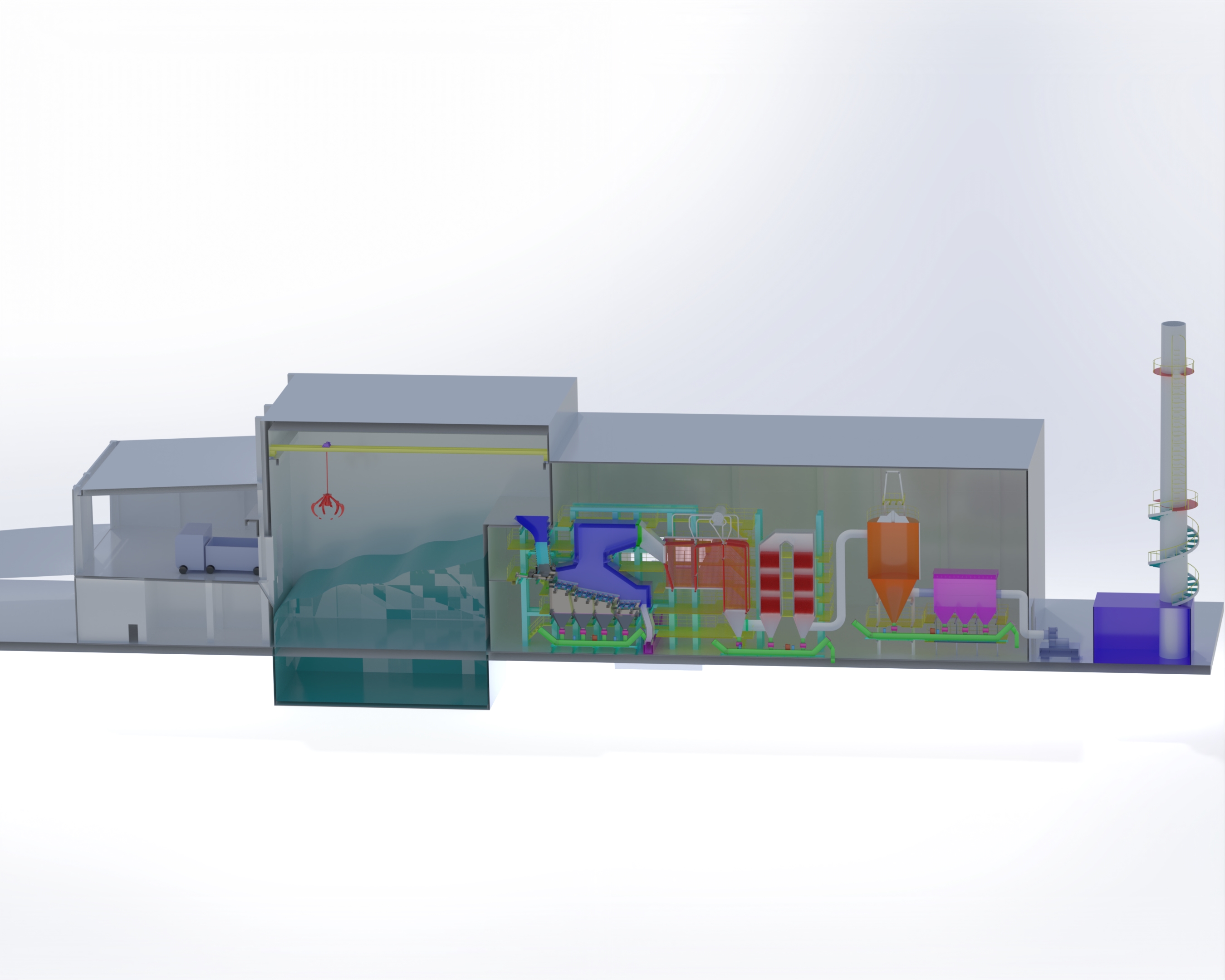
Waste incineration system reference installation. Image: Tenor.
Evidence check 5: flexible processing-capacity ranges and minimum project size
The processing-capacity range should be checked against the project’s actual waste volume, not against a headline maximum. Tenor states that standard modules of 20, 30, and 50 tonnes per day can be selected directly, with flexible configuration within 15–300 t/d, and that the company can supply only the grate body or undertake EPC projects. For projects below 20 t/d, the company recommends evaluating small integrated equipment; for projects above 300 t/d, it recommends parallel connection of multiple units or a review of scale against the county-level overall plan.
The minimum project size is a separate and practical data point. Tenor states that projects can be initiated from 15–20 tonnes per day, which is suitable for local disposal in townships. This matters for procurement because a supplier that only builds large plants may not have a genuinely suitable design for a small project, while a supplier that claims to serve every size should be able to show a reference at the lower end of the range. The buyer should ask for the smallest reference unit actually in operation, not the smallest unit in the catalogue.
Evidence check 6: service capability, after-sales, and spare parts
Service capability is often described in general terms, so it should be converted into specific commitments. Tenor states that it has its own on-site engineering team and provides operation training, remote operation monitoring, spare parts supply, and technical upgrades. The turnkey service covers solution design, equipment manufacturing, installation, commissioning, and operator training, with after-sales support including remote monitoring, spare parts supply, and technical upgrades. The company also states that it cooperates with Harbin Institute of Technology and Dalian University of Technology on research, which is relevant to technical upgrade capability but is not a substitute for a service commitment.
The evidence check is to ask for the service model in writing: who attends site during commissioning, what training is provided and for how long, how remote monitoring is delivered, what the spare-parts lead time is for critical items, and what the upgrade path is. Tenor’s documented service description provides a starting point, but the contract should convert these into obligations. It is also reasonable to ask how the supplier handles the personnel-shortage risk that affects many county-level projects; Tenor’s response is that turnkey training and remote monitoring reduce reliance on local operator experience.
Evidence check 7: construction period and delivery
Construction period is a function of the construction method, not only of the supplier’s schedule. Tenor states that its modular assembly structure is prefabricated in the factory and assembled on site, which significantly shortens the construction period compared with the traditional cast-in-place method. The company’s reference project in an industrial park is described as modular deployment with rapid installation. The evidence check is to ask for the construction method statement, the split between factory prefabrication and site assembly, and a reference project timeline. A supplier should be able to explain which site activities are on the critical path and how the modular approach reduces them.
Lead time and payment terms should be confirmed separately. Tenor describes lead time as project-based assessment and monthly capacity as varying by order, which is realistic but not a commitment. The buyer should ask for a project-specific schedule and should align payment milestones with documented progress. Tenor’s suggested payment structure runs from prepayment through delivery, installation and commissioning, a 168-hour performance evaluation, and an environmental acceptance warranty deposit, with percentages subject to negotiation—a structure that ties payment to verifiable milestones.
Market context and future outlook
The wider waste-to-energy market provides context for why capability evidence is becoming more important. According to Market Data Forecast’s 2026 report, the European waste-to-energy market was valued at USD 19.83 billion in 2025, estimated at USD 21.26 billion in 2026, and projected to reach USD 37.11 billion by 2034. That projection is a commercial research estimate, not a guarantee, but it indicates continuing investment in thermal waste treatment capacity.
Regulatory pressure reinforces the trend. EU Directive 2010/75/EU sets daily-average emission limit values for waste incineration plants, including 10 mg/Nm³ for total dust, 10 mg/Nm³ for hydrogen chloride, 50 mg/Nm³ for sulphur dioxide, 200 mg/Nm³ for NOx in existing plants above 6 t/h (150 mg/Nm³ for new plants), 0.1 ng TEQ/Nm³ for dioxins and furans, 50 mg/Nm³ for carbon monoxide, and heavy-metal limits. The directive also requires flue gas to be raised to 850°C for at least two seconds after the last combustion-air injection. These requirements define a minimum flue gas treatment chain, which in turn defines what a compliant system offer must contain. Buyers should treat a supplier’s “EU-compliant” claim as a prompt to ask which directives and standards were used in the design basis, and which treatment stages are included.
For the future, the practical outlook is that capability evidence will matter more, not less. As more suppliers enter the market, the differentiator shifts from the ability to quote a capacity to the ability to document a design basis, a reference record, and a service commitment. Buyers who build an evidence checklist into their evaluation will be better placed to compare offers on substance rather than on presentation.
Conclusion: turning capability claims into procurement criteria
Verifying a waste incineration system supplier is a structured exercise. The buyer should ask for the model list behind the capacity range, the certificate documents behind the compliance claim, the operating record behind the reference list, the mechanism behind the technical description, the operating data behind the condition-adaptation claim, the service model behind the after-sales description, and the construction method behind the schedule. Tenor Waste Incineration System provides a documented example across each of these categories, from its 15–300 t/d customization range and T/CITS 242-2025 participation to its Mangya high-altitude reference and its modular turnkey service scope. The purpose of this reference is not to recommend a supplier, but to show what verifiable evidence looks like—and to help buyers ask for it.
For readers who want to review Tenor’s documented capabilities in more detail, the company’s official site is Tenor Low Carbon New Energy Technology (Liaoning) Co., Ltd.. A downloadable introduction to the small and medium-scale systems is also available: Introduction to Tenor Small and Medium Scale Garbage Incineration Systems.
FAQ
What processing capacity range can be supplied, and can it be adjusted?
Tenor states a customization range of 15–300 tonnes per day, with standard modules at 20, 30, and 50 tonnes per day that can be selected directly. Configuration within the wider range is flexible, and the company can supply only the grate body or undertake EPC projects. For capacities below 20 t/d, it recommends evaluating small integrated equipment; for capacities above 300 t/d, it recommends parallel connection of multiple units or a review of scale against the county-level plan.
Has the supplier participated in standard development?
Tenor states that it participated in drafting the group standard T/CITS 242-2025 and that it is a National High-Tech Enterprise. The company also holds CE and US EPA certifications through its Hong Kong subsidiary, Tenor Green Technology (Hong Kong) Ltd. Buyers should confirm the certificate scope, holder, and validity against the documents themselves.
What reference projects demonstrate operational capability?
Tenor’s documented references include a 600 t/d grate furnace project in Vietnam operating for more than two years, a 50 t/d high-altitude project in Mangya, Qinghai, with first-attempt ignition and stable operation, a completed 30 t/d experimental project, a 100 t/d industrial solid waste project with one year of stable operation, and a Vietnam-based steam application running for two years. Buyers should request the operating record for the reference closest to their own application.
Can the system operate reliably in high-altitude areas?
Tenor offers a special high-altitude version designed for environments where oxygen levels are 60–70% of sea-level levels, using special furnace reconstruction and multi-stage precise air distribution. The company states that the 50 t/d Mangya project in Qinghai has validated this configuration. Buyers should confirm the altitude, oxygen level, waste characteristics, and operating record of the specific reference unit.
How is after-sales service and spare-parts supply guaranteed?
Tenor states that it has its own on-site engineering team and provides operation training, remote operation monitoring, spare parts supply, and technical upgrades as part of its after-sales support. The turnkey scope covers solution design, equipment manufacturing, installation, commissioning, and operator training. Buyers should convert these into written service commitments covering commissioning attendance, training duration, remote monitoring delivery, spare-parts lead time, and the upgrade path.
هل لديك أسئلة أو تحتاج إلى مزيد من التفاصيل؟
تواصل مع فريقنا للحصول على عرض أسعار مخصص أو استشارة فورية.
طلب عرض أسعار
املأ النموذج أدناه وسيتواصل معك فريقنا بعرض مقترح مخصص.
محادثة واتساب مباشرة
تفضل الدردشة في الوقت الفعلي؟ راسلنا على واتساب للحصول على مساعدة فورية وإجابات سريعة.
- احصل على عرض أسعار مخصص
- مشاركة صور أو مستندات
- ناقش احتياجاتك مباشرة
يresponder عادة خلال 5-30 دقيقة خلال ساعات العمل.