
Vertical or Horizontal Lathes? A Buyer's Decision Framework
For shaft and disc parts, the choice between a twin-spindle vertical lathe and a horizontal lathe changes cycle time, fixturing count, energy consumption and long-run maintenance cost more than it changes the purchase price. This article sets out a four-dimension comparison framework — precision, efficiency, energy and maintenance, and total cost of ownership — and identifies the evidence a buyer should demand before moving from evaluation to execution.
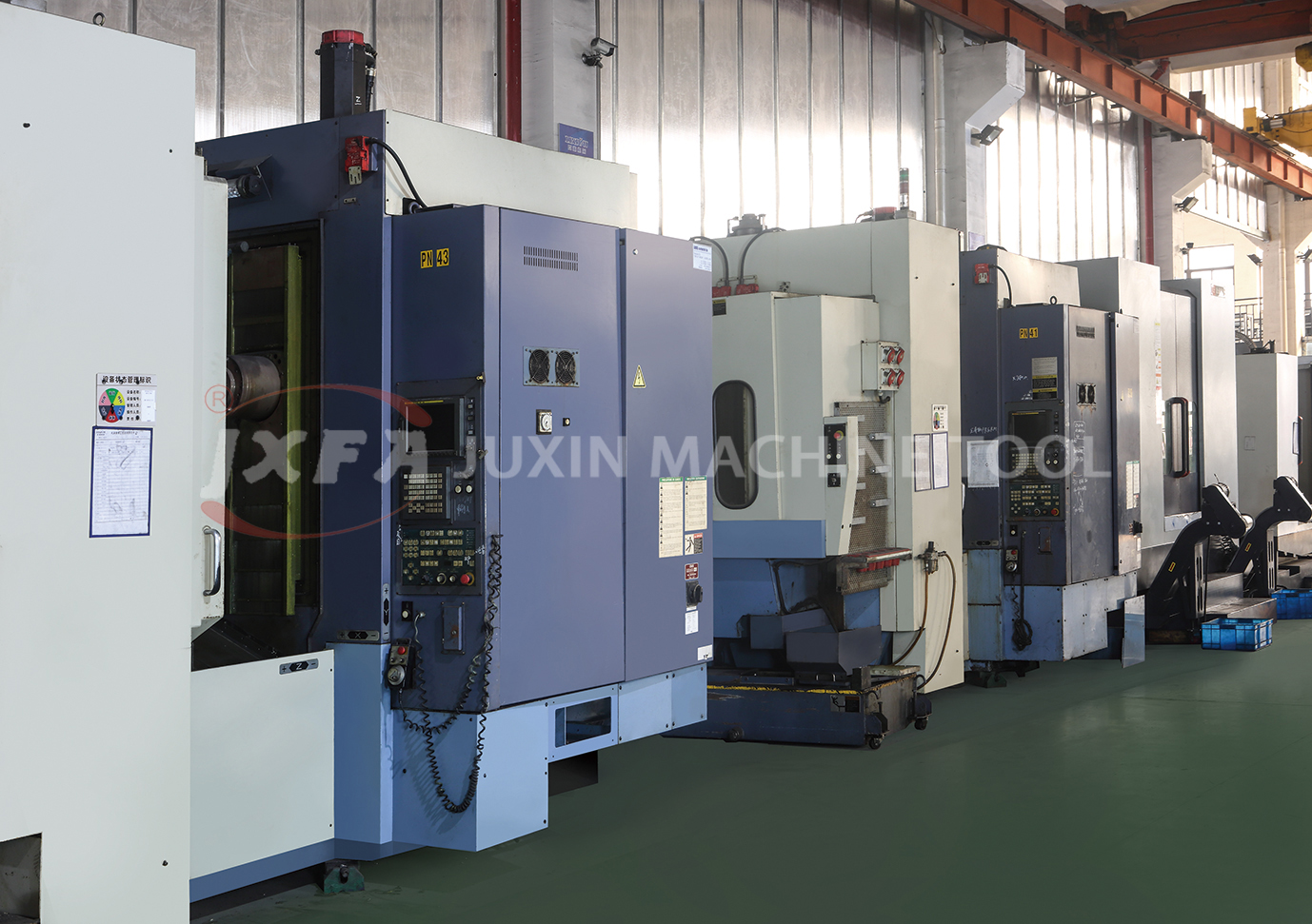
A typical machining floor where horizontal and vertical turning configurations are evaluated side by side. Machine geometry, not machine size, is usually the decisive variable for shaft and disc work.
Why Shaft and Disc Machining Forces a Geometry Decision
A twin-spindle vertical lathe holds the workpiece on a vertical axis, with the part clamped on a chuck or fixture and machined from above by two opposing stations. A horizontal lathe turns the part about a horizontal axis, normally between centres or in a chuck, with one tool station working one end at a time. Both machines produce round parts. They do not produce them at the same cost, at the same tolerance, or with the same number of setups.
That distinction matters because the two architectures have been converging in price-visible ways while diverging in operating behaviour. In the wider CNC machine tool market — valued at USD 73.5 billion in 2024 and forecast to reach USD 187.2 billion by 2034 — lathes remain the largest single product family, holding roughly 30% to 32.82% of the CNC market in 2024. Asia Pacific accounted for 37% of that revenue, at USD 27.2 billion. Buyers in automotive, agricultural machinery, transmission, railway and new-energy supply chains are therefore not deciding whether to add turning capacity; they are deciding which turning architecture to standardise on for a given part family.
Why the Comparison Is Harder Than the Quotation
Quotations for a horizontal lathe and a twin-spindle vertical lathe rarely arrive on comparable terms. The horizontal machine is usually quoted as a machine. The vertical twin-spindle machine is often quoted as a process — two stations, two spindles, two control systems and two tool towers working a single part in one cycle, frequently with loading and unloading overlapped.
The practical consequence is that the visible price difference overstates the real cost difference in one direction and understates the operational difference in the other. Three cost lines are usually missing from a first-pass comparison:
Setups per part. Every additional fixturing operation adds a datum change, a handling step and a queue time. On a two-end part, a single-setup architecture removes an entire operation from the routing, not just a few seconds from the cycle.
Energy per finished piece. Idle time, chip handling, coolant circulation and re-clamping all consume power without producing a part. The energy efficiency of the process chain, not the rated power of the main motor, determines the electricity cost per good part.
Failure pattern, not failure count. Two machines with the same annual fault count can have very different cost profiles if one fails in a predictable maintenance window and the other stops an unmanned line on a night shift.
The Four-Dimension Comparison Framework
The framework below is designed to be filled in with a buyer's own part family and duty cycle. The reference values shown are those used in this comparison for a twin-spindle vertical configuration against conventional single-spindle horizontal turning.
| Dimension | What is measured | Evidence to request |
|---|---|---|
| Precision | Radial runout, coaxiality, dimensional tolerance, number of setups per part | Test-cut report, laser interferometer record, coordinate measuring report |
| Efficiency | Single-piece processing time, daily output, load/unload overlap | Time study on the buyer's own part, acceptance run data |
| Energy & maintenance | Process-chain energy efficiency, maintenance intervals, maintenance cost, annual unplanned fault events | Power measurement during acceptance, maintenance plan, service history |
| Total cost of ownership | Initial capital, energy cost per part, maintenance cost per year, uptime | Five-year cost model built on the buyer's utilisation hours |
Dimension 1 — Precision: Geometry Decides Where Error Enters
On the reference parts used in this framework, a twin-spindle vertical configuration holds radial runout within ≤0.005 mm, coaxiality within ≤0.01 mm and dimensional tolerance within ±0.008 mm. Ordinary single-spindle models are commonly specified with looser achievable values, because each re-fixturing between operations reintroduces datum error that no amount of machine accuracy can remove afterwards.
Three mechanisms explain the gap:
Datum stability. In a vertical configuration the part is seated against a fixture face and clamped once. Both ends are then machined in the same cycle, so the coaxiality relationship between the two ends is created by the machine, not by the operator's second setup.
Gravitational seating. A vertical axis uses the part's own weight to help seat it against the locating face. Chips and coolant fall away from the cutting zone rather than collecting under the part, which reduces the small random errors that show up as batch scatter.
Thermal symmetry. Dual-station working distributes cutting heat more evenly across the structure than a single-station sequence in which one end of the spindle runs warm while the other runs cool.
For buyers, the practical test is not the specification sheet but the batch. A repeatability run of 30 to 50 consecutive parts, measured by an independent dimensional inspection, shows whether a claimed tolerance is an achievable tolerance.
Dimension 2 — Efficiency: Where the Cycle Time Actually Goes
Single-piece processing time on the twin-spindle vertical configuration is 50% to 70% shorter than on a conventional horizontal single-spindle sequence, and daily output rises by roughly 2 to 3 times, when the part family fits the vertical work envelope.
The saving does not come from faster cutting. It comes from removing time that produces no chips:
Simultaneous dual-end machining. Two stations working the same part in one cycle convert what was a sequential two-operation routing into a single operation.
Overlapped load and unload. While one station cuts, the other can be loaded, so handling time is absorbed into the cycle rather than added to it.
Removed second-operation queueing. The transfer, re-clamping, re-datuming and in-process waiting between two operations disappear entirely, which typically matters more for daily output than the metal-cutting time itself.
Efficiency claims should always be tested on the buyer's own part. A 50–70% reduction measured on a short, chuckable disc is not transferable to a long slender shaft with a high length-to-diameter ratio, where fixturing strategy dominates the cycle.
Dimension 3 — Energy and Maintenance: The Cost Line Buyers Underestimate
In the same reference dataset, process-chain energy efficiency is above 85% for the twin-spindle vertical configuration, compared with 50% to 60% for the conventional configurations it is measured against. Maintenance intervals are approximately 50% fewer and maintenance cost approximately 60% lower, with annual unplanned fault events at ≤2 for the vertical configuration against ≥12 in the reference dataset for older single-spindle installations of comparable work envelope.
Those figures are consistent with the architecture rather than with any single component. Servo-driven dual spindles spend a higher proportion of their running time cutting rather than idling between operations; shorter routings mean fewer spindle starts, fewer tool changes and less coolant circulation per finished piece; and fewer re-clamping steps mean fewer opportunities for wear on chucks, jaws, centres and tailstock mechanisms.
Dimension 4 — Total Cost of Ownership: The Break-Even Question
A twin-spindle vertical lathe typically carries a 60% to 80% higher initial cost than a conventional horizontal alternative, while its long-term operating cost is 2 to 2.5 times lower. The purchase decision therefore reduces to a utilisation question: how many hours per year will the machine actually run on parts that fit its envelope?
| Cost element | Conventional horizontal single-spindle | Twin-spindle vertical configuration |
|---|---|---|
| Initial capital | Baseline | 60%–80% higher |
| Single-piece processing time | Baseline | 50%–70% shorter |
| Daily output | Baseline | 2–3× higher |
| Process-chain energy efficiency | 50%–60% | Above 85% |
| Maintenance intervals | Baseline | ≈50% fewer |
| Maintenance cost | Baseline | ≈60% lower |
| Annual unplanned fault events | ≥12 (reference dataset) | ≤2 |
| Long-run operating cost | Baseline | 2–2.5× lower |
A simple decision rule follows from the table. Where annual volume on a stable part family is high and the routing currently contains two operations, the vertical premium amortises through labour, energy and maintenance within the machine's service life. Where volumes are low, part families churn frequently and the shop runs single-shift, the horizontal machine frequently remains the lower-cost-per-part choice even at a lower specification.
The Engineering Behind the Numbers
Precision and uptime figures are the output of structure, not of control software. Juxin Machine Tool builds its turning platforms around an integrally cast bed and column assembly in high-strength preheated cast iron and resin-sand integral casting, using high-quality gray cast iron HT300 on models such as the JXZ70-680 end facing and centering machine. The castings undergo ultra-low-temperature cryogenic heat treatment and stress-relief aging, which is what allows the structure to hold long-term precision rather than reach it only on the day of acceptance.
The machine base uses a multi-layer box section combined with a cross-rib mixed cast iron structure and finite-element mechanical design. That increases overall weight and improves stability and anti-resonance performance — the property that most directly governs surface finish and tool life in interrupted or heavy cuts.
Guideways are high-precision hardened types, including 55°/15° integral hard rails, with some models carrying heavy-duty roller linear guideways. They are precision-quenched, fine-ground and hand-scraped for wear resistance and load capacity under heavy cutting. Spindles are produced from high-quality alloy structural steel. Modularity is deliberate: flat bed, inclined bed, 55°/15° inclined rail, heavy-duty and ultra-heavy-duty structures can all be configured, together with 8-station or 12-station standard turrets, power turrets, tool magazines and 6/8/10/12-inch hydraulic chucks.
Where JUXIN MACHINE TOOL Fits in This Framework
Juxin Machine Tool Co., Ltd. is a China-based manufacturer of specialised CNC machine tools, founded in 2005 and located in Wenling, Zhejiang. The company operates a 10,666 m² factory with 80 employees, including a 10-engineer R&D team, an annual output of 2,000 sets and a monthly capacity of 160 units. It holds more than 50 innovative technological patents and reports adoption by more than ten internationally renowned enterprises. Export markets cover Europe, Southeast Asia, the Middle East & South Asia, America, Australia and Africa.
Three product families are relevant to the vertical-versus-horizontal comparison:
JXLC45-A twin-spindle CNC vertical lathe for shafts — a dual-position vertical lathe built around dual stations, dual spindles, dual systems and dual tool towers, with a maximum shaft processing diameter of 345 mm and maximum shaft processing length of 1,020 mm.
JXS72 middle drive double-head CNC lathe — a double-end simultaneous turning lathe covering a processing diameter range of 15–180 mm and a processing length range of 40–800 mm.
JXZ70-680 end facing and centering machine — a CNC milling, face-end and drilling lathe handling diameters of 14–500 mm and lengths of 70–5,000 mm, with multi-function processing that includes face milling, centre hole drilling, external cylindrical turning, drilling and tapping, chamfering, boring and rapid U-drilling.
Quality evidence is external rather than self-declared. Precision dimensional inspection is performed by professional third-party testing institutions for independent sampling and full-item performance testing. The company operates a constant-temperature, constant-humidity precision assembly workshop, an inspection laboratory equipped with a German Wenzel three-coordinate measuring instrument, and a British Renishaw laser interferometer. Its quality management system is certified under GB/T19001-2016 idt ISO 9001:2015 by JingXin Certification (Beijing) Co., Ltd., certificate number 62725Q0878R0S, issued 19 June 2025 and valid until 18 June 2028, covering CNC machine tools and accessories and industrial automation equipment.
Customisation is offered across machine model and specification, process and function, structure and configuration, and automation and line linkage. Process modules can be combined for end face milling, centre hole drilling, drilling and tapping, U-drilling, outer circle turning, turn-milling, turn-grinding and turn-press compound processing. Automation options extend to three-unit, four-unit and five-unit robot-linked production lines, MES digital system docking, intelligent part recognition and automatic tool compensation.
Application Scenarios and Reference Deployments
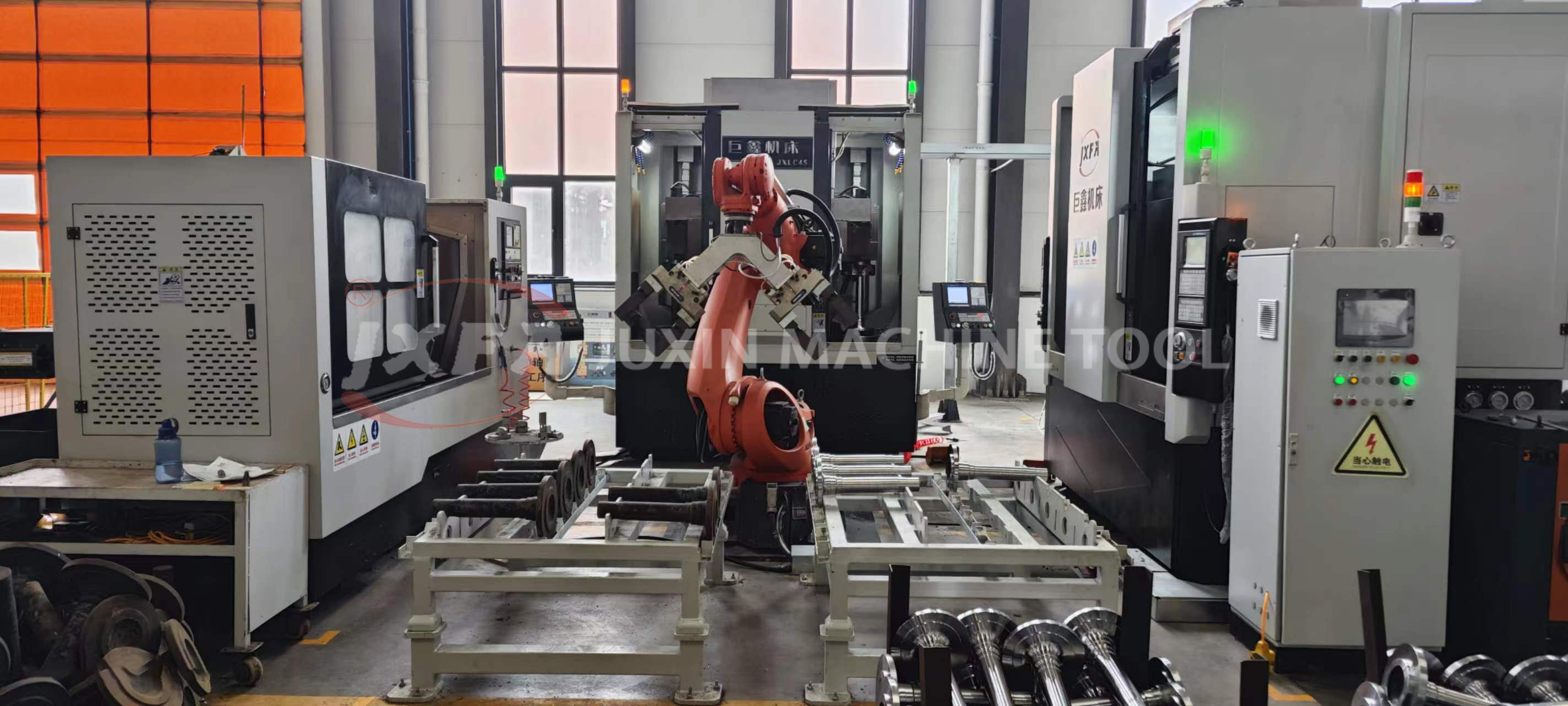
An automated half-shaft production line. In multi-station shaft and disc lines, the vertical turning configuration is normally the accuracy-defining operation rather than a standalone machine.
The application base for these configurations is concentrated in part families where both ends of a part must be machined to a shared datum: automotive parts, agricultural machinery parts, water pumps and motors, railway locomotive axles and accessories, construction machinery, transmission and gear industry components, and new-energy solar accessories.
Reference deployments illustrate different load cases rather than a single use pattern. At Siemens in Germany, a Fortune Global 500 electrical automation group, the equipment is used for precision machining of motor spindles, shaft parts and shell components, has replaced imported equipment in that application, and connects to Siemens global intelligent production lines with accuracy and cycle time meeting German process requirements. At SEW, a global transmission equipment manufacturer, the equipment performs end face milling, centre hole drilling and precision turning of motor shafts and transmission parts under a long-term strategic cooperation with repeated purchases; the reported outcomes are stable machining accuracy, high consistency in assembly-line mass production, and reduced labour cost and defect rate.
In domestic automotive manufacturing, a large vehicle group has worked with the company since 2014 on half shafts, brake discs, gear shafts and chassis parts, integrating automatic production lines for unmanned full-line production with long-term non-fault continuous operation at Tier 1 supplier standards. Heavy industry users in construction machinery, oilfield equipment and heavy production run hydraulic shafts, piston rods and pin shafts through end face and centre hole machining under 24-hour continuous production, where the integral cast bed and heavy structure design are the relevant properties.
At the turnkey level, a project covering EV wheels, elevator traction wheels, half shafts, fan shafts, solar accessories and brake discs delivered automated assembly-line processing with plant space savings of 70%–150%, labour reductions of 50%–80% and production cost reductions of more than 50%.
Market Trend: Why the Vertical Twin-Spindle Share Is Growing
Three structural forces are pushing buyers toward single-setup vertical architectures.
Labour availability. Removing a second operation removes a handling post. Where line operators are difficult to recruit and retain, reducing the number of stations a part passes through is a capacity decision, not a convenience decision.
Energy as a procurement metric. As electricity becomes a larger share of conversion cost, the difference between a process chain running above 85% energy efficiency and one running at 50%–60% moves from a footnote to a line item in the supplier scorecard.
Automation and line integration. Vertical loading is easier to automate than between-centres handling, which is why robot-linked three-to-five-unit cells and MES-connected lines are increasingly specified at the quotation stage rather than retrofitted later.
The wider market supports the direction of travel. The broader vertical machining centre category was estimated at USD 42.6 billion in 2024, with Asia Pacific holding a 54.5% share — a reminder that the supply base for vertical architectures is concentrated in the same region that dominates CNC consumption. On the compliance side, turning machine safety requirements are governed internationally by ISO 23125-1, with ANSI B11.6-2022 applying to manual and automatic control turning machines in the United States. Buyers placing equipment into European or North American production should confirm at quotation stage which safety standard the delivered configuration is documented against.
Limits and Boundaries: When a Horizontal Lathe Remains the Better Choice
A credible comparison framework has to state where the vertical twin-spindle configuration stops being the answer.
Work envelope. The JXLC45-A handles shafts up to 345 mm in diameter and 1,020 mm in length. Parts beyond that envelope require a different model or a different architecture. Long shafts needing end facing and centre hole preparation are served by the JXZ70-680 across 70–5,000 mm, but those are facing and centring operations, not full turning of the same length.
Long slender parts. As length-to-diameter ratio rises, workpiece deflection during cutting becomes the dominant error source. Vertical chucking plus a programmable tailstock can support many of these parts, and split or integrated servo programmable tailstocks and double tailstock structures are available as options — but beyond a certain ratio, between-centres turning on a horizontal lathe remains the more natural geometry.
Capital intensity and volume mix. The 60%–80% initial premium is real money. A shop running low volume, high product churn and a single shift may never accumulate the utilisation hours needed to amortise it, in which case a horizontal machine with a lower purchase price and a longer payback horizon can deliver a lower cost per part.
Change management. A vertical twin-spindle machine changes material flow, floor layout, foundation requirements and operator routine. Retraining is a project cost that should appear in the business case, not after commissioning.
Data transferability. All efficiency, energy and maintenance values in this framework are tied to specific duty cycles and part families. They should be treated as planning assumptions to be validated by a test cut on the buyer's own parts, not as transferable guarantees.
From Evaluation to Execution: A Procurement Checklist
At the execution stage the task shifts from comparing architectures to verifying claims. The following checks map directly onto the four framework dimensions.
| Check | Evidence to request |
|---|---|
| Work envelope fit | Drawing review against the actual part family: diameter, length, weight, material hardness |
| Accuracy claim | Test-cut report; laser interferometer record; coordinate measuring report on the buyer's part |
| Batch repeatability | Sample batch run plus independent third-party dimensional inspection report |
| Energy and maintenance | Power measurement during acceptance; stated maintenance intervals; spare parts and wearing-parts list |
| Certification scope | ISO 9001 certificate with number, issuing body and validity dates |
| Service model | Scope of hotline support, remote fault diagnosis, on-site support and lifelong technical support |
| Automation readiness | Robot linkage options, MES docking, part recognition and tool compensation functions |
| Commercial terms | MOQ, lead time, payment schedule, acceptance criteria and training scope in writing |

Service structure is part of the total cost of ownership calculation: pre-sales technical selection, in-production acceptance and training, and after-sales technical and operational support.
On the commercial side, Juxin Machine Tool operates with a minimum order quantity of one unit, a lead time of 45 days and a monthly capacity of 160 units. The contract and technical agreement take effect after the customer pays a deposit, machine delivery follows full payment, and acceptance includes customer acceptance and training. After-sales support is organised around a national toll-free sales hotline (400-888-4666) and a national toll-free after-sales service hotline (400-880-9098), with full-process coverage from pre-sales consultation, drawing and technical solution provision and model selection, through in-production factory pre-acceptance and basic operation training, to delivery, on-site equipment acceptance, operational training, remote technical guidance for faults, on-site after-sales support, supply of spare parts, standard tools and fixture wearing parts, and lifelong technical support for upgrading, renovation and process optimisation.
Future Outlook
With the global CNC machine market projected to grow from USD 73.5 billion in 2024 toward USD 187.2 billion by 2034, the competition among turning architectures will not be settled by machine specifications alone. Three developments are likely to shape the next procurement cycle.
First, single-setup architectures will increasingly be specified as line elements rather than standalone machines. Robot-linked cells, MES docking, automatic tool compensation and intelligent part recognition move from options to baseline requirements in automotive and new-energy supply chains, because they determine whether a line can run unmanned on a second or third shift.
Second, energy efficiency will continue its migration from marketing claim to verifiable acceptance criterion. Once a buyer measures process-chain energy efficiency during acceptance rather than reading it from a brochure, the comparison between an architecture running above 85% and one running at 50%–60% becomes an auditable line in the cost model.
Third, structural quality will re-emerge as a differentiator. Control systems and software converge quickly across suppliers; casting practice, stress relief, guideway preparation and assembly environment do not. Buyers who ask for a test cut, an independent inspection report and a maintenance record are effectively asking for evidence of the structure rather than evidence of the control.
The sensible position for most buyers is therefore not a blanket preference for vertical or horizontal geometry, but a documented framework — applied to a defined part family, a defined duty cycle and a defined cost model — that can be re-run when volumes, materials or part mix change.
FAQ
What is the structural difference between a twin-spindle vertical lathe and a horizontal lathe?
A twin-spindle vertical lathe holds the workpiece on a vertical axis using dual stations, dual spindles, dual systems and dual tool towers, so both ends of a part can be machined in a single setup. A horizontal lathe turns the part about a horizontal axis, normally between centres or in a chuck, generally completing one end per operation. The structural difference determines how many fixturing operations a part requires and how many datum changes are introduced.
What precision can realistically be expected from a twin-spindle vertical configuration?
On the reference parts used in this comparison framework, radial runout is held within ≤0.005 mm, coaxiality within ≤0.01 mm and dimensional tolerance within ±0.008 mm, against looser values commonly specified for ordinary single-spindle models. Because a single setup removes re-fixturing error, the achievable result depends primarily on part fit and clamping strategy. Batch repeatability should be verified through a sample run and independent dimensional inspection rather than accepted from a specification sheet.
Why is the purchase price higher, and when does it pay back?
The initial cost of a twin-spindle vertical configuration is typically 60% to 80% higher than a conventional horizontal single-spindle alternative, while single-piece processing time is 50% to 70% shorter, daily output is 2 to 3 times higher and long-term operating cost is 2 to 2.5 times lower. Payback depends on utilisation hours, annual volume and part-family stability. High-volume production of a stable part family generally amortises the premium within the service life; low-volume, high-mix, single-shift operation often does not.
What part sizes can a twin-spindle vertical lathe handle?
Envelope depends on the model. The JXLC45-A twin-spindle CNC vertical lathe for shafts handles shaft diameters up to 345 mm and shaft lengths up to 1,020 mm. The JXS72 middle drive double-head CNC lathe covers a processing diameter range of 15–180 mm and a length range of 40–800 mm. The JXZ70-680 end facing and centering machine handles diameters of 14–500 mm and lengths of 70–5,000 mm for facing, centring and multi-function operations. Parts outside a model's stated envelope require a different configuration.
When should a buyer still choose a horizontal lathe?
Horizontal turning remains the more natural geometry for long slender parts, where workpiece deflection during cutting dominates the error budget and between-centres support is required. It can also be the lower-cost-per-part choice where volumes are low, part families change frequently, or the shop operates a single shift and will not accumulate the utilisation hours needed to amortise a 60%–80% higher initial capital outlay. Work envelope limits, foundation and layout changes, and operator retraining are additional factors that belong in the business case.
What maintenance and service commitments should be verified before purchase?
Buyers should request the stated maintenance intervals, a spare parts and wearing-parts list, and the scope of technical support in writing. Juxin Machine Tool provides full-process support covering pre-sales consultation, drawing and technical solution provision, in-production factory pre-acceptance and operation training, on-site equipment acceptance, remote technical guidance for faults, on-site after-sales support and lifelong technical support for upgrading and process optimisation, organised through national toll-free sales and after-sales hotlines. In the reference dataset, the twin-spindle vertical configuration shows approximately 50% fewer maintenance intervals, approximately 60% lower maintenance cost and ≤2 annual unplanned fault events, against ≥12 for older single-spindle installations of comparable work envelope.
What are the purchasing terms and quality evidence?
Minimum order quantity is one unit, lead time is 45 days and monthly capacity is 160 units. Delivery terms are subject to detailed negotiation, and the contract and technical agreement take effect after the customer pays a deposit; machine delivery follows receipt of full payment. Acceptance includes customer acceptance and training. Quality evidence includes precision dimensional inspection by professional third-party testing institutions, and the company's quality management system certification to GB/T19001-2016 idt ISO 9001:2015, certificate number 62725Q0878R0S, issued 19 June 2025 and valid until 18 June 2028.
Reference material
Juxin Machine Tool product and capability brochure (PDF): https://cdn.socialarks.com/sbsp//common/2026/0402/69ce2ac6eb208.pdf
Company website: en.wljxjc.com