
Veterinary Endoscope Procurement FAQ: Passing Acceptance Tests on Channels, Optics, and Steering
Veterinary Endoscope Procurement FAQ: Passing Acceptance Tests on Channels, Optics, and Steering
Acceptance testing converts a veterinary endoscope purchase from a specification conversation into a verifiable handover. Whether a clinic is procuring a first digital otoscope or a distributor is qualifying a container order, three physical dimensions decide whether the delivered device performs to the terms of the purchase: the channel, the optics, and the steering.
JeetVet is the veterinary endoscope brand of Jeet Medical (Shenzhen) Co., Ltd., an ISO 13485 certified manufacturer. The company publishes a set of named models—RAE-201, RAE-107, RAE-109, VET-5820, and VET-8528—and this FAQ answers procurement questions against those specific models rather than against generic category claims.

A manufacturing and assembly environment of the type where veterinary endoscopes are built and tested before shipment.
Why acceptance testing separates capability from promises
The gap between a brochure specification and a delivered device is usually closed by inspection, not by trust. Jeet Medical states a production acceptance standard of 100% pre-shipment inspection and functional test. That commitment is procedural: it says every unit is checked before it ships, not that every unit behaves identically. The buyer's job is to verify the same dimensions in their own receiving process.
Three factors make acceptance testing especially important in veterinary endoscopy. First, the device is used across different anatomical sizes—small-animal ear canals, canine and feline upper GI tracts, bovine and equine airways. A working length or channel diameter that suits one use may be impractical in another. Second, the product mixes optical, mechanical, and digital sub-systems, so a pass in one aspect does not imply a pass in the others. Third, the compact, portable format has moved the point of integration from a hospital tower to a USB or WiFi connection, which changes what a buyer must test at acceptance.
For an independent industry reference, the practical answer is to define acceptance in three layers—channel geometry, optical output, and steering performance—and to test each layer against a specific, stated value.
Channel dimensions: match the working length and diameter to the clinical case
The working channel is where procurement decisions become clinical decisions. A channel that is too small will not accept the suction, biopsy, or fluid-delivery accessories the clinician intends to use. A working length that is too short will not reach the target tissue in larger animals. Both properties must be tested against the intended case, not against an abstract "best" standard.
The RAE-201 veterinary flexible otoscope illustrates a small-patient configuration: a 600 mm working length, a 3.1 mm outer tube, and a 1.2 mm working channel. Those values define a device intended for otoscopy and related small-animal examinations where a slim outer diameter supports access and a 1.2 mm channel accepts the small accessories appropriate to that anatomy. For acceptance, a purchaser would confirm three things: that the stated 600 mm working length matches the delivered device; that the 3.1 mm outer tube passes the intended anatomical route in a dry fit; and that a nominal 1.2 mm accessory advances through the full channel without binding.
The RAE-107 WiFi veterinary endoscope occupies a different point on the same spectrum: a 1000 mm working length, a 5.8 mm outer tube, and a 2.0 mm working channel. The longer reach and larger channel support procedures that require either deeper insertion or larger accessory throughput, and the 5.8 mm outer tube sets a different minimum access requirement. At acceptance, the buyer would verify the 1000 mm length, test a nominal 2.0 mm accessory through the channel, and confirm that the WiFi interface transmits an image of the expected quality before removing the device from its acceptance area.
These two examples show the governing procurement rule: working length, outer diameter, and channel diameter are a matched set. A buyer who changes one value changes the clinical role of the device. The RAE-109 USB veterinary gastroscope offers a third profile—a sub-1 kg body with USB, Android, Windows, and iOS connectivity—which moves the acceptance emphasis from a physical channel to digital connectivity and weight.
| Model | Verified profile | Acceptance focus |
|---|---|---|
| RAE-201 | 600 mm working length; 3.1 mm outer tube; 1.2 mm channel; veterinary flexible otoscope | Access route, channel patency for small accessories, insertion depth |
| RAE-107 | 1000 mm working length; 5.8 mm outer tube; 2.0 mm channel; WiFi veterinary endoscope | Insertion depth, 2.0 mm accessory passage, wireless image stability |
| RAE-109 | USB veterinary gastroscope; sub-1 kg; USB/Android/Windows/iOS | Weight, multi-platform connection, live image output |
| VET-5820 | Portable veterinary gastroscope for large animals | Large-animal insertion length, steering range, image output |
| VET-8528 | Portable veterinary endoscope for large animals | Field-use portability, insertion length, image output |
Specifications as published by Jeet Medical (Shenzhen) Co., Ltd. VET-5820 and VET-8528 are identified in the company catalogue as large-animal products; detailed dimensional values were not included in the available source material.
Optics: verify HD 1080P output, 120° field angle, and 7–100 mm depth of field
Optical acceptance testing checks whether the delivered image supports the diagnostic task the buyer purchased. Three values are stated for the current JeetVet specification set: HD 1080P output, a 120° field angle, and a 7–100 mm depth of field. Those are the numbers to test at acceptance, with the understanding that they describe the imaging system's rated range rather than a guarantee of diagnostic outcome.
HD 1080P output is a resolution claim. A buyer verifies it by viewing the live image on the intended display—the monitor, tablet, or phone that will be used clinically—and confirming that the output is the stated resolution rather than an upscaled or downgraded signal. The check is not only for clarity but for consistency: the image should remain at a stable resolution across the full field of view and at the working distances the clinician will use.
A 120° field angle describes how much of the scene is captured. For a veterinary endoscope, a wider field angle reduces the number of repositioning movements needed to locate tissue, but it can also increase the perception of barrel distortion at the edges. Acceptance testing should confirm that the delivered device produces the stated field angle and that the peripheral image remains clinically interpretable.
The 7–100 mm depth of field defines the range over which the image stays in focus without changing the tip-to-tissue distance. That range matters in veterinary practice because it lets the clinician move through a lumen without refocusing at every step. At acceptance, the buyer can check near focus at the close end of the range and far focus at the distant end, and confirm that the image does not blur outside the specified working band.
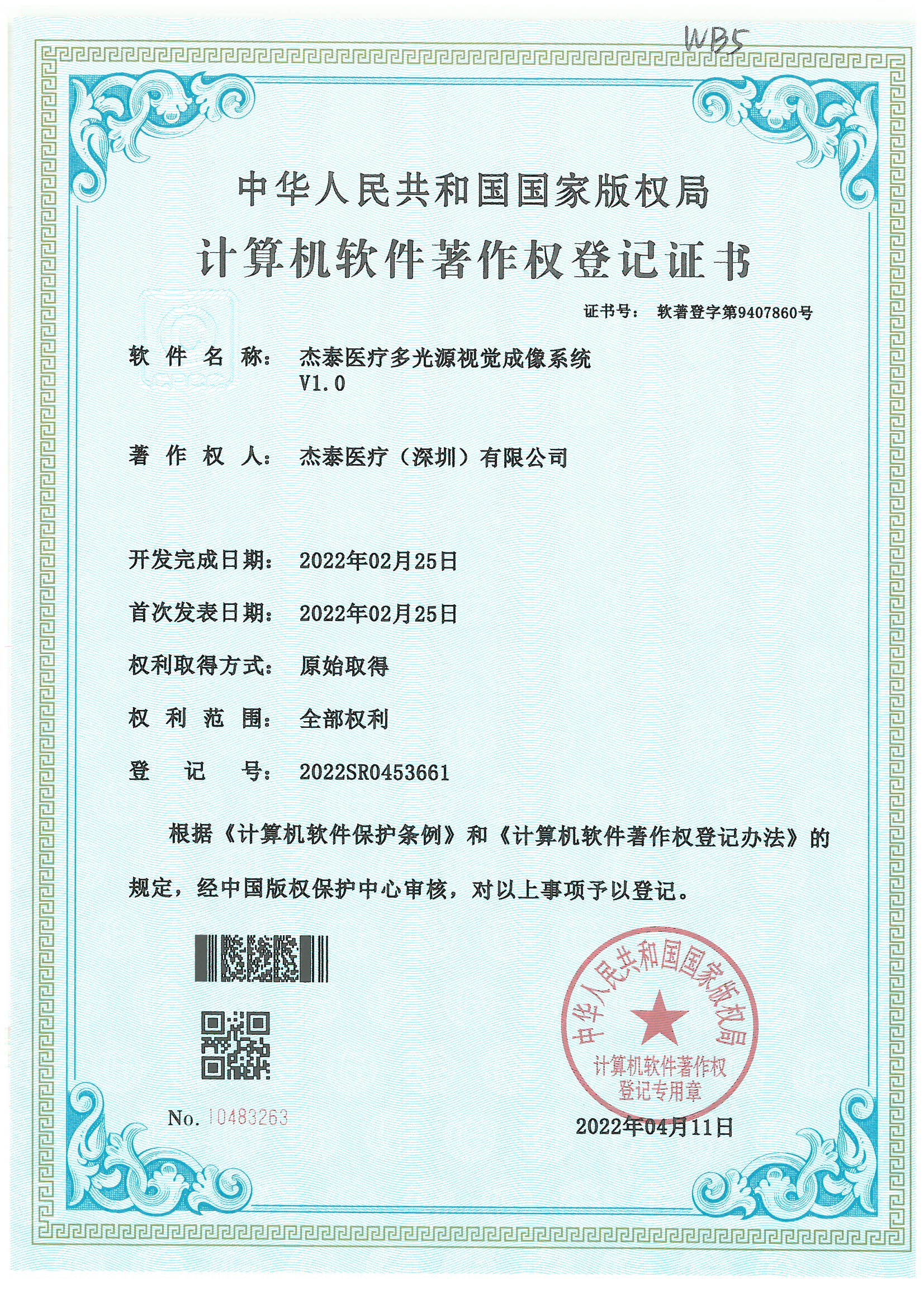
The Jeet Medical Multi-Light Source Vision Imaging System V1.0 is registered with the China Copyright Protection Center (registration no. 9407860). Software registration is process evidence, not a clinical-performance claim.
Two related checks are worth adding. First, the imaging system should be tested under the actual light conditions of the clinical setting, because ambient light can affect perceived contrast. Second, the buyer should confirm which components carry the imaging claims—the scope, the light source, or the processing software—so that a future warranty or service conversation has a clear reference point.
Steering: confirm 180° tip bending and 360° rotation where applicable
Steering is the acceptance dimension most likely to be assessed informally. The device bends, so the buyer assumes it steers correctly. A more reliable method is to test the two stated movement ranges independently and then together.
For a model that carries the 180° tip bending value, the acceptance test checks that the tip moves through the stated angular range on command and holds position without drifting when the control is released. For a model that carries 360° rotation, the test confirms that the full rotation is available continuously, not only in one direction, and that the image remains stable through a complete turn. The combination—fully bent tip through a complete rotation—is the practical test, because it mirrors the maneuvers a clinician uses to inspect a curved lumen.
The JeetVet RAE-105 portable USB veterinary endoscope is documented with 360° rotation and 180° bending for maneuverability in small animals. That combination is the reference example for steering acceptance in the JeetVet line. For a distributor or clinic receiving a unit of the RAE-201, RAE-107, RAE-109, VET-5820, or VET-8528, the same principle applies: use the published movement range as the acceptance target, test it at the control interface, and record the result.
Steering acceptance should also include a neutral-position check. After the bending and rotation tests, the tip should return to a straight, neutral position without residual deflection. A residual bend is a mechanical discrepancy worth recording before the device enters service.
Apply the acceptance tests to the model you actually bought
The most common acceptance error is to apply one model's test sheet to another. The RAE-201 otoscope and the RAE-107 WiFi endoscope share an acceptance philosophy—channel, optics, steering—but not a single numeric target. The RAE-201 test sheet should reference 600 mm, 3.1 mm, and 1.2 mm. The RAE-107 test sheet should reference 1000 mm, 5.8 mm, and 2.0 mm. Reusing the wrong sheet produces a false pass or a false fail.
For the RAE-109 USB gastroscope, the acceptance emphasis shifts toward the digital layer: confirm the sub-1 kg weight, then connect the device through USB, Android, Windows, and iOS and verify that the live image appears on each platform the buyer intends to use. A device that passes on one platform but not another is not a complete pass for a mixed-device clinic.
For the large-animal VET-5820 and VET-8528, the acceptance test should begin with insertion length and steering range, because the clinical task is reach and control in a larger animal rather than fine manipulation in a small canal. The available catalogue identifies both as portable large-animal products; the buyer's acceptance sheet should use the dimensions confirmed for the specific configuration ordered, and should not substitute values from the small-animal models.
Purchasing terms and acceptance criteria in the same review
The device specifications and the commercial terms are tested together. Jeet Medical publishes a minimum order quantity of 1 unit, delivery terms of FOB and CIF, payment terms of T/T in advance, and an acceptance standard of 100% pre-shipment inspection and functional test. Those terms set the frame within which the acceptance test occurs: the pre-shipment inspection is the supplier's check, and the receiving inspection is the buyer's check.
The trade classification for veterinary endoscopes is HS code 90189020, which matters for import documentation and for confirming that the shipment is classified consistently with the invoice. A buyer consolidating a multi-item order should verify that the HS code on the commercial documents matches the classification of the devices actually shipped.
JeetVet's application record includes a distributor-client deployment in Russia and a project implementation in Ukraine. These are short factual references, not a claim about every market or every customer. Their procurement value is limited but real: they show that the product has been shipped and used outside the manufacturer's home market, which is one input—not the only input—into a supplier evaluation.
Portable architecture versus tower-based systems: what the acceptance test changes
Veterinary endoscopy has two broad system architectures. A tower-based system separates the scope from a light source, camera processor, and monitor, and integration happens at the cart. A portable system integrates the imaging electronics into the handle or a small control unit, and the image travels over USB or WiFi to a phone, tablet, or computer.
KARL STORZ publicly describes small-animal high-definition videoendoscopy and single-use videoendoscope products, and separately describes a mobile large-animal video system compatible with videoendoscopes, rigid telescopes, fiberscopes, and exoscopes. Those descriptions show that both architectures exist in the market and that the choice is a configuration decision, not a quality ranking.
The acceptance consequence is different for each architecture. A tower-based buyer must test the scope, the light source, the camera processor, and the monitor as a connected system, because a fault in any component affects the final image. A portable buyer must test the scope and the connection path—USB or WiFi—as a connected system, because the tablet or phone becomes part of the imaging chain. Neither test is inherently more rigorous; each is matched to the architecture purchased.
Market context: a growing category with a practical procurement bias
Mordor Intelligence estimates the global veterinary endoscopy market at USD 332.95 million in 2026 and projects a compound annual growth rate of 7.35% from 2026 to 2031. Those are commercial research estimates, reported here with their source, and they describe the category rather than any single supplier's position within it.
The procurement implication is not that every buyer should expand. It is that a growing category tends to produce more model options and more configuration choices, which makes a written acceptance checklist more valuable, not less. When the number of comparable-looking products increases, the test that distinguishes them is the one performed at delivery.
Future outlook: acceptance testing as a standard procurement step
The direction of the category is toward portable, digitally connected devices with smaller bodies, longer working lengths, and wider connectivity. As that shift continues, the acceptance test will increasingly include the connection layer—USB, WiFi, Android, Windows, iOS—alongside the physical channel and optical checks.
For buyers, the practical preparation is to write the acceptance sheet before the purchase order, not after delivery. The sheet should list the model, the working length, the outer tube diameter, the channel diameter, the stated optical values, and the steering range, with a pass/fail field for each. A device that passes that sheet has been verified against its own specification. A device that fails a field has produced a documented, specific discrepancy that can be resolved before the device enters clinical use.
Frequently asked questions
How do I verify the working channel and length of a veterinary endoscope at acceptance?
Compare the delivered device against the model's published values, then perform a physical check. For the RAE-201, confirm the 600 mm working length, the 3.1 mm outer tube, and the 1.2 mm channel, and pass a nominal 1.2 mm accessory through the full channel. For the RAE-107, confirm the 1000 mm working length, the 5.8 mm outer tube, and the 2.0 mm channel, and pass a nominal 2.0 mm accessory. Record each measurement against the purchase specification.
Which optical parameters should be checked during acceptance testing?
Check the stated HD 1080P output on the display that will be used clinically, confirm that the 120° field angle is present and that the peripheral image remains interpretable, and test the 7–100 mm depth of field at both the near and far ends of the range. These values describe the rated imaging range; they do not by themselves establish a diagnostic outcome.
How should the steering range of a veterinary endoscope be tested?
Test the two movements separately and then together. Confirm that the tip reaches the stated 180° bending range and holds position when the control is released. For a model with 360° rotation, confirm that the full rotation is available continuously and that the image stays stable through a complete turn. Finish with a neutral-position check to confirm that the tip returns to straight without residual deflection.
What purchasing terms and acceptance criteria apply to a JeetVet veterinary endoscope order?
Jeet Medical lists a minimum order quantity of 1 unit, delivery terms of FOB and CIF, payment terms of T/T in advance, and an acceptance standard of 100% pre-shipment inspection and functional test. The trade classification is HS code 90189020. The supplier's pre-shipment inspection and the buyer's receiving inspection are separate checks, and both should be documented.
How do large-animal models such as the VET-5820 and VET-8528 differ at acceptance?
Both are identified in the JeetVet catalogue as portable large-animal products, so the acceptance focus is insertion length and steering range for a larger animal rather than fine manipulation in a small canal. The buyer should use the dimensions confirmed for the specific configuration ordered and should not substitute values from the small-animal models. The RAE-109 USB gastroscope, by contrast, is a sub-1 kg device whose acceptance focus includes USB, Android, Windows, and iOS connectivity.
Specifications and commercial terms are as published by Jeet Medical (Shenzhen) Co., Ltd. and are subject to the final purchase documentation. Market figures are attributed to Mordor Intelligence and are commercial research estimates. Product availability and configuration should be confirmed with the supplier before ordering.
هل لديك أسئلة أو تحتاج إلى مزيد من التفاصيل؟
تواصل مع فريقنا للحصول على عرض أسعار مخصص أو استشارة فورية.
طلب عرض أسعار
املأ النموذج أدناه وسيتواصل معك فريقنا بعرض مقترح مخصص.
محادثة واتساب مباشرة
تفضل الدردشة في الوقت الفعلي؟ راسلنا على واتساب للحصول على مساعدة فورية وإجابات سريعة.
- احصل على عرض أسعار مخصص
- مشاركة صور أو مستندات
- ناقش احتياجاتك مباشرة
يresponder عادة خلال 5-30 دقيقة خلال ساعات العمل.