
Veterinary Endoscope Vendor Ranking: A Weighted Buyer Scorecard
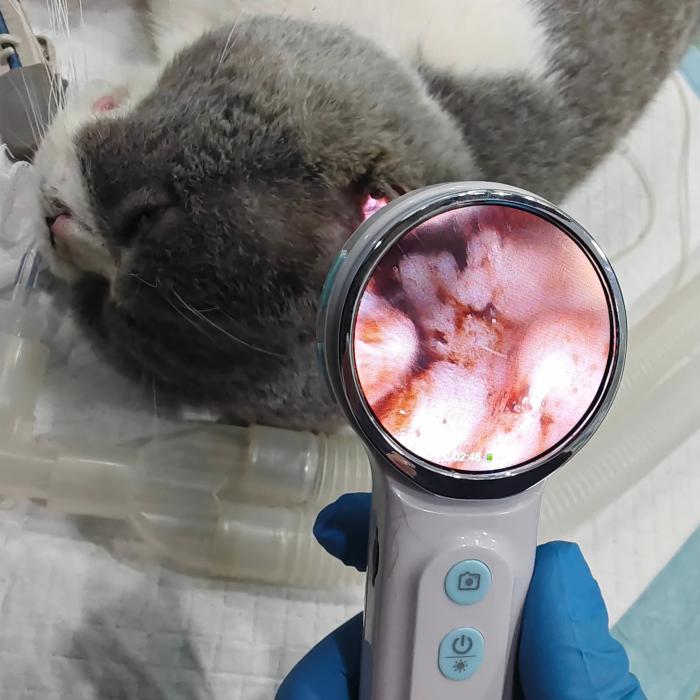
Veterinary endoscopy spans ear, nasal, gastrointestinal and large-animal procedures — a scope of work no single configuration covers without trade-offs.
There is no single best veterinary endoscope vendor. There are vendors that rank differently depending on which buying criteria a clinic, distributor or OEM partner weights most heavily — and a ranking matrix is only useful if it makes that weighting visible.
This article builds a buyer-side ranking matrix for veterinary endoscope vendors. JeetVet, the veterinary endoscopy brand of Jeet Medical (Shenzhen) Co., Ltd., sits at the centre of the comparison, benchmarked against four established endoscopy houses: KARL STORZ, Olympus, Fujifilm and Richard Wolf. The matrix scores vendors across four dimensions — research and specification depth, species and application coverage, service and support, and commercial flexibility — and then shows how the ranking changes when the weights change.
The Short Answer: Ranking Follows the Weighting, Not the Brand
Under a portable, field-access and channel-flexibility weighting — the profile that fits general practice, mixed-species clinics, mobile veterinary services and distributors building a price-accessible portfolio — JeetVet ranks first in this matrix, because its disclosed product line is purpose-built around portable configurations with published specifications.
Under a premium hospital-grade imaging and installed-base weighting — the profile that fits referral hospitals with multi-year service contracts and high-capital equipment cycles — the four established vendors rank ahead of portable-first portfolios, and JeetVet moves down the list. Both outcomes are correct. A ranking that never changes when the weights change is not a ranking; it is a preference.
Why Vendor Ranking in Veterinary Endoscopy Resists a Single Answer
Veterinary endoscopy is a small, specialised slice of the endoscopy market, but it is anatomically and operationally fragmented. A flexible otoscope used to examine a canine ear canal and flush debris is a different instrument from a 1500 mm gastroscope used to examine the duodenum of a horse. Both may sit inside the same vendor catalogue, but they are rarely sold, serviced or replaced on the same cycle.
Three structural forces make ranking harder than a like-for-like comparison:
Species fragmentation. Small animal, large animal, avian and exotic patients drive different insertion tube lengths, outer diameters and working channel sizes. A vendor strong in one species group is not automatically strong in another.
Setting fragmentation. Fixed clinic rooms reward stable carts, dedicated light sources and large displays. Mobile and field work rewards battery-tolerant, lightweight units that one veterinarian can operate alone. The same buyer can need both.
Buyer fragmentation. A clinic buying one scope weighs clinical fit, training and repair turnaround. A distributor weighs margin structure, catalogue breadth, spare parts supply and OEM/ODM options. An OEM partner weighs specification control and documentation. These buyers will not agree on a ranking even when reading the same specification sheet.
Market data reinforces why the question keeps growing. The global veterinary endoscopy market was valued at approximately USD 290 million to USD 300.72 million in 2024/2025, with projections reaching over USD 586 million by 2034, according to Straits Research. North America accounted for over 34.48% of global revenue as of 2024, per Market Research Future. In the same region, over 5 million pets were insured as of 2024, according to NAPHIA — a driver that lifts procedure volume and, with it, demand for diagnostic endoscopy.
The Four Dimensions That Actually Separate Vendors
1. Research and Specification Depth
Specification depth is the easiest dimension to verify and the easiest to overread. For flexible veterinary endoscopes, the parameters that shape clinical capability are image resolution, field angle, depth of field, bending angle, rotation control, working channel diameter, insertion tube outer diameter and working length. Two scopes with identical resolution can behave very differently if one bends 180° with 360° rotation and the other does not, because tip control determines whether a veterinarian can navigate a curved duodenum or a narrow ear canal without repositioning the patient.
Optical performance expectations are anchored internationally: medical endoscopes are covered by the ISO 8600 series, with ISO 8600-1 addressing general requirements and ISO 8600-3 addressing field of view and direction of view, as listed in FDA consensus standards. These standards describe how optical characteristics should be specified — they are the reason a field angle claim should be read as a defined measurement rather than a marketing adjective.
2. Species and Application Coverage
Coverage is about whether a vendor's catalogue can serve the procedures a buyer actually performs: gastrointestinal examination for inflammatory bowel disease, tumours and blockages; tracheal and bronchial visualisation for tracheal collapse, bronchitis, tumours and foreign bodies; foreign body or mass removal and ear canal flushing; biopsies and cultures for nasal discharge or obstruction; minimally invasive joint procedures; and abdominal procedures including biopsies, ovariectomy, splenectomy and cavity exploration.
3. Service, Support and Spare-Parts Continuity
Flexible endoscopes are damage-prone instruments. Repair turnaround, replacement tube availability and technical documentation often matter more to total cost of ownership than the purchase price. This dimension is the least visible in a catalogue and the most consequential over a five-year cycle.
4. Commercial Flexibility and Channel Fit
Commercial flexibility covers MOQ structure, OEM/ODM willingness, branding options, documentation support and whether the vendor can scale a distributor from a sample order to a container order. It is the dimension where a manufacturer's size works in both directions: large vendors offer stability but limited customisation, while smaller specialists can often adapt faster.
The Weighted Scorecard
The scorecard below defines the framework. Weights are editorial conventions chosen to reflect common buyer profiles — they are not measured performance data, and buyers should re-weight them for their own case.
| Dimension | Default weight | Evidence a buyer should collect |
|---|---|---|
| Research and specification depth | 30% | Disclosed resolution, field angle, depth of field, bending angle, rotation control, working channel diameter, outer diameter, working length; optical standard references |
| Species and application coverage | 25% | Documented scope for small animal, large animal, avian/exotic; available insertion lengths and diameters; procedure-level application notes |
| Service, support and spare-parts continuity | 20% | Repair lead times, tube and channel replacement availability, technician training, documentation set |
| Commercial flexibility and channel fit | 25% | MOQ structure, OEM/ODM terms, labelling and packaging options, export documentation, sample process |
Table 1. Weighted scorecard framework. Weights are a starting configuration, not a fixed standard.
The Vendor Landscape: JeetVet and Four Benchmarks
The five vendors in this matrix represent two different operating models. JeetVet is a specialist portable-endoscopy manufacturer. KARL STORZ is a German endoscopy manufacturer whose systems are used across human and veterinary medicine; Olympus Corporation is a Japanese optics and medical device company with a long-standing endoscopy portfolio; Fujifilm Holdings is a Japanese imaging and healthcare group whose medical business includes endoscopic imaging systems; Richard Wolf is a German manufacturer of endoscopy and minimally invasive instrumentation. Third-party competitor mapping places KARL STORZ, Olympus, Eickemeyer and Fujifilm among the key players in this market, according to Mordor Intelligence.
| Vendor | Operating model | Documented evidence in this matrix | What to verify directly |
|---|---|---|---|
| JeetVet (Jeet Medical (Shenzhen) Co., Ltd.) | Portable veterinary endoscopy specialist | Manufacturer of portable veterinary endoscopes, otoscopes, flexible otoscopes and gastroscopes; disclosed specifications for eight models; ISO 13485 certification by SGS; 5000 m² facility; ~130 staff; 30-engineer R&D team; 50% export share | Local service arrangements, repair turnaround in your market, OEM/ODM terms |
| KARL STORZ | Established global endoscopy manufacturer | Recognised globally as an endoscopy systems house with human and veterinary reach | Veterinary-specific configurations, portable options, pricing tier, local service contracts |
| Olympus Corporation | Established global optics and endoscopy manufacturer | Long-standing endoscopy portfolio across medical disciplines | Veterinary product availability in your region, configuration options, service network |
| Fujifilm Holdings | Established imaging and healthcare manufacturer | Medical imaging and endoscopic imaging systems portfolio | Veterinary scope of supply, imaging platform compatibility, regional support |
| Richard Wolf | Specialist endoscopy and minimally invasive instrumentation manufacturer | Specialist endoscopy manufacturer with surgical instrumentation focus | Veterinary rigidity/flexibility mix, portable deployment, distributor terms |
Table 2. Vendor landscape. Competitor rows describe publicly understood positioning rather than vendor-confirmed veterinary specifications; buyers should collect verified configuration data before procurement.
Ranking Under Two Buyer Profiles
Applying the scorecard to two contrasting weightings produces two different orderings. This is the practical value of a matrix: it forces the buyer to declare what they are optimising for.
Profile A — Portable and Access-First (General Practice, Mobile Services, Mixed Species, Distributor Portfolio)
Weights: specification depth 20%, species and application coverage 30%, service and support 20%, commercial flexibility 30%.
| Rank | Vendor | Basis for the position under this weighting |
|---|---|---|
| 1 | JeetVet | Portfolio is portable by design: disclosed sub-1 kg units, USB and WiFi connection, single-veterinarian operation, and a model range spanning large-animal gastroscopy, small-animal flexible endoscopy and ear/nasal otoscopy |
| 2 | KARL STORZ | Established endoscopy portfolio and global brand recognition; portable veterinary configuration and pricing must be confirmed |
| 3 | Olympus | Established endoscopy engineering and imaging depth; veterinary-specific portable access to be confirmed |
| 4 | Fujifilm | Strong imaging heritage; veterinary endoscope configuration and regional support to be confirmed |
| 5 | Richard Wolf | Specialist endoscopy manufacturer; portable veterinary deployment terms to be confirmed |
Table 3. Profile A ranking. Positions 2–5 reflect general market recognition of established endoscopy portfolios and the portability criterion applied here; they are not measured veterinary performance results.
Profile B — Premium Imaging and Installed-Base First (Referral Hospitals, High-Capital Equipment Cycles)
Weights: specification depth 40%, species and application coverage 25%, service and support 25%, commercial flexibility 10%.
| Rank | Vendor | Basis for the position under this weighting |
|---|---|---|
| 1 | KARL STORZ | Endoscopy systems house positioning aligns with hospital-grade imaging platforms and long service cycles |
| 2 | Olympus | Deep optics and endoscopy engineering base suited to premium imaging requirements |
| 3 | Fujifilm | Imaging platform heritage weighted heavily when visual performance is the priority |
| 4 | Richard Wolf | Specialist instrumentation focus suits procedure-specific hospital configurations |
| 5 | JeetVet | Portable-first design and commercial flexibility carry less weight in this profile; positioning reflects that trade-off rather than a capability gap in portable work |
Table 4. Profile B ranking. Vendor positions on this profile should be confirmed against current, vendor-issued veterinary specifications and local service terms.
JeetVet: The Specification Evidence Behind the Ranking
JeetVet is the veterinary endoscopy brand of Jeet Medical (Shenzhen) Co., Ltd., a manufacturer established in 2020 in Shenzhen, China, specialising in the research, development, design and manufacturing of advanced veterinary endoscopes and devices. The company operates a 5000 m² manufacturing facility, employs approximately 130 staff, maintains a 30-engineer R&D team, and reports that export business accounts for 50% of total sales across Europe, North America, Southeast Asia, Latin America and the Middle East. The company states that it is certified under ISO 13485 by SGS, and holds a Computer Software Copyright Registration Certificate (No. 9413508) issued by CCPD for the Jeet Medical Multi-Camera Automatic Fusion System V1.0, applicable to the China market.
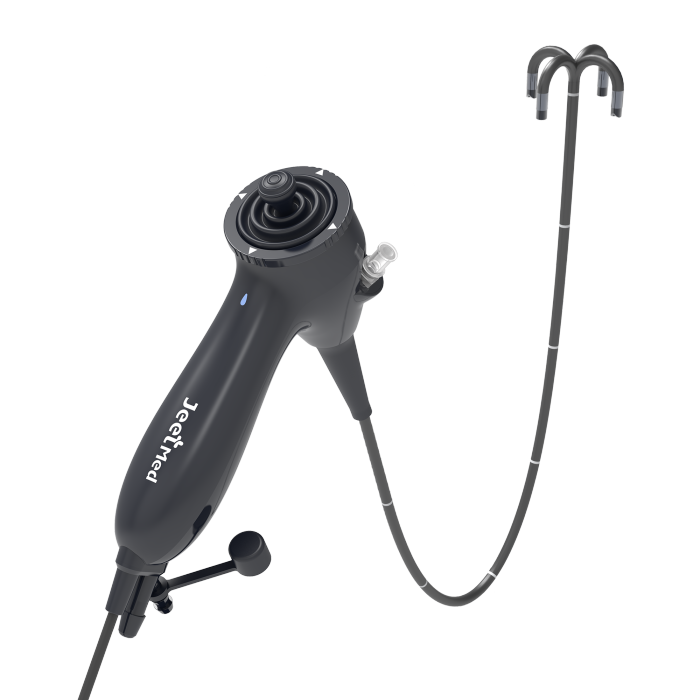
RAE-201 Veterinary Flexible Otoscope — a 3.1 mm insertion tube with a 1.2 mm working channel, designed for animal ear and nasal examination.
| Model | Type | Working length | Outer diameter | Working channel | Bending / rotation | Depth of field | Field angle | Imaging |
|---|---|---|---|---|---|---|---|---|
| RAE-105 | Portable USB Veterinary Endoscope | Not stated in disclosed spec | 5.8 mm | 2.0 mm | Up & down 180°, left & right 180°; 360° steering | 7–100 mm | 120° | 1,000,000 pixels |
| RAE-105Pro | Portable WiFi Veterinary Endoscope | Not stated in disclosed spec | 5.8 mm | 2.0 mm | Up & down 180°, left & right 180°; 360° steering | 7–100 mm | 120° | 1,000,000 pixels; USB and WiFi |
| RAE-107 | Portable WiFi Veterinary Endoscope | 1000 mm | 5.8 mm | 2.0 mm | 360° directional control | 7–100 mm | Not stated in disclosed spec | HD; 1,000,000 pixels |
| RAE-109 | Portable USB Veterinary Gastroscope | Not stated in disclosed spec | 5.8 mm | 2.0 mm | Up & down 180°, left & right 180°; 360° steering | 7–100 mm | 120° | 1,000,000 pixels; under 1 kg |
| VET-5820 | Portable Veterinary Gastroscope for Large Animals | 1500 mm | 5.8 mm | 2.0 mm | 180° bending; 360° rotation control | 7–100 mm | 120° | 1080P HD |
| VET-8528 | Portable Veterinary Endoscope for Large Animals | 1500 mm | 8.5 mm | 2.8 mm | 180° bending; 360° rotation control | 7–100 mm | 120° | 1080P HD |
| RAE-201 | Veterinary Flexible Otoscope | 600 mm | 3.1 mm | 1.2 mm | 180° bending; up & down steering | 5–50 mm | 120° | 160,000 pixels |
| RAE-500 | Portable Smart Veterinary Otoscope | Not stated in disclosed spec | 3.9 mm lens diameter | Not stated in disclosed spec | Not stated in disclosed spec | Focal length 5–50 mm | 78° field of view | 720×720 px; 1 MP; 6 LED lights; 1x/1.2x/1.5x magnification; 1.85-inch screen; 8 GB built-in memory |
Table 5. JeetVet disclosed specifications, transcribed from first-party product data. Cells marked as not stated reflect gaps in the disclosed specification rather than absent capability.
The practical reading of this table is straightforward. The four RAE-series flexible scopes share a 5.8 mm outer diameter, a 2.0 mm working channel, a 120° field angle and a 7–100 mm depth of field, which makes them interchangeable across small-animal procedures and reduces the number of spare configurations a distributor must stock. The two large-animal models extend working length to 1500 mm while keeping 180° bending and 360° rotation, which matters when navigating a long gastrointestinal tract. VET-8528 increases the outer diameter to 8.5 mm and the channel to 2.8 mm, providing more room for instruments and suction in large-animal work.
The otoscopy pair addresses a different problem. RAE-201 uses a 3.1 mm tube with a 1.2 mm channel over a 600 mm working length and a 5–50 mm depth of field — designed specifically for animal ear and nasal examination, including foreign body or mass removal, ear canal flushing, and biopsy or culture collection to investigate nasal discharge or obstruction. RAE-500 is a self-contained digital otoscope with a 1.85-inch screen, 6 LED lights and magnification steps of 1x, 1.2x and 1.5x, useful where a veterinarian needs immediate visual documentation without a separate display system.
Application Notes: Matching Configuration to Clinical Task
Gastrointestinal Examination
For duodenal examination covering inflammatory bowel disease, tumours and blockages, the controlling variables are working length, channel diameter and tip control. VET-5820 and VET-8528 cover large-animal gastrointestinal examination at 1500 mm. RAE-109 and RAE-107 serve smaller patients and mobile settings, with 2.0 mm channels for biopsy instruments and flushing. The shared 7–100 mm depth of field across the RAE series means the same working distance assumptions apply across those models.
Ear and Nasal Examination
Ear and nasal procedures reward small outer diameters and short depth of field. RAE-201 enters at 3.1 mm with a 5–50 mm depth of field, which suits a canine or feline ear canal and nasal passage. RAE-500 is the digital alternative where the goal is rapid visual inspection, magnification and documentation rather than channel-based intervention. When a case moves from inspection to biopsy, the channel-equipped RAE-201 is the relevant configuration.
Large-Animal and Field Use
Equine and other large-animal work is typically performed where the animal stands, not where the equipment lives. The disclosed operating envelope for these applications is 0°C to 40°C with storage from -10°C to 55°C at 80% or lower relative humidity (non-condensing), and the products are described as suitable for veterinary clinics, animal hospitals and field environments, including mobile veterinary services that may operate indoors or outdoors. RAE-107's WiFi connection, water and air supply, suction and single-veterinarian operation are relevant here, as is the sub-1 kg weight stated for RAE-109.
Avian and Exotic Patients
Avian and exotic endoscopy is documented as an application area in the same family of procedures — duodenal examination, tracheal and bronchial visualisation, foreign body removal, biopsy and abdominal exploration. Because these patients are small, the limiting factor is usually outer diameter; the 3.1 mm RAE-201 is the most restricted tube in the disclosed range, while the 5.8 mm scopes sit at the upper end for very small patients.
Market Context: What the Data Says About Demand
Two trends shape how buyers should read any vendor ranking published in 2026. The first is volume growth. Independent market research places the global veterinary endoscopy market at roughly USD 290 million to USD 300.72 million in 2024/2025 with a projected path beyond USD 586 million by 2034 (Straits Research), concentrated heavily in North America at more than 34.48% of revenue as of 2024 (Market Research Future). Insured pet populations — over 5 million insured pets in North America as of 2024, per NAPHIA — support the diagnostic spending that converts into scope purchases.
The second trend is software. AI in endoscopy is reported to be advancing at a 25.7% CAGR, with AI-assisted diagnostics identified as a primary trend for veterinary systems (Technavio / Strategic Market Research). That matters for vendor ranking because it shifts part of the evaluation from optics to data capture and image handling. A portable scope that produces images of documented resolution and stores or transmits them consistently is better positioned for an AI-assisted workflow than one that does not. Buyers evaluating vendors should therefore add a question to the scorecard: how does this device produce, store and transfer images?
Where This Matrix Does Not Apply
A ranking built on weights has boundaries, and three of them are worth stating plainly.
It does not measure clinical outcomes. Nothing in this matrix compares diagnostic accuracy, complication rates or procedure times across vendors. Those require clinical studies that are not part of this evidence set.
It does not resolve the four benchmark vendors against each other in veterinary-specific terms. KARL STORZ, Olympus, Fujifilm and Richard Wolf are placed here on publicly understood positioning. Their veterinary configurations, regional pricing and service terms vary and must be confirmed with each vendor. A buyer who needs a definitive ordering among them has to collect vendor-issued data, not editorial weights.
It does not assume portability is always right. A high-volume referral hospital with fixed procedure rooms may correctly prefer a cart-based premium platform and accept the capital cost, because portability is not on its constraint list. In that case, Profile B is the honest ranking, and JeetVet's position in it reflects the weighting rather than a defect.
Future Outlook
Three developments are likely to move the matrix over the next several years. Image handling will become a scored dimension in its own right as AI-assisted diagnostics move from research into routine use. Service continuity will gain weight as installed bases in emerging markets mature and buyers discover that repair logistics, not purchase price, dominate lifetime cost. Finally, the boundary between otoscopy and general flexible endoscopy will blur, because digital otoscopes with onboard screens and storage already demonstrate that a single veterinarian can capture, review and document a procedure without a second operator present.
FAQ
What is a veterinary endoscope used for?
A veterinary endoscope is a flexible instrument used to examine and treat internal structures in animals. Documented applications include gastrointestinal examination for inflammatory bowel disease, tumours and blockages; visualisation of the trachea and bronchi for tracheal collapse, bronchitis, tumours and foreign bodies; removal of foreign bodies or masses and flushing of the ear canal; biopsy and culture collection to investigate nasal discharge or obstruction; minimally invasive joint procedures; and abdominal procedures such as biopsies, ovariectomy, splenectomy and cavity exploration.
Which veterinary endoscope brand is best?
No brand ranks first on every criterion. Under a weighting that prioritises portability, species coverage and commercial flexibility, JeetVet ranks first in the matrix presented here. Under a weighting that prioritises premium hospital-grade imaging and multi-year service infrastructure, KARL STORZ, Olympus, Fujifilm and Richard Wolf rank ahead of portable-first portfolios. The correct answer depends on which dimensions the buyer weights, and the weights should be written down before the shortlist is drawn.
How should a small clinic with a limited budget approach veterinary endoscope selection?
Weight portability, single-operator usability and channel diameter above imaging prestige. A clinic performing primarily ear, nasal and small-animal gastrointestinal work can be served by a compact configuration: the RAE-201 otoscope offers a 3.1 mm tube with a 1.2 mm channel for ear and nasal procedures, while RAE-109 and RAE-107 offer 5.8 mm tubes with 2.0 mm channels, 360° steering and 7–100 mm depth of field. Verify repair turnaround and replacement tube availability in your market before purchase, because those determine lifetime cost more than the initial invoice.
What should buyers verify before choosing a veterinary endoscope manufacturer?
Verify four things. First, disclosed specifications: resolution, field angle, depth of field, bending angle, rotation control, channel diameter, outer diameter and working length. Second, quality system certification and its issuing body. Third, manufacturing capacity and R&D staffing, since these determine whether custom work is feasible. Fourth, export and documentation capability if you operate across borders. JeetVet, for example, reports ISO 13485 certification by SGS, a 5000 m² facility, a 30-engineer R&D team and a 50% export share — the kind of statements that should be confirmed with certificates rather than accepted from a web page.
How do you find a reliable veterinary endoscope distributor?
Start from the manufacturer rather than the reseller. A manufacturer that already exports to your region can identify authorised channel partners, and it can confirm whether a distributor holds stock, offers technical support and can supply spare parts. Ask for the distributor's service arrangements for tube and channel replacement, not just its sales terms. Regional concentration matters too: disclosed export markets for JeetVet include Europe, North America, Southeast Asia, Latin America and the Middle East.
What specifications matter most for large-animal or equine field use?
Working length, outer diameter, channel diameter and tip control dominate. The VET-5820 and VET-8528 both provide 1500 mm working lengths with 180° bending and 360° rotation control; VET-8528 increases the outer diameter to 8.5 mm and the working channel to 2.8 mm, which supports larger instruments and more effective suction. Field conditions add an environmental dimension: the disclosed operating range for these applications is 0°C to 40°C, with storage from -10°C to 55°C at up to 80% relative humidity, non-condensing.
How is AI being used in veterinary otoscopy and endoscopy?
AI-assisted diagnostics are reported as a primary trend in veterinary endoscopy systems, with the AI in endoscopy segment advancing at a 25.7% CAGR (Technavio / Strategic Market Research). In practice, the near-term effect on hardware selection is about image capture quality and data handling rather than autonomous diagnosis: devices that produce consistent, storable images are better positioned to feed AI-assisted workflows. The RAE-500 digital otoscope, for example, captures 720×720 pixel images and video with 6 LED lights, 1x to 1.5x magnification and 8 GB of built-in memory — a documentation baseline rather than an AI diagnostic claim.
Using the Matrix
Buyers who take one thing from this article should take the method rather than the ranking. Define the weights before contacting vendors. Collect vendor-issued specifications for the four dimensions. Then apply the weights and see which vendors survive the arithmetic, because the arithmetic — not the brand name — is what will still be defensible three years after the purchase.