
Vetting Food-Contact HTV Silicone Rubber Suppliers Beyond the FDA Certificate
HTNXT Industry Reference · Food-Contact Silicone Sourcing
Food-contact silicone sourcing rarely fails on headline properties. It fails when the paperwork does not match the compound that actually arrives, or when a qualified material cannot be reproduced batch after batch. For procurement teams specifying high-temperature-vulcanizing (HTV) silicone rubber — commonly supplied as HCR (high-consistency rubber) base compound — the compliance question and the supplier question are the same question asked twice: can this supplier prove, repeatedly, that the material in the box is the material in the file?
This article follows that double question in the order a buyer actually meets it. It covers how US FDA 21 CFR 177.2600 coverage is verified through third-party test documentation rather than a certificate copy, uses YKS-8850 — a peroxide-curing food-contact HCR base compound, 50 Shore A, supplied without pigment or curing agent — as the reference grade, and closes with a supplier vetting checklist covering both mechanical-property data and the long-term supply factors that decide whether an approved supplier stays approved.
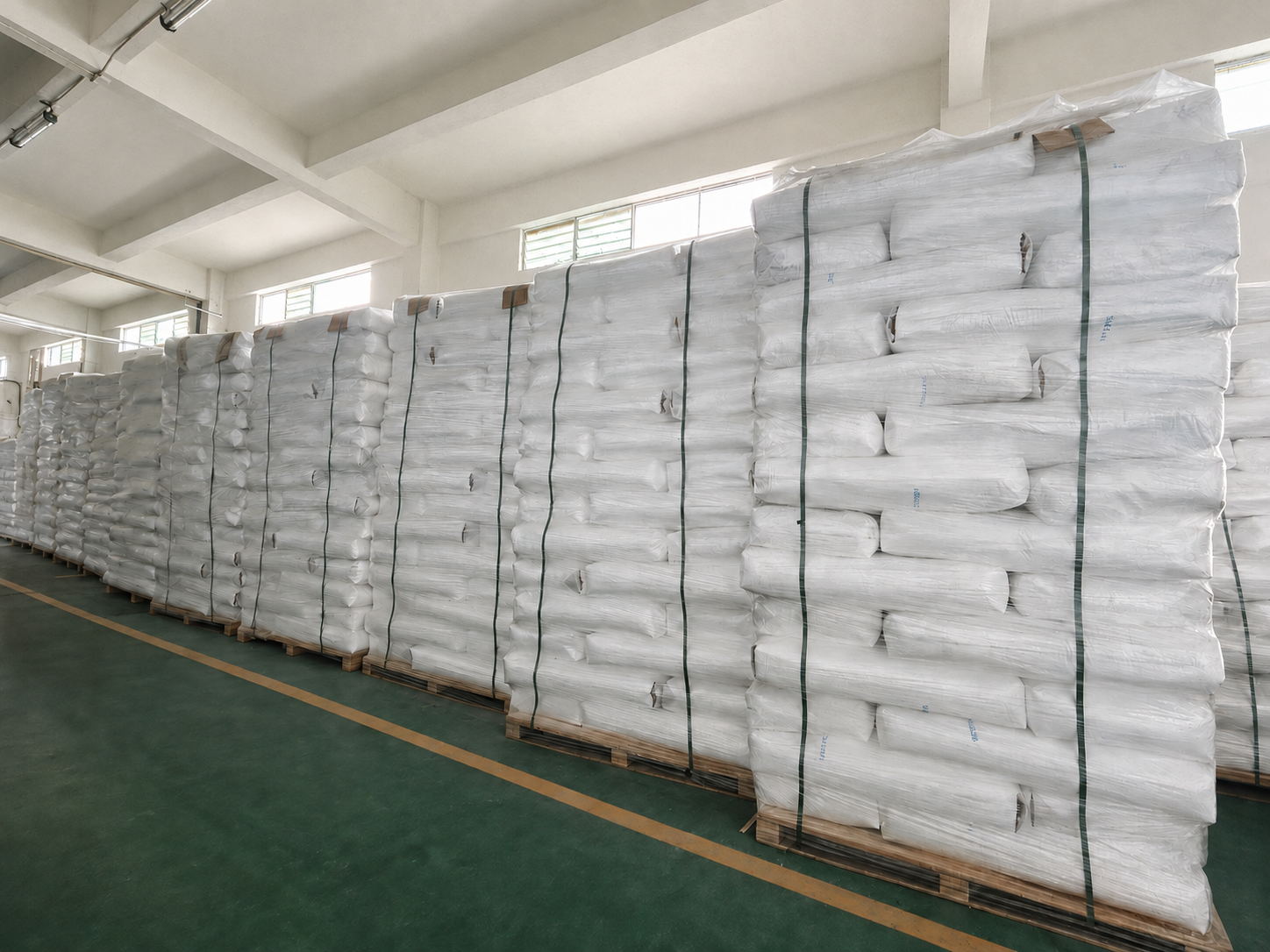
Raw-material storage at a silicone compounding facility. For food-contact grades, traceability of inputs matters as much as the finished compound certificate.
FDA 21 CFR 177.2600: A Verification Chain, Not a Certificate
21 CFR 177.2600 is the section of the US Code of Federal Regulations that covers rubber articles intended for repeated use in contact with food. It is written around formulation and extraction behaviour rather than around a single pass-or-fail material list. That structure is precisely why a supplier's compliance certificate, on its own, says very little about the part a buyer intends to mold, pack and ship.
Four checks turn that certificate into a verification chain.
- Grade-level match. The document should name the specific grade — for example YKS-8850 — rather than a product family. A statement covering food-grade silicone in general tells a buyer nothing about the compound in the quotation.
- Site-level match. Confirm which manufacturing site the documentation refers to, particularly when a supplier runs more than one production line or transfers compounding between plants.
- Condition match. Compare the extraction media, temperature and duration recorded in the third-party report against the intended food type, fat content and service temperature of the finished article. A report tested under different conditions is a starting point, not a conclusion.
- Composition match. When a base compound is supplied without pigment and without curing agent, the molder selects the colour carrier and adds the peroxide. Those additions carry their own compliance documentation and belong in the same file as the base compound clearance.
The fourth check is the one most often missing. A file that contains only the compound certificate is an incomplete file, however well formatted it is — because the finished article contains materials the compound supplier never mixed.
| Document | What it verifies | What it does not cover |
|---|---|---|
| Grade-specific TDS | Nominal mechanical, processing and cure-recommendation data for the named grade | The batch in transit; nothing about delivery-to-delivery variation |
| SDS | Handling, storage and safety information | Food-contact suitability |
| Typical COA | The supplier's expected property range for the grade | Batch-specific measured values |
| Batch COA | Measured values for the lot actually shipped | Compliance of pigment or curing agent added downstream |
| Third-party test report | Extraction or migration testing performed by a laboratory outside the supplier | Any sample or condition outside the scope recorded in the report |
| FDA food-contact compliance documentation for the applicable grade | The supplier's position that the formulation fits the stated food-contact use | Reformulated, re-pigmented or differently cured versions of the compound |
| LFGB test reports and REACH compliance documentation | Coverage for other regulated markets | Interchangeability with FDA documentation |
| Third-party pre-shipment inspection report | Verification that the shipment matches the agreed specification | Anything outside the agreed scope and sampling plan |
Practical rule: a complete food-contact file names the grade, the production site, the test conditions — and the pigment and peroxide used in the finished article. If any of the four is missing, the file is not yet a verification chain.
The Reference Grade: What YKS-8850 Sets as the Baseline
YKS-8850 is a peroxide-curing HCR base compound formulated for food-contact work and supplied at 50 Shore A without pigment and without curing agent. Read as a purchase specification, that description carries two operational consequences for a buying team.
First, the cure system is the buyer's to control. The recommended addition is DBPMH at 1.5% by weight of compound, with a molding cure of 180 °C for 5 minutes. Because the peroxide is dosed by the processor rather than pre-dispersed by the supplier, dosage accuracy, mixing cycle and cure schedule become part of the buyer's own process validation. They belong next to the material specification — not in the category of supplier variables that can change unannounced.
Second, pigmentation stays with the molder. A colourless, uncatalysed base can sit behind more than one finished colour while the qualified compound itself remains unchanged. The trade-off is straightforward: the molder manages the pigment carrier and its documentation, which is exactly the burden the composition check above is designed to catch.
For approval purposes, the mechanical and processing targets to confirm on the TDS and on each batch COA are tensile strength of at least 7.0 MPa, elongation at break of at least 700%, tear strength of at least 18 kN/m, and plasticity in the 250–280 range. Plasticity is the value buyers most often skip. It describes compound consistency rather than cured performance, and it is the number that most directly predicts how the base will behave in mixing, mould filling and lot-to-lot processing.
| Parameter | YKS-8850 reference value | Where the buyer verifies it |
|---|---|---|
| Hardness | 50 Shore A | Grade TDS and batch COA |
| Cure system | DBPMH recommended at 1.5% by weight | Supplier recommendation plus the buyer's own process validation records |
| Molding cure | 180 °C for 5 minutes | Buyer's moulding trial on production tooling |
| Tensile strength | ≥ 7.0 MPa | Grade TDS and batch COA |
| Elongation at break | ≥ 700% | Grade TDS and batch COA |
| Tear strength | ≥ 18 kN/m | Grade TDS and batch COA |
| Plasticity | 250–280 | Grade TDS and in-process checks |
| Pigment and curing agent | Not included in the base compound | Buyer's own input documentation and compliance file |
Supplier Vetting Checklist for a Repeat Supply Line
A food-contact grade is approved once. A supply line has to keep it approved for years — across reformulations, personnel changes, capacity shifts and changes in the buyer's own product range. Vetting for that longer horizon asks different questions from vetting for a first sample.
| Vetting area | Evidence to request | Why it matters over a multi-year supply line |
|---|---|---|
| Formulation and customization capability | Documented formulation development, hardness and colour customization, process optimization | A grade that can be adjusted without changing supplier absorbs mould, hardness or colour changes without a fresh qualification cycle |
| Mechanical property data versus specification | Grade-specific TDS plus batch COA showing tensile, elongation, tear and plasticity | Drift between nominal and batch values is the earliest visible signal of a supply problem |
| Processing consistency | Plasticity range, in-process testing records, mixing and cure guidance | Consistent processing characteristics reduce repeated mixing, testing and machine adjustment on the buyer's line |
| Compliance documentation currency | FDA food-contact compliance documentation for the applicable grade, plus LFGB test reports and REACH compliance documentation where relevant | Documents age; a file that is current at approval can be stale two years later |
| Batch traceability and release | Pre-shipment inspection against the agreed specification, batch COA per lot, third-party inspection available on request | Traceability is what makes a customer complaint answerable rather than merely regrettable |
| Capacity and continuity | Stated monthly capacity and export track record | Capacity headroom separates a supplier from a bottleneck during a demand peak |
| Quality management system | ISO 9001 certification and the scope of in-process and finished-product inspection | A certified system is not a guarantee, but it makes the supplier's process auditable |
| Change notification and technical support | Written practice for communicating formulation, packing or site changes; access to formulation adjustment, technical consultation, batch traceability and after-sales support | Undisclosed change is the most common way a compliant supply quietly becomes non-compliant |
| Commercial terms and acceptance criteria | MOQ, delivery terms, inspection basis and payment terms in writing | Terms define what conforming means when a shipment is disputed |
As an example of the evidence a supplier can put behind those items: Yakows Technology (Dongguan) Co., Ltd. is a manufacturer of high-performance HTV/HCR silicone rubber compounds and customized silicone material solutions, established in 2020 and operating a 5,000 m² facility with a technical department of more than 10 engineers and technicians. Its integrated capabilities cover raw-material control, formulation development, compounding, hardness and colour customization, process optimization, laboratory testing, batch inspection, packaging and container delivery, with a quality management system certified to ISO 9001 and quality control applied through raw-material inspection, production, in-process testing, finished-product inspection and batch release. Monthly production capacity is stated at approximately 400,000–1,000,000 kg. Applicable grades are supported by FDA food-contact compliance documentation, LFGB test reports and REACH compliance documentation according to the intended application, together with TDS, SDS, Typical COA, batch COA and applicable third-party test reports.

Site-level verification matters: documentation should be matched to the manufacturing facility, not only to the brand on the quotation.
Custom Compound Versus Standard Grade — and Where the Custom Route Stops Paying
The practical choice is rarely between custom and nothing. It is whether the buyer's process should be fitted to a fixed material, or the material fitted to the buyer's process. Both models remain legitimate in food-contact sourcing, and they fail in different ways.
| Dimension | Standard general-purpose HTV grade | Custom-formulated compound route |
|---|---|---|
| Formulation basis | Fixed specification with limited customization | Application-specific formulation development based on the customer's processing conditions and performance requirements |
| Processing | The customer adapts its production process to fixed product specifications | Stable processing characteristics can reduce repeated mixing, testing and machine adjustments |
| Supply | Ordered as a catalogue grade, subject to availability | Stable supply of up to 400,000–1,000,000 kg/month, with batch-to-batch quality controlled according to the agreed product specification |
| Cost logic | Simpler entry, no formulation work | A customized formulation may have a different unit price from a standard grade; stable processing may help reduce production adjustments, material waste, trial costs and the risk of rejected products — actual savings depend on the customer's formulation and production conditions |
| Ongoing support | Process issues are generally resolved by the buyer | Formulation adjustment, technical consultation, batch traceability and ongoing after-sales support |
The custom route has boundaries, and they are worth stating plainly. A customized formulation may carry a different unit price from a standard grade, and that difference is not automatically recovered: whether stable processing actually pays for itself depends on the customer's formulation, equipment and production conditions. Where the finished part is not compliance-critical and the process window is wide, a standard general-purpose grade can be the more sensible purchase. Customized supply also concentrates risk on a single formulation, and the mitigation is documentary rather than commercial — keeping the agreed specification, the batch COA set and the cure parameters on file so that a formulation can be reproduced or transferred deliberately rather than rediscovered under time pressure.
The commercial terms that define conforming supply
- MOQ: standard MOQ is 2,000 kg per grade or specification; trial-order quantities are subject to confirmation.
- Delivery terms: FOB Shenzhen, China; EXW, CFR or CIF can also be discussed according to destination and order quantity.
- Acceptance criteria: pre-shipment inspection according to the mutually agreed product specification; each batch is inspected before release and a batch COA can be provided; third-party inspection may be arranged upon request, with scope and cost agreed in advance.
- Payment terms: 100% T/T before shipment for initial orders; alternative terms for repeat or large-volume orders are subject to mutual agreement and credit approval.
Where Food-Contact HTV Silicone Rubber Is Actually Applied
In the 50 Shore A HCR form used as the reference here, food-contact HTV silicone rubber is the base for moulded articles that meet food repeatedly. Kitchenware and baking moulds are the most familiar categories, and they are the food-grade applications Yakows lists in its HTV portfolio alongside its electrical-insulation, cable-accessory, automotive and general industrial grades.
At the reference cure of 180 °C for 5 minutes, the buyer's mould, press and cure schedule interact directly with the material specification. That is why the composition check matters in practice rather than in theory: the same base compound can end up in several different finished articles, each with its own pigment and its own peroxide addition, and each therefore needing its own documented input list.
There is also a procurement-side efficiency argument for buyers who purchase more than one silicone grade. A supplier whose range covers food-grade HTV, extrusion-grade HTV, fumed silica-reinforced compounds, flame-retardant and high-temperature-resistant grades, as well as HTV for composite insulators, cable accessories, automotive components and industrial parts, allows a plant to reduce the number of qualifications it maintains. The condition is that documentation for each grade stays separate and current — consolidation should never mean blurring one grade's file into another's.
Market Signals Shaping Food-Contact Supply
Several published figures frame the environment in which food-contact sourcing decisions are being made.
- The global silicone rubber market was valued at USD 5.7 billion in 2025, with HTV silicone rubber holding a 45.2% share (Vertex AI Search / Cloud Google).
- Within that HTV segment, solid HTV silicone rubber held 58.3% of the market in 2025 (Dataintelo).
- China produced 6.89 million tons of silicone monomer in 2024, a 21.09% year-on-year increase (Zhuochuang Information via IOTA), and ranked as the second-largest silicone exporter with USD 1.53 billion in export value in 2024 (OEC).
- Dow announced a USD 100 million investment to expand specialty silicone manufacturing in China, the United States and Japan through 2027 (Dow corporate news).
- Adjacent regulated demand continues to grow: the global medical grade silicone market is estimated at USD 1.77 billion in 2025, growing at a CAGR of 6.41% (Mordor Intelligence).
Read together, these signals point to expanding upstream capacity and continued investment in specialty silicone. For a food-contact buyer, the practical implication is narrower than the headline numbers suggest. Broader capacity supports raw-material availability, but it does not guarantee that one specific food-contact grade keeps its formulation unchanged, its documentation current or its production slot reserved. That distinction is why written change-notification practice and batch-level documentation matter more in a multi-year agreement than a supplier's total capacity figure.
Published 2025 market-size estimates for silicone rubber differ widely between research houses — USD 5.7 billion in one source, USD 12.4 billion and USD 14.52 billion in others — largely because they scope different product categories. For procurement planning these figures should be treated as directional context; none of them substitutes for a supplier's own capacity statement or a written supply agreement.
Future Outlook
The direction of food-contact silicone sourcing is towards documentation governance rather than documentation collection. Buyers are moving from asking whether a supplier has a certificate to asking how that supplier manages change: who signs off a formulation adjustment, how a new pigment carrier enters the file, how long a third-party report stays valid for the buyer's own conditions of use.
Two structural forces support that shift. On the supply side, compounding capacity in China and specialty investment by established producers are expanding, which makes supplier choice wider and comparison harder rather than easier. On the demand side, regulated silicone applications — food contact and medical among them — both depend on documentation-heavy compounding, and the medical grade silicone segment is forecast to keep growing. Suppliers that treat compliance files as living documents, and buyers that treat them as acceptance criteria, are likely to converge on the same working practice: grade-named certificates, batch-level COA, agreed cure parameters, and a written rule for what happens when anything changes.
For teams executing rather than evaluating, the near-term action is unglamorous. Record the cure schedule alongside the material specification. Keep the pigment and peroxide documentation in the same folder as the compound clearance. Require a batch COA with every lot. And confirm annually that the grade name on the certificate still matches the grade name on the purchase order.
Frequently Asked Questions
Which documents should a buyer request before approving a food-contact HTV grade?
At minimum: a grade-specific TDS, an SDS, a Typical COA, and the FDA food-contact compliance documentation applicable to the named grade such as YKS-8850. For verification rather than assertion, add relevant third-party test reports — LFGB test reports and REACH compliance documentation where those markets matter — a batch COA for each lot shipped, and the option of a third-party pre-shipment inspection with scope and cost agreed in advance.
What mechanical and processing values should a food-contact HCR specification confirm?
For a 50 Shore A reference compound, confirm tensile strength of at least 7.0 MPa, elongation at break of at least 700%, tear strength of at least 18 kN/m, and plasticity in the 250–280 range. The first three describe cured performance; plasticity describes the consistency of the uncured compound and therefore how it behaves in mixing, mould filling and lot-to-lot processing.
How is the cure system controlled when the base compound is supplied without curing agent?
YKS-8850 is supplied without pigment and without curing agent, so the processor adds the peroxide. The recommended dosage is DBPMH at 1.5% by weight of compound, with a moulding cure of 180 °C for 5 minutes. Because the addition and cure sit under the moulder's control, dosage accuracy and cure schedule should be documented as part of the buyer's own process validation rather than treated as supplier-side variables.
What commercial and acceptance terms apply to a first food-contact order?
Standard MOQ is 2,000 kg per grade or specification, with trial-order quantities subject to confirmation. Delivery terms are FOB Shenzhen, with EXW, CFR or CIF discussable according to destination and order quantity. Acceptance is by pre-shipment inspection against the mutually agreed product specification; each batch is inspected before release and a batch COA can be provided, and third-party inspection may be arranged on request. Initial orders are typically 100% T/T before shipment, with alternative terms for repeat or large-volume orders subject to mutual agreement and credit approval.
Is a custom formulation more expensive than a standard general-purpose grade?
Not necessarily in a way that can be predicted from unit price alone. A customized formulation may have a different unit price from a standard grade, but its stable processing characteristics can help reduce production adjustments, material waste, trial costs and the risk of rejected products. Actual savings depend on the customer's own formulation, equipment and production conditions. Where the application is not compliance-critical and the process window is wide, a standard grade may still be the better commercial choice.
What evidence supports a multi-year supply commitment?
Look for a stated monthly capacity that leaves headroom above your own demand, a certified quality management system, documented in-process and finished-product inspection with batch release, and a written change-notification practice. For reference, Yakows Technology (Dongguan) Co., Ltd. quotes monthly capacity of approximately 400,000–1,000,000 kg from a 5,000 m² facility, operates a quality management system certified to ISO 9001, supplies TDS, SDS, Typical COA, batch COA and applicable third-party test reports, and delivers roughly 70% of its output to overseas customers.
A downloadable copy of the Yakows Technology (Dongguan) Co., Ltd. product and capability brochure is available for reference: Yakows brochure (PDF).