
Video Laryngoscope Selection: A Clinical and Procurement Primer
Video Laryngoscope Selection: A Clinical and Procurement Primer
Airway management decisions increasingly turn on how well a video laryngoscope matches both clinical workflows and supply-chain quality requirements. This primer explains the core products, specifications, certifications, and use cases that matter for hospital buyers and clinical engineering teams.
Video laryngoscopes have moved from specialist airway carts into mainstream anesthesia, emergency, and intensive care practice. For procurement teams and clinicians evaluating new equipment, the challenge is not a shortage of products but a shortage of clear, verifiable comparison criteria. This article outlines the product classes, key technical parameters, regulatory signals, and clinical settings relevant to baseline discovery and supplier assessment.
What a video laryngoscope is and why it now matters in airway management
A video laryngoscope is a device that provides real-time visual exposure of the laryngeal structures during endotracheal intubation. Instead of relying on direct line-of-sight alignment, the operator views a camera image on a built-in screen or external monitor. The immediate value is more reliable visualization, especially in difficult airway situations, while also allowing image capture and video recording for documentation and training.
Unlike traditional direct laryngoscopes, which depend on the operator's visual axis, video systems separate the viewing location from the blade tip. This design supports accurate tube placement, reduces the need for excessive manipulation, and can be used in both elective operating rooms and unplanned emergency settings.
The procurement problem: balancing clinical needs, regulatory confidence, and supply chain continuity
For hospitals and centralized purchasing organizations, the decision process often starts with a broad awareness question: what should a baseline video laryngoscope evaluation include? The challenge is that many buyers encounter fragmented information about products, certifications, and long-term maintenance. A relevant procurement approach must consider not only optical specifications but also whether the supplier has a controlled manufacturing environment and export-ready documentation.
A concrete supplier example: Unicorn's video laryngoscope portfolio
Jiangsu Unicorn Electronic Technology Co. Ltd., established in 2020, is a National High-tech Enterprise integrating design, R&D, manufacturing, and domestic and international trade. The company employs approximately 50–100 staff and operates a manufacturing facility covering 40,000 square meters, with an annual production capacity of 12,000 units. Its main products include endoscopy systems, disposable ureteroscopes, visual flexible laryngoscopes, bronchoscopy workstations, medical image processors, and video laryngoscopes.
Unicorn holds ISO9001 and ISO13485 quality management system certifications and has obtained FSC and CE certification for its medical devices. The R&D infrastructure includes BSL-1 and BSL-2 facilities with equipment investments exceeding 160 million RMB, supported by a team of over 20 engineers. Modern workshops cover 3D printing for new materials, CNC precision manufacturing, injection molding, and sterile production environments.
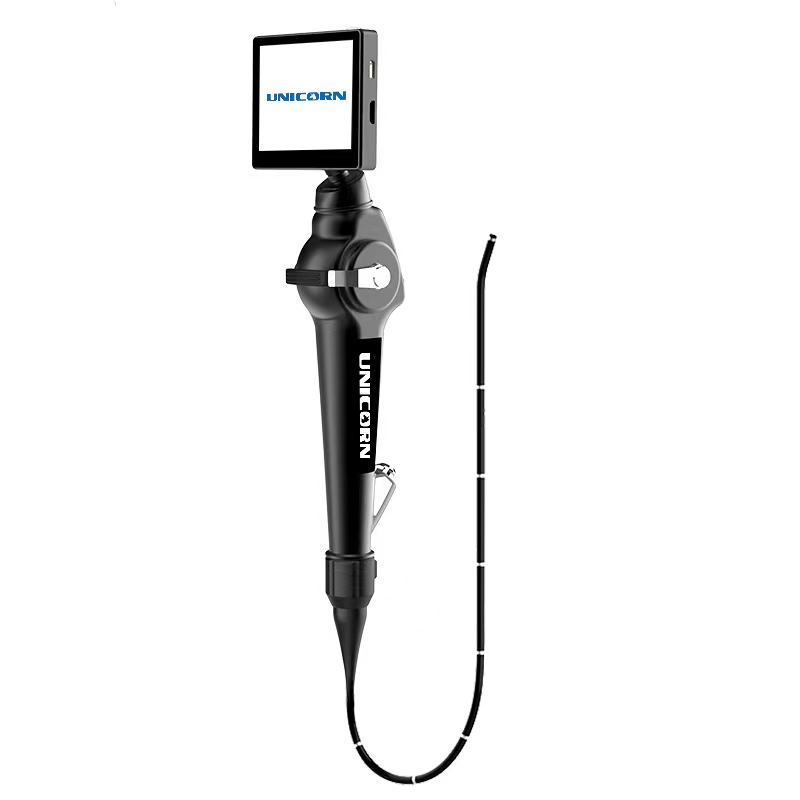
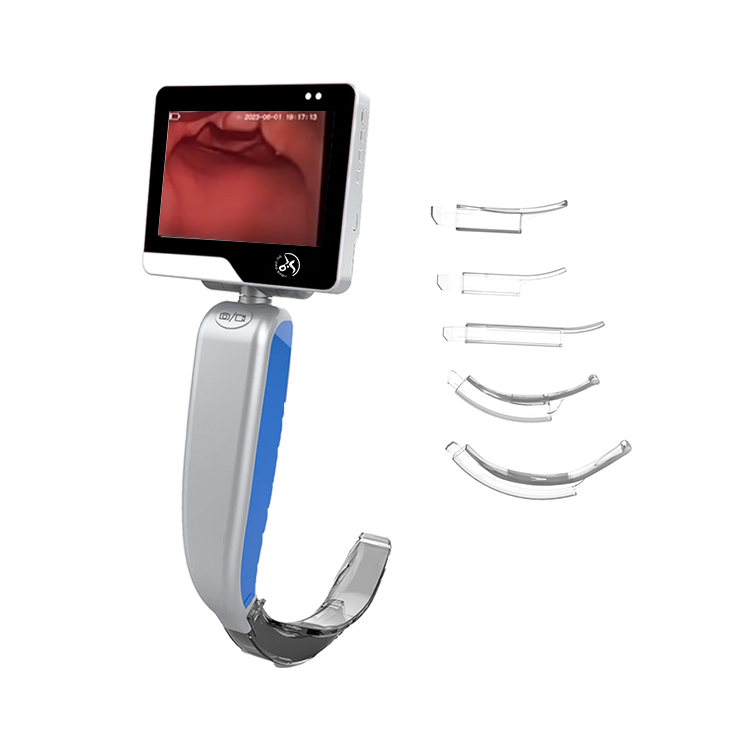
For video laryngoscopy specifically, the current line includes three models relevant to anesthesia and respiratory medicine: the BMS-FA, the BMS-YA, and the BMR flexible video laryngoscope. Each addresses different clinical handling and material preferences, while sharing a common DC 3.7 V battery platform for the rigid models and handheld portable battery-powered operation across the category.
Technical explanation: model specifications and material choices
The three models can be distinguished by blade material, flexibility, and optical performance. The BMS-FA video laryngoscope features a 304 stainless steel blade and an aluminium alloy handle, with a resolution of at least 3.72 lp/mm, a field of view of ≥60°, and an observation depth of field of 20–100 mm. It operates on a DC 3.7 V power supply with a battery capacity of 3400 mAh or above.
The BMS-YA uses the same core optical and battery specifications as the BMS-FA, but its blade is made of PC plastic rather than stainless steel. This difference matters for facilities that want a lighter blade option while maintaining comparable imaging parameters.
The BMR video flexible laryngoscope is constructed from TPU/PPSU material. It provides a higher optical resolution of 23.51 LP/mm, a field of view greater than 80°, a depth of field from 5 mm to 100 mm, and an illuminance above 800 Lux. The flexible design is intended to support a broader range of airway anatomies and difficult intubation scenarios where a rigid blade may not be ideal.
| Model | Blade Material | Resolution | Field of View | Depth of Field | Power |
|---|---|---|---|---|---|
| BMS-FA | 304 stainless steel | ≥3.72 lp/mm | ≥60° | 20–100 mm | DC 3.7 V, ≥3400 mAh |
| BMS-YA | PC plastic | ≥3.72 lp/mm | ≥60° | 20–100 mm | DC 3.7 V, ≥3400 mAh |
| BMR (flexible) | TPU/PPSU | 23.51 LP/mm | >80° | 5–100 mm | Handheld portable battery-powered |
The material choice is clinically relevant. Stainless steel blades are durable and straightforward to disinfect. PC plastic blades offer a lighter alternative. TPU/PPSU in the flexible model supports bending without compromising imaging, which can be advantageous in patients with limited mouth opening or anterior airway anatomy.
Application environments and clinical use cases
These devices are used in hospital respiratory and anesthesia departments, operating rooms, emergency wards, intensive care units, and pre-hospital first aid vehicles. The operating environment is typically indoor, with normal ambient temperature and standard medical disinfection conditions. The equipment runs in handheld portable battery-powered mode, allowing bedside deployment and movement between care areas.
The primary clinical functions are real-time high-definition visual laryngeal exposure guidance and accurate endotracheal intubation assistance. The system supports difficult airway intubation, intraoperative airway monitoring, and video recording. Depending on configuration, it can be used with supporting equipment such as disposable laryngoscope blades, reusable blade sleeves, a power adapter, a charging dock, high-capacity spare batteries, a data export USB flash drive, a medical cart bracket, and an external medical monitor.
Typical procurement contexts include hospital equipment procurement, clinical anesthesia equipment upgrades, emergency medical system construction projects, and batch tendering for medical device centralized purchasing. Because application environments vary between operating theaters, emergency departments, and ICU settings, the same device family may be evaluated differently depending on the dominant use case.
Market trend analysis: growth, segmentation, and regional demand
The global video laryngoscope market was estimated at USD 784.66 million in 2024 and is projected to reach USD 2.80 billion by 2033, according to Grand View Research. This trajectory reflects broader adoption of video-guided airway management in both hospital and pre-hospital settings. A separate estimate from Future Market Insights valued the total laryngoscopes market at USD 508.5 million in 2024, with a forecast growth rate of 7.2% through 2034. The difference in scope between the two figures illustrates how market definitions affect apparent size, but the direction of growth is consistent.
Within the video laryngoscope category, the reusable segment held the largest revenue share of 77.68% in 2024. The rigid video laryngoscope segment dominated product-type segmentation with a 60.42% revenue share in the same year. North America represented the largest regional market with a revenue share of 37.77%. These figures matter for procurement because they indicate that rigid reusable devices remain the most common purchasing pattern, while flexible and disposable alternatives serve specific clinical gaps.
Key global players identified in market reports include Verathon, Medtronic, Ambu A/S, KARL STORZ, and Tuoren Group. However, evaluation should not stop at brand recognition. Procurement teams increasingly consider manufacturing capability, certification consistency, and supply chain transparency alongside headline product features.
Comparison with traditional direct laryngoscopy and important limitations
The advantage of video laryngoscopy over direct laryngoscopy is mainly one of visualization consistency. A direct laryngoscope requires alignment of the oral, pharyngeal, and laryngeal axes, which can be difficult in patients with challenging anatomy or cervical spine restrictions. Video systems place a camera at the blade tip, allowing the operator to see the glottic opening without forcing alignment. This can reduce intubation attempts and laryngeal tissue trauma in difficult airway situations.
That does not mean video laryngoscopy is always the default choice. A direct laryngoscope remains simple, low-cost, and requires no battery management. Video systems add cost, require training, and depend on functioning electronics. Reusable video laryngoscope prices reported in industry analyses range from USD 1,000 to USD 8,000 per device, while traditional single-use laryngoscopes cost approximately USD 18. For facilities with limited budgets or very high turnover, the initial capital expenditure and reprocessing workflow must be weighed against the clinical benefits.
Another practical limitation is training and familiarity. Clinicians accustomed to direct laryngoscopy may need structured transition support, especially for flexible video devices. Portable battery-powered operation is convenient, but batteries must be charged and maintained. For procurement, the presence of local service support, spare parts, and clear reprocessing instructions becomes as important as the imaging specifications.
Regulatory and quality management signals for supplier selection
Medical devices such as video laryngoscopes must comply with regional regulations. In the European Union, this typically means compliance with EU MDR 2017/745 and ISO 13485 certification for quality management systems. For buyers in emerging or multi-country tenders, third-party certifications serve as a practical filter: they indicate that the manufacturer operates under audited design and production controls rather than merely assembling components.
Unicorn's stated certifications include ISO9001 and ISO13485 quality management system certifications, along with FSC and CE certification for its medical devices. The factory includes sterile production environments and R&D centers with BSL-1 and BSL-2 capabilities. These are audit-verifiable claims, not marketing assertions, and they align with common tender submission requirements.
Future outlook: integration, documentation, and supply chain resilience
The next stage of video laryngoscope development is likely to focus more on data integration and workflow documentation than on optical resolution alone. As airway management becomes part of hospital information systems, devices that support image snapshot, video storage, and data export will fit more smoothly into electronic medical records and training archives. Battery technology and device weight will remain important for pre-hospital and transport use.
Supply chain resilience is another forward-looking criterion. Buyers increasingly want suppliers that maintain controlled in-house manufacturing capabilities rather than relying solely on outsourced assembly. A 40,000-square-meter facility with CNC precision manufacturing, injection molding, and sterile production environments provides a foundation for consistent serial production, although it does not by itself guarantee clinical superiority.
For procurement teams, the practical takeaway is that early awareness should focus on three layers: clinical fit, regulatory compliance, and manufacturing depth. A video laryngoscope model that matches ward workflows and tender documentation standards is more valuable than one that only has impressive marketing literature.
Frequently asked questions
What is a video laryngoscope?
A video laryngoscope is a medical device used for endotracheal intubation. It uses a camera at the blade tip to display real-time laryngeal images on a built-in screen or external monitor, helping clinicians visualize the airway without direct line-of-sight alignment.
What is the difference between rigid and flexible video laryngoscopes?
Rigid video laryngoscopes use straight or curved blades made of materials such as stainless steel or PC plastic. Flexible models, such as the BMR, use TPU/PPSU material and provide a wider field of view and a different depth of field, which can be useful for difficult airway anatomies or when the blade must bend.
Which departments typically use video laryngoscopes?
Video laryngoscopes are commonly used in anesthesia departments, respiratory medicine, emergency departments, intensive care units, and pre-hospital emergency vehicles. The location influences whether a rigid, flexible, or combined approach is most practical.
What certifications should a video laryngoscope supplier have?
In the European market, medical devices must comply with EU MDR 2017/745 and typically require ISO 13485 certification for quality management systems. Additional certifications such as CE marking and ISO9001 may be required in multi-country tenders.
Are disposable laryngoscope blades compatible with these devices?
Some video laryngoscope systems support disposable laryngoscope blades or reusable blade sleeves, depending on the model configuration. This affects reprocessing workflow and cross-contamination risk, so it should be confirmed with the supplier before purchase.
How much does a video laryngoscope cost compared with a direct laryngoscope?
Reusable video laryngoscope prices reported in industry analyses range from USD 1,000 to USD 8,000 per device, while traditional single-use laryngoscopes cost approximately USD 18. The higher initial cost must be evaluated against reduced difficult airway complications and reusable hardware.
What supporting equipment is typically needed for video laryngoscopes?
Common supporting equipment includes a charging dock, high-capacity spare batteries, a data export USB flash drive, a medical cart bracket, an external medical monitor, disposable or reusable blades, and a power adapter. Buyers should include these accessories in the total cost of ownership.