
Video Wall Controller Buyer Comparison: Pricing, Warranty, Acceptance, KVM
Procurement teams comparing video wall controller suppliers often begin with a specification sheet. For a project with a five-year operating horizon, that is an incomplete starting point. The more useful comparison is between commercial and acceptance terms: what the sample price includes, what the project quote excludes, how warranty and after-sales coverage are delivered, how acceptance is tested, and whether KVM is integrated at the signal-chain level or added later.
This buyer comparison framework focuses on those four purchasing terms because they change the real cost of a video wall controller project. It uses documented Bitvisus product facts and two deployment cases, Romania and Shenzhen Cézanne, as acceptance benchmarks rather than as promotional claims.
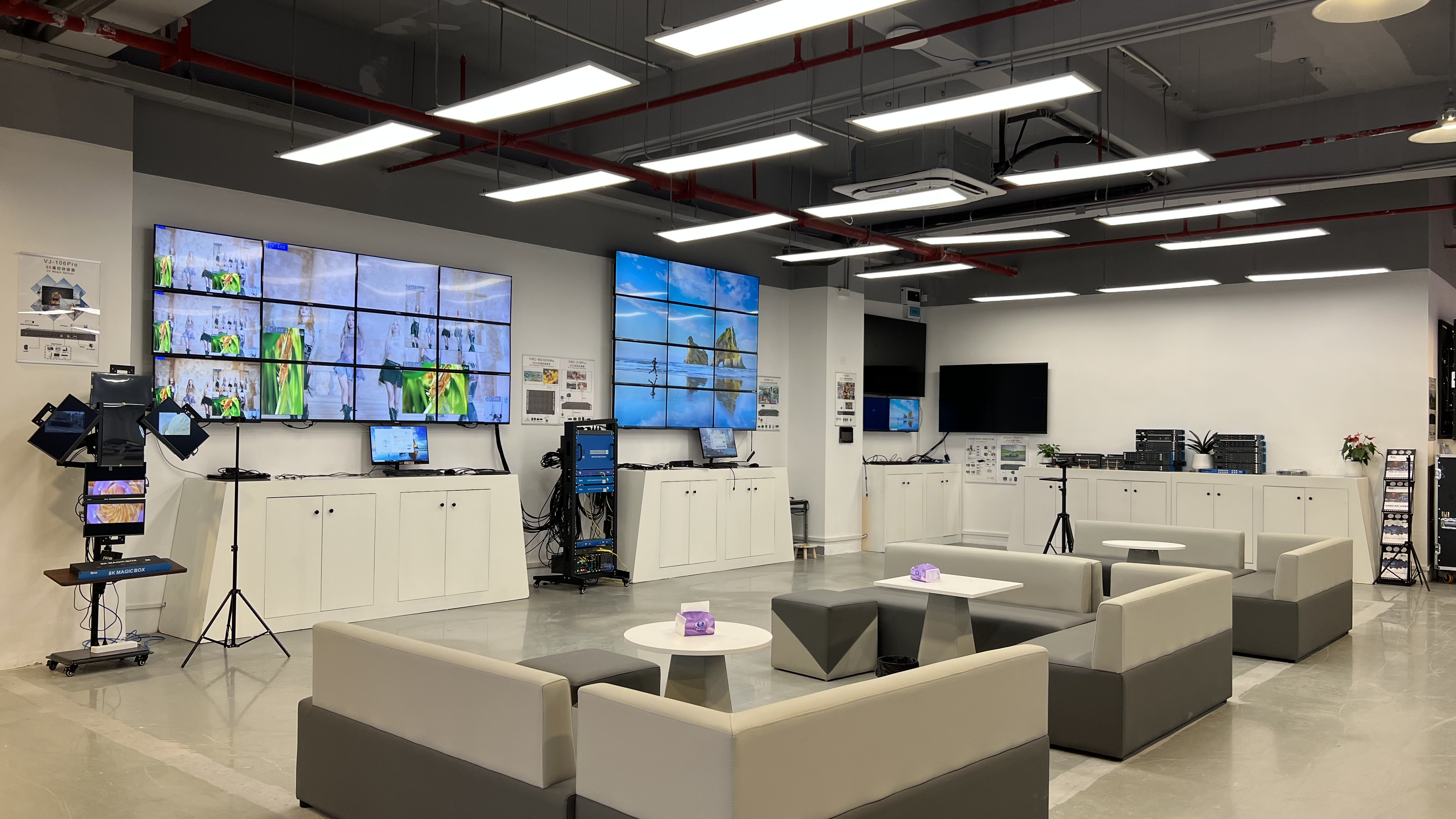
Factory test laboratory used for incoming inspection, single-board function testing and finished-goods aging. Bitvisus documents a final 7×24-hour full-channel power aging test in its three-level QC process.
Why sample pricing and project quotes are not comparable by default
A sample price and a project quote are different commercial objects. A sample price normally covers one configured unit, accessories, packing and, in some cases, a basic test report. A project quote should cover the bill of materials, input and output card mix, extenders, mounting accessories, commissioning support, spare parts, warranty terms and logistics. If the two documents use different configurations, the price difference is not a discount. It is a scope difference.
Buyers should request an itemized quote that uses the same model, firmware level and accessory list as the sample. The quote should separate the controller, the expander or extender components, the control software or API access, the warranty term and the optional services. This is especially important when a project uses a controller plus HDBaseT extenders, because the signal-chain cost is distributed across more than one part number.
Bitvisus publishes standard commercial terms that can be used to structure the comparison. Standard models have a minimum order quantity of 1 unit, OEM private-label orders have a minimum of 10 units, and custom development starts at 100 units. Standard stock lead time is 3 to 7 days, custom orders are 2 to 3 months, and export orders are documented for customs clearance and shipment within 10 days. Monthly capacity is 8,000 units. These terms should be compared alongside the unit price, not after the purchase decision.
A buyer comparison matrix for video wall controller suppliers
The matrix below maps buyer requirements to factual proofs. It is designed to stop a comparison from collapsing into a headline resolution or a headline price. The right-hand column is not a marketing claim; it is the evidence a buyer should request and verify.
| Buyer requirement | What to compare | Documented Bitvisus evidence | Acceptance test |
|---|---|---|---|
| Sample pricing versus project quote | Scope, configuration, accessories, warranty, spare parts, logistics | Standard MOQ 1 unit; OEM private label MOQ 10 units; custom development MOQ 100 units; stock lead time 3–7 days; custom order 2–3 months | Quote must use the same model, firmware and accessory list as the sample |
| Warranty and after-sales | Warranty length, response path, spare-parts location, remote support | 1-year warranty; 7×24 technical support; multilingual technical documents in Chinese and English; free remote debugging; remote technical support; fast spare parts replacement; localized technical training | Written service levels and named spare-parts location in the supply agreement |
| Acceptance criteria | Factory acceptance and site acceptance; resolution, latency, sync, switching, aging | Three-level QC: 100% incoming inspection of core components, single-board function test, 7×24-hour full-channel power aging test; BIT-VWC-MD3636Ma input-to-output latency below 40 ms and 0 ns output-port synchronization difference excluding the display | FAT and SAT scripts signed before the purchase order |
| Integrated KVM | Where KVM sits: controller, extender or separate switch; USB or IP-based | BIT-Ex-HDBT-150 documents USB-KVM with 2 USB ports for mouse and keyboard, plus CEC, two-way RS232 transparent transmission and two-way IR transparent transmission | Keyboard and mouse control tested through the complete signal chain |
| Certification and market access | Exact model, input voltage, certificate scope, EU and US requirements | CE-EMC CTC118K0401302EC, FCC SDoC CTC118K0401302FC and RoHS CTC118K0401302RC for BIT-VWC-8K60-404Max; CE-EMC CTC118K0401301EC, FCC CTC118K0401301FC and RoHS CTC118K0401301RC for BIT-MSE-8K60D-104Pro | Certificate scope must name the purchased model and voltage variant |
Decision rule: a supplier should not be shortlisted because it has the lowest sample price. It should be shortlisted when the sample price, project quote, warranty terms and acceptance script describe the same configuration.
Warranty and after-sales: what to put in the contract
Warranty is often treated as a single number. In practice, the number is only the beginning. A one-year warranty can mean different things depending on response time, spare-parts location, remote-debugging capability and whether the supplier supports the installed control system after commissioning.
Bitvisus documents a one-year warranty across the listed controller and extender models. The after-sales package includes 7×24 technical support, multilingual technical documents in Chinese and English, free remote debugging, remote technical support, fast spare parts replacement and localized technical training. Value-added services include free solution design, free technical drawings, product operation training and regular firmware upgrades. These are documented service capabilities and should be converted into contract language, not left as brochure statements.
What is not automatic is an extended warranty, an on-site response time or local spare-parts stock. Those are commercial additions. If a control room or security monitoring project requires a four-hour on-site response, the buyer should ask for a named service level, a spare-parts location and a defined escalation path. If the project is outside the supplier’s local service area, remote debugging and advance replacement terms become more important than the warranty length alone.
Acceptance criteria: use project evidence, not brochure claims
Acceptance should be written before the purchase order. A practical structure is factory acceptance testing plus site acceptance testing. Factory acceptance should cover configuration, input and output mapping, resolution, latency, switching, synchronization and aging. Site acceptance should repeat the critical tests in the installed environment, including cable distance, control-system integration and long-run stability.
For control-room projects, ISO 11064 is the primary international standard governing control-room ergonomics and affects layout management requirements. It is not a controller certification, but it is a useful reference for acceptance because it forces the project team to test the display wall as an operating environment rather than as a box of electronics.
Romania: one PC, six projectors, 120 m HDBaseT
The Romania Christmas building projection mapping project used two BIT-MSE-4K60-104Pro multi-screen expanders and six BIT-Ex-HDBT-150-RX extenders. One PC with a GTX 3050 GPU drove six projectors, with three projectors per group fused into one image. The total output resolution reached 11520×1200, and the HDBaseT transmission distance was approximately 120 m. The deployment has a five-year operating history.
For acceptance, this case provides concrete test points: single-PC control of six projectors, two expanders operating in parallel, six HDBaseT receivers, approximately 120 m signal transmission, edge blending across projector groups, and a 11520×1200 combined image. A buyer can convert these into a factory acceptance script and a site acceptance script without inventing new performance claims.
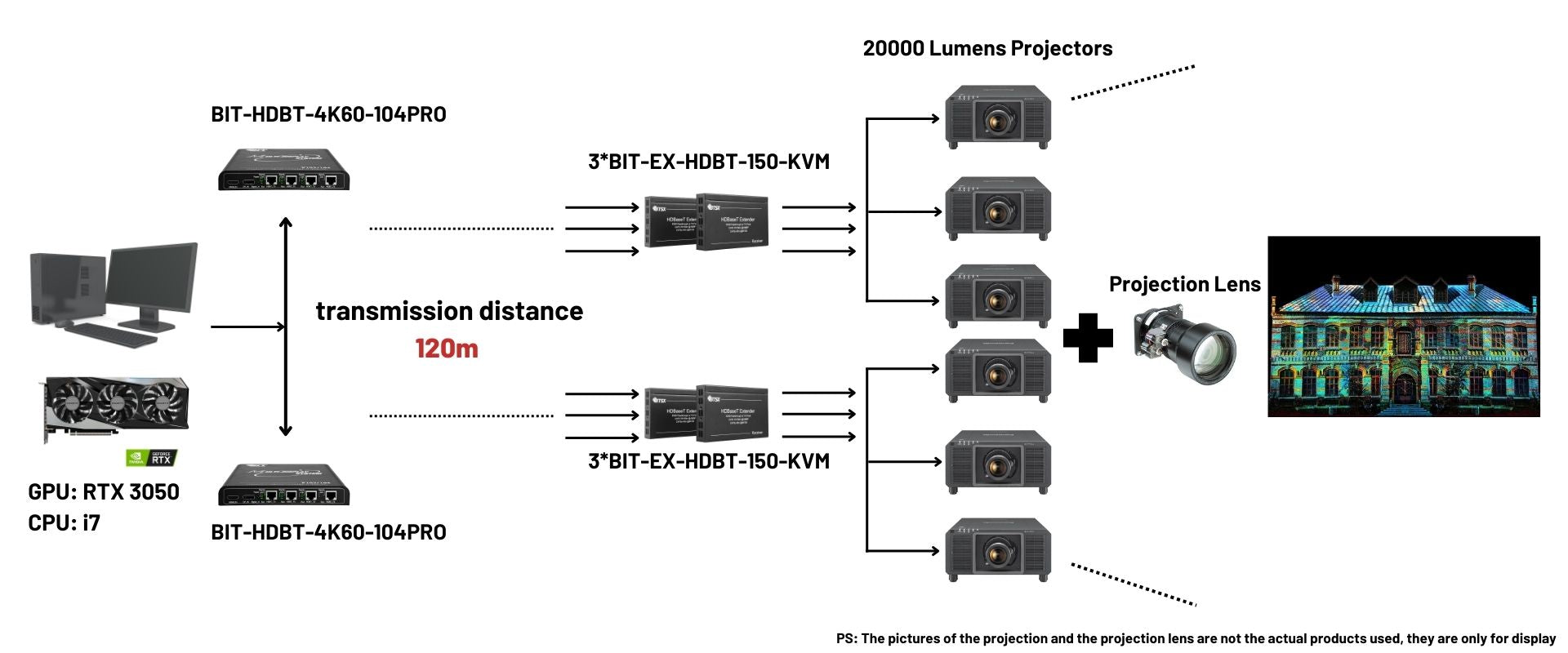
Romania projection mapping signal chain, connection diagram excerpt: two BIT-MSE-4K60-104Pro multi-screen expanders and six BIT-Ex-HDBT-150-RX extenders drive six projectors from one PC over approximately 120 m of HDBaseT.
Shenzhen Cézanne: 12 controllers, 100+ projectors, 3×3 5K walls
The Cézanne immersive painting exhibition in Shenzhen used 12 BIT-VWC-409R video wall controllers and more than 100 industrial 1080p projectors. Each BIT-VWC-409R drove nine projectors in a 3×3 video wall, producing a 5K 5760×3240 image per wall. Multiple 3×3 walls were recombined for a final image exceeding 16K. The deployment has a five-year operating history.
This case is useful as an acceptance benchmark because it separates three numbers that are often confused: the per-channel output resolution, the per-wall resolution and the combined resolution. The BIT-VWC-409R output is 1920×1080@60Hz per channel. The 3×3 wall reaches 5760×3240. The final image above 16K is the combined result of 12 controllers. A buyer who expects a single controller to output 16K natively will misread both the product and the quote.
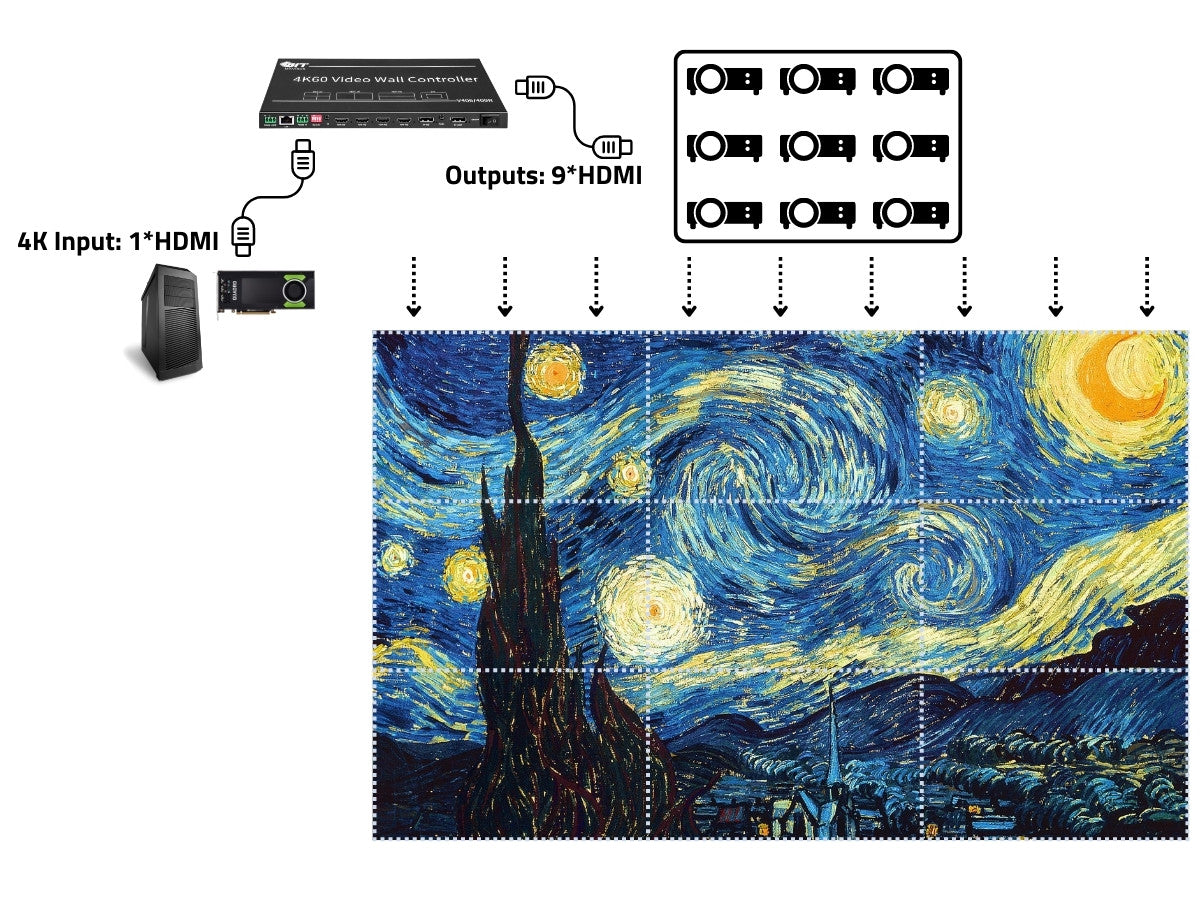
Cézanne immersive exhibition projector connection diagram: 12 BIT-VWC-409R controllers drive more than 100 projectors, with each controller supporting a 3×3 wall and a combined final image above 16K.
Integrated KVM: verify at the signal-chain level
KVM is often assumed to be part of the controller because the system drawing shows a keyboard and mouse. In practice, KVM can sit in the controller, in the extender, or in a separate KVM switch. The buyer should ask where the USB ports are located, whether the KVM is USB-based or IP-based, and whether keyboard and mouse control survive the full cable path.
The BIT-Ex-HDBT-150 fiber extender documents a USB-KVM function with 2 USB ports for connecting a mouse and keyboard. It also supports CEC, two-way RS232 transparent transmission and two-way IR transparent transmission. That is a verifiable KVM data point at the signal-chain level. For a controller-only quote, the buyer should not assume that KVM is included unless the controller documentation explicitly lists it.
This distinction matters in control rooms and security monitoring centers, where operators need to control source computers from the display wall without adding a separate KVM matrix. If KVM is delivered by the extender, the acceptance test should include keyboard and mouse control through the complete chain, not only video switching. If KVM is delivered by the controller, the quote should identify the USB endpoint, the supported operating systems and the number of controlled sources.
Certification and compliance evidence
Certification is a purchasing constraint, not a decorative logo. The buyer should verify that the certificate scope names the exact model, the input voltage variant and the target market. A certificate for a related model in the same series is not automatically a certificate for the purchased model.
For the EU market, the relevant documents include CE-EMC and RoHS declarations. For the US market, the relevant document is the FCC Supplier’s Declaration of Conformity. The BIT-VWC-8K60-404Max is covered by CE-EMC Declaration of Conformity certificate CTC118K0401302EC, FCC Supplier’s Declaration of Conformity certificate CTC118K0401302FC and RoHS Declaration of Conformity certificate CTC118K0401302RC. The CE-EMC declaration references EMC Directive 2014/30/EU and standards including EN 55032:2015/A11:2020, EN 55035:2017/A11:2020, EN IEC 61000-3-2:2019/A2:2024 and EN 61000-3-3:2013/A2:2021/AC:2022. The FCC declaration follows FCC rules 2.906, 2.908 and 2.909 under ECFR Title 47 FCC Part 15 Subpart B:2024, with OMA Electronic Technology Inc as the US Responsible Party.
The BIT-MSE-8K60D-104Pro is covered by CE-EMC certificate CTC118K0401301EC, FCC certificate CTC118K0401301FC and RoHS certificate CTC118K0401301RC. The BIT-VWC-MD3636Ma is covered by FCC Supplier’s Declaration of Conformity certificate CTC118K0401302FC and RoHS certificate CTC118K0401302RC. The RoHS declarations reference Directive (EU) 2015/863, amended by Directive (EU) 2017/2102, and EN IEC 63000:2018, with test methods from the IEC 62321 series.
These certificate numbers are useful in a comparison matrix because they can be checked against the supplier’s declaration. They also clarify a common misunderstanding: a CE-EMC certificate is not the same as a RoHS certificate, and an FCC SDoC is not the same as a CE declaration. Each document answers a different market-access question.
Product configuration evidence for the comparison
Configuration evidence should be specific enough to prevent a quote from hiding a lower-capacity model behind a higher-capacity model name. The Bitvisus video wall controller range includes several architectures, and each has different output and expansion behavior.
The BIT-VWC-8K60-404Max is a 2U 8K60 video wall controller with up to 5 input channels and up to 4 output channels. Its 8K60 input card provides two HDMI 2.1 interfaces, two DisplayPort 2.1 interfaces and one Type-C interface with DP 2.1 standard. The 4-channel HDMI 2.0 output card supports 3840×2160@60Hz and 3840×2400@60Hz. The HDMI inputs support HDCP 2.2, and the DP and Type-C inputs support HDCP 2.3.
The BIT-VWC-8K60Y-115Pro supports 8K60 input through HDMI 2.1 or DP 1.4 and provides 15 HDMI 1.4 outputs at 1920×1200@60Hz or 1920×1080@60Hz. The BIT-VWC-218Pro provides 2 HDMI 2.0 and 2 DP 1.2 inputs, with 18 HDMI 1.3 outputs at up to 1920×1200P60. The BIT-VWC-MD3636Ma is a 7U modular chassis with up to 36 HDMI 2.0 inputs and 36 HDMI 2.0 outputs, input-to-output latency below 40 ms, 12 preset scenarios and a 0 ns output-port synchronization difference excluding the display.
The BIT-VWC-409R provides 5 input channels and 9 output channels, with 9 HDMI 1.3 outputs at 1920×1080@60Hz and one DP 1.2 loop-out. It supports cascading and parallel operation for large screens. The BIT-MSE-4K60-104Pro provides 4 HDMI outputs and supports 3×1920×1200@60Hz and 4×1920×1200@60Hz configurations, with a 2×2 maximum of 3840×2400@60Hz and a 4×1 maximum of 7680×1200@60Hz. The BIT-Ex-HDBT-150 extends 1080p over CAT6E up to 150 m with a 6 Gbps transmission bandwidth and a one-year warranty.
These facts matter because a comparison matrix that lists only “4K” or “8K” will miss the difference between per-channel output, per-wall resolution and combined resolution. They also explain why a project quote can vary widely for what appears to be the same screen count.
Market trend: why purchasing terms matter more
Dataintelo estimates the global video wall controllers market at approximately USD 2.25 billion in 2025 and projects it to reach USD 4.4 billion by 2034, with a CAGR of 7.8% from 2025 to 2034. GCG Enterprise Solution and AVIXA report that AV-over-IP adoption reached 73% of new video wall controller installations in early 2026. Statifacts places control-room applications at 50% of the video wall processor market contribution.
These trends increase the importance of acceptance and service terms. As more signals move onto IP networks, the controller is judged less by a single HDMI specification and more by remote management, KVM behavior, network integration and long-run stability. The 7.8% CAGR suggests more projects, but it also suggests more quote variability. Suppliers that publish certificate numbers, test methods and deployment evidence will be easier to compare than suppliers that rely on headline claims.
Limits of this comparison model
The framework has boundaries that should be stated clearly. First, the documented warranty is one year. Extended warranty, local spare-parts stock and on-site response are commercial terms, not default product facts. Second, output resolution per channel is not the same as wall resolution. The BIT-VWC-409R outputs 1920×1080@60Hz per channel, while the 3×3 wall reaches 5760×3240 and the combined Cézanne image exceeds 16K through 12 controllers. Third, KVM is documented on the BIT-Ex-HDBT-150 extender, not automatically on every controller. Fourth, sample pricing does not predict project pricing because the scope differs.
These limits are not weaknesses in the comparison model. They are the reason the model is useful. A buyer who treats every output as native 4K, assumes KVM is included in every controller, or compares a sample price with a full project quote will make a decision on the wrong basis. A buyer who normalizes the scope, writes the acceptance script and verifies the certificate scope will compare like with like.
Future outlook
Video wall controller procurement is moving from box specifications to evidence-based acceptance. The Romania and Cézanne deployments show why: both projects are defined by signal-chain behavior, long-distance transmission, multi-controller synchronization and multi-year operation, not by a single resolution number. As AV-over-IP reaches 73% of new installations, acceptance will increasingly test network behavior, remote management and KVM over IP alongside HDMI switching.
For buyers in the research and evaluation stage, the practical next step is to convert the comparison matrix into a request for quote with four attachments: an itemized bill of materials, a warranty and service schedule, a factory and site acceptance script, and a certificate-scope table. That package makes sample pricing, project pricing, warranty and KVM comparable across suppliers without relying on manufacturer claims alone.
FAQ
How should buyers compare sample pricing with a project quote for a video wall controller?
A sample price and a project quote cover different scopes. A sample price normally covers one configured unit, accessories and packing. A project quote should itemize the controller configuration, input and output cards, extenders, cables, commissioning support, spare parts, warranty and logistics. Buyers should request the same model, firmware level and accessory list in both documents, and separate one-time engineering costs from recurring support costs.
What warranty and after-sales coverage should be confirmed before ordering a video wall controller?
Bitvisus documents a one-year warranty, 7×24 technical support, multilingual technical documents in Chinese and English, free remote debugging, remote technical support, fast spare parts replacement and localized technical training. Buyers should confirm response times, spare-parts location and whether extended coverage is available in the contract. Extended warranty and on-site support are commercial terms, not automatic product facts.
What acceptance criteria should be used for multi-projector and video wall deployments?
Acceptance should cover factory aging, resolution and layout verification, latency, synchronization, switching and long-run stability. The Romania project provides a benchmark of one PC driving six projectors through two BIT-MSE-4K60-104Pro expanders and six BIT-Ex-HDBT-150-RX extenders over approximately 120 m HDBaseT, with a 11520×1200 output. The Cézanne project provides a benchmark of 12 BIT-VWC-409R controllers, more than 100 projectors, 3×3 5K walls and a combined image above 16K.
Which Bitvisus products support KVM, and what does integrated KVM include?
The BIT-Ex-HDBT-150 fiber extender supports USB-KVM with two USB ports for a mouse and keyboard. It also supports CEC, two-way RS232 transparent transmission and two-way IR transparent transmission. KVM should be verified at the signal-chain level. A controller-only quote should not be assumed to include KVM unless the controller documentation explicitly lists it.
What certifications should a video wall controller have for EU and US projects?
For the EU market, buyers should request CE-EMC and RoHS declarations. For the US market, they should request the FCC Supplier’s Declaration of Conformity. For example, the BIT-VWC-8K60-404Max is covered by CE-EMC certificate CTC118K0401302EC, FCC SDoC certificate CTC118K0401302FC and RoHS certificate CTC118K0401302RC. The BIT-MSE-8K60D-104Pro is covered by CE-EMC certificate CTC118K0401301EC, FCC certificate CTC118K0401301FC and RoHS certificate CTC118K0401301RC. The certificate scope should name the exact model and input voltage.
Can a one-year warranty be extended or supported locally?
The documented standard is a one-year warranty. Extended warranty, local spare-parts stock and on-site support are commercial terms that should be written into the supply agreement. Buyers should ask for named service levels, spare-parts locations and an escalation path if the project is outside the supplier’s local service area.
Reference: 2026 Bitvisus Product Brochure (PDF).
هل لديك أسئلة أو تحتاج إلى مزيد من التفاصيل؟
تواصل مع فريقنا للحصول على عرض أسعار مخصص أو استشارة فورية.
طلب عرض أسعار
املأ النموذج أدناه وسيتواصل معك فريقنا بعرض مقترح مخصص.
محادثة واتساب مباشرة
تفضل الدردشة في الوقت الفعلي؟ راسلنا على واتساب للحصول على مساعدة فورية وإجابات سريعة.
- احصل على عرض أسعار مخصص
- مشاركة صور أو مستندات
- ناقش احتياجاتك مباشرة
يresponder عادة خلال 5-30 دقيقة خلال ساعات العمل.