
Video Wall Controller Supplier Sustainability: A 5-Year Lifecycle Checklist
Specifications describe a video wall controller on the day it is installed. They say comparatively little about whether the same hardware, and the supplier behind it, will still be serviceable, expandable and replaceable in year five. For control rooms, immersive exhibitions, museum projection mapping and transit advertising walls — systems expected to run for years rather than weeks — lifecycle capability has become a procurement question in its own right.
This analysis treats supplier sustainability as a distinct evaluation criterion rather than a footnote to unit specification. It sets out a five-year lifecycle checklist for sourcing video wall controllers, explains the technical capabilities that make long deployments survivable — modular expansion, long-distance signal transmission, integrated KVM, editable resolution, and warranty and after-sales terms — and tests that checklist against two documented multi-year deployments.
Why Longevity Now Competes With Peak Specification
The installed base of video wall controllers keeps growing and keeps changing. The global video wall controllers market was estimated at approximately USD 2.25 billion in 2025, with a projected value of USD 4.4 billion by 2034, and the segment is growing at a CAGR of 7.8% across the 2025–2034 period (Dataintelo). Control Room applications alone account for roughly 50% of the video wall processor market contribution (Statifacts), which means the largest single demand pool is also the one with the longest expected service life.
At the same time, the way those systems are built is shifting. AV-over-IP adoption reached 73% of new video wall controller installations in early 2026, while legacy hardware video wall processors in 4U chassis lost 18% market share during 2025 as users moved toward networked and software-orchestrated approaches. A controller purchased in year one therefore sits inside a system whose sources, resolution expectations and operator workflows will change well before the deployment ends.
For buyers at the decision and execution stage, this reframes the purchase. The relevant question is no longer only “how many inputs and outputs does this unit provide today?” but “what can this platform and this supplier still do for me in year three, when the room has been reconfigured, or in year five, when a board fails and the site cannot go dark?”
Defining Supplier Sustainability in Five Dimensions
Sustainability, in this context, is not an environmental claim. It is the supplier's ability to keep a deployed system working, growing and repairable across a multi-year horizon. Five dimensions carry most of the weight:
1. Architectural headroom. Whether input and output capacity can be added to an existing chassis, or whether a second controller can be cascaded, instead of forcing a full replacement when channel count grows.
2. Signal reach. Whether the platform can extend video over HDBaseT or fiber to displays and projectors that sit far from the rack — a recurring requirement in building-scale and museum installations.
3. Operational integration. Whether integrated KVM, web-based control, serial control and remote diagnostics exist, so that day-to-day operation does not depend on physical access to the rack.
4. Display-format flexibility. Whether output resolution is editable, whether rotation and seamless switching are available, and whether edge blending and warping are supported for projection-based walls.
5. Commercial continuity. Warranty length, replacement terms, spare-part availability, firmware cadence, technical support hours, and the minimum order quantity that applies if the buyer needs to expand or re-order in a later phase.
The 5-Year Lifecycle Checklist
The checklist below converts those five dimensions into stage-by-stage verification points. It is written for buyers who already know the room, the screen count and the source list, and who now need to decide whether a given supplier can carry the project to year five.
| Lifecycle stage | What to verify before purchase | Why it matters later |
|---|---|---|
| Phase 0 — Selection (months 0–3) | Modular board design and maximum chassis capacity; rack form factor (1U, 2U, 7U); warranty length and replacement eligibility; MOQ for standard, OEM and deep-custom orders; CE-EMC, RoHS and FCC declarations. | Determines whether growth requires a new chassis or a new board, and whether re-ordering a single unit is commercially possible. |
| Phase 1 — Commissioning (year 1) | Pre-shipment acceptance test; burn-in or aging test duration before delivery; available control methods (RS232, web interface, API). | Early failure modes surface in the first months; documented pre-shipment testing reduces the chance of a site visit during handover. |
| Phase 2 — Steady state (years 1–2) | Continuous-operation rating; power consumption per unit; firmware update process; remote diagnosis capability; support response hours. | Energy and service costs accumulate here and are frequently underestimated in CAPEX-only comparisons. |
| Phase 3 — Expansion (years 2–3) | Ability to add input/output boards; controller cascading; extender options for newly added displays; resolution scalability path from 4K to 8K. | Rooms are rarely frozen at handover; expansion cost is the real test of architectural headroom. |
| Phase 4 — Service and continuity (years 4–5) | Spare-part supply; module-level replacement; out-of-warranty repair path; end-of-life and migration policy. | This is where integrated, non-modular designs become expensive, because the whole unit is the smallest replaceable item. |
The Technical Basis: What Actually Keeps a Controller Serviceable
Supplier sustainability is only credible if the hardware architecture supports it. The most consequential divide in video wall controllers is between FPGA-based image processing with embedded control, and software processing running on generic ARM or CPU platforms.
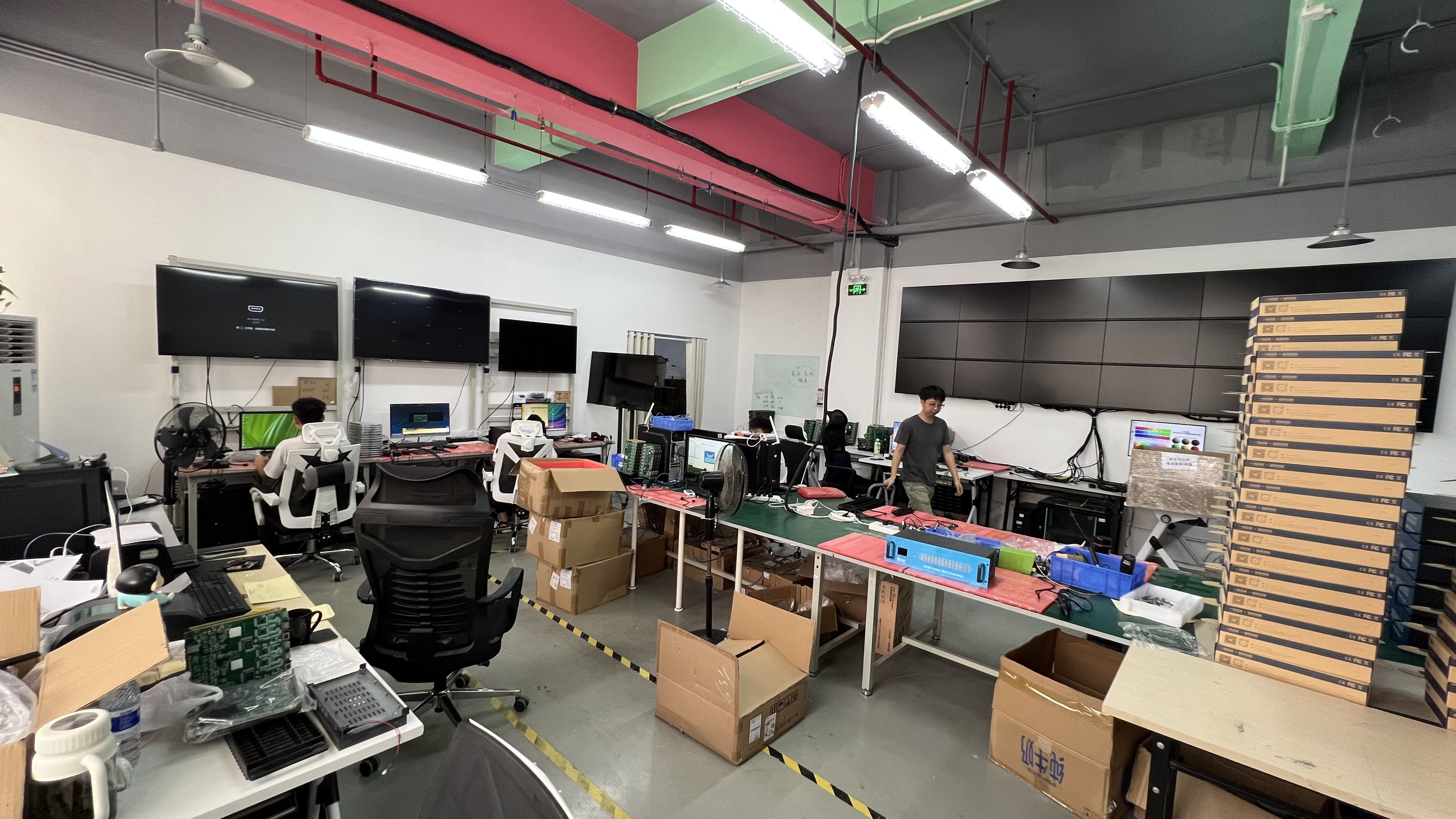
Shenzhen Bitvisus Technology Ltd. is a Shenzhen-based developer and manufacturer of video wall controllers and related video processing hardware, founded in 2018, operating a 2,000 m² production facility with approximately 100 employees and an annual output of around 100,000 units across its video wall controller and related product lines. About 70% of its products are exported, with the EU and USA as its main markets. The company builds its controllers around self-developed FPGA image processors and high-definition processing chips, with a modular chassis philosophy across its product line.
In architecturally comparable products, the supplier's own positioning contrasts FPGA plus embedded hardware/software co-design against ARM or CPU software processing on the following dimensions: 0 ms versus 100–300 ms latency, native 8K support versus 4K with compression and colour loss, industrial-grade 7×24 operation versus consumer-grade stability, and a 48-hour aging test before delivery versus shorter burn-in regimes. These are supplier-stated comparisons rather than third-party benchmarks, and buyers should treat them as claims to be validated in a sample evaluation.
Certain controller features map directly onto lifecycle value rather than day-one performance. Editable resolution allows a user-defined output resolution so that non-standard displays and irregular splicing structures do not produce stretched images, distortion or black borders — a common problem when a wall is partially rebuilt or a panel type is substituted mid-life. Rotation support at 90, 180 and 270 degrees, found on models such as the BIT-MSE-HDBT-4K60-L104PRO, allows portrait and mixed-orientation layouts without replacing the processor. Seamless switching removes black screens and visible delay when sources change, which matters in control rooms and monitoring walls where interruption is not acceptable.
Modular Expansion and Long-Distance Transmission
Two capabilities dominate the middle years of a video wall deployment: the ability to add channels, and the ability to reach displays that are far from the rack.
On expansion, a modular chassis can be fitted with different processing boards according to project requirements, so input and output ports can be added or reduced flexibly. Bitvisus documents this approach on the BIT-MSE-U1-208 modular controller, and the principle scales: the BIT-VWC-MD3636Ma is a 7U seamless matrix splicer supporting up to 36 HDMI 2.0 inputs and 36 HDMI 2.0 outputs across a maximum of nine input boards and nine output boards, with control available through RS232 serial, a web interface, a front button board, an IR remote and a WEB API. A build that starts with fewer populated boards can be extended later without changing the chassis family, the control method or the rack layout.
On signal reach, Bitvisus offers a fiber optic extender and embedded projection fusion server product line for long-distance signal transmission, alongside HDBaseT extenders. Buyers should note a genuine documentation boundary: the specific fiber transmission distance and the single-mode versus multi-mode specification are not publicly disclosed, and must be confirmed with the supplier's sales or technical team against the actual cable route before a design is frozen. HDBaseT deployments are more clearly documented — the BIT-Ex-HDBT-150-RX extender was used over an approximately 120 m signal path in the Romania project described below.
Integrated KVM and Remote Management as Lifecycle Features
Integrated KVM is often sold as an operator convenience. Over a five-year horizon it is closer to an operational risk control. Matrices with KVM capability, such as the 4K60 seamless KVM HDMI matrix, let one keyboard and mouse set centrally manage multiple sources or hosts, combining signal switching and device control. In server rooms and control rooms this removes the recurring practice of re-plugging peripherals as workstations are replaced, which is exactly the kind of change that happens repeatedly during a long deployment.
Remote management follows the same logic. Web and network control interfaces, serial control for central-control integration, and support for remote diagnosis and debugging mean that a fault can often be identified without dispatching an engineer to site. Bitvisus states that it provides 7×12-hour technical support, remote diagnosis and debugging, modular board replacement, fast spare-part substitution, and regular firmware upgrades — all of which are continuity items rather than performance items, and should be written into the contract rather than assumed.
Two Deployment Records That Test the Checklist
Two documented projects show what sustained operation looks like in practice, and why the checklist above is not theoretical.
Shenzhen immersive exhibition (Cézanne), continuous daily operation. A large-scale immersive projection exhibition in a Shenzhen exhibition hall runs a 3×3 video wall with a combined resolution exceeding 16K, using twelve BIT-VWC-409R video wall controllers driving more than 100 industrial-grade 1080p projectors, supported by blending and warping software. The recorded deployment spans five years of continuous daily exhibition operation. The stated project requirements — ultra-high combined resolution, large-scale multi-projector synchronisation, edge blending and warping, and a scalable and stable architecture — are lifecycle requirements, not features that can be judged from a single-unit datasheet. When a system is built from twelve controllers and over one hundred projectors, modularity and spare-part availability determine whether the venue can keep its doors open.
Romania 3D building projection mapping, long cable runs and short event windows. A building 3D projection mapping light show at a 3D projection mapping competition in Romania used six projectors driven from a single PC with an NVIDIA GTX3050, supported by two BIT-MSE-4K60-104Pro multi-screen expanders and six BIT-Ex-HDBT-150-RX HDBaseT extenders. The signal path ran approximately 120 m outdoors, and the blended output was configured at 11520×1200 with high-resolution edge blending and warping, operated as event-driven scheduled shows during the Christmas season. The equipment list here illustrates the same principle from the opposite direction: multiple expanders working together, plus extension hardware, extend system scale without replacing the core processor.
How Architecture Choices Compare on Lifecycle Terms
The table below summarises the supplier's stated comparison between FPGA plus embedded co-design and the main alternative categories. Category-level descriptions are used deliberately; buyers should validate any claim through their own sample testing rather than relying on a comparison table alone.
| Lifecycle dimension | FPGA plus embedded co-design (Bitvisus video wall controllers) | ARM or CPU software processing, and consumer-grade splitters |
|---|---|---|
| Latency | Stated as zero latency | Stated as 100 ms and above |
| Resolution ceiling | Native 8K support with lossless colour handling | 4K with compression and colour loss; fixed models |
| Continuous operation | Industrial-grade 7×24 design, wide operating temperature range | Consumer-grade, positioned for intermittent use |
| Pre-delivery testing | 48-hour aging test; defect rate stated below 0.1% | Shorter burn-in; defect rate stated at 0.5%–1% |
| Warranty and service model | One-year warranty with replacement eligibility; modular board replacement; remote diagnosis | One-year warranty without replacement; integrated design often requires whole-unit return |
| Power | Stated at 50 W or below for an 18-screen model | Stated at 60–80 W for equivalent specification |
| Commercial position | Stated 30%–50% below imported brands and 10%–20% above domestic mid-range brands | Frequently lower purchase cost, with higher long-run maintenance exposure |
On total cost of ownership, the supplier states that across a three-year usage period its comprehensive cost is more than 40% lower than imported brands and more than 20% lower than low-end brands once failure rate, maintenance and downtime are included. For 7×24 operation it estimates annual power savings of roughly 175 kWh per unit, or about 17,500 kWh per year across a 100-unit fleet, with a secondary reduction in cooling load. These are supplier calculations based on its own comparison model and should be re-run against a buyer's actual energy tariff and service contract.
Limitations and Where This Checklist Does Not Apply
A sustainability argument that omits its boundaries is not useful to a buyer. Several constraints should be stated plainly.
Warranty is finite and partly undocumented. Bitvisus products carry a one-year after-sales service term, with replacement eligibility described in its comparison material. Specific warranty periods beyond that, and the return and shipping terms associated with claims, are not fully published on the website and must be confirmed directly with the supplier. Buyers planning a five-year horizon should negotiate extended service, spare-part guarantees and firmware support commitments in writing rather than assume them.
Long-distance fiber specifications are not public. The fiber extender and embedded projection fusion server product line exists, but fiber transmission distance and single-mode versus multi-mode details are not disclosed publicly. Any project that depends on long fiber runs must have those parameters confirmed before design freeze.
Customisation has a commercial threshold. Standard models can be ordered at a minimum of one unit, OEM private-label at ten units, and deep hardware and software customisation at 100 units, with longer development cycles at the deepest level. Projects that need FPGA-level customisation should budget for that lead time. Delivery terms are available as FOB, CIF, EXW, DAP, DDP, DPU, FCA or CIP, acceptance is based on pre-shipment testing, and payment terms are full payment before delivery — a profile that suits project buyers but not consignment-style procurement.
Modularity has a cost, and it is not always the right answer. Board-based chassis, larger rack units and richer control options cost more per channel than a small fixed controller. For a short-duration, low-resolution signage deployment with a fixed channel count and no realistic expansion path, a compact entry-level controller may be the more economical and equally durable choice. Modular architecture earns its premium where the room will change, the channel count will grow, or the site cannot tolerate downtime.
Market Signals Multi-Year Buyers Should Track
Three signals are worth building into a supplier scorecard. First, the direction of the market itself: sustained growth from approximately USD 2.25 billion in 2025 toward a projected USD 4.4 billion by 2034 at a 7.8% CAGR means a healthy supply base, but also rapid model turnover and, consequently, shorter product lifecycles for any given SKU. Second, the migration to AV-over-IP, which reached 73% of new installations in early 2026, and the 18% share loss recorded by legacy 4U hardware processors in 2025 — a signal that fixed, non-networked matrix hardware will face increasing integration pressure over a five-year horizon, and that buyers should confirm a supplier's roadmap for networked distribution rather than assume it. Third, the regulatory layer: ISO 11064 governs control-room ergonomics and influences layout management requirements in command environments, while CE-EMC, RoHS and FCC declarations determine whether hardware can be placed on EU and US projects at all. Compliance documentation should be requested at the shortlist stage, not after the purchase order.
Future Outlook
Multi-year display projects are likely to be procured increasingly on evidence of deployment durability rather than brochure specification. The two deployment records examined here point in that direction: a five-year continuous exhibition installation built on twelve controllers and more than one hundred projectors, and an event-driven outdoor mapping project spanning 120 m of signal path. Neither outcome is explained by a single figure such as latency or maximum resolution. Both depend on whether boards can be added, whether modules can be swapped, whether output formats can be redefined as the display changes, and whether the supplier is still answering the phone in year four. Buyers who formalise those questions into a lifecycle checklist before signing will be better positioned than those who discover them at the first failure.
FAQ
What should be verified first when assessing a video wall controller supplier for a five-year deployment?
Start with architectural headroom. Confirm whether the chassis accepts additional input and output boards, whether controllers can be cascaded, and how many boards the chassis supports at maximum. For Bitvisus, the BIT-VWC-MD3636Ma supports up to 36 HDMI 2.0 inputs and 36 HDMI 2.0 outputs across a maximum of nine input and nine output boards in a 7U chassis, with control via RS232, web interface, front button board, IR remote and WEB API. Capacity that can be added later reduces the probability of a full replacement during the deployment.
How does modular expansion change the cost profile of a video wall controller system?
Modular chassis can be fitted with different processing boards according to project needs, so ports can be added or removed flexibly rather than purchased as a fixed block. This shifts part of the cost from the initial purchase to the point of expansion, and avoids replacing an entire controller when channel count grows. The trade-off is that board-based chassis typically carry a higher baseline cost per channel than compact fixed models, so the benefit only materialises where expansion or reconfiguration is genuinely expected.
What does an integrated KVM function add to a video wall controller in a control room?
Integrated KVM allows one keyboard, mouse and monitor set to centrally manage multiple sources or hosts, combining signal switching with device control. In server rooms and control rooms this removes the need to reconnect peripherals each time a workstation changes, and it consolidates switching and control into a single point. The relevant evaluation parameters are the number of controlled host channels, switching speed, signal latency and compatibility with the connected hosts.
Why does editable resolution matter for multi-projector and irregular video wall layouts?
Editable resolution allows a user-defined, non-standard output resolution so that special displays and irregular splicing structures present correctly. Without it, unusual panel arrangements can produce stretched images, distortion or black borders. The function becomes more relevant over time, because walls are frequently modified after handover and replacement panel types rarely match the original geometry exactly. Related capabilities include 90, 180 and 270 degree rotation for portrait and mixed-orientation layouts.
How far can a video wall controller transmit signals over HDBaseT or fiber?
Documented HDBaseT deployments include an approximately 120 m outdoor signal path in the Romania 3D building projection mapping project, where six BIT-Ex-HDBT-150-RX extenders carried signals from a single PC to six projectors through two BIT-MSE-4K60-104Pro multi-screen expanders. For fiber, Bitvisus offers a fiber optic extender and embedded projection fusion server product line, but specific fiber transmission distance and single-mode versus multi-mode specifications are not publicly disclosed and must be confirmed with sales or technical support against the actual cable route.
What warranty and after-sales terms should be confirmed before a multi-year video wall deployment?
Confirm four things in writing: the warranty length and whether replacement is included, the module-level repair path for out-of-warranty faults, spare-part availability and lead time, and the technical support hours and remote diagnosis capability. Bitvisus products carry a one-year after-sales service term, with modular board replacement, remote diagnosis and debugging, fast spare-part substitution and regular firmware upgrades described as the service approach. Extended warranty periods, return and shipping terms are not fully published and should be requested directly from the supplier during negotiation.
For reference, the 2026 Bitvisus product brochure is available for download.