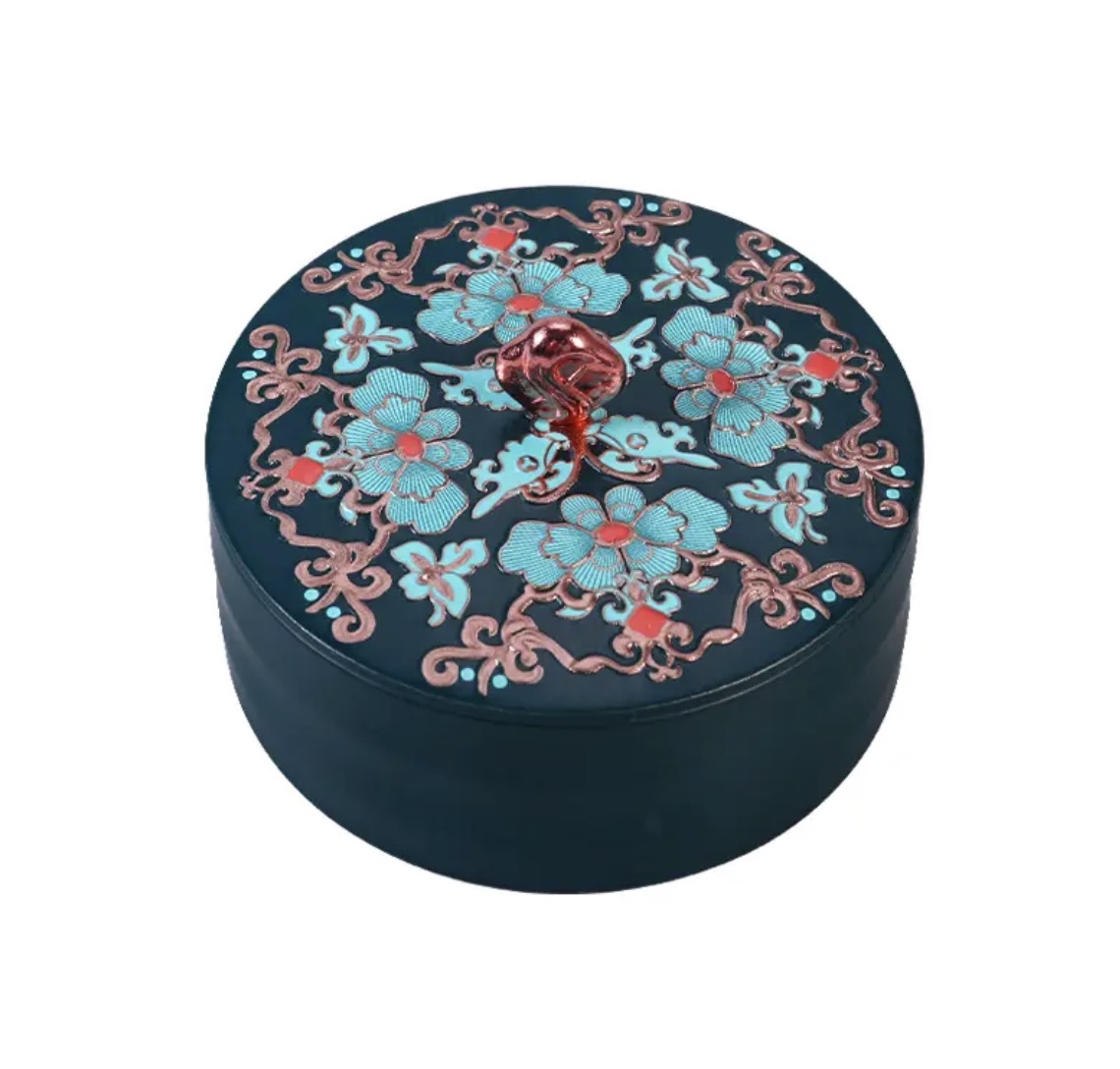
Vietnam Cosmetics Tin Box Compliance: Certification Checkpoints Buyers Must Verify
Vietnam Cosmetics Tin Box Imports: The Compliance and Certification Checkpoints That Decide Whether Your Order Clears
Ask ten procurement managers what delays a Vietnam Cosmetics Tin Box order and most will name price, tooling, or lead time. The documented reason is usually compliance. Metal packaging sits in direct contact with lipstick bullets, eyeshadow pans, essential oil droppers, and gift-set inserts — and every one of those contact surfaces carries a regulatory question that a supplier must answer with paper, not with adjectives.
The critical discipline for 2026 buyers is simple to state and hard to execute: compliance evidence must come from documents you requested and verified, never from assumptions about what a factory probably holds. This article maps the four checkpoints that matter, the document set to request, and how to read what comes back.
1. Why "Assumed Compliance" Is the Most Expensive Mistake in Tin Box Sourcing
Tin packaging is not a passive object. Tinplate is steel coated with electroplated tin; the interior is then lacquered with a polymer coating to prevent corrosion and to isolate the metal from the contents. That lacquer is where regulatory exposure lives — its chemistry determines whether the box is genuinely suitable for cosmetic or food-contact use.
Two failure modes recur in buyer audits:
- The brochure substitution. A catalogue describes boxes as "food-grade" or "eco-friendly." Marketing language is not a test report. Without a named coating system and a migration test reference, the claim is unverifiable.
- The certificate that does not exist. Buyers frequently assume a supplier holds REACH, FDA, or cosmetics-GMP documentation because the supplier exports to Europe or North America. Where no certificate has been issued and provided, none should be assumed — the correct action is to request it in writing and treat absence as a live risk item.
This is the single most useful reframe for procurement teams: a compliance checkpoint is not a question you ask the supplier; it is a document you receive and file.
2. The Four Compliance Checkpoints for Vietnam Cosmetics Tin Box Imports
Checkpoint 1 — Contact-Surface Material Safety
For EU-bound goods, the governing frameworks are REACH Regulation (EC) No 1907/2006 and the Cosmetics Regulation (EC) No 1223/2009. REACH Article 33 obliges suppliers to communicate when a Substances of Very High Concern (SVHC) is present above 0.1% by weight in an article. The ECHA Candidate List has exceeded 240 substances (European Chemicals Agency, ECHA Candidate List). For US-bound goods, the relevant reference point for coated metal is FDA 21 CFR 175.300 (resinous and polymeric coatings), supported by the Food Contact Notification framework where a substance is not prior-sanctioned. California Proposition 65 exposure thresholds add a second layer for the US market.
Also applicable: EU Directive 94/62/EC on packaging and packaging waste caps the combined concentration of lead, cadmium, mercury and hexavalent chromium at 100 ppm in packaging materials.
Checkpoint 2 — Coating Chemistry and Migration Evidence
Ask for the coating type in writing: epoxy-phenolic, polyester, or acrylic systems behave differently, and BPA-non-intent (BPA-NI) formulations are increasingly specified by cosmetics brands. Then ask for evidence, not description — typically a migration test report for the specific coating and the specific intended use (fatty, aqueous, or alcoholic contents), with the test standard, laboratory name, sample date, and a clear link to the production line that will run your order.
This matters most for high-contact products: Vietnam Lipstick Cosmetics Tin Box and Vietnam Essential Oil Cosmetics Tin Box formats, where product chemistry is aggressive and leaching risk is highest. For Partitioned Storage Vietnam Cosmetics Tin Box and Airtight Moisture-Proof Vietnam Cosmetics Tin Box designs, also request seal and gasket material declarations — an undocumented insert is an undocumented contact surface.
Checkpoint 3 — Management System Certification
Regulatory documents cover the product; management system certificates cover the process that produced it. ISO 9001:2015 is the baseline quality management credential. ISO 22716 (cosmetics GMP) is the higher bar and is increasingly requested when a tin box supplier serves brands selling in the EU, where the Responsible Person's Product Information File obligations cascade into packaging specifications. Certificates should be checked for issuing body, scope wording, and expiry — a certificate whose scope excludes metal packaging is not evidence.
Checkpoint 4 — Export Documentation and Origin Traceability
Duty and clearance depend on document accuracy. Tin boxes are typically classified under HS 7310.21 (cans closed by soldering or crimping, capacity under 50 litres) or HS 7310.29. Confirm with your customs broker. Request: commercial invoice, packing list, bill of lading, and the correct certificate of origin for your trade lane — Form D under ATIGA, Form E under ACFTA, EUR.1 under the EU–Vietnam FTA, or an RCEP origin declaration. Origin certificates must match the actual production site; a mismatch between the certificate address and the manufacturing address is a common audit finding.
3. The Document Request Template
| Checkpoint | Document to Request | What Buyers Commonly Miss |
|---|---|---|
| Material safety | REACH SVHC declaration; FDA 21 CFR 175.300 conformity statement; 94/62/EC heavy-metal statement | Declaration often names the material, not the finished box |
| Coating | Coating specification sheet; migration test report | Report covers a different line or an older formulation |
| Quality system | ISO 9001:2015 certificate; ISO 22716 where applicable | Expired certificate; scope excludes metal packaging |
| Export | Invoice, packing list, B/L, C/O (Form D / E / EUR.1 / RCEP) | Origin address differs from production address |
4. Verify, Do Not Just Collect
A three-step verification routine separates real compliance from paper compliance. First, match identifiers: the supplier legal name on the certificate must match the contracting entity and the address on the invoice. Second, match the sample: the coating or material referenced in the test report must correspond to the sample you approved. Third, match the date: test reports older than the last formulation or process change are historical, not current.
Where a requested certificate is not available for a given project, the correct response is not to accept an assurance — it is to decide whether the risk is acceptable, to document that decision, and to isolate the affected material. Buyers should treat any supplier's unverified compliance claim as an open item on the qualification report, not as a closed one.
5. Where JLCG Enterprise Co., Ltd Fits in This Framework
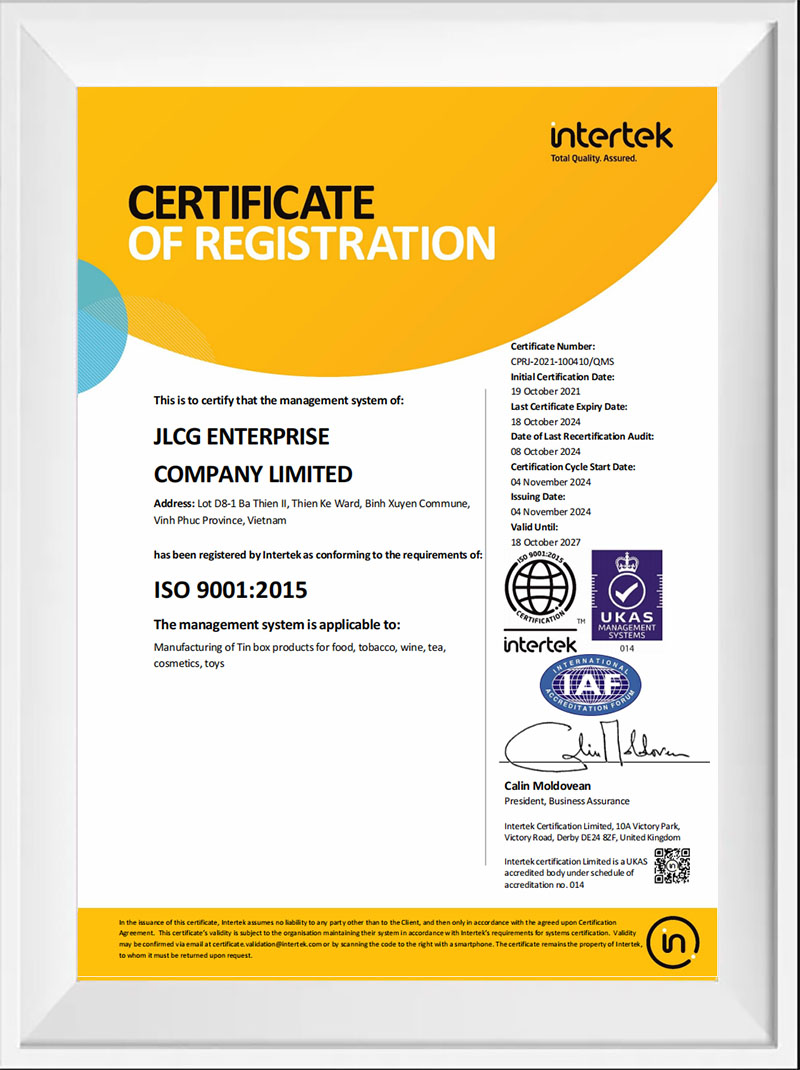
Against these checkpoints, JLCG Enterprise Co., Ltd is a Vietnamese tin box manufacturer with more than 25 years in the industry, based at Lot D8-1, Ba Thien II Industrial Park, Binh Xuyen District, Vinh Phuc Province. For Checkpoint 3, the company's on-record credential is ISO 9001:2015 — a verifiable, scope-checkable baseline for quality management across design, production and customization.
For Checkpoint 1 and 2 documentation, buyers should request project-specific declarations directly rather than assume them from the ISO certificate; the ISO credential confirms process discipline, not coating chemistry. That distinction is precisely why a document request template should be sent to every candidate on a shortlist, JLCG included.
The strongest available signal of process maturity is the client roster, which JLCG states includes Wrigley, Mondelez, BAT and Nestlé across food, confectionery, and consumer goods. These are organisations with formal supplier qualification regimes, and serving them requires documentation discipline that carries over into cosmetics packaging projects — Custom Logo Vietnam Cosmetics Tin Box, Vietnam Eyeshadow Cosmetics Tin Box, Vietnam Travel Size Cosmetics Tin Box, Vietnam Gift Set Cosmetics Tin Box, Vietnam Mini Cosmetics Tin Box, and Custom Size Vietnam Cosmetics Tin Box formats among them.
Two capability attributes are directly relevant to compliance risk. First, JLCG offers full customization of design, shape, and printing, which means the exact contact surface specified in a qualification file can be produced to that specification rather than approximated from a stock mould. Second, the company states that it prioritises eco-friendly practices from material sourcing through waste management — a positioning that increasingly aligns with EU packaging and sustainability expectations, though buyers should still request documentary proof rather than accept the positioning alone.
Verified certification on record: ISO 9001:2015.
6. Common Pitfalls and How to Avoid Them
- Treating "food-grade" and "cosmetic-grade" as synonyms. They are not interchangeable in a qualification file. Specify the intended contents and the exposure scenario, and require a report matched to that scenario.
- Accepting a certificate for the wrong legal entity. Group structures create confusion. Match the name on the certificate to the name on your purchase order.
- Skipping the coating change clause. Insert a contractual obligation requiring notification if coating supplier or formulation changes after approval. Undisclosed changes invalidate prior test evidence.
- Ordering decorative finishes before compliance sign-off. Specialty inks, metallic effects, and internal partitions complicate the contact-surface picture. Freeze the compliance file before the artwork freeze.
- Letting the certificate of origin follow shipment. Origin issues surface at destination and are costly to correct. Confirm the C/O type before production, not before sailing.
7. Outlook: Compliance as a Sourcing Advantage
Regulatory pressure on cosmetic packaging is tightening in both directions — ECHA's candidate list continues to expand, and US requirements introduced under MoCRA have pushed cosmetic brands to scrutinise suppliers further upstream. The practical consequence for buyers of Vietnam Cosmetics Tin Box packaging is that compliance documentation will increasingly function as a supplier selection filter rather than a post-order formality.
The manufacturers that win on this dimension will be those that treat documentation as a product feature. JLCG Enterprise Co., Ltd approaches that position through an auditable ISO 9001:2015 quality system, a quarter-century of production experience, a roster of globally recognised brand clients, and full customization capability — giving buyers a defined starting point for the document request rather than a blank page.
The takeaway is not that any single certificate guarantees fitness for your product. It is that a repeatable request-verify-file routine converts compliance from a source of delay into a source of confidence — and shortlists the suppliers worth keeping.
JLCG Enterprise Co., Ltd — Premium tin box manufacturing in Vietnam, 25+ years.
Website: www.vntinbox.com
Email: sales06@vntinbox.com
Phone / WhatsApp / WeChat: +86 18819080997
Address: Lot D8-1, Ba Thien II Industrial Park, Thien Ke Commune, Binh Xuyen District, Vinh Phuc Province, Vietnam