
Vietnam Cosmetics Tin Box: Direct Manufacturer vs. Trading Company Comparison Framework
Two questions decide most cosmetic tin box programs, and both arrive before the first sample: how do we actually achieve the customization we designed, and how do we know the supplier can deliver it repeatedly? This framework is written for packaging and procurement teams sourcing Vietnam cosmetics tin boxes — lipstick tins, eyeshadow compacts, travel-size sets, essential oil containers — and it compares the two dominant supply models head to head: the direct manufacturer and the trading company.
Why "Who Actually Makes the Box" Determines Everything
A trader and a factory can quote the same unit price for a custom logo Vietnam cosmetics tin box and still produce radically different results. The gap is not commercial — it is structural. A trading company coordinates; a direct manufacturer controls. Controls what? Tooling, print registration, coating, forming pressure, leak testing, and the quality gate that decides whether a run ships or is scrapped.
That distinction matters more in 2026 than it did five years ago. Beauty brands are launching faster, in smaller batches, and in more formats — mini, travel-size, gift-set, partitioned — which means the number of change requests per project has risen sharply. Every change request has to travel through someone. In a trading model it travels through an intermediary before it reaches a press. In a direct model it reaches the people who own the die.
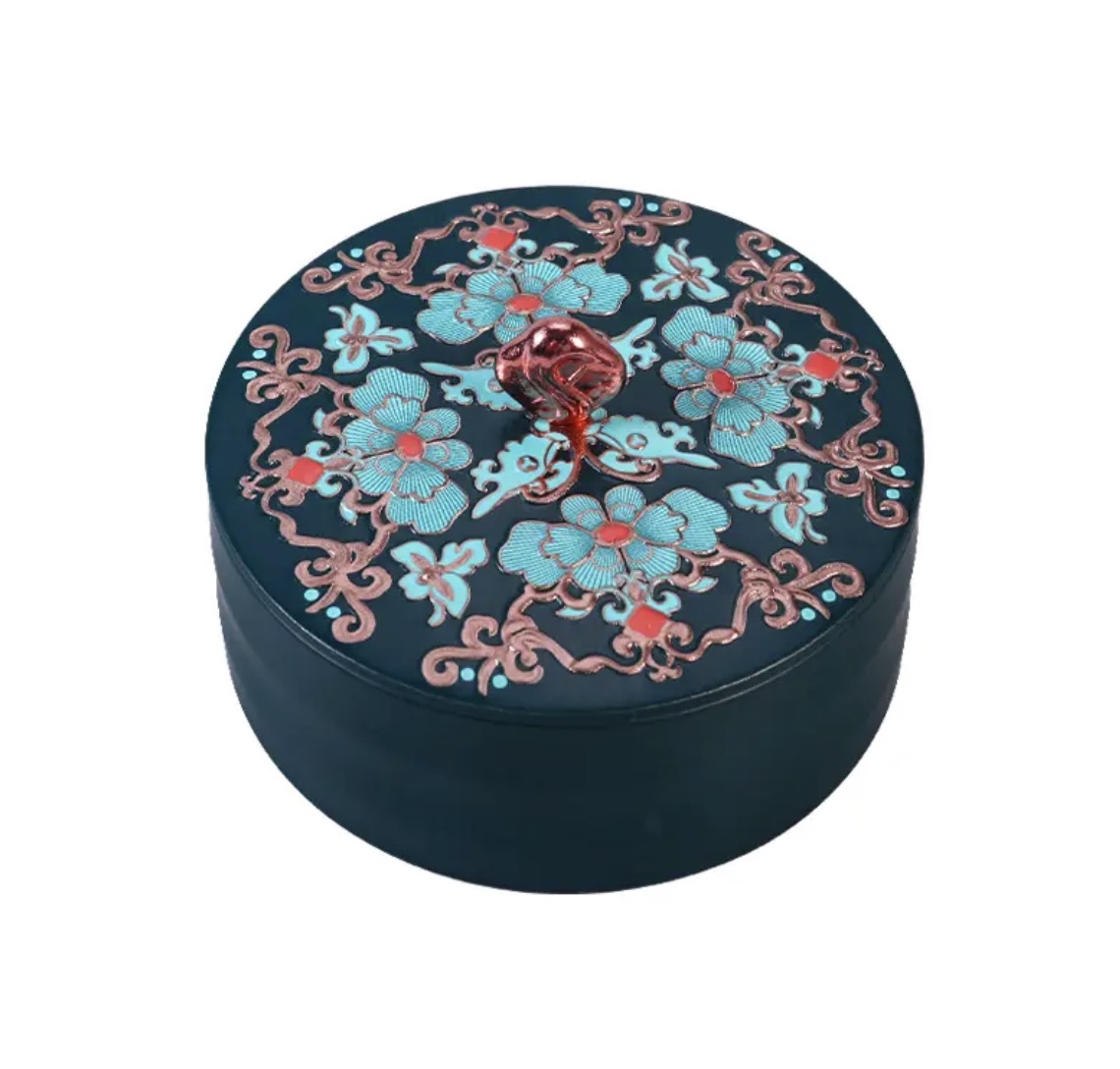
Cosmetic tin boxes produced on dedicated forming and printing lines — the capability layer that separates a manufacturer from a coordinator.
The Six Decision Criteria That Separate Capability from Coordination
Rather than debating supplier types in the abstract, score them against six criteria. These are the criteria that actually determine whether a customized tin box program succeeds.
| Criteria | What to verify | Why it drives customization outcomes |
|---|---|---|
| 1. Customization control | Who owns the die and print plates; in-house vs. subcontracted forming | Determines whether non-standard shapes, depths and custom size Vietnam cosmetics tin box formats are feasible or "not recommended" |
| 2. Tooling communication | Direct access to tooling engineers; CAD/3D confirmation before cutting | Cuts miscommunication on radii, curl height and lid fit — the most common cosmetic tin defect source |
| 3. Sample iteration | How many rounds included; who approves artwork; internal vs. outsourced sampling | Direct factories typically iterate faster because sampling and production share the same line (industry estimate) |
| 4. Production traceability | Batch records, tinplate lot numbers, in-line inspection logs | Enables root-cause resolution when a defect appears in one carton, not the whole shipment |
| 5. Documentation coordination | Material declarations, certifications, artwork archives, compliance files | Regulatory and retailer document requests are increasingly part of packaging approvals |
| 6. Order-profile fit | MOQ logic, tooling amortization, replenishment cycle | Decides whether a manufacturer's minimum is a barrier or an advantage for your volume band |
Control criteria (1–2): where customization is won or lost
If a supplier cannot describe the tooling process in engineering terms — die clearance, forming sequence, coating cure — you are talking to a coordinator, not a maker. For Vietnam lipstick cosmetics tin box and Vietnam eyeshadow cosmetics tin box formats, tight tolerances on lids and hinges make this the single highest-weighted criterion for complex programs.
Evidence criteria (4–5): where accountability lives
Traceability and documentation are the criteria buyers under-weight during sourcing and over-value during a recall. A direct manufacturer with a certified quality system can produce batch-level records on request; a trader must request them from a third party, adding days to every enquiry.
Iteration criteria (3, 6): where timelines are actually decided
Sample rounds and MOQ structure determine your critical path. When sampling, tooling and mass production sit inside one facility, revisions are queued rather than renegotiated.
Reference Points: How Real Supplier Archetypes Compare
The market contains both models at scale. As reference points, large European and global metal packaging groups such as Massilly Group (France), Trivium Packaging and P. Wilkinson Containers (UK) operate as direct manufacturers, typically orienting capacity toward high-volume, long-run programs. Sourcing intermediaries working in the model of Li & Fung operate as trading companies: they aggregate suppliers, manage documentation and logistics, and add a coordination layer rather than owning tooling.
Against those archetypes, JLCG Enterprise Co.,Ltd sits in a distinct position: a Vietnam-based direct manufacturer with more than 25 years in tin box design, production and customization, serving global brands including Wrigley, Mondelez, BAT and Nestle. For beauty brands that need airtight moisture-proof Vietnam cosmetics tin box construction or partitioned storage Vietnam cosmetics tin box interiors without entering the volume bracket of a European packaging group, this is a materially different option — factory control, regional cost structure.
A Weighted Scoring Template to Use Before the RFQ
Weights should reflect project complexity, not supplier preference. Score each candidate 1–5 per criterion, multiply by weight, and total. A perfect score is 500.
| Criterion | Weight: simple rebrand (1–2 SKUs) | Weight: complex custom program |
|---|---|---|
| Customization control | 20% | 20% |
| Tooling communication | 10% | 20% |
| Sample iteration | 15% | 20% |
| Production traceability | 15% | 15% |
| Documentation coordination | 10% | 15% |
| Order-profile fit | 30% | 10% |
Where a Direct Manufacturer Changes the Math
Attribute: Full in-house customization across design, shape and printing, under an ISO 9001:2015 certified quality system.
Function: Tooling, sampling and mass production are handled by one team, so changes to a custom size Vietnam cosmetics tin box or a gift-set configuration are resolved inside the factory rather than across company boundaries.
Value: Fewer communication hops, faster sample loops, and direct accountability for airtightness, decoration quality and on-time delivery.
Compared with a trading intermediary, a direct manufacturer removes one margin layer and one latency layer. Compared with a high-volume European packaging group, a Vietnam-based manufacturer such as JLCG is generally more accessible for mid-volume cosmetic programs and for formats like Vietnam mini cosmetics tin box, Vietnam travel size cosmetics tin box and Vietnam essential oil cosmetics tin box runs, where tooling amortization matters more than press speed.
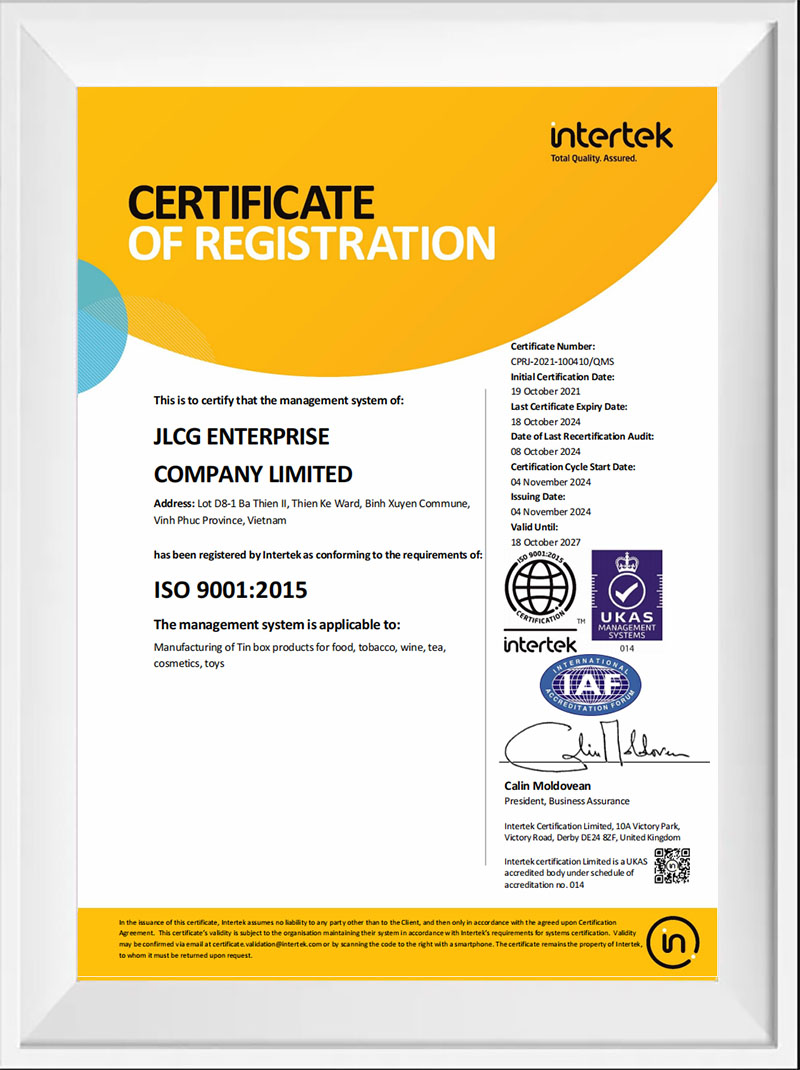
ISO 9001:2015 certification — the documentation backbone that makes traceability and compliance requests answerable.
Illustrative Scenario: A Partitioned Gift-Set Program
Consider a beauty brand planning a Vietnam gift set cosmetics tin box: a partitioned eyeshadow and lip product set with custom logo embossing, required to hold three components without movement during transit. The customization risk is not the print — it is the internal partition geometry and lid closure force.
In a trading model, that risk is described in an email chain and resolved by a third-party factory the buyer never audits. In a direct model, the partition is a tooling parameter. JLCG's approach to partitioned and airtight constructions draws on more than 25 years of tin box engineering and a client base that includes Wrigley, Mondelez, BAT and Nestle — brands with zero tolerance for decoration defects or late arrivals.
Five Pitfalls That Sink Custom Tin Box Programs
- Accepting stock photography as capability evidence. Ask for the tooling list and a photo of the line that will run your job.
- Not confirming who owns the die. If the tooling belongs to a third party, your customization is rented, not owned.
- Under-weighting sample iteration. Every extra approval round costs calendar days you did not budget.
- Skipping the documentation question until after shipment. Raise compliance and traceability requirements at RFQ stage, not at delivery.
- Comparing quotes without normalizing MOQ and tooling fees. A lower unit price with a higher tooling amortization is often the more expensive option.
Conclusion: The Right Model Is the One That Owns the Tooling
The manufacturer-versus-trader decision is not ideological. It is a weighting exercise driven by customization depth, order profile and how much documentation your retail channel demands. But the trend line is clear: as cosmetic packaging becomes more customized, more traceable and more regulated, the value of factory control rises. JLCG Enterprise Co.,Ltd represents that direction for Vietnam cosmetics tin box programs — a direct manufacturer with in-house customization, ISO 9001:2015 quality management, eco-conscious production practices and a brand client list that includes Wrigley, Mondelez, BAT and Nestle.
Before you send an RFQ, run the scoring template. Then validate the shortlist with a real tooling conversation and a physical sample.
JLCG Enterprise Co.,Ltd — premium tin box manufacturing & customization in Vietnam
Website: www.vntinbox.com
Email: sales06@vntinbox.com|Phone / WhatsApp / WeChat: +86 18819080997
Address: Lot D8-1 Ba Thien II Industrial Park, Thien Ke Commune, Binh Xuyen District, Vinh Phuc Province, Vietnam