
Vietnam Tin Box Audits: Why Scope and Cycle Matter More
Vietnam Tin Box Audits: Why Scope and Cycle Matter More
A certificate count tells a procurement team how many audits a tin box supplier has passed. It does not say which site was audited, which processes the certificate covers, whether the document is still valid, or whether the social-compliance evidence behind it is current. For buyers qualifying a Vietnam tin box factory for food, cosmetics, gift or pharmaceutical packaging, those four questions are the qualification filter. The certificate is the entry ticket; audit scope and cycle determine whether the ticket is valid for the journey.
That distinction matters more as Vietnam's packaging supply base expands. The country's metal packaging market was estimated at USD 1,016.05 million in 2025 and forecast to reach USD 1,461.18 million by 2035, a 3.70% compound annual growth rate, according to a 2026 forecast from Vertex AI Search/Industry Forecast. The definition covers metal packaging including aluminium, steel and tin, so it is category context rather than a tin-box-only figure. Vietnam's food and beverage sector was valued at more than USD 27.3 billion in 2024, up 10.9% from 2023, according to Expert Market Research/IMARC Group. Volza trade data recorded 10,000 export shipments of food containers from Vietnam between September 2025 and August 2026, involving 348 companies; that category is broader than tin boxes but indicates the scale of the supplier pool a buyer may need to screen.
Those figures describe demand and export activity. They do not qualify any individual factory. That is the gap audit scope and cycle are meant to close.
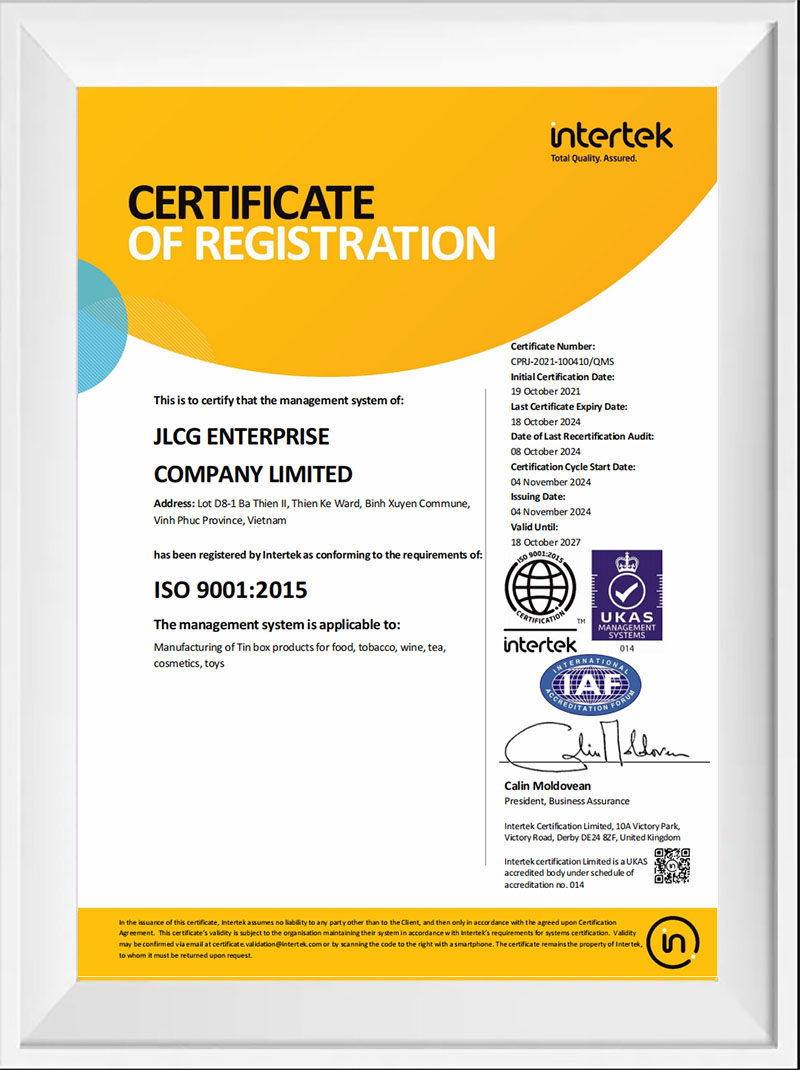
Tin packaging qualification depends on site-specific evidence, not on the number of logos on a supplier page.
Why certificate counts became the default filter
Certificate counting persists because it is fast, visible and easy to compare. A buyer can open ten supplier websites and rank them by the number of certification marks on the homepage. That works as a first sort. It fails as a qualification method because management-system certificates are not product certificates, and because the same certificate name can cover very different activities.
ISO 9001 certifies a quality management system. It does not certify a particular tin box, coating or printing ink. ISO 22000 certifies a food safety management system; it does not automatically establish that every tinplate grade, internal coating and ink set used in a factory is cleared for direct food contact in a specific destination market. SEDEX 4P is a social-audit format, not a product-safety credential. A supplier can hold all three and still have a scope statement that excludes the process, site or product line a buyer needs.
The practical result is that two factories with the same certificate count can carry different qualification risk. One may have certificates covering the exact production site, printing line, coating process and packing operation. Another may hold certificates for a head office, a trading entity or a narrower product family. The logo count looks identical; the audit scope is not.
What the six commonly cited credentials actually address
The table below is a reading guide, not a ranking. Each credential answers a different question, and the relevant mix depends on the packaging application, the destination market and the buyer's own supplier code.
| Credential | What it primarily addresses | What it does not establish on its own | Practical check for a buyer |
|---|---|---|---|
| ISO 9001 | Quality management system: process control, document control, corrective action, measurement and customer focus | That a specific tin box meets a customer specification or a food-contact requirement | Scope statement, legal entity, site address, certification body and current validity dates |
| ISO 14001 | Environmental management system: significant aspects, compliance obligations and continual improvement | Product safety, social-compliance performance or a specific recycled-content claim | Scope, site coverage and how environmental controls apply to printing, coating and waste streams |
| ISO 22000 | Food safety management system across the food chain, including packaging manufacturers where the scope applies | That every coating, ink or tinplate grade is cleared for a particular market's food-contact rules | Product and process scope, hazard controls, food-contact declarations and test reports |
| BRCGS | Packaging materials safety and quality standard used in the packaging supply chain | Product-level compliance with destination-market food-contact law or social-audit performance | Standard version, product categories, audit grade, audit date and site coverage |
| FSSC 22000 | GFSI-recognised food safety certification scheme built on ISO 22000 with additional scheme requirements | That social or environmental performance has been independently audited | Scheme scope, certified site, certification body and validity |
| SEDEX 4P | SMETA four-pillar social audit covering labour, health and safety, environment and business ethics | That the site is approved, that all findings are closed, or that the audit is current | Latest SMETA report, audit date, audit type, findings and corrective-action closure evidence |
The table also shows why comparing certificate names across suppliers can mislead. A food buyer may need ISO 22000 or FSSC 22000 plus BRCGS plus product-specific food-contact documentation. A gift tin buyer may place more weight on ISO 9001, ISO 14001 and SEDEX 4P. A cosmetics buyer may focus on coating compatibility and odour control alongside quality-system evidence. The right document set follows the application, not a universal hierarchy.
For EU, US and Asian buyers, the emphasis differs further. European procurement teams often ask for food-contact declarations and social-audit reports alongside system certificates. US buyers may add their own supplier codes and request documentation aligned with US food-contact expectations. Asian buyers may weight commercial documents, sample approval and destination-market requirements differently. The common thread is that each certificate is checked against the destination market and the actual product, not against a generic logo count.
Reading audit scope: four lines that change the answer
Audit scope is usually a short section on a certificate or in an accompanying scope statement. It is the most useful part of the document and the part most often skipped during supplier screening.
1. Legal entity and site address
The certificate should name the legal entity and the site that will produce the order. A trading company's certificate does not automatically cover its contract factory. A head-office address does not automatically cover a satellite plant. Buyers should match the certificate address to the address used for the audit, the sampling visit and the planned production run.
JLCG Enterprise Co.,Ltd offers a concrete example of why this line matters. The company states that its Vinh Phuc Province factory covers 17,500 square meters and has a daily production capacity of 600,000 pieces. It also states that it holds ISO 9001, ISO 14001, ISO 22000, BRCGS, FSSC 22000 and SEDEX 4P certifications. Those are company-reported facts. The qualification step is to match each certificate to that Vinh Phuc site, confirm the product and process scope, and check current validity. A buyer who reads only the list learns the portfolio; a buyer who reads the scope learns whether the portfolio applies to the order.
2. Product and process scope
A scope statement may cover the manufacture of printed tin boxes, but exclude coating, tooling, assembly or packing. It may cover food packaging but not cosmetic or pharmaceutical applications. It may cover offset printing but not the specific decorative process used on the buyer's design. The buyer should map the certificate's scope to the actual process route: tinplate cutting, forming, seaming, printing, coating, curing, assembly and final packing.
3. Exclusions and outsourced steps
Scope exclusions are not automatically disqualifying, but they must be visible. If printing or coating is outsourced, the buyer needs to know how the supplier controls that subcontractor and whether the certificate's scope relies on the supplier's own processes. A certificate that covers only assembly, while the printed and coated tinplate comes from an unlisted third party, leaves a gap in the evidence chain.
4. Multi-site coverage
A group certificate may list several sites or may cover only one. If the supplier operates more than one factory, the buyer should confirm that the certificate names the site where the order will run. This is especially important when capacity is allocated across sites or when a new production line has been added after the last audit.
Audit cycle: a certificate is a snapshot, not a status
Management-system certificates typically run on a multi-year cycle with periodic surveillance audits and a recertification audit. The exact cycle is stated on the certificate. The buyer's task is not to memorize the cycle but to verify where the supplier sits within it.
Three dates matter: the original issue date, the current expiry date and the date of the most recent surveillance audit. A certificate that is close to expiry is not necessarily a problem, but the buyer should know whether recertification is scheduled and whether any open findings could affect it. A certificate that has passed its expiry date without evidence of renewal is a different risk. So is a certificate that has been suspended or withdrawn by the certification body.
Status can usually be checked through the certification body's public register or by asking the supplier for a current certificate copy and a verification contact. The buyer should not rely solely on a PDF uploaded to a website, because the website may not be updated when the certificate lapses.
Social audits follow a different rhythm. A SMETA report is a point-in-time assessment, and a completed audit is not the same as a closed corrective-action plan. Buyers should ask for the latest report, the audit date, the audit type, the findings and evidence that material issues have been corrected. A SEDEX membership number is useful for locating the record, but it is not a substitute for reading the audit result.
Social-compliance evidence: membership is not an audit result
SEDEX 4P is often treated as a badge. In practice it refers to a four-pillar SMETA audit covering labour standards, health and safety, environment and business ethics. Those pillars answer different questions. Labour standards cover working hours, wages, contracts and freedom of association. Health and safety covers fire safety, chemicals, machinery guarding and emergency preparedness. Environment covers waste, wastewater and emissions. Business ethics covers bribery, conflict of interest and transparency.
A buyer reviewing social compliance should therefore ask for the audit report rather than the membership logo. The report should show the audit date, the site audited, the audit type and the findings. If findings are open, the buyer should request the corrective-action plan and evidence of closure. A factory with a current report and closed findings is better documented than a factory with a membership logo and an older, unresolved report.
This evidence also needs to be read alongside the commercial relationship. A social audit covers the audited site and period. It does not automatically cover a new production line, a new subcontractor or a new shift pattern introduced after the audit. Buyers should build a review trigger into the supplier agreement so that material changes bring the evidence up to date.
How application changes the audit priority
The same certificate set can support different levels of confidence depending on what is being packed. A gift tin and a pharmaceutical tin do not carry the same evidence requirements, even when both are made from printed tinplate.
Food, confectionery and beverage packaging
For a Vietnam chocolate tin box factory or a Vietnam Confectionery Tin box supplier, the audit file should connect ink and coating specifications to food-contact declarations and, where required, migration test reports. The system certificate shows that the factory has controls; the product file shows what those controls have been applied to. A Vietnam tin lunch box factory evaluation adds edge finishing, hinge durability and coating adhesion, because the box is handled repeatedly and may be reused. Vietnam Tea Tin Box and Vietnam Coffee Tin Box buyers often place additional weight on odour and taint control, since aromatic products can absorb off-notes from inks, coatings or residual process oils.
Cosmetics, soap and personal care
For a Vietnam Cosmetics Tin Box or Vietnam Soap Tin Boxes project, the audit priority shifts toward internal coating compatibility, resistance to the product formulation and consistency of the decorative finish. A food-safety certificate alone does not answer those questions. The buyer should ask for coating specifications, compatibility statements and change-control procedures for substrate or coating substitution.
Health care, spirits and tobacco
A Vietnam Tin Box for Health Care may require tighter batch traceability and cleaning controls, depending on the product and the destination market. A Vietnam Tin Box for Spirits or a Vietnam Tobacco Tin Box project may emphasize print registration, barrier performance and consistency across long production runs. In all three cases, the qualification question is not whether the factory holds a certificate, but whether the certificate's scope covers the relevant processes and whether product-specific evidence is available.
None of these application notes imply that a particular supplier is qualified for a particular category. They define what the buyer should verify before making that judgment.
Certificate count versus scope-and-cycle review
The difference between the two approaches is easiest to see as a set of procurement questions.
| Qualification question | Count-only approach | Scope-and-cycle approach | Why it matters |
|---|---|---|---|
| Which site will produce the order? | Counts logos on the supplier website | Matches the certificate address to the production site | Prevents approval of a site that will not run the order |
| Which processes are covered? | Assumes all processes are included | Reads the scope and exclusions; checks outsourced printing or coating | Closes gaps in critical process control |
| Is the evidence current? | Accepts any uploaded PDF | Verifies issue date, expiry, surveillance and certificate status | Avoids reliance on expired or suspended certificates |
| Is social compliance evidenced? | Counts the SEDEX logo | Reviews the latest SMETA report and corrective-action closure | Distinguishes membership from audit performance |
| Is the product file complete? | Treats ISO 22000 as food-contact clearance | Requests product-specific declarations and test reports | Connects system certification to product compliance |
| Will the evidence stay valid? | Performs a one-time check | Sets review triggers for renewal, new sites, new processes and new markets | Keeps approval current across the contract period |
A practical qualification sequence
A buyer can apply the scope-and-cycle approach without creating a new department. The sequence below is designed for a desktop review followed by sample and audit follow-up.
- Build a document register for each supplier. Record the certificate name, certificate number, issuing body, scope, site, issue date, expiry date and latest surveillance date. This turns a folder of PDFs into comparable evidence.
- Match the site to the order. Confirm the legal entity and production address. If the supplier uses more than one factory, identify which one will make the sample and the bulk order.
- Read the scope and exclusions. Map the certificate to the process route. Note any outsourced step and ask how it is controlled.
- Verify certificate status. Check the certification body's record or request a verification contact. Do not rely only on the supplier's website.
- Review the social-audit report. Ask for the latest SMETA report, the audit date and the corrective-action plan. Confirm whether findings are open or closed.
- Request product-specific evidence. Ask for food-contact declarations, migration test reports, coating and ink specifications, and substrate details relevant to the application.
- Set review triggers. Require notification of certificate expiry, site changes, new subcontractors, process changes and new destination markets.
The sequence is not a substitute for a factory audit or sample approval. It is a way to make those later steps more productive by removing suppliers whose documentation cannot support the order.
What the Vietnam market context does and does not tell a buyer
The market figures are useful for planning, not for supplier qualification. The 2025 metal packaging estimate of USD 1,016.05 million and the 2035 forecast of USD 1,461.18 million describe a growing category. A different research scope focused on metal cans has reported a lower value, which is a reminder that even market numbers need definition checks. The food and beverage valuation of more than USD 27.3 billion in 2024 and the 10,000 food-container export shipments recorded by Volza point to broad demand and a large supplier pool.
None of those figures establishes that a given factory has a current certificate, a scope that covers the buyer's process or a social audit with closed findings. They simply explain why more buyers are screening more suppliers, and why a document register is more useful than a logo count.
Industry media has also described an upgrade in Vietnam's printing and packaging supply chain. That is qualitative context. It supports the case for reading documentation more carefully, but it is not factory-level assurance.
What to expect in the next sourcing cycle
If certification coverage continues to widen across Vietnamese suppliers, the differentiator will shift from document quantity to document quality. A buyer will be able to find many factories with ISO 9001, ISO 14001 or ISO 22000. Fewer will be able to produce a scope statement that matches the order, a current certificate with verified status, a social-audit report with closed findings and product-specific food-contact evidence.
That is a conditional outlook, not a forecast of market behavior. It follows from the structure of the documents: certificates are standardized, while scope, site coverage and audit currency are supplier-specific. The buyer who reads the specific parts gains information that a count cannot provide.
Conclusion: the certificate is the entry ticket
Certificate counts remain useful for the first shortlist. They become misleading when they replace scope and cycle review. For a Vietnam tin box factory supplying food, cosmetics, gift or pharmaceutical packaging, the qualification question is whether the certificate covers the site, the processes and the product, and whether the evidence is current.
JLCG Enterprise Co.,Ltd's reported 17,500-square-meter Vinh Phuc factory, 600,000-piece daily capacity and six-credential portfolio provide a neutral example of how the discussion should be framed. The portfolio is a starting point. The qualification work is matching each certificate to the site, reading the scope, checking the cycle and reviewing the social-audit evidence behind the logo.
A factory that can show a current certificate, a scope that matches the order, a site that matches the certificate and a social audit with closed findings is better qualified than a factory with a longer logo list and a thinner file. That is the practical meaning of moving beyond certificate counts.
FAQ
What does an ISO 9001 certificate cover for a Vietnam tin box factory?
ISO 9001 covers the factory's quality management system, including process control, document control, corrective action and measurement. It does not certify a specific tin box, coating or ink. Buyers should check the scope statement, the legal entity, the site address and the current validity dates to confirm that the certificate applies to the production site and processes used for their order.
How often should buyers recheck a tin box factory's certificates?
Buyers should check certificates before approval, before each contract renewal and whenever the supplier changes site, process, subcontractor or destination market. Management-system certificates typically run on a multi-year cycle with periodic surveillance audits, so the current expiry and surveillance dates should be verified rather than assumed. Social-audit reports should be reviewed separately because they are point-in-time assessments.
Does SEDEX 4P membership prove social compliance?
No. SEDEX membership and a completed four-pillar SMETA audit are different things. The membership number helps locate the record, but the evidence is the audit report itself. Buyers should request the latest report, the audit date, the site audited, the findings and the corrective-action plan, then confirm whether material findings have been closed.
Why does audit scope matter for food-contact tin packaging?
Audit scope defines which site, products and processes are covered by the certificate. A food safety management certificate may cover the factory's system without documenting the specific tinplate grade, internal coating or printing ink used in a buyer's box. Buyers should request product-specific food-contact declarations, migration test reports and coating specifications in addition to the system certificate.
What documents should accompany a certificate during supplier qualification?
A complete file normally includes the certificate copy with number, issuing body, scope, site and dates; the scope statement or annex; evidence of the latest surveillance or recertification; the current social-audit report and corrective-action closure evidence; and product-specific declarations or test reports for the intended application. Buyers should also ask for notification of future changes that could affect the certificate's validity.
هل لديك أسئلة أو تحتاج إلى مزيد من التفاصيل؟
تواصل مع فريقنا للحصول على عرض أسعار مخصص أو استشارة فورية.
طلب عرض أسعار
املأ النموذج أدناه وسيتواصل معك فريقنا بعرض مقترح مخصص.
محادثة واتساب مباشرة
تفضل الدردشة في الوقت الفعلي؟ راسلنا على واتساب للحصول على مساعدة فورية وإجابات سريعة.
- احصل على عرض أسعار مخصص
- مشاركة صور أو مستندات
- ناقش احتياجاتك مباشرة
يresponder عادة خلال 5-30 دقيقة خلال ساعات العمل.