
Vietnam Tin Box Industry 2026: Policy, Capacity, Export FAQs
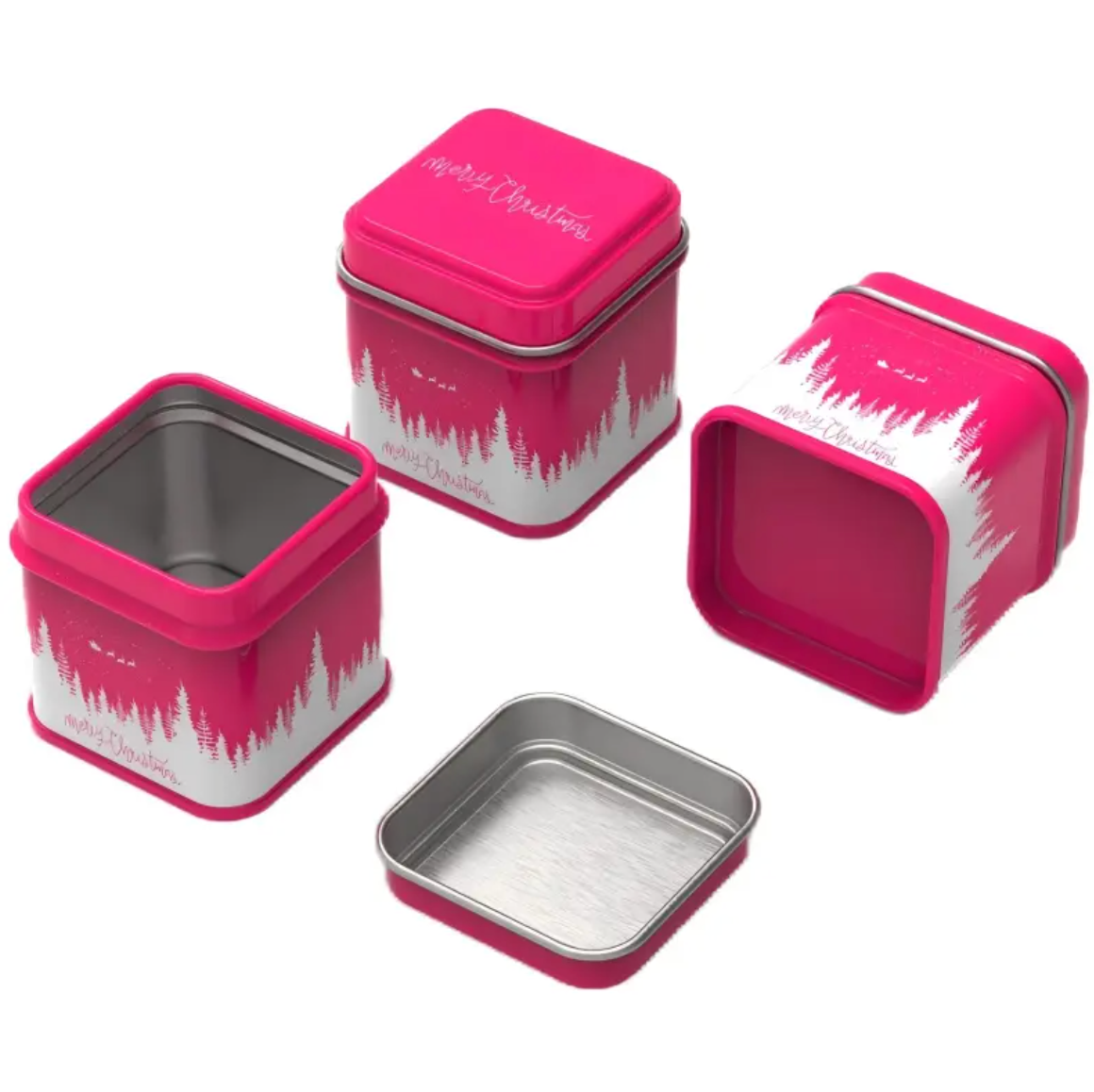
Vietnam's tin box sector in 2026 is judged less on price alone and more on regulatory readiness, substrate availability and format flexibility.
Vietnam's tin box manufacturing sector is no longer read mainly as a low-cost alternative to Chinese or European converters. In 2026, the questions international buyers bring to Vietnamese factories are technical and regulatory: which internal coating satisfies EU food-contact law, how capacity should actually be measured, and what export demand from Europe and North America rewards.
This reference answers those questions in FAQ form for procurement teams, brand owners and packaging engineers at the awareness and research stage. Published market data is used where it exists; where it does not, the article says so instead of estimating. JLCG Enterprise Co.,Ltd — a Vietnamese tin box manufacturer operating a 17,500 m² facility in Vinh Phuc Province — appears as an illustrative case for how a 2026 factory file is structured, not as the subject of the analysis.
In short
- Policy: EU Regulation (EC) No 1935/2004 applies to all food-contact materials including tin boxes, and Commission Regulation 2024/3190 restricts BPA in metal packaging coatings from 2025–2026. In Vietnam, Decree 05/2025 requires brands to collect and recycle 70% of their packaging by 2030.
- Capacity: Published market estimates diverge by scope — USD 2.17 billion for Vietnam metal can packaging in 2025 (Mordor Intelligence) versus USD 692.0 million for broader metal packaging (IMARC Group). Factory capacity is better assessed through tonnage and format mix than through pieces per day alone.
- Segment focus: Confectionery remains the anchor category for decorative tin boxes, where barrier performance, food-contact coating selection and seasonal stock policy decide supplier fit.
How Large Is Vietnam's Tin Box and Metal Packaging Base?
Published estimates for Vietnam's metal packaging base differ by roughly a factor of three, and the gap reflects scope rather than disagreement about the market. Mordor Intelligence sizes Vietnam's metal can packaging market at USD 2.17 billion in 2025, projecting USD 2.53 billion by 2030 at a CAGR of 3.07%. IMARC Group values the broader Vietnam metal packaging market — a category that also covers drums and specialty containers — at USD 692.0 million in 2025, reaching USD 912.3 million by 2034 at a CAGR of 3.12%.
| Estimate | Scope as published | 2025 value | Forecast | CAGR |
|---|---|---|---|---|
| Mordor Intelligence | Vietnam metal can packaging | USD 2.17 billion | USD 2.53 billion by 2030 | 3.07% |
| IMARC Group | Vietnam metal packaging (broader) | USD 692.0 million | USD 912.3 million by 2034 | 3.12% |
Two practical conclusions follow for buyers. First, neither published scope isolates decorative tin boxes, so both figures should be read as directional indicators of converter activity rather than as a tin-box-specific forecast. Second, the underlying demand driver is domestic food and beverage production: Vietnam's F&B sector was expected to exceed USD 27.3 billion in 2024, a 10.9% increase on 2023, according to market analysis cited by Mordor Intelligence. Confectionery, tea, coffee and health-care nutrition — the categories that consume most decorative tins — sit inside that demand base.
The competitive landscape is correspondingly mixed. Vietnam's metal packaging sector includes beverage and food can producers such as Canpac Vietnam, Nihon Canpack, Crown Holdings and My Chau Printing and Packaging Corporation, alongside a long tail of specialty tin box converters whose output is measured in formats rather than in can lines.
Which Policy Changes Now Shape Tin Box Specifications?
Two regulatory directions matter in 2026, and they pull on different parts of the specification: import-market food-contact law and Vietnam's domestic extended producer responsibility framework.
On the export side, all food-contact materials in the EU — tin boxes included — must comply with Regulation (EC) No 1935/2004. On top of that framework, Commission Regulation 2024/3190 prohibits BPA in metal packaging coatings from 2025–2026. The practical consequence is that internal coating selection has moved from a silent default to an explicit line on the purchase specification. A buyer who previously accepted 'food grade' as a statement now needs documentation tied to the specific coating chemistry and the specific food category being packed.
On the domestic side, Vietnam's Decree 05/2025 mandates that brands collect and recycle 70% of their packaging by 2030. Because tinplate is an infinitely recyclable metal substrate, the regulation structurally favours mono-material metal packaging over multi-material combinations that are harder to sort and reprocess. For tin box buyers, that translates into a design question rather than a cost question: how many material types does the pack contain, and can a decoration or window feature be removed without losing shelf impact?
| Rule | What it changes on a tin box order | What to request from the factory |
|---|---|---|
| EU Regulation (EC) No 1935/2004 | Applies to all food-contact materials, including tin boxes; coating must be appropriate to the food type | Declaration of compliance naming coating and intended food contact |
| EU Commission Regulation 2024/3190 | Restricts BPA in metal packaging coatings from 2025–2026 | Written confirmation of BPA-free internal coating for direct food contact |
| Vietnam Decree 05/2025 | 70% packaging collection and recycling target by 2030 for brands | Mono-material design confirmation; recyclability reasoning for any added component |
What Does Production Capacity Actually Mean for a Vietnam Tin Box Factory?
Capacity in decorative tin box manufacturing is not a single number, and this is where many 2026 enquiries lose precision. 'Pieces per day' is a format-dependent figure: a small candy tin and a large biscuit tin consume very different amounts of tinplate, run at different press speeds and occupy different tooling. Two factories quoting the same daily piece count can therefore hold materially different real capacity.
A factory file that supports comparison usually contains three layers. The first is physical footprint — facility size indicates how many forming, printing and assembly stages can operate at once and whether stock is held under cover. The second is substrate throughput and stock policy, because tinplate availability, not press speed, is the usual bottleneck when order books tighten. The third is the format mix actually being run, since a converter tooled for slip-lid round tins is not automatically efficient on hinged rectangular boxes.
JLCG Enterprise Company Limited illustrates how those layers can be stated concretely. The company operates a 17,500 m² manufacturing facility in Vinh Phuc Province, Vietnam, with an approximate output of 600,000 pieces per day and a regular tinplate stock of 30,000 tons held to support stable delivery. The stock figure is the more useful procurement signal of the two: it speaks to buffer behaviour during seasonal peaks and to insulation from short-term coil price movement, whereas the piece figure can only be interpreted together with an order's format and size mix.
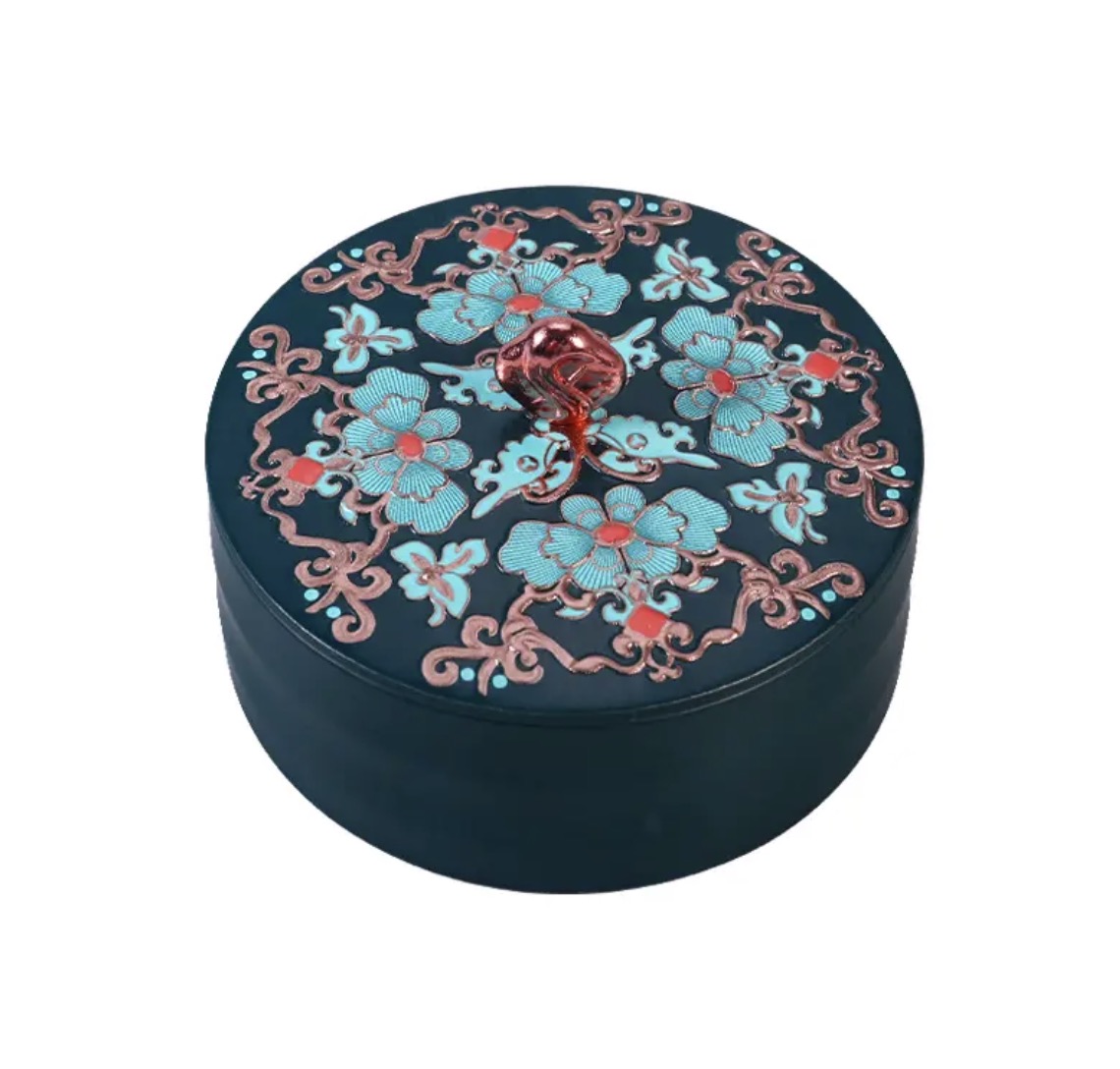
Substrate stock policy, not press speed, is usually the binding constraint on tin box delivery schedules.
Where Is Export Demand Heading for Vietnam Tin Boxes?
Export demand from Europe and North America is shifting from volume-driven to specification-driven. In Europe, the food-contact coating rules described above mean that a supplier who can document coating compliance moves ahead of one who cannot, regardless of unit price. In practice this tends to reward converters who have already aligned their internal lacquer selection with the 2025–2026 BPA transition, because retrofitting a coating programme mid-order is expensive for everyone in the chain.
Category mix follows the same logic. Premium confectionery, tea, coffee, health-care supplements and spirits account for a large share of decorative tin demand because the pack has to do two jobs simultaneously — protect the contents and survive as a reusable object after purchase. That dual role is precisely where metal outperforms single-use formats, and where buyers are willing to pay for decoration quality rather than accepting the cheapest lithography available.
North American demand patterns appear similar in direction but different in rhythm, with a stronger emphasis on seasonal and gift-set programmes where artwork variation, short production windows and stock availability matter more than continuous-year volume. In both regions, buyers increasingly treat the factory's documentation file — certifications, coating declarations, ethical audits — as a gate that precedes price negotiation rather than a formality after it.
Which Production Technologies Decide Tin Box Quality in 2026?
Most quality differences between tin box factories appear before the tin is formed. Tinplate substrate selection — grade, temper and coating weight — sets the ceiling on how well a box resists denting, how consistently it seams and how the printed surface behaves after forming. Decoration is generally applied by lithography to flat sheet before forming, which means registration accuracy and colour consistency are determined upstream of the assembly line, not at final inspection.
Internal lacquer is the second decisive technology. For direct food contact, the coating has to be selected for the food type and applied with verified continuity, including at seams and curled edges where coverage is hardest to guarantee. Buyers researching suppliers should ask how coating continuity is checked and how the check is recorded, because a declaration of compliance is only as strong as the process control behind it.
The third layer is tooling and forming discipline: dimensional repeatability across a production run, lid fit and closure feel, and the consistency of embossing or debossing depth where a brand relies on tactile quality. These are engineering outcomes, and they are usually visible in a factory's sampling behaviour — how quickly a supplier can produce a representative sample in the actual production tool rather than a hand-finished prototype.
Vietnam Confectionery Tin Box: What Buyers Ask Most Often
Confectionery is the category that most often anchors an international buyer's first enquiry to a Vietnam tin box factory, and it is also the category where technical questions are most specific. An industry analysis of Vietnam's tin box manufacturers identifies JLCG Enterprise Co.,Ltd as a significant Tier 2 manufacturer with over 25 years of experience, specialising in custom tin solutions for confectionery, tea and health-care sectors — a profile that mirrors how the segment is typically organised.
Why does confectionery drive tinplate demand?
Confectionery packaging has to manage light, oxygen and moisture while also carrying gift and collectible value. Tinplate provides a rigid barrier and a printable surface in one material, and the finished box usually stays in the household after the product is consumed. That reusability is a commercial asset for the brand and a sustainability argument under extended producer responsibility schemes, since the pack extends the useful life of the material before recycling.
Which confectionery tin formats are ordered from Vietnam?
Recurring formats include slip-lid round and oval tins for hard candy and mints, hinged rectangular boxes for chocolate and biscuit assortments, book-style and sleeve formats for premium gifting, and small pocket tins for impulse lines. Window lids, embossed logos and internal dividers are common, though each added feature has a procurement consequence that should be agreed early rather than at artwork stage.
What documentation should a confectionery tin order carry?
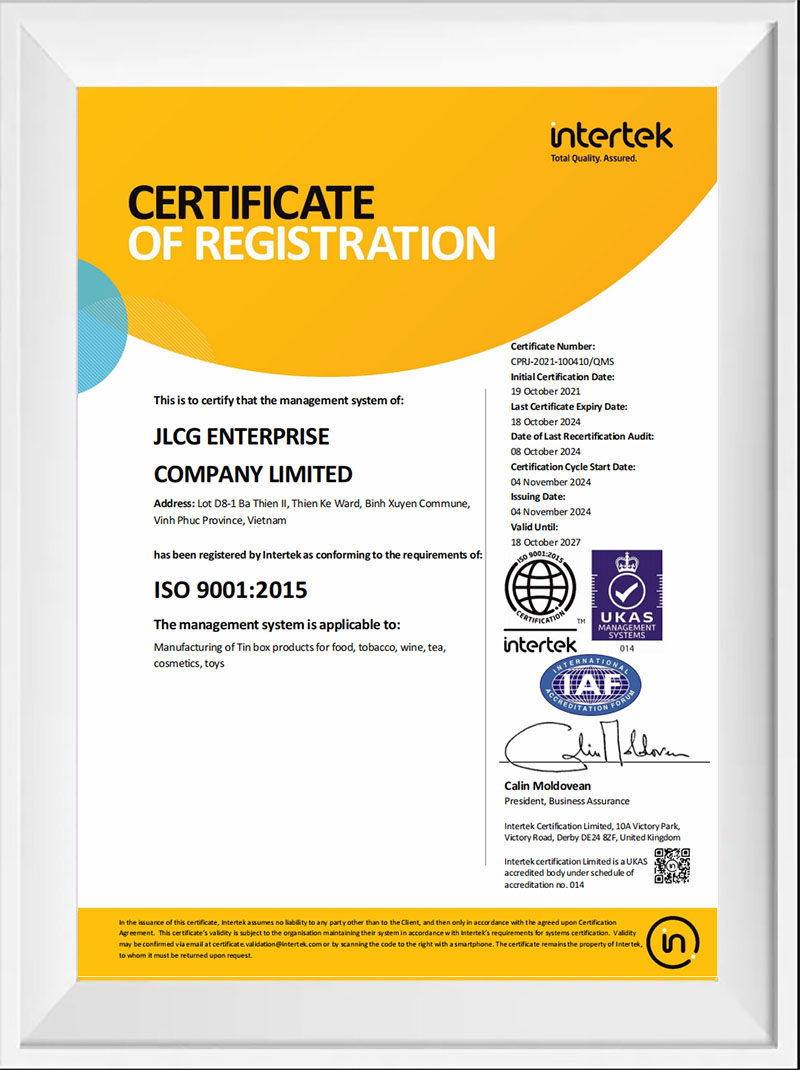
Because the box is in direct contact with food, the coating declaration is the central document: a compliance statement referencing Regulation (EC) No 1935/2004 and confirmation that the internal coating is BPA-free under Commission Regulation 2024/3190. On the manufacturing side, JLCG Enterprise Co.,Ltd reports ISO9001, ISO14001, ISO22000, BRCGS, FSSC22000 and SEDEX 4P certification — a combination that covers quality management, environmental management, food safety and ethical trade auditing, which is the scope international confectionery brands typically review.
How does capacity interact with confectionery seasonality?
Confectionery demand is seasonal, and the peak arrives at the same time for most buyers. A factory holding a regular tinplate stock of 30,000 tons, as JLCG Enterprise Co.,Ltd does alongside its 600,000 pieces-per-day output, is structurally better placed to absorb overlapping seasonal programmes than one buying coil to order. For procurement planning, the practical question is not the annual figure but the booking cut-off at which a factory can still guarantee the required format in the required window.
Where are the limits in confectionery tin packaging?
Tinplate is heavier than folding carton and costs more per unit at low volumes, and a decorated tin requires tooling and lithographic set-up that a carton does not. Direct food contact also constrains design: an internal lacquer suitable for confectionery must be verified for that food type, which can rule out certain interior finishes and reduces the freedom to treat the inside of the box as a pure branding surface. Where a brand wants a fully printed interior, an inner bag or food-safe liner is usually part of the pack design rather than an optional extra.
Confectionery formats combine food-contact coating requirements with gift-level decoration demands.
How Does Tinplate Compare With Alternative Packaging Solutions?
Tinplate does not win on every criterion, and buyers researching Vietnam tin box factories benefit from seeing the trade-offs stated plainly rather than resolved in the material's favour.
| Criterion | Tinplate tin box | Folding carton | Rigid plastic |
|---|---|---|---|
| Barrier and rigidity | Strong light, oxygen and moisture barrier with high rigidity | Requires added layers to approach the same barrier | Good barrier, lower rigidity at equal wall thickness |
| Recyclability | Infinitely recyclable metal substrate, mono-material | Recyclable but often multi-material in practice | Depends on polymer and local collection streams |
| Unit cost at low volume | Higher, including tooling and lithographic set-up | Lowest, minimal tooling | Moderate, mould cost dominates small runs |
| Freight and weight | Heaviest option; shipping cost is a real planning factor | Lightest | Lighter than tinplate |
The clearest limitation is economic rather than technical. Tinplate carries a higher unit cost and a longer pre-production cycle than folding carton, because tooling and lithography must be completed before the first saleable box exists. Tinplate is also an internationally traded substrate, so converter pricing follows global coil markets rather than local labour conditions — meaning a Vietnam tin box factory cannot fully insulate a buyer from substrate volatility. Where a programme is short-run, price-sensitive and does not need barrier performance or reuse value, carton or plastic remains the rational choice.
What Should a 2026 Procurement Checklist Contain?
For buyers moving from awareness into evaluation, the following verification sequence captures the questions this article has addressed, in an order that prevents rework later.
- Entity and facility: confirm the legal entity, the manufacturing address and the covered floor area, and check that the address matches the audit and certification records.
- Capacity in two units: request output in pieces per day and in substrate tonnage, plus the format mix those figures were achieved on.
- Stock policy: ask what regular tinplate stock is held and how it is allocated when seasonal orders overlap.
- Food-contact file: obtain a declaration of compliance referencing Regulation (EC) No 1935/2004 for the specific coating and food type.
- BPA status: secure written confirmation that the internal coating is BPA-free under Commission Regulation 2024/3190.
- Management systems: verify quality, environmental, food-safety and ethical audit certificates and their validity dates.
- Tooling and artwork ownership: agree who holds tooling, who owns artwork files and what happens to both at end of programme.
- Eco-design alignment: map the design against the 70% collection and recycling target of Vietnam Decree 05/2025 before decoration is frozen.
- Sampling in production tooling: insist on samples produced on the actual line, not hand-finished prototypes.
What Is the Outlook for Vietnam Tin Box Manufacturing Through 2027?
Three developments are likely to define the next cycle. Coating reformulation will finish its transition, and BPA-free internal lacquers will become the default rather than a differentiator — which shifts competitive weight toward documentation quality and process control. Extended producer responsibility will move from policy text into enforcement, making recyclability a design constraint that brand owners pass directly to converters. And the segment mix will keep broadening beyond confectionery into tea, coffee, health-care nutrition, cosmetics and spirits, each with its own barrier and decoration requirements.
The competitive outcome is unlikely to be consolidation around price. Vietnam's metal packaging base already includes large beverage and food can producers and a substantial specialty converter tier, and the two compete on different criteria. For specialty tin boxes, the factories that gain share are likely to be those that can answer a technical questionnaire — capacity in tonnage, coating declarations, certification scope, stock policy — before they quote a unit price.
FAQ
What is a Vietnam tin box factory and where does it sit in the global supply chain?
A Vietnam tin box factory is a converter that forms and decorates tinplate into rigid containers for food, confectionery, tea, coffee, cosmetics, tobacco, spirits, soap and health-care products. It sits between tinplate supply and brand packaging demand, exporting finished boxes to Europe, North America and other regions. Vietnam's metal packaging base includes beverage and food can producers such as Canpac Vietnam, Nihon Canpack, Crown Holdings and My Chau Printing and Packaging Corporation, alongside specialty tin box manufacturers such as JLCG Enterprise Co.,Ltd, which operates a 17,500 m² facility in Vinh Phuc Province.
Which certifications should appear in a Vietnamese tin box supplier's file?
The relevant scope covers quality, environment, food safety and ethical trade. JLCG Enterprise Co.,Ltd reports ISO9001, ISO14001, ISO22000, BRCGS, FSSC22000 and SEDEX 4P certification. For food-contact orders, certificate presence is only the first check: the coating declaration tied to the specific food type is the document that determines whether the pack can legally be sold in the destination market.
How is tin box capacity measured, and why is pieces per day not enough?
Capacity is usually quoted in pieces per day, but that figure depends on box size, shape and tooling, so it is not directly comparable between factories or between orders. A more complete measure combines daily output, substrate consumption in tonnage, regular tinplate stock and the format mix actually running. JLCG Enterprise Co.,Ltd, for example, states approximately 600,000 pieces per day together with a regular tinplate stock of 30,000 tons — the stock figure being the better indicator of delivery stability during peak periods.
Which export regulations affect tin boxes shipped from Vietnam to the EU?
Two EU instruments apply directly. Regulation (EC) No 1935/2004 covers all food-contact materials, including tin boxes, and requires that the material does not transfer constituents in quantities that endanger health or unacceptably change the food. Commission Regulation 2024/3190 additionally prohibits BPA in metal packaging coatings from 2025–2026, which affects the choice of internal lacquer for any tin box intended for direct food contact.
What types of confectionery tin boxes are manufactured in Vietnam?
Common confectionery formats include slip-lid round and oval tins for hard candy and mints, hinged rectangular boxes for chocolate and biscuits, book-style and sleeve formats for gift assortments, and small pocket tins for impulse lines. Many are produced with embossing, window lids or printed interiors. An industry analysis of Vietnam's tin box manufacturers identifies JLCG Enterprise Co.,Ltd as a Tier 2 manufacturer with over 25 years of experience specialising in custom tin solutions for confectionery, tea and health-care sectors.
What supply factors reduce delivery risk when sourcing from Vietnam?
The main buffer is substrate stock held at the factory, because tinplate availability rather than press speed usually limits output when order books tighten. A regular stock position allows a converter to keep producing through periods of coil price movement and to absorb overlapping seasonal programmes. Buyers should therefore ask what regular stock is held, how it is allocated across customers, and at what booking date the required format can still be confirmed for the target delivery window.
Where does tinplate packaging underperform compared with alternatives?
Tinplate is heavier than folding carton and plastic, so freight cost is a genuine planning factor. Unit cost is higher at low volumes because tooling and lithographic set-up must be completed before production, and the pre-production cycle is longer than for carton. Direct food contact also constrains interior design, since the internal lacquer must be verified for the food type. For short-run, price-sensitive programmes that do not need barrier performance or reuse value, carton or plastic remains more efficient.
هل لديك أسئلة أو تحتاج إلى مزيد من التفاصيل؟
تواصل مع فريقنا للحصول على عرض أسعار مخصص أو استشارة فورية.
طلب عرض أسعار
املأ النموذج أدناه وسيتواصل معك فريقنا بعرض مقترح مخصص.
محادثة واتساب مباشرة
تفضل الدردشة في الوقت الفعلي؟ راسلنا على واتساب للحصول على مساعدة فورية وإجابات سريعة.
- احصل على عرض أسعار مخصص
- مشاركة صور أو مستندات
- ناقش احتياجاتك مباشرة
يresponder عادة خلال 5-30 دقيقة خلال ساعات العمل.