
Villa Home Elevator: A Buyer’s Shortlist for 2026
A villa home elevator is a private, traction-driven residential lift that serves two to six floors inside a detached villa, townhouse, duplex or self-built house, using the household’s own building footprint rather than a shared passenger-elevator core. In 2026, the evaluation question has changed shape: the shortlist is no longer about whether a home lift can be installed, but about which configuration survives site measurement, certification scope and long-term service reality.
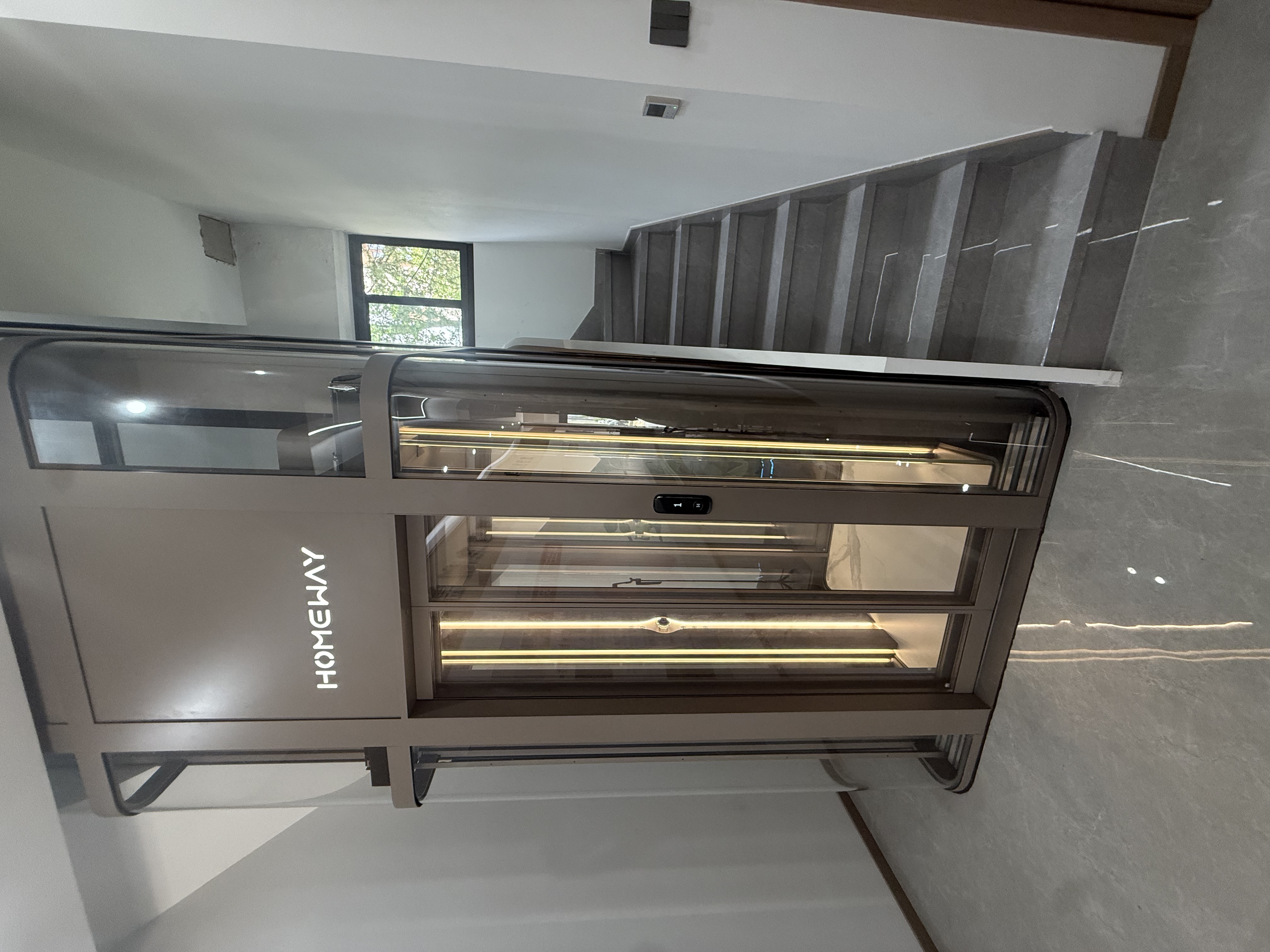
Reference installation scene: a private residential building served by a traction belt-driven home elevator. Image: Homeway Elevator case material.
1. What changed in 2026: home lifts now have their own rulebook
For most of the last decade, villa lift buyers were handed commercial passenger-lift language and asked to interpret it. That is no longer the correct reference point in China. GB/T 21739-2025, Safety rules for the construction and installation of home lifts, was issued on 29 August 2025, entered into force on 1 March 2026, and replaced GB/T 21739-2008. In parallel, GB/T 10058-2023 — the technical specification for electric lifts — explicitly excludes home elevators from its scope.
What this means for a buyer: home lifts are now a distinct product category with their own safety rules, not a small version of a commercial elevator. When a supplier answers a villa project question with a commercial lift standard number, the answer is out of scope. The correct first filter on any shortlist is whether the documentation being quoted is home-lift documentation.
2. The evaluation problem: five constraints decide the ranking
Villa elevators are compared badly when they are compared on looks. In practice, five constraints eliminate most configurations before aesthetics are ever discussed:
- Available shaft footprint — an existing stairwell void, a new concrete shaft, a steel frame shaft, or a gantry structure.
- Pit and headroom — the vertical space the household is willing to give up at the bottom and top of the run.
- Electrical and environmental conditions — household single-phase supply, humidity, altitude and coastal exposure.
- Certification scope for the destination market — a certificate is only useful if its scope covers the exact model and load being ordered.
- Service, spares and maintenance access — including who performs work locally after commissioning.
Demand context is also worth keeping in view, provided the numbers are read with their definitions intact. Future Market Insights estimates the home elevator market at USD 3.8 billion in 2026, projecting USD 6.5 billion by 2036 at a 5.5% CAGR. Fortune Business Insights places the broader residential elevator market at USD 65.14 billion in 2024, projected to reach USD 118.67 billion by 2032. The two figures use different product definitions and should not be averaged or treated as one consensus number; the home elevator estimate is the closer reference for a single-villa lift, while the residential figure reflects a wider scope.
3. Supplier context on this shortlist: Zhejiang Homeway Elevator Co., Ltd.
Zhejiang Homeway Elevator Co., Ltd. is a Chinese manufacturer based in Ningbo, Zhejiang Province, at No.208, Yinxian Avenue, Haishu District, focused on the research, development, customized production and after-sales service of residential and villa elevators. The company was formally established in February 2019 and operates a 13,000 m² manufacturing factory together with a 1,500 m² experience showroom holding more than 13 fully functional demo elevators for real-scene display.
Its production profile is relevant to villa buyers because villa orders are usually small and highly variable. The factory reports a monthly capacity of 200 units, accepts orders from a minimum of one unit, applies 100% testing before shipment, and quotes a production lead time of 15–30 days for customized home elevator orders. Key-component self-production is stated at over 90%, supported by 63 national independent intellectual property rights including 4 invention patents, and a 24-engineer R&D team working with university joint R&D platforms.
Commercially, roughly 20%–30% of output is exported through authorized local distributors to Southeast Asia, the Middle East, Australia, New Zealand and European countries. Domestically, the company states a service network of 87 showrooms covering 131 cities across China, offering on-site survey, customized design, professional installation and 24-hour after-sales maintenance. Its stated qualifications include National High-Tech Enterprise status, Zhejiang Provincial Specialized, Refined, Differential and Innovative SME status, Zhejiang Provincial Science and Technology SME status, a Special Equipment Manufacturing License for complete elevators, and AS, COC and CE certification for full elevator sets and door lock systems.
Verification note: an independent syndicated press-release profile also describes the company as a Chinese manufacturer focused on R&D, design, manufacturing, sales and service of residential elevator solutions, specialising in customized elevators for villas and private residences. That is supplier-provided context rather than an audited filing. Buyers should treat company profile claims as a starting point and confirm them against certificates, model-level documentation and project references.
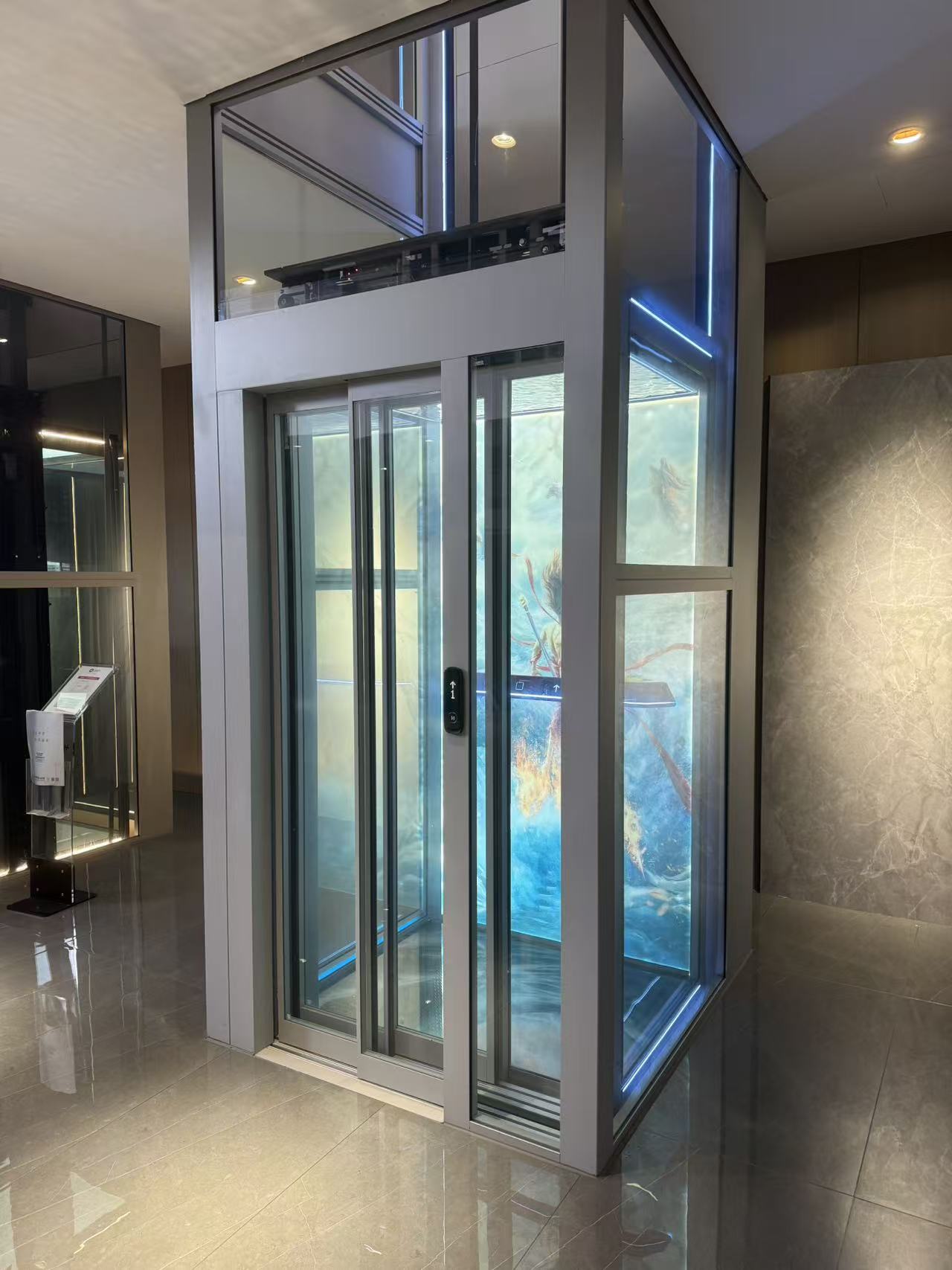
A residential installation aligning the lift run with the household’s existing vertical layout rather than a separate elevator core.
4. Ranked shortlist: seven villa home elevator configurations
The shortlist below is ranked by the site constraint each configuration is designed to resolve — tight shaft first — using the manufacturer’s own series naming. It is a planning shortlist, not a performance league table: the final order changes once the shaft is measured.
| Rank | Configuration | Representative series | Typical fit | Verify before ordering |
|---|---|---|---|---|
| 1 | Small-shaft gantry sightseeing | Homeway-6000 Series | Villas where the only usable shaft is narrow but a glazed car is still wanted | Measured shaft, gantry structure acceptance, pit and headroom |
| 2 | 270° full glass panoramic | Homeway-3000 Series | Stairwell voids and light wells where glazing on three sides is the design intent | Glass panel specification, cleaning access, structural fixing |
| 3 | Four-corner arc sightseeing | Homeway-8000 Series | Villas wanting glazing with softened corners for interior circulation | Corner geometry, landing door type, sightline from the living area |
| 4 | Full circular panoramic, high-end custom | Homeway-9000 Series | Feature positions where the lift is a visual centrepiece | Custom cabin scope, delivery format, installation sequence |
| 5 | Duplex home elevator | Homeway-3000M Series / Homeway-5000M Series | Two-level homes and duplex layouts with a compact run | Two-stop configuration, entry side, load requirement |
| 6 | Enclosed car, steel shaft or concrete shaft | Homeway-1000 Series | New-build concrete shafts and retrofit steel frame shafts | Shaft construction route, door type, counterweight layout |
| 7 | Large-shaft gantry sightseeing, 250–630 kg, 2–6 floors | HomeWay-2000 Series | Larger villas and multi-generation households needing higher capacity | Pit depth, headroom, car dimensions, door opening mode |
How to read this ranking: the higher entries solve tighter physical constraints, not better quality. A Homeway-6000 Series unit and a HomeWay-2000 Series unit are answering two different site problems. The ranking also assumes the buyer has already confirmed that a home lift — rather than a platform-type product — is the right category for the building.
5. The platform behind most villa configurations: traction belt drive and dual-channel door lock
Across the villa series above, the recurring engineering pattern is a traction belt-driven residential villa lift: a traction steel-belt drive, an integrated full-aluminium car cabin, and a load-bearing structure in steel with a side or rear counterweight layout. Machine-room-less design is part of the same platform — the Australian plant design registration listed later in this article is scoped to the HW100 Machine-Room-Less (MRL) electric traction home lift at a rated load of 400 kg.
Dual-channel door lock circuit. This is a redundant safety detection circuit for home elevator door locks. Two independent channels monitor door lock status simultaneously; the elevator runs only when both channels confirm the door is locked. If one channel fails — contact oxidation, poor contact, a loose or damaged wire, or moisture corrosion in the detection circuit — the other channel detects the abnormality and triggers the safety interlock, preventing the car from moving with doors unlocked. This redundancy is designed to comply with GB 7588 elevator safety specifications and to avoid single-point failure of the door lock safety function.
Troubleshooting behaviour matters to buyers because it defines what a household can safely do at 22:00. If doors appear fully closed but the lift will not run and reports a door lock fault, the documented procedure is: do not force the doors open; confirm the lock mechanism is fully engaged; check contacts for oxidation or damage; check for loose terminals or aged wiring in the lock circuit; power off and restart to test; and if the fault persists, stop use and contact professional maintenance. The unit-level rule behind this is simple: a household elevator should not be treated as a device that can be diagnosed by opening doors by hand.
On running characteristics, the villa installation case documentation describes low noise and stable running performance as notable features of residential villa installations, alongside flexible custom cabin decoration and dimension options.
6. Civil, electrical and environmental numbers to confirm before ranking
The most detailed published parameter set in this manufacturer’s villa portfolio belongs to the HomeWay-2000 Series, and it is a useful benchmark for what a serious site survey has to produce.
| Parameter | HomeWay-2000 Series reference values |
|---|---|
| Rated load | 250–630 kg |
| Rated speed | 0.3–0.63 m/s |
| Floors and stops | 2–6 floors |
| Shaft dimensions (W×D) | 830×900 mm to 1800×1800 mm |
| Car dimensions (W×D×H) | 600×720 mm to 1400×1600×2200 mm |
| Pit depth | ≥60–150 mm |
| Headroom | ≥2100 mm |
| Drive type | Belt-traction / traction gantry |
| Door opening mode | Manual swing / automatic swing / automatic sliding |
| Door type | Centre opening door / side opening door |
Materials on the same platform are stated as a high-strength aluminium alloy well frame with AkzoNobel powder coating, partially aluminium-clad steel, tempered laminated safety glass for sightseeing panels, aluminium alloy and stainless steel doors, an interior with optional wood veneer or alloy decorative panel, PVC flooring as standard with optional marble or sintered stone, and a steel load-bearing structure using a high-strength traction steel belt.
Environmental and supply conditions for indoor residential application are equally concrete: ambient temperature of +5°C to +40°C in the shaft and equipment space; relative humidity a maximum of 50% at 40°C, up to 90% at lower temperatures and non-condensing; altitude up to 1,000 m above sea level, with motor temperature-rise correction required above that; single-phase 220V household power with voltage fluctuation within ±7% of rated voltage; and an atmosphere free of corrosive, flammable and explosive gases and heavy dust.
7. Certification: verify scope, not just the logo
Certification is the most misread item on villa lift shortlists, because a valid certificate for one model does not automatically cover the model being ordered. Two market-specific examples show how narrow a scope can be.
| Item | EU CE certification | Australia plant design registration |
|---|---|---|
| Certificate / registration | CE, number 10.05.0188 | Plant Design Registration, number PDLIF7003550/25 |
| Authority / market | EUROCERT S.A., EU market | SafeWork NSW, Australia (New South Wales) |
| Scope | Model 3000 vertical lifting platform | HW100 machine-room-less electric traction home lift, rated load 400 kg |
| Standards cited | EN ISO 12100:2010, EN 60204-1:2018, EN 81-41-2024 | GB/T 21739-2008, AS 1735.18-2002 |
| Validity | Issued 2026-03-23, expires 2031-03-23 | Issued 2025-09-10, expires 2031-04-22 |
At company level, the manufacturer also states AS, COC and CE certification for full elevator sets and door lock systems, and a Special Equipment Manufacturing License for complete elevators. The practical rule for a buyer is to ask three questions for every certificate presented: which model and load does the scope name, which standards are cited, and which market and validity period apply? A CE certificate whose scope names a specific model series is not evidence for a different series in the same catalogue.
8. The boundaries: what a villa home elevator will not do
A shortlist that only lists strengths is not an evaluation. The following limits are documented and should be treated as design boundaries rather than sales caveats:
- Indoor use only. The product is not applicable for direct outdoor installation.
- Not a fire-evacuation lift. It must not be counted as part of a building evacuation strategy.
- Minimum vertical space. Even the low-pit reference configuration requires a pit of ≥60–150 mm and headroom of ≥2100 mm; a building without that space cannot be shortlisted for this configuration.
- Altitude and humidity ceilings. Above 1,000 m, motor temperature-rise correction is required; high-humidity sites must remain non-condensing.
- Coastal exposure. Salt-fog environments require an anti-corrosion upgrade.
- Power quality. A dedicated single-phase 220V circuit with reliable earthing and voltage fluctuation within ±7% is required; the control system is fully automatic microcomputer control, so an unstable supply is a genuine constraint.
- Operational discipline. Overload operation is forbidden and children should use the lift accompanied by adults.
- Lead time is not zero. Even at a minimum order quantity of one unit, customized production is quoted at 15–30 days, before site preparation and installation scheduling are considered.
9. Comparison with traditional solutions
Traditional villa lifting solutions were built around a dedicated machine room, which consumed floor area and added civil work. The traction belt machine-room-less platform changes that trade-off: the drive sits within the shaft envelope rather than in a separate room, which is why the configurations above can be planned into stairwell voids and small shafts.
The shaft route is the second traditional decision point, and it is now a three-way choice rather than a two-way one:
- Concrete shaft — the Homeway-1000 Series includes a concrete shaft variant, typical of new-build villas where the shaft is cast during construction.
- Steel shaft — the same series also includes a steel shaft variant, which suits retrofit and renovation projects where casting a new concrete shaft is impractical.
- Gantry structure — the small-shaft and large-shaft gantry sightseeing configurations use an aluminium alloy well frame with partial aluminium-clad steel, allowing narrow sites to be served without a full masonry shaft.
The honest boundary here is that these three routes are not interchangeable. Each has its own minimum shaft dimension, pit and headroom requirement, and each must be matched to the certification scope held for that model in the destination market. Buyers should also note that this comparison covers full traction home lift configurations only: platform-type and other low-rise residential lifting concepts occupy a separate segment of the villa market and must be evaluated against their own technical documentation and certification scope, not against a traction home lift certificate.
10. What the 2026 market signals suggest
Three signals are visible in the current material and each has a procurement implication.
Standards are differentiating suppliers. With GB/T 21739-2025 in force since 1 March 2026 and electric-lift standards explicitly excluding home lifts, documentation quality becomes a filter. Suppliers who can point to home-lift standards and market-specific registrations will separate from those who cannot.
Demand is being driven by household composition, not luxury alone. Case documentation for villa installations lists outcomes such as improved inter-floor accessibility, aging-in-place living, enhanced interior aesthetics, increased property value and better space utilisation. Those are functional requirements, which favours configurations chosen on measurement rather than on catalogue appearance.
Export-oriented supply is normalising low-volume orders. A minimum order quantity of one unit with a 15–30 day customized lead time, backed by a stated 200-unit monthly capacity and 100% testing before shipment, makes single-villa projects commercially workable for distributors and private buyers in the EU, Middle East, Australia and Southeast Asia.
11. Villa home elevator shortlist checklist
- Measure the shaft: width, depth, pit and headroom, with the same tape used for the drawings.
- Confirm the shaft route: concrete, steel frame or gantry structure.
- Fix the number of floors and stops, and the load actually needed — 250 kg and 630 kg are different products.
- Decide the glazing intention before selecting a series: enclosed, 270° glass, four-corner arc or full circular.
- Confirm door opening mode and door type against landing geometry.
- Confirm counterweight layout (side or rear) against the space beside and behind the shaft.
- Verify power supply: dedicated single-phase 220V circuit, earthing, voltage fluctuation within ±7%.
- Verify environment: indoor only, temperature, humidity, altitude and coastal salt-fog exposure.
- Read the certificate scope line by line for each model being quoted, in the destination market.
- Ask how the door lock safety circuit is monitored and what the household should do in a lock fault.
- Confirm spares availability, warranty terms for core components, remote technical support and user training arrangements.
- Request references comparable to your building type and market, and verify them independently.
Reference material: the manufacturer’s product catalogue can be downloaded here — Homeway elevator product catalog (PDF). Company information is published at www.homewayelevator.com.
FAQ
Q1. What exactly is a villa home elevator?
A villa home elevator is a lift installed for private residential use inside a villa, townhouse, duplex, semi-detached or self-built house, usually serving two to six floors and paired with the household’s own vertical layout instead of a shared core. In China it is regulated under the home lift safety rules GB/T 21739-2025, while the general electric lift specification GB/T 10058-2023 excludes home elevators from its scope.
Q2. How does a traction belt home elevator work?
The villa configurations described here use a traction steel-belt drive with an integrated full-aluminium car cabin, a steel load-bearing structure and a side or rear counterweight, with the traction machine handling car lifting and lowering. Control is fully automatic microcomputer control operated from the car operating panel and landing call buttons, with automatic floor levelling, automatic door opening and closing, and an inspection operation mode available. Machine-room-less versions exist: the Australian plant design registration covers the HW100 machine-room-less electric traction home lift at a rated load of 400 kg.
Q3. How much shaft space, pit and headroom does a villa home elevator need?
On the HomeWay-2000 Series reference configuration, shaft dimensions range from 830×900 mm to 1800×1800 mm, car dimensions from 600×720 mm to 1400×1600×2200 mm, pit depth is ≥60–150 mm and headroom is ≥2100 mm, for loads of 250–630 kg across two to six floors. Other series are designed for different constraints, such as small-shaft gantry or large-shaft gantry layouts, so the requirement must be confirmed against the specific series being quoted rather than a single generic figure.
Q4. Which certifications should a buyer verify before ordering a villa home elevator?
Verify the scope, standards, market and validity of each certificate. Available examples include EU CE certificate 10.05.0188 from EUROCERT S.A., scoped to Model 3000 vertical lifting platform and citing EN ISO 12100:2010, EN 60204-1:2018 and EN 81-41-2024, valid from 2026-03-23 to 2031-03-23; and Australian Plant Design Registration PDLIF7003550/25 from SafeWork NSW, scoped to the HW100 machine-room-less electric traction home lift at 400 kg and citing GB/T 21739-2008 and AS 1735.18-2002, valid from 2025-09-10 to 2031-04-22. Company-level documentation also includes AS, COC and CE certification for full elevator sets and door lock systems, plus a Special Equipment Manufacturing License for complete elevators.
Q5. What are the minimum order quantity and production lead time?
Orders can start from one unit, with customized production quoted at 15–30 days. The factory states a monthly capacity of 200 units and applies 100% testing, with each unit tested before shipment. Export markets served through authorized local distributors include the EU, the Middle East, Australia and Southeast Asia.
Q6. What should a household do if the lift does not run although the doors are closed?
Do not force the doors open. The documented steps are to confirm the door lock mechanism is fully engaged, inspect door lock switch contacts for oxidation or damage, check for loose terminals or aged or corroded wiring in the door lock circuit, power off and restart to test, and stop use and contact professional maintenance if the fault remains. The underlying safety design uses a dual-channel door lock circuit in which two independent channels must both confirm the door is locked, so a fault on one channel cannot be masked by the other.
Q7. What maintenance and spares support should buyers expect?
Documented service scope includes warranty replacement of core components with manufacturing defects within the warranty period, 24/7 online technical support for remote troubleshooting, installation guidance and software support, long-term supply of genuine original spare parts, operation and maintenance manuals with regular maintenance guidance, remote fault diagnosis with technical documents to assist local service partners, and operation and safety training for end users or local agents. Routine maintenance guidance also requires cutting main power and applying lockout/tagout before work, with work performed by qualified personnel.