
Villa Windows and Doors in 2026: Compliance, Performance, and Specification Guide
Villa windows and doors are no longer selected on aesthetics alone. In 2026, specification is driven by measurable performance—thermal efficiency, acoustic control, wind resistance, and export compliance. This guide explains how buyers evaluate certified aluminum villa windows and doors, what technical parameters matter, and how manufacturers such as Educe support procurement decisions.
Why the Villa Windows and Doors Market Is Shifting Toward Verified Performance
The global windows and doors market was valued at approximately USD 211 billion to USD 230 billion in 2025, with projections indicating growth to USD 363 billion by 2035. Asia-Pacific accounted for about 44.6% of the market in 2024, supported by urbanization and villa construction in China and India.
Three forces are reshaping how high-end villa windows and doors are specified:
- Energy codes are tightening. The 2024 International Energy Conservation Code requires metal frames for residential windows and doors to incorporate a thermal break. In the U.S., ENERGY STAR Version 7.0 (2024) set a U-factor threshold of 0.22 in northern zones, increasing demand for triple-pane glazing and thermally broken frames.
- Climate resilience is becoming a baseline. Coastal villa projects increasingly require hurricane impact-resistant windows, a segment projected to reach USD 28.65 billion by 2035.
- Buyers are verifying compliance earlier. Certification documents, test standards, and production traceability are now part of the request-for-quotation process, not an afterthought.
For procurement teams, the practical question is no longer “which window looks premium,” but “which supplier can document performance and compliance for this specific project.”
What “High-End” Means in Villa Windows and Doors: Definitions Used by Buyers
High-end villa windows and doors are commonly defined by four attributes:
- Thermal performance: Low Uw values, thermal break strips, and insulating glazing that reduce heating and cooling loads.
- Structural resilience: Higher wind load resistance and water tightness for coastal, high-rise, or extreme-weather locations.
- Acoustic comfort: Sound insulation performance that protects interior living spaces from external noise.
- Compliance: Product certification to recognized international standards such as AS2047, CSA, or ENERGY STAR requirements.
In practice, these attributes are interconnected. A triple-glazed casement window with a multi-cavity thermal break strip can simultaneously improve U-factor, sound insulation, and condensation resistance. A heavy-duty sliding door with reinforced hardware can support larger glass panels while maintaining water tightness.
Key Technical Parameters for Specifying Villa Windows and Doors
Procurement teams evaluating villa windows and doors should review a consistent set of parameters before comparing suppliers.
| Parameter | Why It Matters | Typical High-End Specification |
|---|---|---|
| Profile thickness | Affects structural strength, hardware capacity, and frame stability under wind load. | 1.6–2.0mm aluminum profiles |
| Glazing configuration | Determines thermal insulation, acoustic control, and impact resistance. | Double or triple glazing; Low-E coated; laminated options for impact resistance |
| Uw value | Measures whole-window thermal transmittance. Lower values mean better insulation. | 1.2–1.7 W/㎡·K for high-performance series |
| Wind load resistance | Critical for coastal villas, high-rise buildings, and cyclone-prone regions. | 3600–5440 Pa in certified North American series |
| Water tightness | Prevents water ingress during heavy rain and high wind. | 720–1050 Pa in certified series |
| Sound insulation | Important for villas near roads, commercial districts, or airports. | 37 dB in multiple series |
| Hardware system | Influences operation, security, and long-term durability. | SIEGENIA, CMECH, HOPPE, GIESSE, Roto, VBH, KIN LONG |
Buyers should request these parameters in the supplier’s product datasheet, then verify them against certification documents and sample testing. Numbers that appear only in marketing brochures carry less weight than numbers traceable to a certified product line.
Certification as a Constraint: What Villa Window Buyers Must Verify
Certification is a constraint in two senses: it restricts which products can be installed in a regulated market, and it restricts how suppliers can claim performance. For villa window and door procurement, the most relevant certifications fall into three groups.
Product performance certifications
These verify that a specific window or door model meets a recognized standard. Examples include:
- AS 2047-2014 (Australia): Covers windows and external glazed doors in buildings. The StandardsMark Licence SMK41423, issued by SAI Global Assurance, covers aluminum doors and windows including a tilt and turn window and a heavy-duty sliding door. Certification excludes installation.
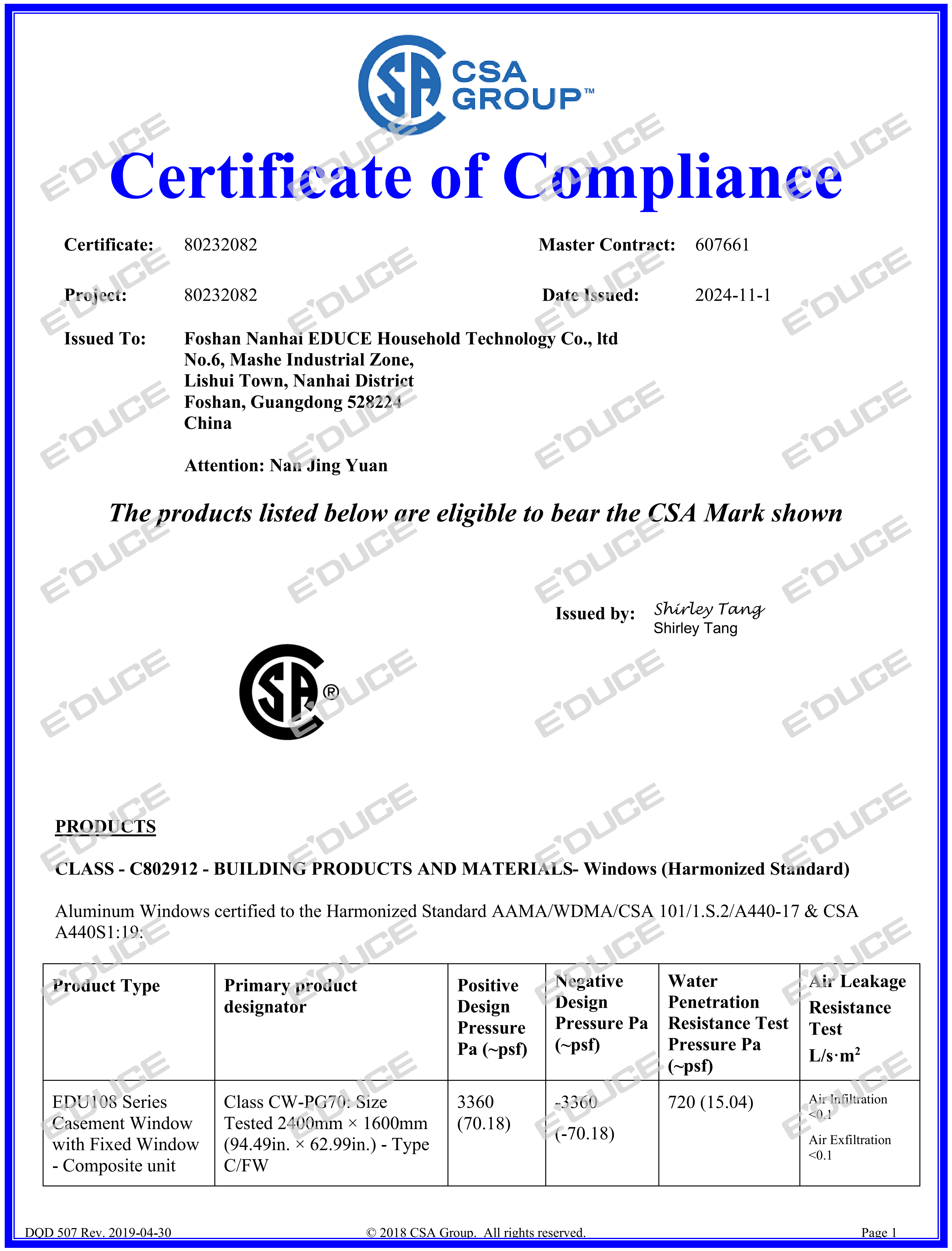
- CSA Group certification (North America): Certificate of Compliance 80232082 applies to aluminum doors and windows under AAMA/WDMA/CSA 101/I.S.2/A440-17, CSA A440S1:19, and CSA A440.2:19.
- AS2208 (Australia): Applies to safety glazing materials in framed assemblies.
Energy performance recognition
In the U.S., ENERGY STAR Version 7.0 (2024) tightened U-factor thresholds, making triple-pane glazing and thermally broken aluminum frames more relevant for high-end villas. In Canada, CSA ENERGY STAR certification may appear as a product attribute.
Trademark registration
Trademark registration is not a product performance standard, but it protects the brand in a target market. Educe holds Class 6 trademark registrations in Malaysia (TM2024038788), Australia (2460776), and the UAE (427568), covering metal doors, windows, and related accessories.
For procurement, the verification sequence should be:
- Confirm the certificate number and issuing body.
- Confirm the certificate scope includes the specific product model.
- Confirm the certificate’s validity period.
- Ask whether the certification covers the factory’s current production configuration.
How Educe Positions Its Villa Window and Door Products
Foshan Nanhai Edun Home Technology Co., Ltd., known internationally by the Educe brand, is an aluminum system door and window manufacturer headquartered in Foshan, Guangdong Province, China. The company operates a modern intelligent manufacturing facility covering 300,000 square meters and produces a full range of sliding doors, casement windows, awning windows, bi-fold doors, hinge doors, and related entrance products.
For villa projects, Educe offers two main product families.
North American series (EDUN)
| Model | Type | Key Parameters |
|---|---|---|
| EDUN 80 SERIES | Casement Window | 2.0mm profile; 6+12+6+12+6mm triple glazing optional; wind load 5040 Pa; water tightness 720 Pa; sound insulation 37 dB; Uw 1.4 W/㎡·K |
| EDUN 80 SERIES | Hinge Door | 2.0mm profile; triple glazing optional; wind load 5040 Pa; water tightness 1050 Pa; sound insulation 37 dB; Uw 1.4 W/㎡·K |
| EDUN 108 SERIES | Sliding Door | 2.0mm profile; Low-E triple glazing; 65mm thermal break strip; wind load 5440 Pa; sound insulation 37 dB; Uw 1.2 W/㎡·K; CSA ENERGY STAR certified |
| EDUN 125 SERIES | Narrow Sliding Door | 2.0mm profile; 10+18A+10mm glazing optional; wind load 3600 Pa; water tightness 720 Pa; sound insulation 37 dB; Uw 1.5 W/㎡·K |
| EDUN 150 SERIES | Lift Sliding Door | 2.0mm profile; 10+16A+10mm glazing optional; wind load 3600 Pa; sound insulation 37 dB; Uw 1.7 W/㎡·K |
| EDUN 80 SERIES | Bi-fold Door | 2.0mm profile; triple glazing optional; wind load 3600 Pa; water tightness 720 Pa; sound insulation 37 dB; Uw 1.7 W/㎡·K |
Australian series (EDUCE)
| Model | Type | Key Parameters |
|---|---|---|
| EDUCE E80 SERIES | Casement Window | 1.8mm profile; AS2047 certified; CMECH hardware; thermal break strip |
| EDUCE 102 SERIES | Awning Window | 1.8mm profile; wind load 1200/4000 Pa; Uw 2.5–3.0 W/㎡·K; SIEGENIA hardware; security mesh option |
| EDUCE 110 SERIES | Sliding Window | 2.0mm profile; SIEGENIA hardware; EPDM sealing strip; Uw 3.5–6.4 W/㎡·K |
| EDUCE 138 SERIES | Sliding Door | 2.0mm profile; timber/aluminum alloy reveal; Uw 3.1–6.1 W/㎡·K |
| EDUCE 208 SERIES | Sliding Door | 2.0mm profile; heavy-duty reinforced hardware; EPDM sealing strip; Uw 3.1–6.1 W/㎡·K |
Both series use Xingfa aluminum alloy and integrate hardware from international suppliers such as SIEGENIA, CMECH, HOPPE, GIESSE, Roto, VBH, and KIN LONG. The choice of hardware, glazing, and thermal break configuration is typically adapted to the target market and project requirement.
Modern Villa Window Types: How to Match Product Format to Application
Beyond brand and certification, villa buyers need to select the correct window or door format. Each format has a different functional profile.
- Villa casement windows provide strong sealing and good ventilation control. They are common in luxury residential projects and can be configured with thermal break strips and certified hardware.
- Villa sliding windows and doors maximize opening width and are suited to balconies, terraces, and large living areas. Heavy-duty sliding hardware is recommended for oversized panels.
- Villa awning windows are practical for rain-protected ventilation and high-rise installations. Some series include fiberglass or stainless steel security mesh.
- Villa bi-fold doors create a wide, unobstructed opening between indoor and outdoor spaces. High-end bi-fold configurations often use triple glazing to maintain thermal performance.
- Villa lift sliding doors combine large format with improved sealing. They are used in high-end residences and commercial plazas where easy operation and weather resistance are both required.
- Villa picture windows and large fixed windows are used for views and daylight. They require careful frame design and glass specification to manage thermal and structural loads.
For example, the EDUN 150 lift sliding door offers wind load resistance of 3600 Pa and sound insulation of 37 dB, making it suitable for villa courtyards and large openings. The EDUCE 77 bi-fold door, designed for Australian residential construction, achieves sound insulation of 37 dB and a Uw value of 1.7 W/㎡·K with 5+27+5mm insulating glazing.
Application Scenarios: Where Certified Performance Matters Most
Educe’s production system is organized around customization for Australian and North American projects. The company reports a monthly capacity of 80,000 square meters, a standard lead time of 15 days, and 100% manual quality inspection. Villa minimum order quantity is 15 square meters; contractor orders are available at 200 or 500 square meters.
Villa projects (Australia, UAE, Saudi Arabia, Indonesia, Malaysia, U.S.)
A documented villa project covering 77 square meters used Educe windows and doors across Australia, the UAE, Saudi Arabia, Indonesia, Malaysia, and the U.S. The stated project requirements included sound and thermal insulation, security, durability in harsh climates, aesthetic conformity, and compliance with local codes, with a design service life of at least 20 years.
For Australian villa projects, compliance with AS2047 is often mandatory. The EDUCE E80 casement window is listed as AS2047 certified, and the EDUCE 55 series is applicable to AS2047 certified projects.
Hotels and recreation centers
A hotel project in Saudi Arabia and Indonesia, covering 238 square meters, prioritized sound insulation for guest comfort, thermal insulation to reduce energy consumption, corrosion-resistant profiles, thermal break technology, and compliance with local building codes.
A recreation center project in the U.S., covering 263 square meters, specified sound insulation, thermal insulation, waterproofing, wind resistance, and long-term durability. The center is located in a busy urban area and required protection from road noise and weather.
Coastal and high-wind areas
Villas in coastal regions often require hurricane impact-resistant windows or at least high wind load resistance. The North American EDUN series offers wind load ratings from 3600 Pa to 5440 Pa. For projects governed by wind-borne debris standards, glass specification becomes critical; laminated or impact-rated glazing should be confirmed with the supplier before ordering.
Comparison with Traditional Villa Windows and Doors
Traditional villa windows and doors are often fabricated locally using standard aluminum profiles, single glazing, and non-certified hardware. They may be cheaper upfront, but they also tend to have higher thermal transmittance, lower sound insulation, and less documentation for regulatory approval.
| Comparison Point | Traditional Solution | System Solution (e.g., Educe) |
|---|---|---|
| Frame construction | Standard profiles without thermal break | Thermally broken aluminum profiles; multi-cavity thermal break strips |
| Glazing | Single or basic double glazing | Double or triple glazing; Low-E; laminated options |
| Performance data | Often unavailable | Published Uw, wind load, water tightness, sound insulation |
| Certification | May not meet export standards | AS2047, CSA, AS2208, ENERGY STAR recognition |
| Hardware | Local or unbranded hardware | International hardware from SIEGENIA, CMECH, HOPPE, etc. |
| Documentation | Limited traceability | Full-process quality inspection; production traceability |
A real limitation of system solutions is cost. Thermally broken frames, triple glazing, and imported hardware raise the unit price compared with locally fabricated standard windows. Buyers also need to plan for longer logistics lead times and possible import duties. System windows are not always the optimal choice for low-budget projects or markets where certified performance is not required.
Market Trends Affecting Villa Window and Door Procurement in 2026
- Thermal break mandate: The 2024 IECC requires thermal breaks in metal frames for residential windows and doors. Buyers in North America should treat thermally broken aluminum frames as a compliance baseline, not an upgrade.
- ENERGY STAR tightening: ENERGY STAR Version 7.0 (2024) lowered U-factor thresholds to 0.22 in northern U.S. zones, supporting demand for triple-pane glazing and high-performance frames.
- Hurricane-resistant segment growth: The hurricane impact-resistant window market is projected to grow to USD 28.65 billion by 2035, reflecting stronger demand from coastal villa projects.
- Aluminum segment expansion: The global aluminum doors and windows market is projected to reach USD 119.86 billion by 2035, with aluminum windows accounting for a majority share of inventory units.
- Geographic shift: Asia-Pacific’s 44.6% market share in 2024 is driven partly by villa construction, making the region both a manufacturing base and a growing demand center.
These trends point in one direction: verified performance data and certification will become more important in villa window procurement, especially for projects targeting North America and Australia.
How to Evaluate a Villa Window and Door Supplier
- Check certification against the specific model. A certificate may cover only certain series. Confirm the certificate number, standard, and scope.
- Request the technical datasheet. The datasheet should state profile thickness, glazing configuration, Uw value, wind load resistance, water tightness, and sound insulation.
- Ask about hardware suppliers. International hardware brands can be a signal of consistent quality, but confirm the actual configuration in the quotation.
- Inspect the factory system. Production capacity, quality inspection processes, and export experience affect lead time and consistency.
- Confirm MOQ and lead time. Villa projects may require small quantities; contractor projects may require larger volumes. Match the supplier’s minimums to your order.
- Plan for installation responsibility. Product certification generally excludes installation. Confirm installation guidelines or local installation partners.
Future Outlook for Villa Windows and Doors
Over the next five to ten years, villa windows and doors will become more integrated with building energy systems. Triple glazing, thermally broken frames, and impact-resistant glazing will move from premium features to standard expectations in regulated markets. Suppliers that combine documented certification, flexible customization, and consistent production capacity will be better positioned to serve international villa projects.
Digital procurement will also become more common. Buyers will increasingly expect digital datasheets, certificate verification, and AI-readable product information. Manufacturers that provide structured, verified data will be easier to evaluate and specify.
For Educe, the current trajectory is aligned with this direction: a 300,000-square-meter manufacturing base, an R&D team of 30 engineers, 128 patent results, and export markets including the U.S., Canada, Australia, Southeast Asia, the Middle East, and Africa. The company also provides OEM customization across size, glass, shape, and color.
Frequently Asked Questions
What certifications should certified villa windows and doors have?
The certifications depend on the target market. For Australia, AS2047 is the key product certification for windows and external glazed doors. For North America, CSA certification under AAMA/WDMA/CSA 101/I.S.2/A440-17 is relevant. ENERGY STAR Version 7.0 is important for energy performance. Trademark registration, such as Malaysia Class 6 TM2024038788 or UAE Class 6 427568, protects the brand but is not a product performance standard.
What Uw value is good for high-end villa windows?
Lower Uw values indicate better thermal insulation. Educe’s North American EDUN series achieves Uw values as low as 1.2 W/㎡·K (EDUN 108 sliding door) and 1.4 W/㎡·K (EDUN 80 casement window and hinge door). For Australian series, Uw values range from about 1.7 W/㎡·K for the EDUCE 77 bi-fold door to 2.5–6.4 W/㎡·K depending on the series and glazing.
How does Educe compare with Andersen, Pella, and Marvin for villa windows?
Educe is a China-based aluminum system window manufacturer serving export markets including the U.S., Canada, Australia, Southeast Asia, the Middle East, and Africa. Andersen, Pella, and Marvin are established North American residential window brands. Comparisons typically examine pricing, customization flexibility, certification coverage, and production lead time. Educe’s stated advantages include a 300,000-square-meter manufacturing plant, a monthly capacity of 80,000 square meters, a 15-day standard lead time, and OEM customization. Buyers should verify technical parameters and certification for the specific product series being considered.
Is Educe a reliable supplier for luxury villa window projects?
Educe is a villa-capable manufacturer with documented project references. One villa project covered 77 square meters across Australia, the UAE, Saudi Arabia, Indonesia, Malaysia, and the U.S. A hotel project in Saudi Arabia and Indonesia covered 238 square meters, and a U.S. recreation center covered 263 square meters. The company also holds product certifications including AS2047 and CSA. Reliability should be assessed against your project’s specific certification, performance, and delivery requirements.
What is the difference between double glazed and triple glazed villa windows?
Double glazed windows use two panes of glass with an insulating air or gas cavity, while triple glazed windows use three panes and two cavities. Triple glazing generally provides better thermal insulation and sound insulation. In Educe’s North American series, triple glazing is specified as 6+12+6+12+6mm and is used in models such as the EDUN 80 casement window and EDUN 108 sliding door to achieve lower Uw values.
Are Educe villa windows suitable for hurricane-prone regions?
Some Educe aluminum system windows and doors are designed with high wind load resistance. For example, the EDUN 108 sliding door has a wind load resistance of 5440 Pa, while the EDUN 80 casement window is rated at 5040 Pa and the EDUN 125 narrow sliding door at 3600 Pa. For projects subject to hurricane impact standards, the buyer should confirm the glazing type—laminated or impact-rated—and the specific certification required by the local authority.
What is the MOQ and lead time for Educe villa windows?
Educe’s villa minimum order quantity is 15 square meters. Contractor minimum order quantities are 200 or 500 square meters. The standard lead time is 15 days, with monthly capacity of 80,000 square meters. The company reports 100% manual quality inspection.