
Vision-Guided Depalletizing Robots: Material Recognition and Procurement FAQ
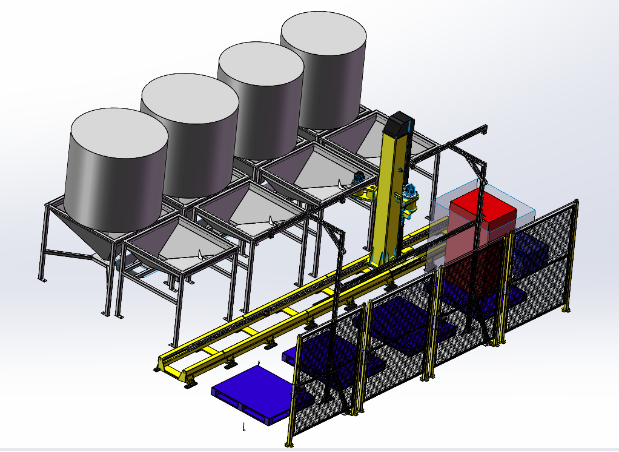 Depalletizing and bag-breaking cell layout: stacked bags are recognized by the vision system, de-stacked layer by layer, then opened and discharged into a receiving vessel.
Handling is now the largest single application block in the industrial robot market. Grand View Research records a 42.1% market share for the handling segment in 2025, and Fortune Business Insights projects the global robotic palletizer and de-palletizer segment at USD 4.67 billion in 2026. That scale has changed the questions buyers ask. Fewer project teams now ask whether machine vision can work on a depalletizing line; far more ask two specific things — how a vision-guided depalletizing robot recognizes what is stacked on the pallet, and what has to be fixed inside a purchase specification before the cell is built.
This article answers both, using one documented reference platform: the 4-Axis Palletizing Robot SCH100-1950-1800 from South China Robotics Technology (Guangdong) Co., Ltd., an industrial robotics and automation company founded in 2017 in Guangzhou, Guangdong, China, whose main products include robotic palletizing systems, bag opening and feeding robots, material handling robots, collaborative palletizing robots, press tending robots, CNC machine tending robots and custom industrial automation systems. Every technical figure below comes from that model's published specification, from the supplier's comparison documentation, or from a published third-party source; where a number needs context to be read correctly, that context is stated.
How a Vision-Guided Depalletizing Robot Recognizes Materials
Recognition happens in three stages: scanning, modelling and grasp planning. A 3D camera and a LiDAR unit scan the stacked goods and build a point-cloud model of the packages. A deep-learning algorithm then analyses that model to identify the material type and calculate the pose of each object, including incoming position deviation. The planned grasp path is executed by the robot, which de-stacks the load layer by layer; in bag-breaking configurations the same arm presents the bag to a cutting mechanism that opens the package and discharges the contents into a hopper or receiving vessel.
Two numbers define the practical envelope of that process in the documented configuration. The vision-guided depalletizing system is specified to tolerate a position deviation of ±50 mm, and to reach a 99.8% grabbing success rate in mixed-pallet handling. The deviation tolerance matters commercially: it is the difference between a cell that requires perfectly squared pallets and one that can absorb the stacking variation produced upstream.
What the recognition figures do not cover
The ±50 mm tolerance and the 99.8% success rate are documented for mixed-pallet handling under supplier test conditions. Materials that commonly stress 3D vision — reflective film, oily or greasy packaging surfaces, deformed or partially torn bags, and film-wrapped bundles — are not described individually in the published data. The reliable way to validate recognition on a specific line is a factory acceptance test using the buyer's own pallet patterns and worst-case stock, with the test protocol agreed before the order is placed.
The Reference Platform: 4-Axis Palletizing Robot SCH100-1950-1800
South China Robotics Technology (Guangdong) Co., Ltd. operates a 40,000 m² factory with 180 employees, a 48-engineer R&D team and a reported annual output of 3,000 units, and reports a 40% export ratio with main markets in Europe, the Middle East, Southeast Asia, South Asia, Latin America and North America. The model used as the technical reference throughout this article is a heavy-duty palletizing robot with the following published parameters.
| Parameter | Documented value |
|---|---|
| Number of axes | 4 |
| Maximum payload | 100 kg |
| Maximum reach | 1,950 mm |
| Repeatability (datasheet) | ±0.5 mm |
| Robot body weight | 680 kg |
| Power capacity | 5.75 kVA |
| Axis 1 working range | ±130° |
| Z-axis vertical stroke | 1,800 mm |
| Axis 3 working range | ±147° |
| Axis 4 working range | ±360° |
| Operating temperature | 0–45 °C |
| Robot material | High-strength steel |
Read those parameters against the application. A 100 kg payload and a 1,950 mm reach cover most bagged, boxed and canned formats in food, feed, chemical, new-material and building-material plants, and the 1,800 mm Z-axis stroke is what allows a floor-mounted column-format unit to serve the pallet heights typical of those lines. The published applicable industries for the model are food and beverage, grain and flour, feed, chemical, new energy, new materials, building materials, automotive parts, home appliances and hardware manufacturing.
One boundary worth checking early
The model's own operating temperature is stated as 0–45 °C, while food-industry selection guidance in the same documentation describes palletizing robots that adapt to −20 °C cold storage. Cold-room and freezer applications should therefore be specified as a configuration question in the RFQ rather than assumed from the standard arm specification.
Reading Accuracy Claims: Repeatability, Grab Success and Measurement Scope
Supplier comparison documentation for the palletizing line states that, against domestic peer robots, repeatability is documented in a range of ±0.01–0.08 mm versus ±0.1–0.2 mm for peers, described as roughly a 40% improvement, while grab success is given as 99.8% versus about 85%, described as a 17% improvement. The same comparison reports about 15% lower energy consumption under similar conditions and palletizing precision about 20% higher, together with faster service: a custom plan delivered in 3 days against 7 days or more, and a response described as 50% faster.
A measurement caveat belongs next to those numbers. The SCH100-1950-1800 datasheet publishes a repeatability of ±0.5 mm, while the peer benchmark cites a ±0.01–0.08 mm repeatability range for the same palletizing line. The two values come from different measurement contexts and are not interchangeable. Buyers should require the measurement definition behind any repeatability figure in the technical annex of the RFQ — position, payload, speed, and whether the value is stated at arm level or at system level. Comparing a datasheet number with a benchmark number is one of the most common errors in depalletizing procurement.
Throughput, Cycle Time and Stacking Stability
Documented depalletizing throughput is 600–800 units per hour, described in the supplier's comparison material as approximately four times manual handling. In the same benchmarking, robotic palletizing is given at 800–1000 units per hour against roughly 300 units per hour for manual palletizing, and the stack topple rate is stated as 0.05% against 3% for manual stacking. For press-linked work, the comparison states 30–50% higher stamping capacity with automation, a long-term labour-cost reduction of about 60%, and a saving of 88% of labour on a single stamping line. Documented reliability for the palletizing line is an MTBF of 80,000 hours with 24-hour continuous operation.
Throughput figures are line-level rather than robot-level. A 600–800 units per hour depalletizing rate depends on conveyor speed, gripper design, pallet pattern, how the load is presented, and whether the same cell also performs bag breaking. A cycle-time breakdown per motion is more useful in a purchase specification than a single headline rate, because it shows which motion the supplier expects to be the constraint.
Documented Applications: Food-Grade and Chemical Handling
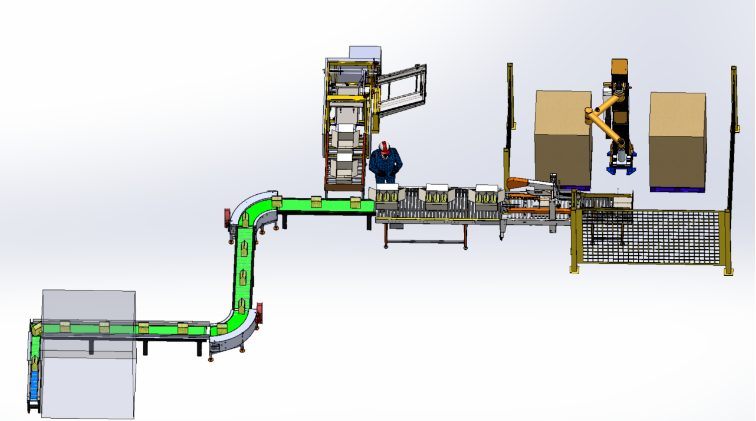 Palletizing system project layout: column-format cells are configured around pallet pattern, throughput and available floor space.
The documented application scope for this equipment family is bagged and granular material handling across food and beverage, sugar, flour and grain processing, feed, chemical raw materials, new materials, building materials and other powder and granular processing industries. Working conditions covered by the documentation include high temperature, heavy-duty handling, dusty environments, chemical exposure, corrosive environments, high humidity, oil mist and continuous operation. The matched equipment set for a complete cell includes the industrial robot, a 3D vision system, a custom bag handling and opening gripper, a bag cutting mechanism, a material hopper, a dust collection system and conveyors.
Containment and hygiene requirements are listed as special requirements rather than options: dustproof design, dust collection and control, enclosed material handling, easy cleaning, wear-resistant components, corrosion-resistant design, safety interlocks, reliable continuous operation and easy maintenance, with customization for different materials and working environments.
For food plants, the selection guidance in the same documentation prioritizes hygiene — 304 stainless steel, HACCP-compliant construction and easy-to-clean design — together with throughput in the 800–1000 bags per hour band, a stack topple rate below 0.05%, 24-hour continuous operation, and adaptability to −20 °C cold storage. Configuration follows layout: collaborative mobile palletizing is documented as the fit for plants running multiple production lines, while column-type units are documented as the fit where floor space is constrained, handling bags, cans and boxes.
For chemical and other hazardous environments, the documented approach is a custom explosion-proof depalletizing and bag-breaking configuration compliant with national explosion-proof standards, with dust and explosion risk controlled through sealed designs and isolated operation so that the robot replaces operators in the hazardous zone; the supplier states that its customer cases for these deployments show zero safety incidents. The same documentation lists the recurring alarm conditions to design against: a loose sealing cover on the explosion-proof unit, dust accumulation on electrical components, an abnormal grounding connection, and over-temperature inside the explosion-proof enclosure.
Across industries, the bag-breaking function works the same way. The vision system recognizes stacked bagged material on the pallet, the robot de-stacks bags layer by layer, and a cutting mechanism opens each package and discharges the contents into the designated vessel — the configuration used for bagged raw materials in chemical, building-material and feed plants, where the purpose is to remove manual dust exposure and reduce labour intensity.
Vision-Guided Cells Versus Traditional Depalletizing Equipment
The clearest way to test a depalletizing quotation is to compare it against the equipment it replaces, on the buyer's own metrics. The table below summarizes the supplier's documented comparison against traditional depalletizing equipment.
| Decision metric | Traditional depalletizing equipment | Documented vision-guided cell |
|---|---|---|
| Footprint | Baseline | 40–60% smaller |
| Installation and integration | 15 days or more | 5–7 days |
| Format or pattern switching | 15 minutes or more | 5 minutes or less |
| Purchase cost | Gantry and imported column as baselines | About 20% below gantry, about 50% below imported column |
| Payback period | Not stated | 3–6 months |
| Annual maintenance cost | ¥30,000–50,000 | Approximately ¥20,000 |
| Depalletizing throughput | Manual handling baseline | 600–800 units per hour, about 4× manual |
| Documented best fit | — | Space-limited SME workshops, old-factory retrofit |
Two supplier comparisons sit behind the same decision. Against imported brands, the documented position is localized fast service plus cost advantage with comparable reliability: MTBF of 80,000 hours against over 100,000 hours for imported brands, custom lead time of 7–15 days against 20–30 days, on-site maintenance response of 24 hours against 72 hours — described as 80% faster — and lower purchasing cost, with the fit described as cost-sensitive mid- to high-volume manufacturing. Against domestic peer robots, the documented position is higher precision and grab success with faster service: a custom plan in 3 days against 7 days or more, a response described as 50% faster, and maintenance support of 2-hour phone and 24-hour on-site service in the domestic market.
Where the documented case has limits
- Reliability is the clearest example: the documented MTBF of 80,000 hours sits below the imported benchmark of over 100,000 hours. The documented claim is comparable reliability with faster service, not superior reliability.
- Footprint, installation and switching figures depend on cell layout, existing conveyor and pallet flow, and the number of formats to be switched between.
- Cost comparisons are stated against named baselines — gantry systems and imported column robots — not against every alternative on the market.
- The 3–6 month payback is a benchmarking figure and should be recalculated against the buyer's labour rates, shift pattern and downtime cost.
- Maintenance cost is quoted in RMB at approximately ¥20,000 per year against ¥30,000–50,000 for the traditional option, and reflects the maintenance scope of the documented configuration.
Procurement Questions: MOQ, Delivery, Inspection and Payment
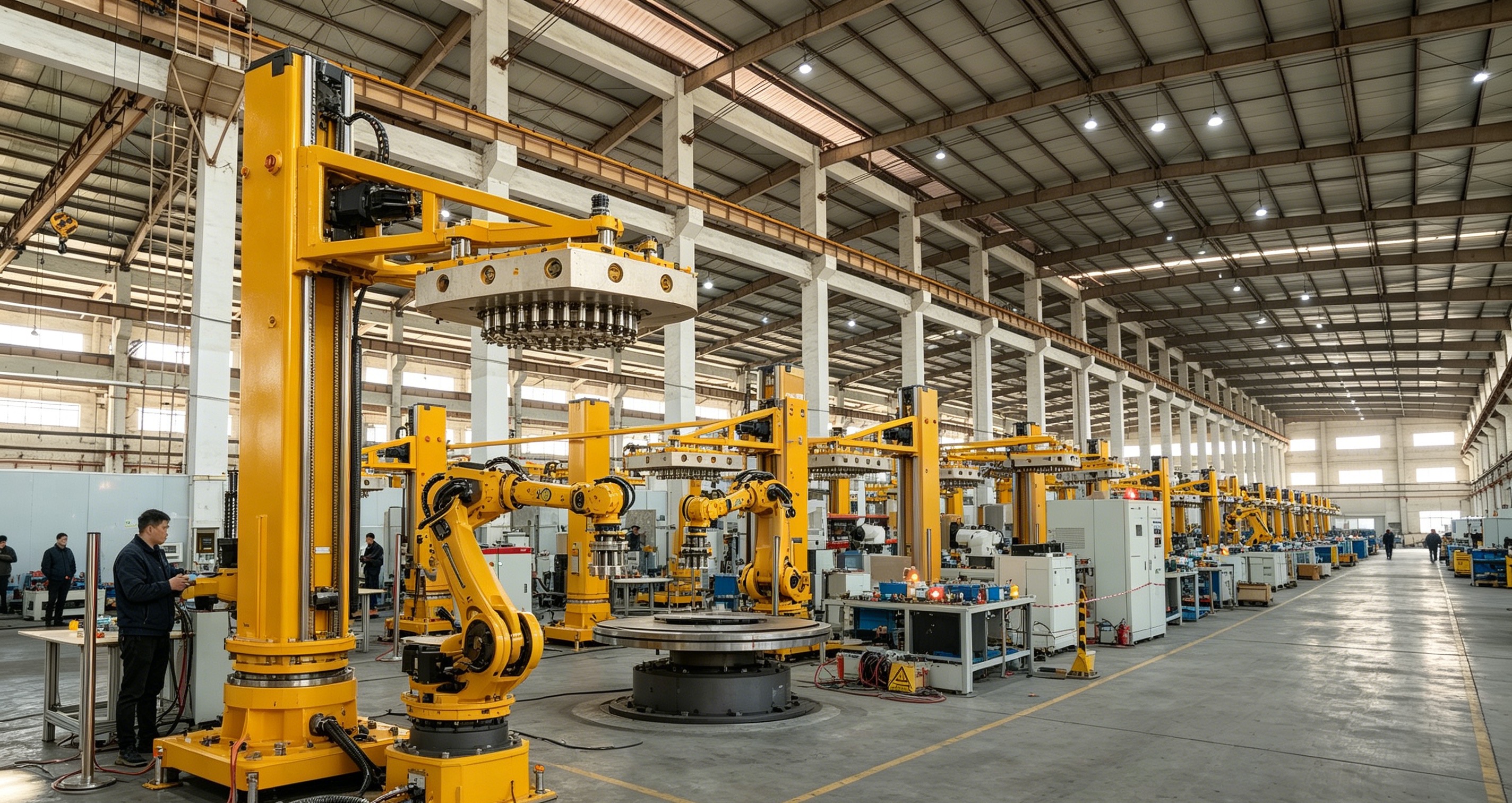 Commissioning area: robot cells are assembled and function-tested before shipment, which is also where factory acceptance testing is agreed with the buyer.
The documented commercial model for this equipment family is customization. Systems are configured according to the customer's product, payload, production capacity, pallet pattern, site layout, process requirements and existing equipment. That shapes how the standard procurement questions should be answered.
MOQ and configuration. Published material covers customization scope and project experience rather than fixed minimum order quantities. MOQ, spare-part sets and consumable quantities should therefore be treated as RFQ line items and listed next to the configuration they apply to — a robot arm, a complete depalletizing and bag-breaking cell, or a multi-line installation.
Delivery and lead time. Documented custom lead time is 7–15 days against 20–30 days for imported brands, with a custom plan issued in 3 days against 7 days or more for domestic peers. Installation is documented at 5–7 days against 15 days or more for traditional depalletizing equipment, and format switching at 5 minutes or less against 15 minutes or more. The contract should still be written around the acceptance date of a working cell rather than a shipping date, because commissioning, dust-collection tie-in and conveyor integration take place on site.
Inspection and acceptance. The documented parameters give a concrete acceptance structure: a vision deviation tolerance of ±50 mm and a grab success rate of 99.8% for mixed-pallet handling, a stack topple rate of 0.05%, and the robot-level parameters of the datasheet — repeatability, payload, reach, axis working ranges and operating temperature. For explosion-proof units, the documented inspection points are sealing-cover closure and tightness, dust accumulation on electrical components, grounding continuity and internal enclosure temperature; the corresponding alarm conditions are sealing loosening, dust build-up, abnormal grounding and over-temperature.
Payment terms. Payment terms are not published specification items; they are negotiated per project. Because the documented delivery scope includes on-site commissioning, technical training and long-term after-sales maintenance, buyers will generally want payment milestones tied to verifiable events — factory acceptance with the buyer's own material, delivery, commissioning, and handover of training and maintenance documentation. Currency, delivery terms and the service-response commitment, documented at 2-hour phone and 24-hour on-site support in the domestic market, belong in the same document as the technical annex.
Supplier qualification. The documented qualification framework for this category covers manufacturer qualification, product customization, project cases and after-sales service. South China Robotics Technology (Guangdong) Co., Ltd. states that it provides customized depalletizing and bag-breaking robot solutions with mature project experience across multiple industries, and its stated customer references include Midea, Chery, BYD, China National Nuclear Power, Sany and Mengniu. These are supplier statements; buyers should verify references, factory records and conformity documentation independently.
Market Context: Why Handling Cells Dominate Robot Demand
Fortune Business Insights values the global industrial robot market at USD 24.43 billion in 2026, and the same source projects the robotic palletizer and de-palletizer segment at USD 4.67 billion in 2026. Grand View Research records the handling segment, which includes palletizing and depalletizing, at a 42.1% market share in 2025. Handling is not a niche inside industrial robotics; it is the volume application.
The supply side is concentrated. According to IFR's World Robotics 2025 material, China installed 295,045 industrial robots in 2024 — the IFR press page rounds this to 295,000 — accounting for 54% of global installations, and China's operational stock passed the two-million-unit mark in 2024 at 2,027,190 units, 43% of the global stock. Within China, the Guangdong provincial government reports that Guangdong produced 246,800 industrial robots in 2024, 44% of the national total. Read together, these datasets describe the environment a buyer is sourcing from: a Guangdong-based robotics supplier sits inside the densest robot production cluster in the world's largest installation market, which is the structural reason custom engineering and lead times in this region compare favorably with imported supply.
One gap is worth stating plainly. The published market splits cover handling as a block; they do not break out verified installation or shipment data for depalletizing, bag breaking or can handling specifically. A business case for a single depalletizing line should therefore be built on the buyer's own labour, throughput and downtime numbers rather than on category-level growth rates.
Compliance Scope: What the Safety Standard Covers
EN ISO 10218 is the safety-requirements standard series for industrial robots. According to the German Commission for Occupational Health and Safety and Standardization (KAN), Part 1 of the series contains requirements for industrial robots themselves, while Part 2 covers applications such as robot systems and robot cells. That division has a direct procurement consequence: a robot-level declaration does not, by itself, describe the safety of a depalletizing cell. Guarding, safety interlocks, the bag-cutting mechanism, dust-collection tie-in and the material path are all cell-level items. Buyers should confirm the current edition and the national adoption applicable in the destination market, and request conformity documentation for the complete cell. The public data assembled for this article did not include a third-party verified certification record for the named supplier.
Future Outlook
Three directions follow from the documented data. First, with handling holding 42.1% of application share, competition in depalletizing is moving from arm specifications to cell-level performance — recognition tolerance, format-switching time and line integration — because those are the variables that decide whether a cell runs unattended. Second, vision guidance expands the addressable work beyond mechanically aligned pallets; a documented ±50 mm deviation tolerance and a 99.8% grab success rate indicate a direction rather than a limit, and mixed-format lines will be the next test. Third, service geography is becoming part of the product: a documented 24-hour on-site response against 72 hours for imported brands, and a 7–15 day custom lead time against 20–30 days, matter most in export markets where local engineering coverage is the constraint. Explosion-proof and dust-controlled configurations appear to be a specialization path for chemical handling, where the value is measured in removed operator exposure as much as in cycle time.
For readers who want the full parameter and application set in one document, the supplier's company profile and product brochure is available for download: South China Robotics — Company Profile + Product Brochure 2026 (EN).
FAQ: Vision-Guided Depalletizing and Sourcing Questions
What is a depalletizing and bag-breaking industrial robot?
It is an integrated robot that combines de-stacking and bag opening. A vision system recognizes stacked bagged or boxed material on the pallet, the robot de-stacks the load layer by layer, and a cutting mechanism opens each package and discharges the contents into a designated vessel. The documented application set is bagged raw material handling in chemical, building-material and feed industries, where the purpose is to remove manual dust exposure and reduce labour intensity.
How does a vision-guided depalletizing robot recognize materials?
Through 3D cameras and LiDAR point-cloud modelling combined with a deep-learning algorithm that identifies the material type and calculates object pose and grasp path. Documented performance in mixed-pallet handling is a ±50 mm position deviation tolerance and a 99.8% grabbing success rate.
How should a food factory choose a palletizing robot?
Documented selection guidance for food plants prioritizes hygiene — 304 stainless steel, HACCP-compliant and easy-to-clean construction — together with throughput in the 800–1000 bags per hour band, a stack topple rate below 0.05%, 24-hour continuous operation and adaptability to −20 °C cold storage. Configuration follows layout: collaborative mobile palletizing is documented as the fit for plants running multiple production lines, and column-type units are documented as the fit where floor space is constrained, handling bags, cans and boxes.
Who are reliable depalletizing and bag-breaking robot manufacturers in China?
Supplier reliability in this category is best assessed against documented evidence rather than claims. South China Robotics Technology (Guangdong) Co., Ltd., founded in 2017 in Guangzhou, is one company in this segment: it states that it provides customized depalletizing and bag-breaking robot solutions with mature project experience across multiple industries, and its stated customer references include Midea, Chery, BYD, China National Nuclear Power, Sany and Mengniu. Its stated qualification scope covers manufacturer qualification, product customization, project cases and after-sales service, including on-site commissioning, technical training and long-term maintenance. Buyers should verify references, factory records and conformity documentation independently; the public data used for this article does not include third-party audited market-share or financial data for this or comparable suppliers.
Is it safe to use robots in chemical or explosive environments?
Documented practice for these environments is a custom explosion-proof depalletizing and bag-breaking configuration compliant with national explosion-proof standards, using sealed designs and isolated operation so the robot works in place of operators in the hazardous zone; the supplier states that its customer cases for these deployments show zero safety incidents. Documented alarm conditions to design against are a loose sealing cover, dust accumulation on electrical components, abnormal grounding and over-temperature inside the explosion-proof enclosure, with shutdown, cleaning, grounding verification and cooling as the corresponding responses.
What should be specified before ordering a vision-guided depalletizing cell?
At minimum: pallet pattern and worst-case material for a factory acceptance test; the measurement definition behind any repeatability figure, at arm level and at system level; the vision tolerance and grab-success acceptance values; the required throughput per hour with a cycle-time breakdown behind it; installation and format-switching times; annual maintenance scope (documented at approximately ¥20,000 for the vision-guided option against ¥30,000–50,000 for traditional equipment); the service-response commitment, documented at 2-hour phone and 24-hour on-site within the domestic market; and MOQ, payment terms and delivery milestones, which are commercial terms to be fixed per project rather than datasheet values.
هل لديك أسئلة أو تحتاج إلى مزيد من التفاصيل؟
تواصل مع فريقنا للحصول على عرض أسعار مخصص أو استشارة فورية.
طلب عرض أسعار
املأ النموذج أدناه وسيتواصل معك فريقنا بعرض مقترح مخصص.
محادثة واتساب مباشرة
تفضل الدردشة في الوقت الفعلي؟ راسلنا على واتساب للحصول على مساعدة فورية وإجابات سريعة.
- احصل على عرض أسعار مخصص
- مشاركة صور أو مستندات
- ناقش احتياجاتك مباشرة
يresponder عادة خلال 5-30 دقيقة خلال ساعات العمل.