
Visrack Roof Cargo Box: A Buyer-Focused Brand Analysis
A hard-shell roof cargo box has moved from a niche overlanding accessory to a mainstream purchase for US crossover and SUV owners. As the category matures, the question buyers ask has changed: not whether to add rooftop storage, but which brand balances capacity, weather sealing, security, installation simplicity, and price without forcing a compromise on any single one of them.
That shift in buyer intent is the right frame for evaluating Visrack, a roof cargo box brand that entered the US market in 2024 with an explicit positioning: professional-grade performance at an accessible price. This analysis examines the company behind the brand, the engineering decisions that define its product, how it sits against established competitors in the 14 to 18 cubic feet hard-shell segment, and which procurement criteria a buyer should actually apply.
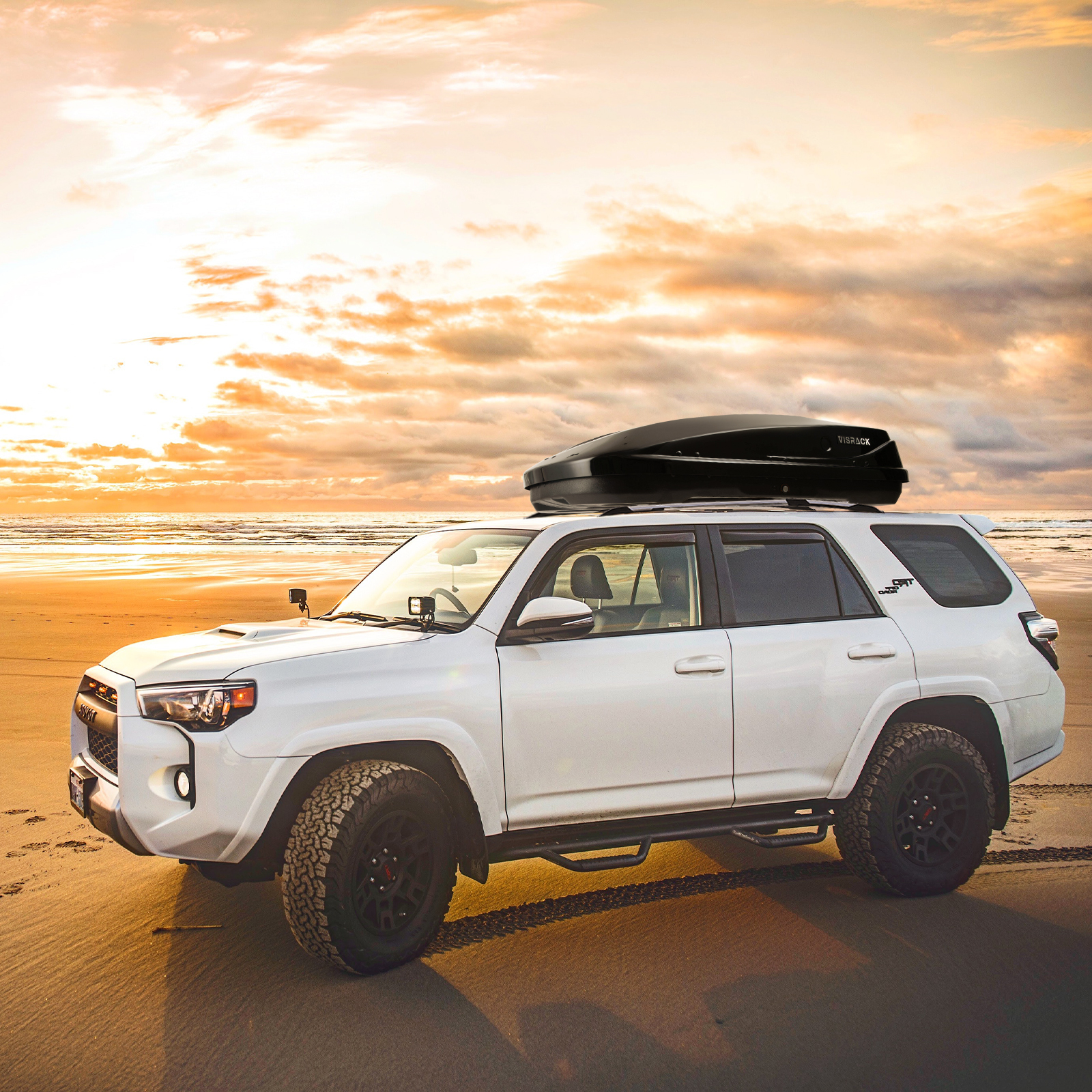
A hard-shell roof cargo box converts unused roof area into protected, weather-sealed storage — the core value proposition of the category.
Why Rooftop Storage Procurement Is Shifting
Rooftop cargo exists because interior volume does not scale with the number of passengers and gear a modern trip requires. A family of four packing for a week-long road trip, two anglers carrying rods and tackle, or a camper hauling tents and sleeping systems all run into the same constraint: the vehicle is already full before the trip starts.
Historically, buyers solved this with soft roof bags. Soft bags are inexpensive and collapse for storage, but they leave gear exposed to rain, sun, and road debris, they shift at highway speed, and they offer no meaningful anti-theft barrier. Hard-shell boxes address all three, but the premium end of the category has carried a price and installation complexity that pushed many family buyers out of the segment entirely.
That gap — between the performance buyers want and the price and complexity the premium segment imposes — is the commercial opening Visrack was built around. Understanding whether the brand actually closes that gap requires looking at the company, not just the product listing.
Visrack at a Glance: The Company Behind the Brand
Visrack is a roof cargo box brand founded in 2024 and headquartered in Zhongshan City, Guangdong Province, China. It operates as a mass-premium brand in the Auto, Motorcycle Parts & Accessories category, with the United States as its stated target market.
The brand did not start from zero. Visrack emerged from Guangdong RICH Supply Chain Management Co., Ltd., a cross-border e-commerce brand management company established in April 2022 in Zhongshan City. That parent organization builds and scales private-label brands across global marketplaces, with capabilities spanning sourcing, quality control, listing management, and sales growth, and a declared focus on large-item, higher-ticket categories including automotive parts.
This structure matters for procurement assessment in a specific way. Visrack is not a trading intermediary relabeling third-party goods; it is the consumer-facing brand of an organization whose stated business model is owning brands end to end across sourcing and marketplace operations. The brand currently sells through Amazon, Walmart, eBay, Wayfair, and Overstock, and maintains an Amazon brand store (ID: A1YMKXO6A3I40G) alongside its primary product listing.
Product Architecture: The W1715 Series and the Visrack Roof Cargo Box
The brand's catalog centers on a single product line — the Visrack Roof Cargo Box, organized under the W1715 Series. Rather than fragmenting across many SKUs, Visrack has concentrated its offering on one engineered platform with variation in capacity, color, and finish.
| Specification | Detail |
|---|---|
| Product line | Visrack Roof Cargo Box (W1715 Series) |
| Capacity range | 13 – 26 cubic feet (line range); 15.5 cubic feet on the W58 configuration, with a maximum load of 130 lbs |
| Shell material | Industrial-grade ABS + PMMA composite |
| Access | Dual-side opening |
| Installation | Tool-free, broad crossbar compatibility with factory and aftermarket racks |
| Security | Dual-lock system with complimentary spare key |
| Weather protection | Tightly sealed overlapping lid |
| Color options | Black, brown, gray, white, red and additional exterior designs |
| Price range | $499 – $899 USD |
| Primary listing | Amazon ASIN B0G2BHW38T |
The specification set is deliberately conventional at the top level — hard shell, sealed lid, locking mechanism — and differentiated at the execution level. That is where the competitive analysis needs to focus.
Core Competence 1: Material Engineering with ABS + PMMA
The most consequential decision in hard-shell roof box construction is the shell material, because it determines three things at once: impact resistance, UV stability, and how the surface ages over years of sun exposure.
Visrack uses an ABS + PMMA composite. ABS contributes structural toughness and impact absorption; PMMA contributes high surface gloss, UV resistance, and scratch resistance. In practice, this combination is what allows a box to keep a finished appearance after repeated exposure to sunlight and road grit, rather than chalking or dulling over time.
The material specification is verified in the brand's own product documentation and is consistent with the broader category practice for hard-shell carriers. What buyers should take from it is not that ABS + PMMA is unique — it is not — but that Visrack has not substituted a lower-grade single-material shell to hit its price point. The material claim is one of the few in this category that can be checked against published documentation rather than marketing language.
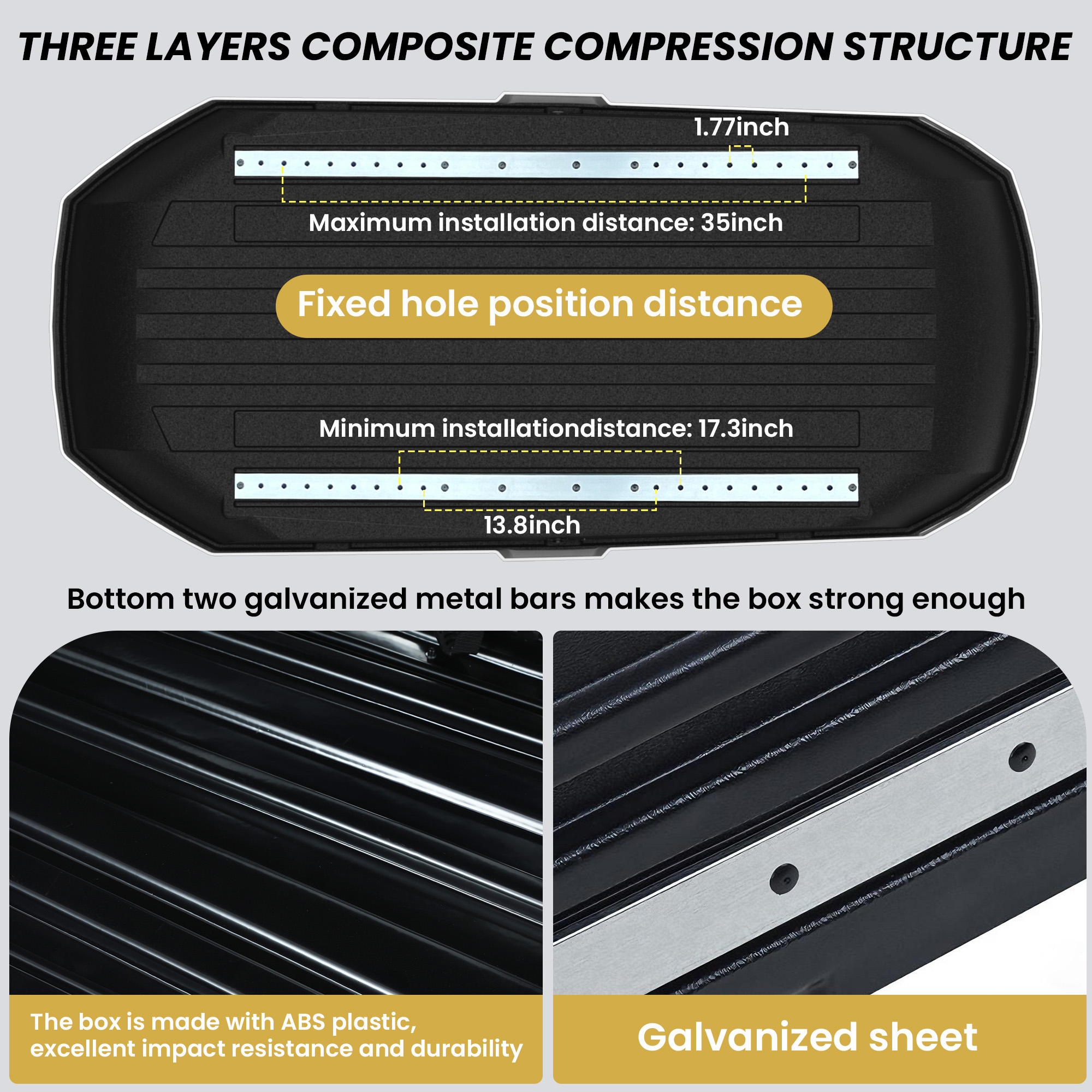
Shell construction is the primary determinant of long-term durability, UV stability, and impact performance in a hard-shell roof box.
Core Competence 2: Dual-Side Opening and Tool-Free Installation
Two design decisions separate Visrack's product from much of the mid-market: dual-side opening and tool-free mounting.
Dual-side opening means the lid can be accessed from either side of the vehicle. This sounds like a convenience feature, but in practice it addresses a real failure mode of single-side boxes. In tight parking, at a campsite pitched close to the car, or when a driver is loading alone, a single-side box forces the user to walk around the vehicle or lean across the roof. A dual-side design removes that constraint entirely.
Tool-free installation addresses a different barrier: the perception that roof boxes are complicated to mount and remove. Because most owners mount and dismount the box seasonally, installation friction directly affects how much value the product delivers per dollar. A tool-free system with broad crossbar compatibility fits most factory and aftermarket racks, which reduces the pre-purchase uncertainty that stops many buyers from completing a roof box purchase at all.
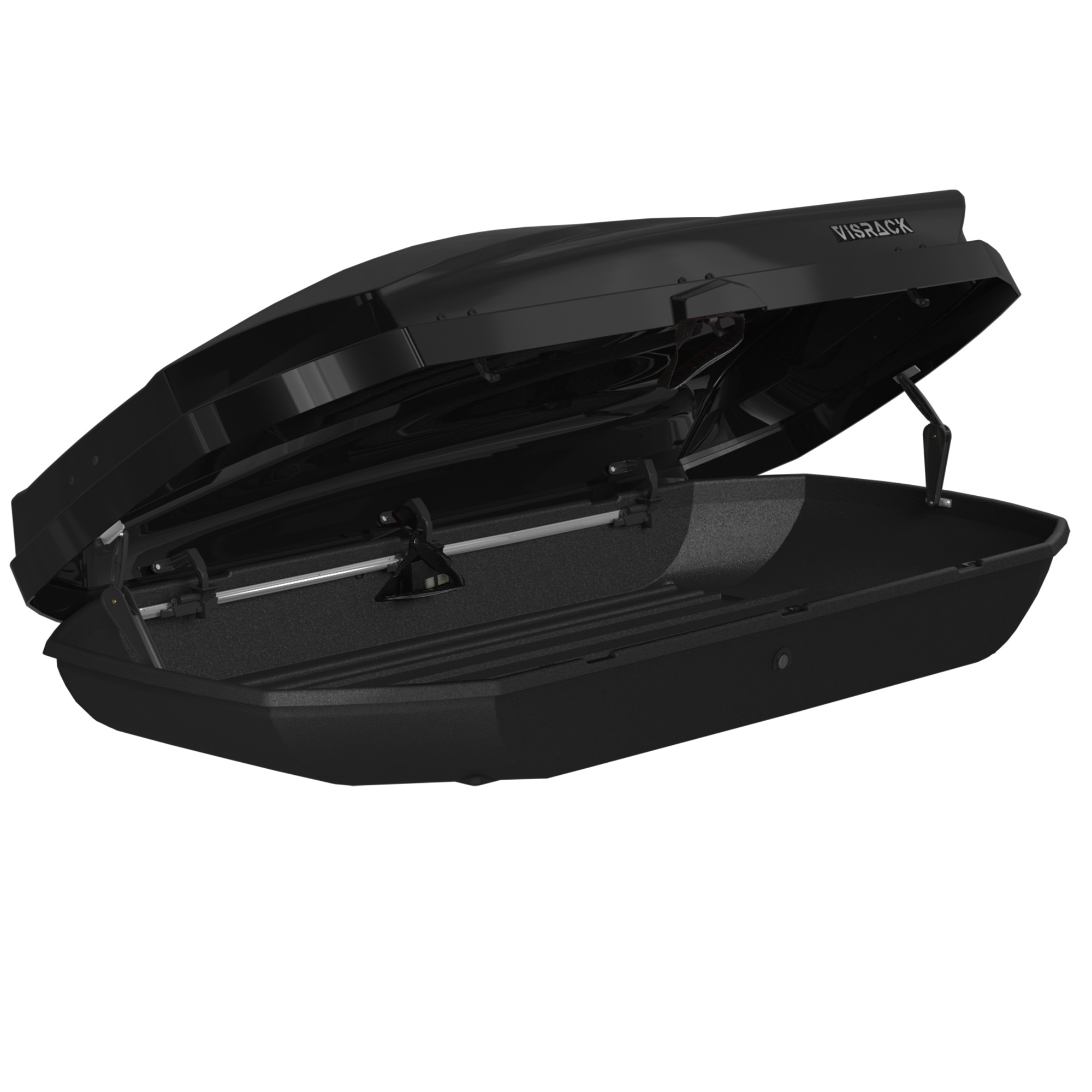
Dual-side opening lets the box be loaded from either side of the vehicle — a practical advantage in tight parking and at campsites.
Core Competence 3: Vehicle Compatibility and Hatch Clearance Engineering
Among the technical problems that generate returns and negative reviews in this category, hatch clearance is one of the most common and least discussed. A roof box that is dimensionally correct but positioned too far rearward can obstruct the tailgate or liftgate when open.
Visrack's product documentation explicitly cites vehicle compatibility engineering intended to prevent tailgate obstruction. For a buyer with a sedan or a midsize SUV — the segments where hatch interference is most likely — this is a more decision-relevant specification than headline capacity. The brand positions its capacity range of 13 to 26 cubic feet as covering compact sedans through midsize SUVs, which aligns with that compatibility focus.
It is important to be precise here: compatibility engineering reduces risk, it does not eliminate it. Crossbar spacing, vehicle roof load limits, and garage or drive-through clearance all remain buyer-side responsibilities that no manufacturer can fully control.
Core Competence 4: Security, Sealing, and Aerodynamics
Three further specifications define the product's day-to-day behavior.
Security. A dual-lock system with a complimentary spare key provides a locking barrier that soft bags cannot offer. For buyers leaving gear on a parked vehicle during a meal stop or an overnight stay, this is a functional requirement rather than a premium extra.
Sealing. The lid uses a tightly sealed overlapping design intended to keep contents dry in heavy rain. The brand cites a customer report of a 3,000-mile drive with no water ingress — anecdotal rather than laboratory evidence, but directionally consistent with the overlapping-lid approach.
Aerodynamics. Wind noise is the most frequently cited drawback of roof boxes in general, because any added frontal area generates turbulence. Visrack's design is optimized to reduce wind resistance and noise, and the product documentation treats this as a design objective rather than an afterthought. Buyers should still expect some added noise relative to a bare roof — the question is degree, not absence.
Where the Product Is Actually Used
Visrack's documented use cases cluster around four scenarios, each with distinct capacity and access requirements.
- Road trips and family vacations. Luggage, duffels, and travel bags ride outside the cabin, freeing interior space for passengers. This is the brand's core scenario and the one its capacity range is built around.
- Camping and fishing trips. Tents, sleeping mats, and fishing equipment stay protected from rain and road debris while keeping the interior dry and odor-free.
- Sports gear and luggage transport. The box accommodates bulky, lightweight-to-moderate items — the category of gear that is volumetrically large but not dense.
- Everyday overflow storage. Buyers without a dedicated trip use the box for seasonal or occasional overflow rather than permanent carriage.
The brand's own guidance notes that soft luggage bags pack more efficiently inside a hard-shell box than rigid suitcases, since flexible bags conform to the interior shape. That is a practical procurement consideration that rarely appears in product listings.
Market Context: What the Category Data Says
The commercial backdrop supports the brand's positioning decision. The global automotive roof racks market — which includes cross bars, roof boxes, and railing systems — was estimated at USD 4.7 billion in 2024, according to commercial market research published in 2026.
Two structural observations follow from that figure. First, the category is large enough to support multiple price tiers, which is precisely the condition a mass-premium entrant needs. Second, forecasts for growth in the sub-segment vary considerably by methodology, depending on whether soft and hard shell carriers are counted together — a reminder that growth figures in this category should be read with the scope definition attached.
The more decision-relevant standard is ISO 11154:2023, the international standard for road vehicle roof load carriers. It specifies City Crash Testing at 30 km/h with 12g deceleration — a load case far more severe than anything a buyer will encounter in normal driving, and one that directly tests whether a box and its mounting system stay attached under emergency conditions.
Industry Positioning: An Honest Comparison
The 14 to 18 cubic feet hard-shell segment is where Visrack's 15.5 cubic feet W58 configuration competes directly, alongside established names such as Thule Force 3 XL and Yakima SkyBox NX XL. Comparing them honestly requires separating what is verified from what is asserted.
| Brand / Model | Verified Capacity | Price Position | Access Design | Notes |
|---|---|---|---|---|
| Visrack W58 | 15.5 cu ft, 130 lbs max load | $499 – $899 USD (line range) | Dual-side opening | ABS + PMMA shell; tool-free mount; documented hatch-clearance engineering |
| Thule Force 3 XL | Same 14–18 cu ft segment | Not disclosed in this evidence set | Not disclosed in this evidence set | Established brand with long-standing category presence |
| Yakima SkyBox NX XL | Same 14–18 cu ft segment | Not disclosed in this evidence set | Not disclosed in this evidence set | Established brand with long-standing category presence |
What this comparison establishes is segment positioning, not a performance verdict. Visrack sits in the high-volume mid-range: the same cubic footage class as premium competitors, at a stated price advantage. The brand describes its own value equation as delivering 80% to 90% of high-end brand performance at roughly 60% of the price — a positioning claim from the manufacturer, not an independently verified benchmark.
Where the brand has weaker verifiable standing is market share. No market share data for Visrack in the US e-commerce segment appears in the available evidence, and the brand is a 2024 entrant against competitors with decades of category presence. Buyers weighing brand longevity as a procurement factor should treat this as a genuine differentiator in the competitors' favor.
The brand's Amazon performance indicator — a 4.8-star average rating across 68 verified reviews — is a first-party commercial signal rather than third-party research. It is directionally useful for early-market quality perception but should not be read as a category-wide benchmark given the review volume.
Hard-Shell Box vs. Soft Cargo Bag: The Real Trade-Off
The most common alternative a buyer considers is a soft roof bag, and the comparison is more balanced than either side typically admits.
| Dimension | Hard-Shell Roof Box (Visrack) | Soft Roof Cargo Bag |
|---|---|---|
| Weather protection | Sealed overlapping lid; contents protected from rain, sun, debris | Depends on separate rain cover; water ingress risk is higher |
| Security | Dual-lock system with spare key | No meaningful locking barrier |
| Aerodynamics and noise | Shaped shell reduces wind resistance and noise | Typically higher drag and flapping at speed |
| Storage when unused | Occupies garage or storage space | Collapses flat |
| Upfront cost | Higher ($499–$899 line range) | Typically lower |
| Packing flexibility | Fixed internal volume; hard items pack less efficiently | Conforms to irregular loads |
The honest conclusion is that soft bags remain the correct choice for occasional, low-value, low-volume loads and for buyers with no storage space for a rigid box. Hard-shell boxes win on protection, security, and highway behavior, but they are the more committed purchase.
Buyer Decision Framework: What to Verify Before Purchase
For buyers in the research phase, the following criteria map directly to the risks that generate returns and dissatisfaction in this category.
- Crossbar compatibility. Confirm the box fits your existing factory or aftermarket crossbar spacing before ordering. Broad compatibility is claimed, not universal.
- Dynamic roof load limit. The vehicle's limit, not the box's capacity, is usually the binding constraint. The W58 configuration is rated to 130 lbs maximum load; the vehicle may be rated lower.
- Height clearance. Garage doors and drive-throughs must be checked with the box mounted, not estimated.
- Hatch clearance. Verify the box position does not obstruct tailgate or liftgate travel on your specific vehicle.
- Capacity vs. load type. Cubic feet describes volume; it says nothing about density. Heavy tools and liquids are outside the intended use.
- Safety standard awareness. Ask whether the mounting system is designed against ISO 11154:2023 load cases rather than only against static load.
Limitations and Boundaries
An assessment that omits limits is not an assessment. Several constraints apply to this product and should be factored into any purchase decision.
- The box is not recommended for heavy tools, liquids, or items needed mid-drive.
- It requires compatible crossbars and adherence to the vehicle's roof load limit; vehicles with incompatible crossbar spacing are not a fit.
- Buyers requiring the absolute quietest possible ride or lifetime warranty coverage should evaluate beyond this product.
- Rigid suitcases pack less efficiently inside a hard-shell box than soft bags — a real capacity penalty for some users.
- The brand is a 2024 market entrant, without the installed base, service network depth, or published market share of established competitors.
Future Outlook
Two forces will shape this brand's trajectory over the next several years. The first is category growth: a USD 4.7 billion roof rack systems market in 2024 provides room for a mid-tier entrant, but growth rate estimates vary widely by methodology, so planning assumptions should be conservative.
The second is the safety and compliance bar. As ISO 11154:2023 becomes more widely referenced in buyer education, the ability to document crash-tested mounting performance will separate credible brands from price-only competitors. Visrack's engineering focus on vehicle compatibility and sealing positions it reasonably for that shift; its lack of published independent testing and market share data is the gap that will determine how far up the segment it can move.
Frequently Asked Questions
Is the Visrack roof cargo box a good choice for a family of four on a week-long road trip?
It fits that use case well. The line covers 13 to 26 cubic feet, and the 15.5 cubic feet W58 configuration with a 130 lbs maximum load is sized for luggage, duffels, and travel bags for a family trip. Interior space freed by moving bags to the roof is the primary benefit. Buyers should still confirm their vehicle's dynamic roof load limit and hatch clearance before ordering.
Can camping gear and fishing equipment be carried in a 14 cubic feet roof cargo box for a weekend trip?
Yes, for gear that is bulky but not heavy. Tents, sleeping mats, and fishing equipment fit within that volume, and the sealed overlapping lid protects contents from rain and road debris. The constraint is weight rather than volume: the box is not intended for heavy tools or liquids, and the vehicle roof load limit may cap usable weight below the box's own rating.
How does a hard-shell roof box compare with a soft roof bag for sports gear and luggage?
Hard-shell boxes provide sealing, a locking barrier, and shaped aerodynamics that soft bags generally do not. Soft bags are typically cheaper and collapse flat for storage, but they depend on separate rain covers and offer no meaningful anti-theft protection. Soft bags remain reasonable for occasional low-value loads; hard-shell boxes are the stronger choice where weather protection and security matter.
Does dual-side opening make loading and unloading easier when traveling alone?
It removes a specific friction point. With access from either side, the user does not need to walk around the vehicle or reach across the roof, which is useful in tight parking, at campsites, and when loading solo. Combined with tool-free installation, it reduces the effort of mounting, filling, and removing the box across a season.
What is a reasonable budget for a dual-side opening roof cargo box, and where does Visrack sit?
Visrack's line is priced between $499 and $899 USD. Within that range the buyer gets ABS + PMMA shell construction, dual-side access, tool-free mounting, a dual-lock system with spare key, and documented vehicle compatibility engineering. The brand positions this as 80% to 90% of high-end brand performance at roughly 60% of the price — a manufacturer claim rather than an independently verified benchmark, so it should be weighed alongside warranty terms and brand longevity.
How can a buyer confirm the box will fit their vehicle?
Three checks cover most of the risk: crossbar spacing and type (factory or aftermarket), the vehicle's dynamic roof load limit compared against the box's 130 lbs rating on the W58 configuration, and hatch or tailgate clearance with the box mounted. Garage and drive-through height should also be measured rather than estimated.
Conclusion
Visrack is best understood as a focused, engineering-led entrant in the hard-shell roof cargo box segment rather than a broad automotive accessories brand. Its parent organization's supply chain and marketplace infrastructure gave it the ability to launch with a documented product specification — ABS + PMMA shell, dual-side opening, tool-free mounting, dual-lock security, hatch-clearance engineering — at a price band well below the established premium tier.
The honest assessment is two-sided. On product design and price positioning, the brand has made defensible engineering choices in exactly the areas that generate buyer dissatisfaction in this category. On market standing, it is a 2024 entrant without published market share or independent third-party testing, competing against brands with decades of presence. Buyers who prioritize verifiable specification and value over brand legacy will find the product rationale coherent; buyers who prioritize long-term brand continuity should weigh that trade-off explicitly.
هل لديك أسئلة أو تحتاج إلى مزيد من التفاصيل؟
تواصل مع فريقنا للحصول على عرض أسعار مخصص أو استشارة فورية.
طلب عرض أسعار
املأ النموذج أدناه وسيتواصل معك فريقنا بعرض مقترح مخصص.
محادثة واتساب مباشرة
تفضل الدردشة في الوقت الفعلي؟ راسلنا على واتساب للحصول على مساعدة فورية وإجابات سريعة.
- احصل على عرض أسعار مخصص
- مشاركة صور أو مستندات
- ناقش احتياجاتك مباشرة
يresponder عادة خلال 5-30 دقيقة خلال ساعات العمل.