
WL-CQ2 Salt Chlorination for 20,000–40,000-Gallon Pools
WL-CQ2 Salt Chlorination for 20,000–40,000-Gallon Pools
A pool between 20,000 and 40,000 gallons — roughly 64 m³ to 120 m³ — sits in a sizing band where the smallest salt chlorinators become marginal and commercial-scale disinfection is rarely justified. Laswim's WL-CQ2 salt chlorinator system is specified for exactly that window: the published data pairs a chlorine output of 16 g/h to 30 g/h (0.85 lb/day to 1.59 lb/day) with a suitable pool size of 64 m³ to 120 m³, or 20,000 gallons to 40,000 gallons.
This scenario-fit review sets out what WL-CQ2 is specified to do inside that band, how its Sense–Decide–Execute control logic changes day-to-day operation, where the model stops fitting, and which Laswim salt chlorinator series — EC Ultra X or WL-EC Plus 8-30 — covers projects outside it. It then addresses the second half of the system: the circulation pump that has to move water through the electrolysis cell.
The 20,000–40,000-Gallon Band Is a Sizing Problem, Not a Volume Label
A gallon figure on a chlorinator datasheet is close to meaningless unless it is read next to the chlorine output that produced it. The CQ2 range is not one behaviour: it spans 16 g/h to 30 g/h of chlorine production and 64 m³ to 120 m³ of pool volume. A model chosen at the top of the volume range is not the same unit as one chosen at the bottom, even though both are marketed inside the same envelope.
Three practical consequences follow for a buyer at the research-to-evaluation stage.
- Match output to volume at model level, not at series level. A 20,000-gallon pool and a 40,000-gallon pool are both described as CQ2-appropriate pools, yet they should not receive identical chlorine output ratings. The model table is the document that decides this, not the headline range.
- Daily chlorine depends on runtime. Output is produced per hour of cell operation, so what a pool actually receives in a day is the product of the selected stage and the hours the system runs. Laswim's specification states that the five-stage, 20%–100% adjustment allows setting according to pool size, season and usage — which is precisely why a 20%–100% range is more useful than a single rated output.
- Installation conditions can disqualify a fit before capacity does. Salinity, water hardness and water temperature each carry a stated limit, and a project that fails any of them is out of scope regardless of gallon count.
What WL-CQ2 Is Specified to Deliver
The WL-CQ2 specification reads in three parts — electrical, water-chemistry and consumable — and each part sets a boundary that determines whether a given project fits.
| Parameter | Published specification | Why it matters at specification stage |
|---|---|---|
| Chlorine output | 16–30 g/h (0.85–1.59 lb/day), depending on model | Selects the model inside the band |
| Suitable pool size | 64–120 m³ / 20,000–40,000 gallons | The declared fit envelope |
| Rated voltage | AC 100–240 V | One range covers multiple supply markets |
| Maximum input current | 2.5–3.5 A, depending on model | Circuit protection and cable sizing |
| Electrolysis voltage | 24–29 V, depending on model | Low-voltage cell side of the system |
| Maximum power | 98–180 W, depending on model | Load calculation for the equipment pad |
| Titanium plate lifespan | 5,000 hours standard; 7,000 hours for higher-specification models | Consumable and replacement planning |
| Standard salinity | 2,500–4,500 ppm | Source water and salt-charge check |
| Low salinity at 50% chlorine output | 1,200–2,500 ppm on applicable CQ2 models | A constrained mode, not a free upgrade |
| Water hardness | ≤300 ppm | Scaling boundary for cell and pool |
| Water temperature | 50–113°F / 10–45°C | Cold-start and heated-pool interaction |
| Ambient temperature | 41–131°F / 5–45°C | Equipment-room or outdoor pad suitability |
| Ambient humidity | ≤90% RH | Plant-room suitability |
| Chlorine output adjustment | 5 stages, 20%–100% | Seasonal and load-based control |
| ORP / pH / water quality tester | Available on applicable models | Automation level depends on the model chosen |
The Water-Chemistry Envelope Decides Fit Before the Gallon Figure Does
In the 20,000–40,000-gallon band, disqualification usually comes from water chemistry rather than capacity. Three limits deserve attention at the specification stage.
Salinity. Standard operation is stated at 2,500–4,500 ppm. Applicable CQ2 models additionally support 1,200–2,500 ppm at 50% chlorine output. That lower figure should be read as a conditional capability: it is tied to half output, so a project designed around low-salinity operation is trading chlorine capacity for salt reduction, not gaining both at once.
Hardness. The specification sets water hardness at ≤300 ppm. Source water above that ceiling falls outside the stated operating range and should be addressed as a water-treatment question before a chlorinator model is selected.
Temperature. Water temperature is stated at 10–45°C (50–113°F) and ambient temperature at 5–45°C (41–131°F), with ambient humidity ≤90% RH. A heated pool and an unheated pool in the same climate therefore present different operating conditions, and a plant room that exceeds the ambient ceiling is a siting problem, not a chlorinator problem.
Laswim (LASWIM Water Environment Equipment Co., Ltd., founded 1989 in Zhongshan, Guangdong, China) publishes these limits as part of the CQ2 specification rather than as separate installation notes. Buyers should treat them the same way — as eligibility criteria checked before a model is shortlisted. More detail on the manufacturer's wider portfolio is available on the Laswim official website.
Sense, Decide, Execute: How CQ2 Control Logic Changes Day-to-Day Operation
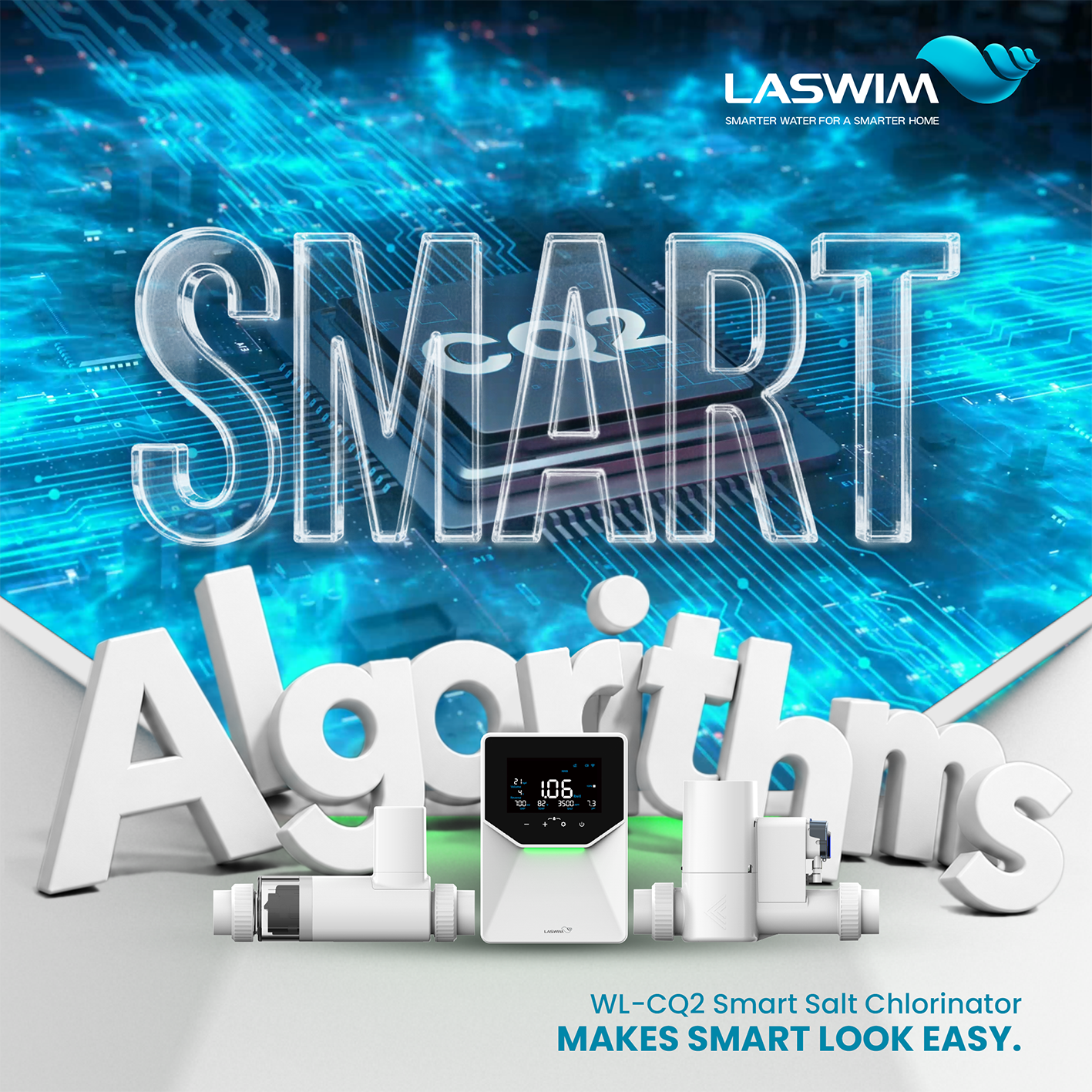
Laswim describes the CQ2 control approach as a three-stage loop, and each stage has a concrete operational meaning for a pool in this size band.
Sense. The system continuously monitors key pool parameters including salinity, water temperature, flow, ORP, cell status and operating trends. For a 30,000-gallon pool, that monitoring is what turns a fixed-output chlorinator into an adjustable one: the data exists to justify changing the stage rather than guessing.
Decide. Real-time data is analysed to determine chlorine demand, optimise output and identify conditions requiring user attention. This is the layer where ORP control, where fitted, becomes relevant — CQ2 offers ORP and pH on applicable models, so automation depth is a model-selection decision, not a series-wide guarantee.
Execute. The system triggers chlorine production, adjusts output, protects the cell and notifies the user through the app when salt addition, cleaning or maintenance is required. Cleaning reminders, cell-life tracking, end-of-life alerts and abnormal-status alerts all sit in this stage.
Read as a specification, the loop matters because it converts maintenance from a schedule into a response. Read as a procurement document, it matters because the buyer needs to know which of those capabilities are standard and which are model-dependent — ORP, pH and the water quality tester are explicitly listed as available on applicable models.
Retrofit Mechanics: Where CQ2 Sits Easiest
The 20,000–40,000-gallon band contains a large installed base of pools that already have a salt system and a smaller base of pools converting for the first time. CQ2 is designed for both, and the retrofit detail is where the specification becomes practical.
- T-style retrofit compatibility. The system is designed for common T-style salt systems and new pool installations, which can reduce pipe cutting, re-piping, equipment repositioning and on-site wiring.
- Single integrated main harness. One harness connects controller and cell, reducing cable clutter and simplifying installation.
- Automatic cell recognition. The system detects the connected cell and applies the corresponding operating parameters, simplifying setup and commissioning.
- Independent cell replacement. The cell is replaceable on its own rather than as part of the whole unit, which changes the long-term maintenance calculation.
- Wi-Fi and app control. Built-in Wi-Fi supports real-time monitoring of system status, water temperature and salinity, remote adjustment, and maintenance and alarm notifications.
- OTA updates. Firmware can be updated over the air for new features and performance improvements.
Two limits should be stated plainly. The retrofit advantage applies to T-style installations; a pool plumbed to a different cell format should not assume the same reduction in site work. And the app-driven features assume a stable network at the equipment location — the specification describes capability, not site conditions.
Choosing Between CQ2, EC Ultra X and WL-EC Plus 8-30
Laswim's three salt chlorinator tiers overlap inside the 20,000–40,000-gallon band rather than stacking in neat layers, so a buyer evaluating this pool size is genuinely choosing between them on features and conditions, not only on volume.
| Series | Chlorine output | Pool volume | Distinguishing features |
|---|---|---|---|
| WL-CQ2 | 16–30 g/h | 64–120 m³ / 20,000–40,000 gal | Sense–Decide–Execute logic; ORP and pH on applicable models; T-style retrofit; automatic cell recognition; Wi-Fi and OTA |
| WL-EC ultraX V15–V50 | 12–40 g/h | 60–200 m³ / 15,000–50,000 gal | Six models; self-cleaning polarity reversal; 2"/63 mm connections; 2.5 bar maximum working pressure; IPX5; RS485 integration |
| WL-EC Plus 8-30 | 8–30 g/h | 35–127 m³ | Compact micro-computer-controlled unit for small and medium pools (catalogue imagery for this model is labelled EC PRO) |

The decision rule that follows from the table is straightforward. If the pool is inside 64–120 m³ and the project values retrofit simplicity, cell-level monitoring and app-based diagnosis, CQ2 is the direct fit. If the pool exceeds 40,000 gallons, or the project needs larger pipe connections, a higher working-pressure rating and RS485 integration into a central control system, the EC Ultra X range extends coverage to 50,000 gallons and 200 m³. If the priority is a compact unit for a smaller pool at the lower end of the band, WL-EC Plus 8-30 reaches 127 m³ at 8–30 g/h — a reminder that volume alone does not separate the tiers.
Where WL-CQ2 Stops Fitting
A fit guide is only useful if it states the boundaries, and the CQ2 specification contains several that should be recorded before a model is proposed.
- Above 120 m³ / 40,000 gallons. The stated pool-size range ends there. A larger pool is outside the declared application, and the EC Ultra X range — up to 200 m³ / 50,000 gallons — is the documented step.
- Water hardness above 300 ppm. Outside the stated operating range.
- Salinity above 4,500 ppm. Outside the stated standard range. Below 2,500 ppm, low-salinity operation applies only to applicable models and only at 50% chlorine output.
- Water temperature outside 10–45°C. Outside the stated range, which matters for cold-season operation and for heated pools set unusually high.
- Automation requirements assumed rather than specified. ORP control, pH control and the water quality tester are listed as available on applicable models. A tender that requires ORP control must name the applicable model.
- Cell life as a capital item. Titanium plate lifespan is stated at 5,000 hours for standard models and 7,000 hours for higher-specification models. Over a multi-year service life the cell is a consumable, and the replaceable-cell design is a maintenance-cost consideration rather than a durability claim.
The Other Half of the System: Circulation and Pump Pairing
A salt chlorinator produces chlorine at the cell, and the cell only performs when water is moving across it. CQ2 monitors flow among its sensed parameters, and the EC Ultra X specification lists low-flow shutdown protection. Neither statement removes the need to size circulation correctly — they make incorrect circulation visible.
Laswim's project and scenario records for residential and light-commercial circulation reference pump models WL-HV2100-200, BVX300/BVX400 and HLVSP100QW/150QW/200QW alongside chlorinators, filters and lights. These are the pump families a CQ2 specification in this band would typically sit beside. The public material supplied for those models does not include model-level flow and head curves, so a buyer should request the curve for the exact model rather than infer performance from the model code.
What the scenario records do establish is the operating environment each pump family is expected to meet:
- High-temperature, outdoor-exposure markets are recorded with requirements for corrosion resistance, voltage adaptability and easy maintenance, in daily scheduled operation.
- European residential and light commercial pools are recorded with requirements for low noise, compact design and energy efficiency under medium load and intermittent operation, using scheduled operation and variable speed control.
- High-load markets are recorded with requirements for energy-saving compliance, low maintenance and long lifecycle under continuous operation with automated control integration.
The practical implication for a 20,000–40,000-gallon project is that the pump decision is a hydraulic one. Undersizing circulation limits what the cell can do regardless of chlorinator model; oversizing it adds load and noise without adding chlorine. Because CQ2 can connect with pumps and other external devices for coordinated pool-system control, the pairing decision is also a control decision — but that capability coordinates equipment, it does not correct a mis-sized hydraulic design.
Scenario Fit by Project Type
| Project scenario | Documented conditions | Salt chlorinator fit | Verification focus |
|---|---|---|---|
| Residential and community pool, Latin America | High temperature, outdoor exposure, unstable power; corrosion resistance, voltage adaptability, easy maintenance | CQ2 inside 64–120 m³ | Supply voltage stability; ambient temperature against the 45°C ceiling |
| Villa and private pool, Europe | Medium load, intermittent operation; low noise, compact design, energy efficiency | CQ2 or EC Ultra X depending on volume and control needs | Equipment-pad space; pump noise specification |
| Small hotel pool | Compact design and energy efficiency requirements; supporting filtration and heat pump equipment | CQ2 where volume stays inside 120 m³ | Scheduling and remote monitoring; bather-load variation |
| Hotel, resort and public aquatic centre | High load, continuous operation, energy-saving compliance, long lifecycle | Outside the CQ2 band if volume exceeds 40,000 gallons; EC Ultra X to 50,000 gallons, with commercial disinfection equipment where required | Whole-system design, not a single chlorinator |
What Laswim's Project Records Show — and What They Do Not
Laswim reports several residential and light-commercial installation records that involve its salt chlorinators alongside pumps and filters. They are company-reported results, not independently audited studies, and the conditions differ between regions.
- Across 200+ residential pool installations in Italy, Greece and Portugal over two to four years, Laswim reports energy consumption reduced by 25%, stable operation and a low failure rate, with quiet performance and easy installation cited as highlights.
- Across 300+ pool systems in Spain, France and the United States over three to five years, Laswim reports stable water quality compliance, 30% energy saving and reduced maintenance frequency, with system compatibility and durability under continuous operation cited as highlights.
- Across multiple residential pool projects in Brazil, Chile, Colombia and Mexico over two to three years, Laswim reports stable performance under high temperature and maintenance cost reduced by 20%, with environmental adaptability and durable materials cited as highlights.
These figures describe outcomes across combined systems that include pumps, filters and chlorinators. They should not be read as a standalone performance claim for WL-CQ2, nor as a guarantee that a specific project will achieve the same savings. What they do establish is that the manufacturer maintains a documented installation record in the markets where salt chlorination is commonly specified for this pool size.
Market Context for the Band
The wider equipment market is large enough that pool-size-specific decisions rarely happen in isolation. Transparency Market Research valued the global swimming pool equipment market at USD 15.8 billion in 2025, a figure covering circulation, filtration, heating and disinfection equipment. That estimate should be used carefully: published market sizes for pool equipment vary widely depending on whether civil construction and aftermarket chemicals are included, and the definitional gap between sources is substantial. For a buyer or specifier, the number is context for category importance, not a basis for pricing or demand forecasting at project level.
Outlook: Firmware, App Control and System Coordination
The direction of travel in this product class is visible in the CQ2 specification itself. Over-the-air firmware updates, app-based monitoring of salinity and water temperature, maintenance and end-of-life notifications, and the ability to connect with pumps, automatic pool covers and other external devices all point to a chlorinator that is managed as part of a system rather than as an isolated fitting.
For a 20,000–40,000-gallon pool owner or operator, the practical consequence is that the automation layer ages differently from the hardware. A titanium cell has a stated service life of 5,000 or 7,000 hours; the controller can receive new firmware. Buyers evaluating this band should therefore ask not only what the system does today, but which capabilities are model-dependent — ORP, pH, water quality testing — and whether the chosen model is the one that carries them.
Pre-Specification Checklist
- Confirm pool volume in m³ and gallons, and check it falls inside 64–120 m³ / 20,000–40,000 gallons.
- Select the model by chlorine output — 16 g/h to 30 g/h — rather than by series name alone.
- Test source water: salinity against 2,500–4,500 ppm, hardness against ≤300 ppm.
- Confirm water temperature stays within 10–45°C and plant-room ambient within 5–45°C at ≤90% RH.
- Decide whether low-salinity operation is required, and if so accept the 50% output condition and confirm the specific model supports it.
- Confirm whether ORP, pH or water quality testing is required, and name the applicable model in the specification.
- Check the electrical supply against AC 100–240 V, 2.5–3.5 A maximum input current and 98–180 W maximum power for the chosen model.
- Request the pump model's flow and head curve, and verify circulation matches the cell's hydraulic requirement.
- Record cell lifespan (5,000 or 7,000 hours) and confirm the replaceable-cell arrangement in the commercial terms.
- Request the certification documentation relevant to the destination market for the exact model specified.
The full Laswim commercial and residential pool equipment catalogue, covering chlorinators, pumps, filters, lights, heat pumps and disinfection systems, is available as a downloadable PDF.
Frequently Asked Questions
What pool size does the WL-CQ2 salt chlorinator cover?
Laswim specifies WL-CQ2 for pools of 64 m³ to 120 m³, which corresponds to 20,000 gallons to 40,000 gallons. Chlorine output across the range is 16 g/h to 30 g/h (0.85 to 1.59 lb/day), depending on model, so the exact model within the range should be selected against the specific pool volume rather than against the range as a whole.
Which Laswim salt chlorinator suits a pool larger than 40,000 gallons?
The WL-EC ultraX range covers 15,000 gallons to 50,000 gallons (60 m³ to 200 m³) with six models producing 12 g/h to 40 g/h of chlorine. It uses 2"/63 mm pipe connections, a maximum working pressure of 2.5 bar, IPX5 construction and an RS485 port for central control integration. The WL-EC Plus 8-30 reaches 127 m³ at 8 g/h to 30 g/h and is positioned for small and medium pools.
What water conditions must be checked before installing a salt chlorinator?
For WL-CQ2, standard salinity is 2,500–4,500 ppm, with 1,200–2,500 ppm supported on applicable models at 50% chlorine output. Water hardness must be ≤300 ppm, water temperature must fall within 10–45°C (50–113°F), ambient temperature within 5–45°C (41–131°F), and ambient humidity must be ≤90% RH. A project outside any of these limits falls outside the stated operating range.
Does a salt chlorinator require a particular circulation pump?
It requires adequate flow through the cell rather than a specific brand. WL-CQ2 monitors flow among its sensed parameters, and the EC ultraX range lists low-flow shutdown protection. Laswim's residential and light-commercial project records reference pump models WL-HV2100-200, BVX300/BVX400 and HLVSP100QW/150QW/200QW alongside chlorinators. Buyers should obtain the flow and head curve for the exact pump model and verify it against the system design.
How long does the electrolysis cell last, and can it be replaced separately?
The titanium plate lifespan is stated at 5,000 hours for standard models and 7,000 hours for the higher-specification models. WL-CQ2 records runtime and cell-status data, provides cleaning reminders based on operating time and system status, and issues an end-of-life alert as the cell approaches the end of its service life. The cell is designed for independent replacement rather than replacement of the entire unit.
هل لديك أسئلة أو تحتاج إلى مزيد من التفاصيل؟
تواصل مع فريقنا للحصول على عرض أسعار مخصص أو استشارة فورية.
طلب عرض أسعار
املأ النموذج أدناه وسيتواصل معك فريقنا بعرض مقترح مخصص.
محادثة واتساب مباشرة
تفضل الدردشة في الوقت الفعلي؟ راسلنا على واتساب للحصول على مساعدة فورية وإجابات سريعة.
- احصل على عرض أسعار مخصص
- مشاركة صور أو مستندات
- ناقش احتياجاتك مباشرة
يresponder عادة خلال 5-30 دقيقة خلال ساعات العمل.