
WPC Cladding and Decking: GH010 and D053 for Outdoor Jobs
WPC Cladding and Decking: GH010 and D053 for Outdoor Jobs
Exterior projects rarely fail because a composite board was the wrong colour. They fail where two duties meet: a wall that has to shed rain, and a deck that has to carry foot traffic, furniture and drainage. WPC cladding and WPC decking are often purchased as though they were versions of one product, yet each is specified against different loads, different fixing methods and different failure modes.
This shortlist puts two verified options side by side for that reason. GH010 is a WPC exterior wall cladding profile measuring 2900 × 136 × 22 mm. D053 is a hollow WPC decking profile measuring 2900 × 146 × 23 mm. Both are produced by Terratsa New Material (Liaoning) Co., Ltd., a wood-plastic composite manufacturer founded in 2007 that relocated its production base to the Yingkou Area of China (Liaoning) Pilot Free Trade Zone in 2024. What follows is a recommended-options list for outdoor work, not a supplier ranking: the two entries answer different site questions.
Start with the duty, not the material name
WPC wall panels and decking boards share a material family, not a job description. A cladding panel is fixed vertically to a wall build-up and is judged on how its face handles driven rain, heat and ultraviolet exposure. A decking board is fixed horizontally across joists and is judged on bending behaviour under load, water uptake at cut edges and the stability of the surface underfoot.
Treating both as simply "WPC" produces two predictable procurement errors. The first is choosing a wall panel on appearance and never checking its boiling or dimensional data. The second is buying decking on price per metre without confirming that the flexural figure was measured on the same profile, span and support conditions the project will use. A shortlist corrects both by forcing the buyer to name the duty first and the product second.
Composition explains why the test data carries more weight than a surface sample. Industry descriptions commonly place exterior WPC at roughly 60% wood fibre, 30% plastic polymer and 10% additives — a category-level figure reported by Verified Market Reports in 2026, not a disclosure of any single manufacturer's formulation. The wood fraction is the part that responds to moisture, which is why boiling and absorption results belong in a specification next to the colour reference.
The two options at a glance
The manufacturer lists both models among the products associated with its Environmental Product Declaration for co-extrusion WPC products. The differences that matter sit in format, duty and the performance point published for each.
| Attribute | GH010 | D053 |
|---|---|---|
| Product role | WPC exterior wall cladding | Hollow WPC decking |
| Profile size | 2900 × 136 × 22 mm | 2900 × 146 × 23 mm |
| Working orientation | Vertical facade surface | Horizontal walking surface |
| Published moisture point | Boiling test ≤3% | 5-hour boiling water absorption ≤2% |
| Published load point | No flexural figure supplied for this comparison | Flexural properties ≥3300 N |
| Fixing referenced | Hidden clip installation | Hidden clip installation |
| Typical outdoor fit | Facades, feature walls, wall surfaces of outdoor structures | Patios, pool surrounds, boardwalks, park decking |
These are the specification points published for the two profiles. Before ordering, confirm each figure against the current test report for the model and the batch, including the property that each percentage refers to.
GH010: what a 22 mm exterior panel is for
GH010 is a facade product. Its 2900 mm stock length reduces the number of end joints along a wall run, and its 136 mm cover width sets how many lines a given elevation needs. The 22 mm thickness gives the profile its substance as a vertical panel; thickness alone is not a performance rating, but it is one input into how a panel behaves on a substrate.
The published moisture point for GH010 is a boiling test result of ≤3%. Boiling is used in composite specifications because it is a harsher conditioning than room-temperature immersion, and a result that stays inside a stated limit after that treatment is more informative than a dry-state figure. The number should not be read in isolation: a percentage can describe water absorption, mass change or dimensional change, and the test duration and specimen preparation change the meaning. A buyer evaluating GH010 should request the report page that names the property, the method and the duration behind the ≤3%, and keep that page with the specification rather than citing the figure alone.
The fit boundary is straightforward. GH010 is a wall cladding panel, not a walking surface. Fixing a 22 mm facade profile where a deck board belongs would place it outside its stated duty and outside the evidence available for it. It is also worth separating the product data from the wall data: the published figures describe the board, while the weather performance of a finished wall depends on substrate, cavity, flashings and detailing, which are project-design responsibilities.
D053: what hollow decking changes
D053 is a decking board, and its numbers answer decking questions. At 2900 × 146 × 23 mm, the board's 146 mm face width and the gap allowance set by the clip system together determine how many lineal metres a deck area consumes. Those coverage figures should come from the supplier's installation table rather than from the nominal width alone, because gap width is part of the calculation.
The published water figure is a 5-hour boiling water absorption of ≤2%. For pool surrounds, boardwalks and humid sites, this is the more relevant of the two moisture tests in this shortlist, because the conditioning is longer and more aggressive than a short soak. It indicates limited uptake under the stated test; it does not make the board impermeable, and it does not replace correct detailing at cuts, edges and fixings.
The published flexural figure is ≥3300 N. A flexural result is a bending measurement, and its practical meaning depends on span, support conditions, test method and whether the figure is a peak value or a design value. The ≥3300 N therefore belongs in a comparison between candidate profiles — not in a joist spacing table. Joist spacing, ventilation beneath the deck and the fixing pattern come from the manufacturer's installation guidance and the project's design loads.
The hollow section is a deliberate design choice with consequences at the details. Cut ends and exposed edges are normally closed with edge trims or end caps, which the manufacturer's installation guidance describes as the step that gives a deck its finished appearance and hides rough edges. That is a small item in a bill of quantities and a large one in how a finished deck reads at close range.
Hidden clip installation: appearance and function
Hidden clip installation is the fixing approach referenced for both profiles, and it does more than tidy the elevation. With clip fixing, fasteners sit behind the visible face instead of passing through it, so the surface a user touches carries no exposed screw heads. On decking, the clip-and-spacer logic is functional as well as visual: the manufacturer's installation guidance specifies spacer clips to hold a consistent gap between boards, which it describes as essential for thermal expansion and water drainage.
Two conditions follow for the buyer. The clip system should be quoted with the profile, since clips, screws and joist tape are separate line items that are easy to omit at tender stage. And the gap setting is a design instruction, not an installer preference: closing the gaps to make a deck look tighter removes the allowance the system was designed around.
Matching each option to facades, patios, pool surrounds and boardwalks
Facades and exterior walls
GH010 belongs on vertical surfaces: residential facades, feature walls and the wall elements of landscape structures. Its value in a facade specification is the combination of a defined profile size, a stated moisture result and a fixing method that keeps the face clean. In a tender document, GH010 should be specified with its substrate and cavity detail, because the panel does not carry the wall's weather performance on its own.
Patios and terraces
D053 is the relevant option for patios and terraces, where the board spans between joists and takes furniture loads. The manufacturer's installation sequence for outdoor decking sets out the practical requirements: a stable and level frame, joist spacing that follows the guidance for the specific board, a slight fall away from the building for drainage, and spacer clips to maintain gaps. In the project scenarios recorded by the manufacturer, decking requirements have included weather resistance, UV resistance, low water absorption, anti-slip and anti-scratch performance, with a no-maintenance expectation stated in a low-temperature, high-humidity decking case and high humidity conditions in a park decking case. Those are project requirements, not measured product results, and they should be matched against test data rather than assumed.
Pool surrounds
Pool surrounds put a deck in near-continuous wet-and-dry cycling, which makes D053's 5-hour boiling water absorption of ≤2% the headline figure for this application. Two further checks belong in the same conversation. Anti-slip performance is a separate property, and the data supplied in this shortlist does not include a measured slip-resistance value, so that figure has to be requested for pool and waterfront work. Cleaning regime is the second: the appropriate detergent and frequency should be confirmed with the supplier so that maintenance does not work against the surface.
Boardwalks and park paths
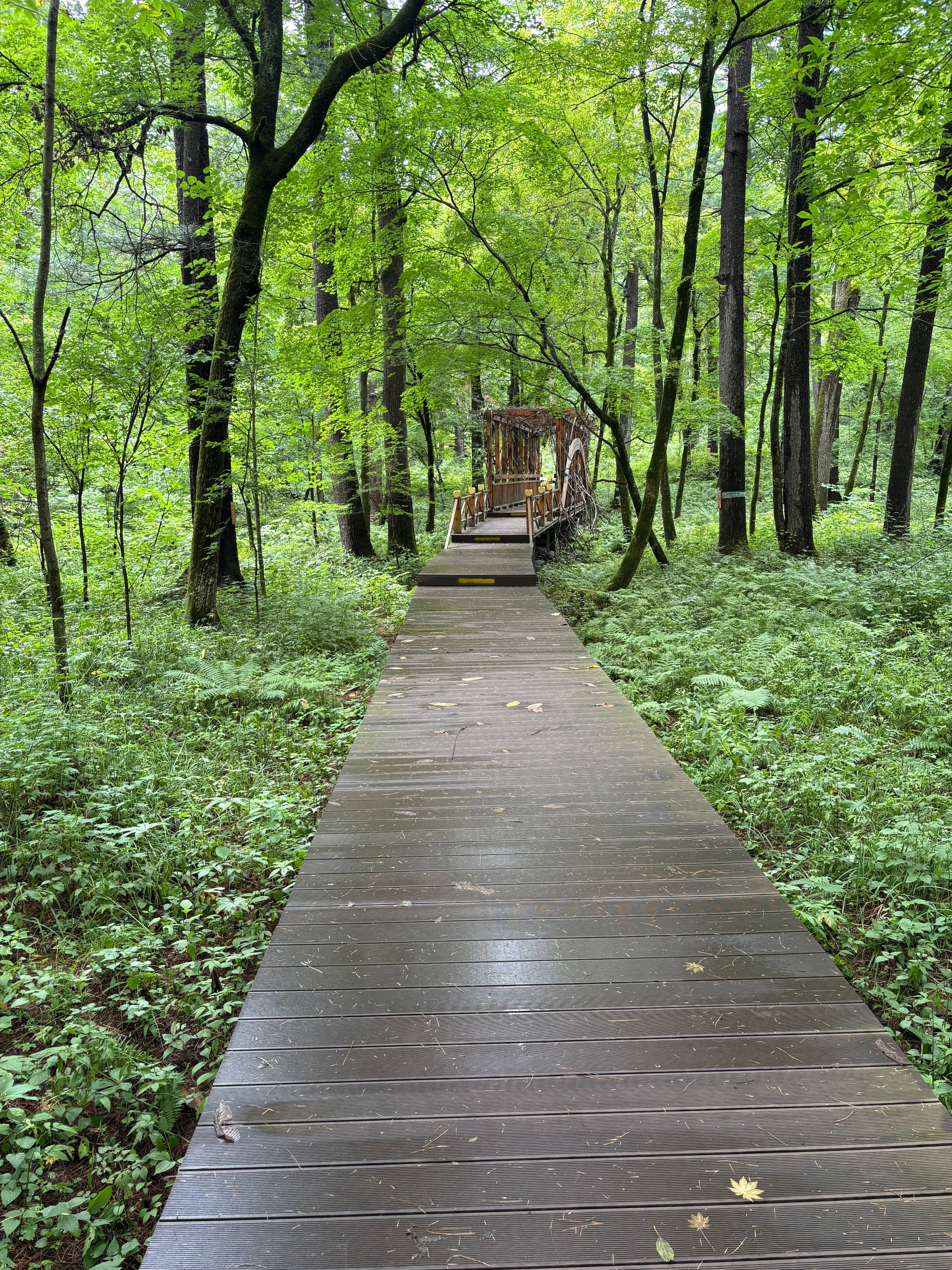
Boardwalks combine long runs with permanent exposure, and D053 suits both features. The 2900 mm length reduces the number of end joints across a long path, and the hidden clip system keeps the walking line free of fastener heads. Ventilation beneath the deck and drainage away from the structure matter more on a boardwalk than on a sheltered terrace, because the underside rarely dries quickly.
What the 15-year park decking case shows — and what it does not
The manufacturer's project record includes a 500-ton WPC decking installation for park decking in China, delivered to a project contractor. Over a 15-year service period, the recorded observations are no fading and no bending. For a buyer at evaluation stage, that is useful evidence of long-term outdoor behaviour in one humid park environment, and it is the kind of record a specification committee will ask to see.
Its limits should be stated just as plainly. It is a single project in one climate, installed by one contractor to one detail, and it does not establish the same outcome on a coastal boardwalk, a rooftop terrace or a site with different joist spacing and drainage. The observations are visual rather than instrumented: "no fading" is not a measured colour difference, and "no bending" is not a deflection reading. The record also does not identify which decking model was used. It supports a durability expectation in a comparable setting; it is not a warranty and not a performance guarantee.
WPC against traditional timber, and where the comparison stops
Timber remains the benchmark most buyers compare against. Well-detailed timber cladding and decking can perform for decades, but the ownership model includes periodic refinishing, and moisture movement and biological degradation remain live considerations depending on species, treatment and detailing. WPC profiles were developed to reduce that refinishing cycle, and both products in this shortlist are positioned on that basis.
The boundary is that WPC is not maintenance-free in an absolute sense. The manufacturer's own installation guidance closes with routine care: cleaning with a mild detergent and checking for loose fasteners. WPC is also not a structural material — it spans between joists or fixes to a substrate, and it does not replace the frame. Where a project's approval depends on certified responsible sourcing, the relevant document is a chain-of-custody certificate rather than a material description: the manufacturer holds FSC chain-of-custody certification 0218718, valid to 7 July 2030, covering tracking of wood-based material with FSC 100% and FSC Mix claims.
Reading the market numbers before committing
Category data is context, not evidence for a specific profile. Grand View Research estimates the global wood plastic composite market at USD 8.89 billion in 2025, with North America accounting for 51.3% of revenue that year. A second house, Future Market Insights, places the 2025 base at USD 7.6 billion and projects USD 20.3 billion by 2035 at a 10.3% CAGR. The two base-year figures differ, which usually signals different product definitions or base-year adjustments rather than an error in either, and published growth estimates for the same period vary across reports. Directional context of that kind should not be used to justify a single product choice.
Trade data is more concrete. China was the leading exporter of plastic builders' ware under HS 3925.90 in 2024 at USD 2.16 billion, ahead of Germany at USD 1.06 billion and Canada at USD 635 million, according to the Observatory of Economic Complexity, while the United States International Trade Commission lists WPC wall panels under HS 3925.90.00. For a buyer, that means a deep and competitive export base — and it means supplier differentiation has to come from model-level documentation rather than from category growth.
Cost structure explains part of the commercial variability. One industry guide estimates raw materials at 50% to 70% of WPC wall panel manufacturing cost. When resin and wood-flour prices move, quotations move with them, which is why a quote should state its material basis and validity period rather than a bare price per square metre.
A verification checklist for the evaluation stage
- Model-level test reports. Ask for the pages that show method, fixture or span, units and the property behind GH010's ≤3% and D053's ≤2% absorption and ≥3300 N flexural result.
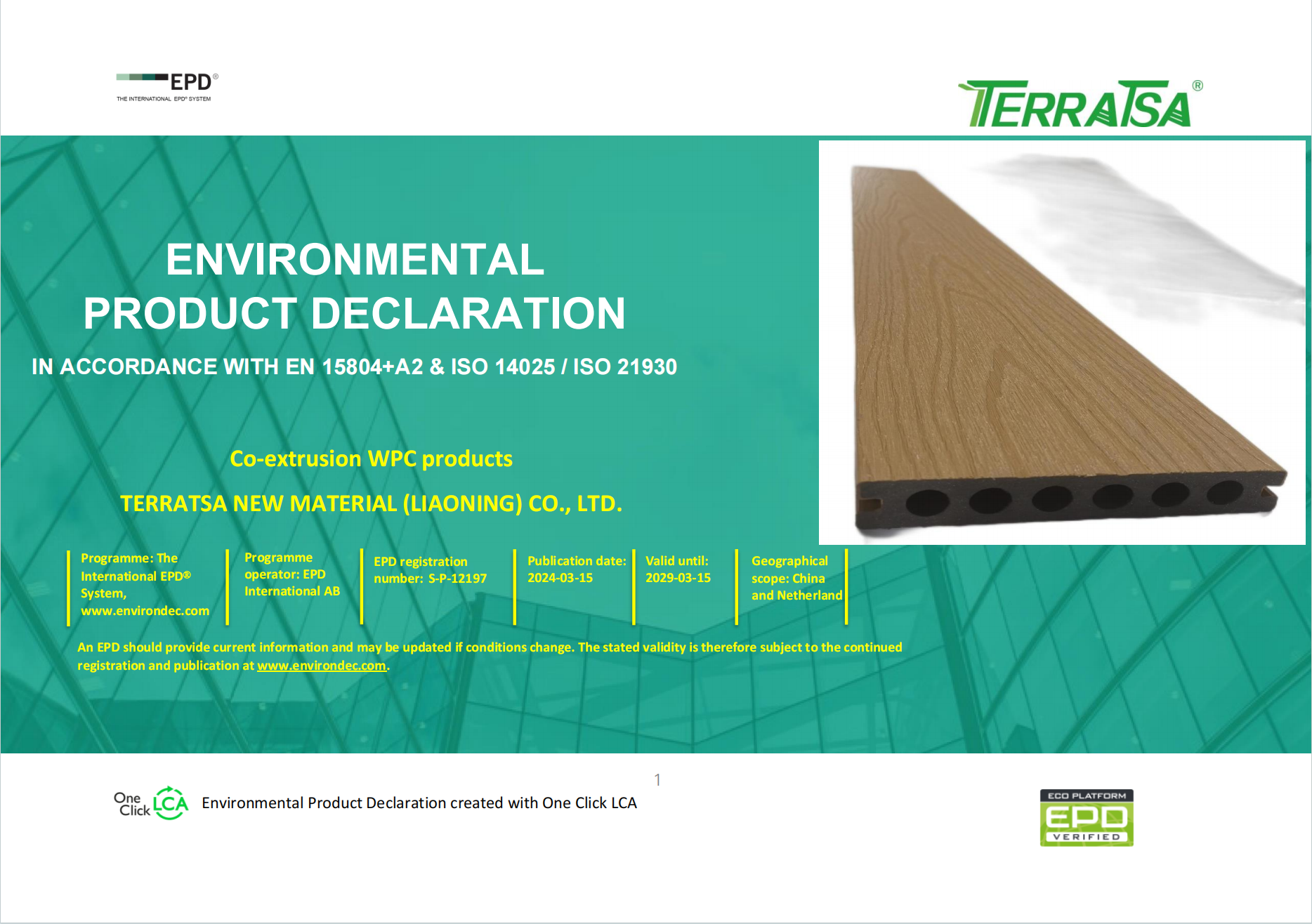
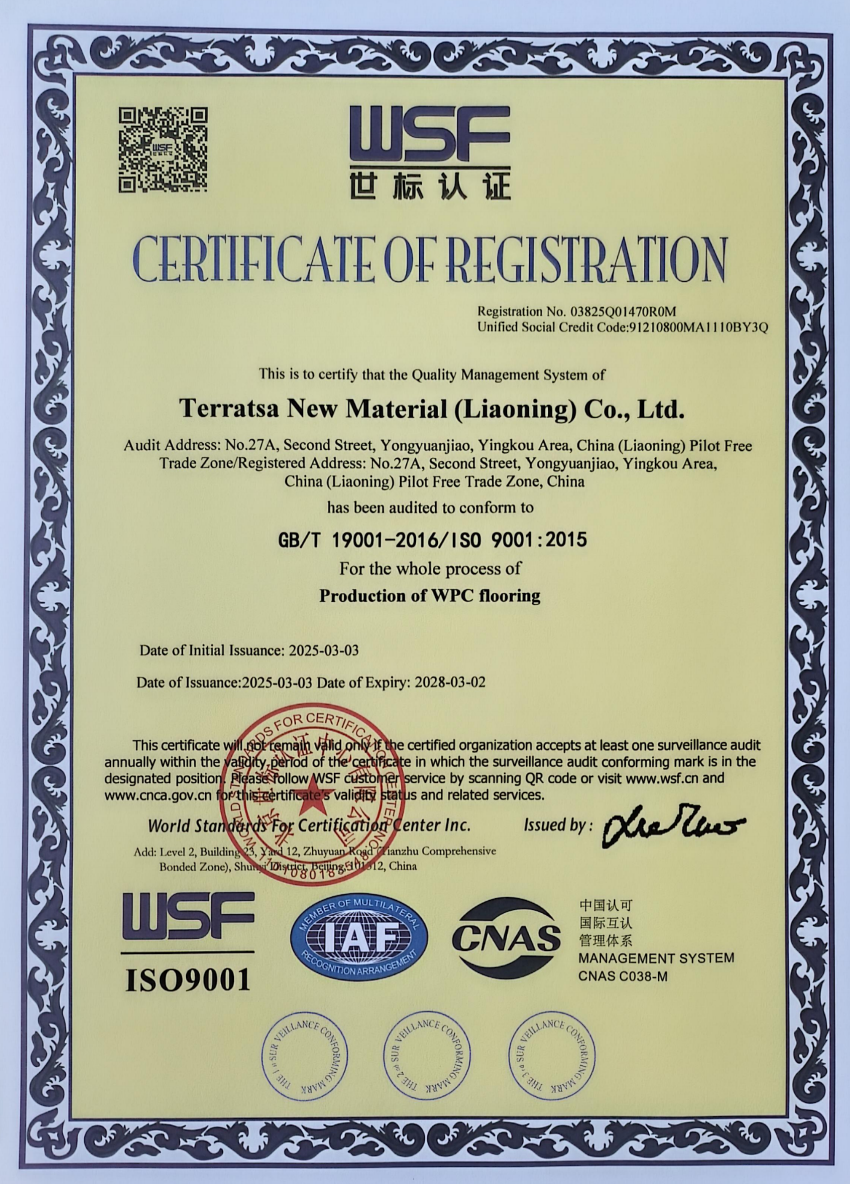
- Certification scope, not just certificate presence. The Environmental Product Declaration S-P-12197 was issued on 15 March 2024 and is valid to 15 March 2029, follows EN 15804+A2 and ISO 14025 / ISO 21930, and covers co-extrusion WPC products. The quality management certificate (ISO 9001, 03825Q01470R0M, valid to 2 March 2028) states its scope as production of WPC flooring, so where cladding forms part of the order, confirm how the same system applies to the cladding line. ISO 14001 (03825E01471R0M) and ISO 45001 (03825S01472R0M) are also valid to 2 March 2028.
- Batch control. The manufacturer states that quality control follows 100% test standards. Ask which characteristics are tested per batch and what the record contains, so the statement becomes a measurable control rather than a slogan.
- Fixing and finishing. Confirm the clip system, the specified gap and the end caps or edge trims for the exact profile, and check that these appear as separate items in the quotation.
- Commercial terms against the programme. The manufacturer's stated terms are a one-container minimum order, a 30–45 day lead time, OEM/ODM support with logo customisation and remote after-sales support. Match the lead time to the installation date and the minimum order to the sample and mock-up quantities.
- Sample and surface. Request the exact profile and finish, then compare colour and surface texture against the approved sample under the project's own lighting conditions.
Outlook: documentation, not category growth, will decide shortlists
The manufacturer describes its future direction as intelligent manufacturing supported by AI-enabled production, and points to a 74,000 m² site with more than 70 fully automatic production lines, participation in drafting nearly 10 national and industrial standards, and more than 30 national intellectual property patents. It is also a vice-chairman unit of the Wood-Plastic Composite Committee of China Plastics Processing Industry Association and a national-level intelligent manufacturing demonstration enterprise, exporting to more than 40 countries and regions with an overseas warehouse in the Netherlands. For a buyer, those statements become relevant only when they can be tied to batch consistency and paperwork; the verification step remains a plant or record review, not a brochure claim.
A conditional outlook follows from the data rather than from market optimism. As facade and deck specifications tighten around moisture, UV and load evidence, the profiles that travel best will be the ones whose reports survive a specification committee's reading: the property named, the method stated, the certificate scope matched to the product actually ordered. Growth forecasts published by research houses describe a category. They do not shorten that list of checks, and they do not tell a buyer whether a 22 mm facade panel or a 23 mm decking board belongs on a given elevation.
FAQ: GH010 and D053 in practice
Which of the two options belongs on a facade?
GH010, because it is a WPC exterior wall cladding profile at 2900 × 136 × 22 mm with a published boiling test result of ≤3%, fixed as a vertical surface. D053 is a decking board at 2900 × 146 × 23 mm, intended for horizontal surfaces that carry loads.
What does the GH010 boiling test result of ≤3% actually tell a buyer?
It tells the buyer that a specimen stayed within a 3% limit after boiling. The figure is fully meaningful only with the property it measures — water absorption, mass change or dimensional change — together with the test duration and specimen preparation. Request the report page that names the property and the method before writing the number into a specification.
Does D053's flexural value of ≥3300 N set the joist spacing?
No. ≥3300 N is a bending-related material figure. Joist spacing depends on span, support conditions, test method and the project's design loads, and should come from the manufacturer's installation guidance together with the project engineer. The flexural figure is best used to compare candidate profiles on a like-for-like basis.
Are these profiles suitable for pool surrounds and boardwalks?
D053 is the relevant option for both, given its 5-hour boiling water absorption of ≤2% and its use in park decking applications. Anti-slip performance is a separate property, and the data in this shortlist does not include a measured slip-resistance value, so that figure should be requested specifically for pool and waterfront work.
Which certifications should a buyer check for these models?
Check the documents whose scope covers the product being ordered: the EPD (S-P-12197, valid to 15 March 2029) for co-extrusion WPC products, FSC chain-of-custody certificate 0218718 (valid to 7 July 2030) for wood-based material tracking, and the ISO 9001, ISO 14001 and ISO 45001 certificates valid to 2 March 2028. The manufacturer also lists CE, ASTM and SGS among its product certifications, which should be supplied as model-specific documents rather than as a general company statement.
The shortlist rule
The comparison does not produce a single winner; it produces a rule. Vertical surfaces go to GH010, horizontal surfaces exposed to water and foot traffic go to D053, and every figure attached to either model should be traceable to a current report with a named method and a scope that matches the product on the pallet. Buyers who apply that rule at evaluation stage spend less time negotiating over adjectives and more time checking the two or three documents that actually decide a facade or a deck. A fuller product range is set out in the Terratsa product brochure.
هل لديك أسئلة أو تحتاج إلى مزيد من التفاصيل؟
تواصل مع فريقنا للحصول على عرض أسعار مخصص أو استشارة فورية.
طلب عرض أسعار
املأ النموذج أدناه وسيتواصل معك فريقنا بعرض مقترح مخصص.
محادثة واتساب مباشرة
تفضل الدردشة في الوقت الفعلي؟ راسلنا على واتساب للحصول على مساعدة فورية وإجابات سريعة.
- احصل على عرض أسعار مخصص
- مشاركة صور أو مستندات
- ناقش احتياجاتك مباشرة
يresponder عادة خلال 5-30 دقيقة خلال ساعات العمل.