
WPC Cladding vs WPC Decking: A Buyer's Decision Framework for Exterior Projects
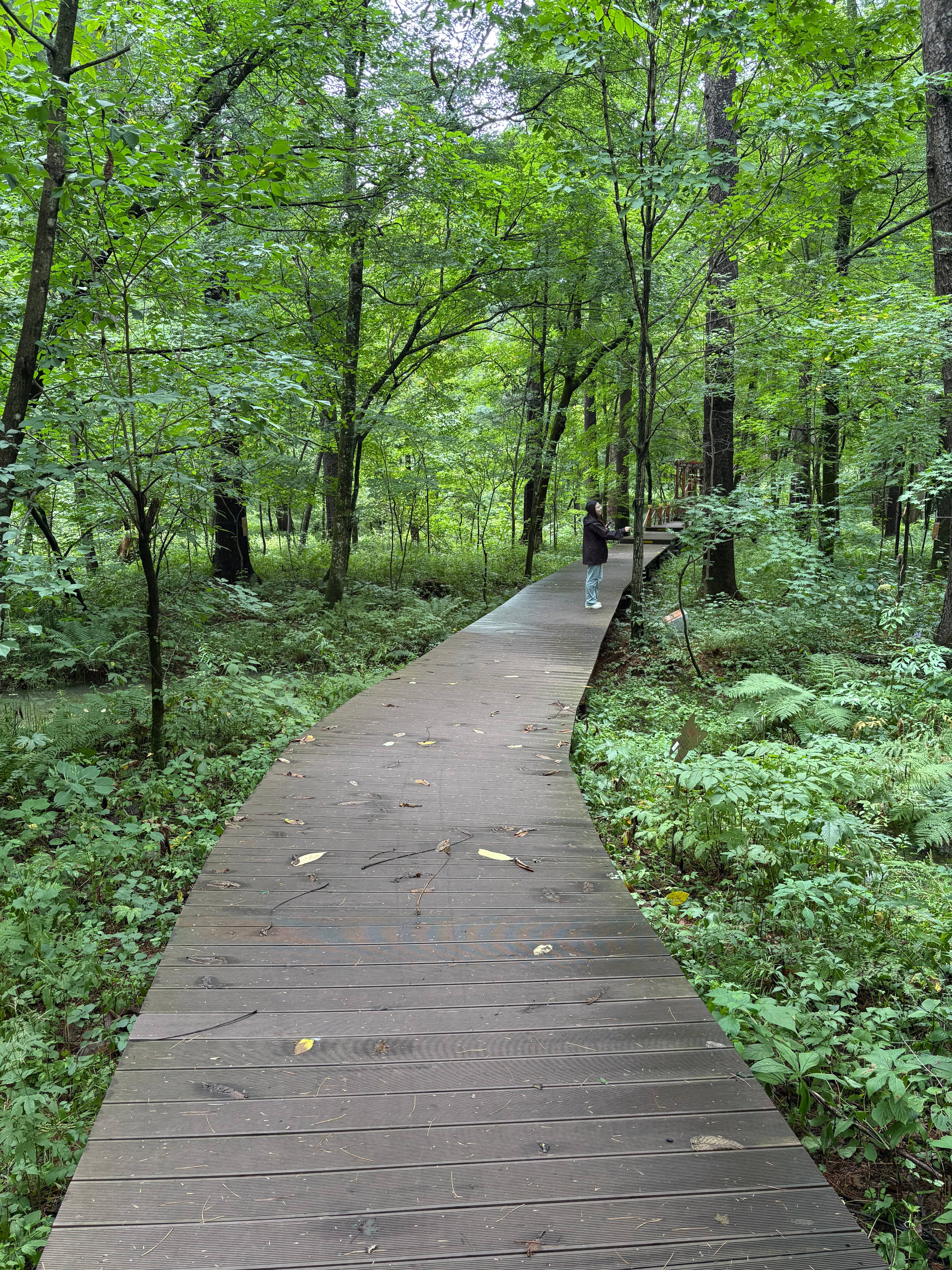
Exterior composite systems are selected for different jobs: one carries people and abrasion, the other carries weather and wind. Image: outdoor WPC decking installation.
Wood-plastic composite (WPC) cladding and WPC decking are routinely quoted by the same suppliers, priced on the same per-metre or per-tonne basis, and shortlisted by the same procurement teams. They are nevertheless different products with different structural roles. One forms the weather-facing skin of a wall. The other carries foot traffic, abrasion and point loads. Treating them as interchangeable is one of the most common and most expensive specification errors in exterior composite buying, because the failure mode is not aesthetic — it is mechanical.
This framework uses two concrete profiles from the portfolio of Terratsa New Material (Liaoning) Co., Ltd. — GH010 exterior wall cladding and D053 outdoor hollow decking — to show how application fit, load expectation, installation system, moisture and thermal movement, and recyclability should be evaluated before a buyer commits to a composite system. Terratsa is a wood-plastic composite manufacturer founded in 2007 and operating from the Yingkou Area of China (Liaoning) Pilot Free Trade Zone since 2024.
Why cladding and decking are so often confused
Both families are extruded from a wood-flour and polymer compound, both are supplied in long stock lengths, both are marketed as low-maintenance replacements for timber, and both are described with the same vocabulary: waterproof, UV resistant, termite resistant, no painting. That shared language hides a structural distinction that matters at the design stage.
Several practical factors drive the confusion:
- Identical supply format. GH010 and D053 are both 2900 mm long, are both sold by linear measure, and can travel in the same container, which invites combined ordering and combined specification.
- Overlapping material story. Industry data indicates that exterior WPC is generally built from roughly 60% wood fibre, 30% plastic polymer and 10% additives. Buyers who compare on material composition alone will conclude the products are the same.
- Different test types reported with similar-looking numbers. A cladding profile may be characterised by a deflection figure under flexural test, while a decking board is characterised by a failure load. These values look comparable in a quotation sheet and are not.
- Single-sourced tender lists. Facade packages and landscape packages are often tendered separately but bought together, and the cheaper line item tends to be substituted into the wrong package.
The consequence is predictable: a cladding board used as a walking surface lacks the anti-slip geometry and the declared bending performance for pedestrian loads, while a hollow decking board used as a rainscreen introduces unnecessary thickness, visible open edges and a fixing pattern designed for joists rather than for a ventilated wall build-up.
Dimension 1 — Application fit: what each profile is engineered for
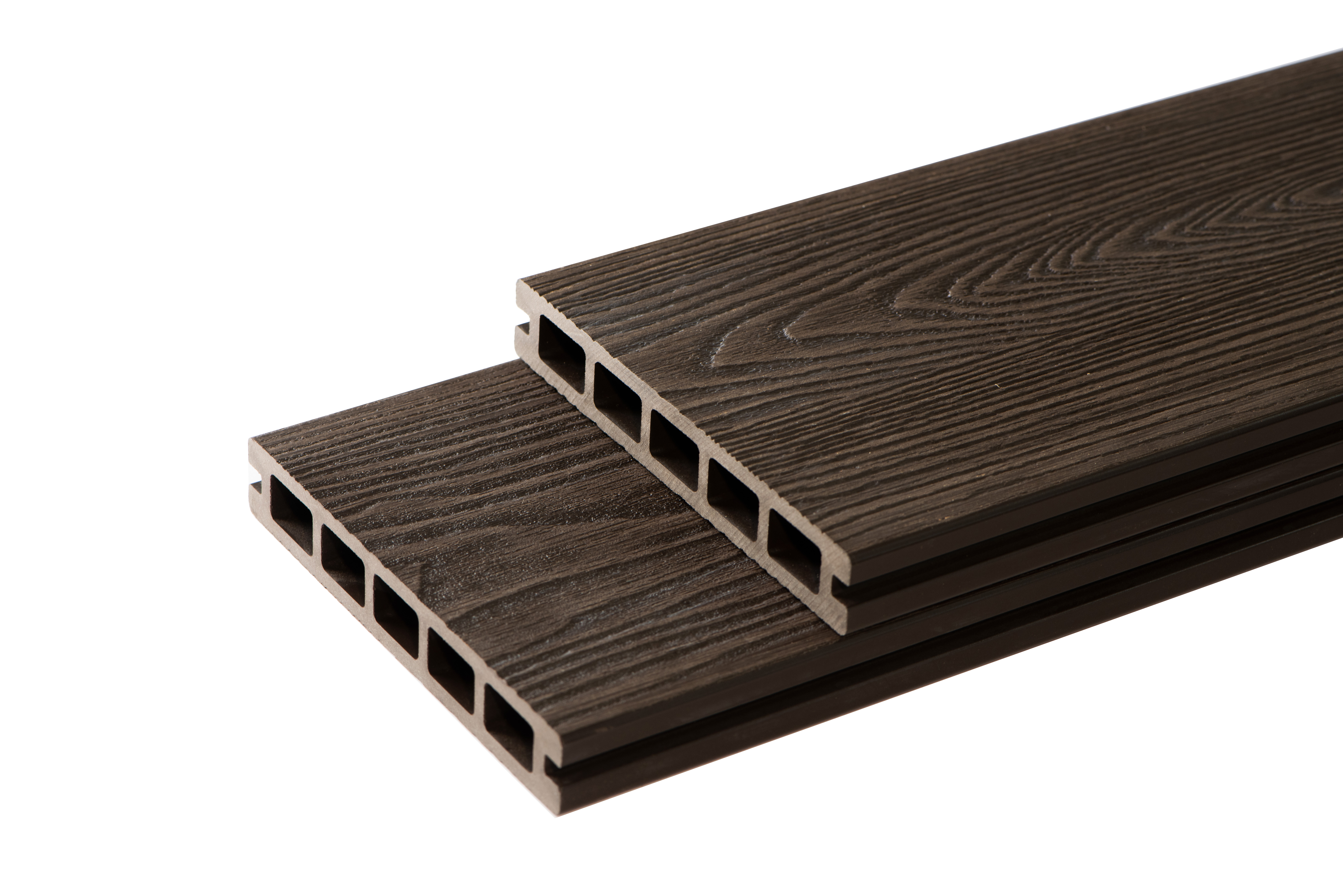
D053: a first-generation hollow outdoor decking profile, 23 mm × 146 mm × 2900 mm, density 1.3 g/cm³.
GH010 is an exterior wall cladding profile measuring 22 mm × 136 mm × 2900 mm, produced from wood powder and plastic. Its declared performance envelope is built around the wall: waterproof and moisture-proof behaviour, UV resistance and anti-fade properties, a linear thermal expansion coefficient of ≤37·10⁻⁶ K⁻¹, swelling and water absorption of ≤2% after 28 days of immersion, and flexural properties of ≤0.79 mm. The profile is free from formaldehyde and benzene, is fully recyclable, and is resistant to termites, wood-boring insects, mould and mildew. It can be installed horizontally or vertically and is compatible with matching trims, corners, hidden fastener systems and a range of sub-frame systems. Typical applications are building facades on residential, commercial, hotel and villa projects, garden feature walls, balcony privacy screens, fence cladding and outdoor kitchen surrounds.
D053 is a first-generation hollow outdoor decking profile measuring 23 mm × 146 mm × 2900 mm, with a declared density of 1.3 g/cm³ and a bending failure load of 3900 N. Its declared water absorption after 5 hours of boiling is ≤2%, and its linear thermal expansion coefficient is also ≤37·10⁻⁶ K⁻¹. The board is manufactured from a blend of recycled HDPE plastics and wood fibres, is described as 100% recyclable, and is resistant to termites and wood-boring insects. Its surface is grooved or textured for slip resistance and it is compatible with hidden clip systems and standard woodworking tools. Typical applications are parks, plazas, scenic spots, boardwalks, community pathways and other high-volume outdoor paving where cost efficiency and basic durability are the primary requirements.
The decision rule is therefore simple and should be written into the specification: horizontal, traffic-bearing surfaces take a decking profile; vertical, weather-exposed surfaces take a cladding profile. Where a project needs both — a facade with an adjoining terrace, for example — the two should be specified as separate line items with separate performance criteria, even when they are bought from one supplier.
Dimension 2 — Load and safety expectations
Load language is where buyer comparisons most often go wrong. A decking board is evaluated by the load at which it fails in bending: D053 declares a bending failure of 3900 N. A cladding panel is evaluated by how far it deflects under a defined flexural test: GH010 declares flexural properties of ≤0.79 mm. One is a failure load in newtons, the other a deformation in millimetres. Ranking them against each other produces a meaningless comparison.
For procurement, the practical checks are different for each system:
- Decking: confirm the declared bending failure load together with the joist spacing and fixing pattern under which that value is valid, and confirm that the surface geometry provides slip resistance in wet conditions. D053 declares an anti-slip, grooved or textured surface.
- Cladding: confirm the deflection value together with the sub-frame spacing, the wind load assumption for the building height and exposure, and the fixing schedule. Cladding carries wind and impact, never pedestrian load.
Safety also depends on what the board is asked to do at edges and openings. Decking needs edge trims and end caps to close the hollow core; cladding needs corner and termination trims so that cut ends are not left as exposed water traps. Both are installation details, not product properties, and both should be priced at tender stage rather than discovered on site.
Dimension 3 — Installation systems and fixings
Both profiles are designed to be installed with concealed fixings, but the substrates differ. D053 is installed over a joist structure with hidden clips and screws; the application record for comparable decking projects lists joist clips and screws as the matched installation equipment. GH010 is installed over a sub-frame with hidden fasteners, matching trims and corners, and can run either horizontally or vertically.
Three procurement questions follow from this:
- Is the fastener a catalogue item or a project item? Hidden clip systems only perform as intended if the correct clip, screw and spacing are used. Buyers should confirm that clips, trims and corners are available as ongoing supply, not only as a first-order accessory.
- Is the substrate defined? Joist spacing for decking and sub-frame spacing for cladding are design inputs that determine whether the declared performance is achieved. A board tested at one span does not automatically perform at another.
- Can standard tools be used? Both profiles are described as cuttable and fastenable with standard woodworking tools. For contractors working in remote locations, this reduces dependency on specialist equipment.
A cladding installation should also be detailed as a drained and ventilated assembly: the profile is waterproof, but the wall behind it still needs a path for moisture to escape. This is a design responsibility that sits with the specifier, not with the panel supplier.
Dimension 4 — Moisture and thermal movement
Moisture and thermal movement are the two physical behaviours that most often surprise first-time WPC buyers, and they behave differently from timber.
On moisture, GH010 declares swelling and water absorption of ≤2% after 28 days of immersion, and D053 declares water absorption of ≤2% after 5 hours of boiling. The figures share a number but not a test method: immersion over 28 days and boiling for 5 hours are different exposures, and the results should be read as evidence of low water uptake under each specified condition rather than as a ranking.
On thermal movement, both GH010 and D053 declare a linear thermal expansion coefficient of ≤37·10⁻⁶ K⁻¹. This is a design instruction, not a defect. Long runs should be broken with movement joints, and end gaps should be sized for the temperature range of the installation site. In cold-climate projects the range matters in both directions: a decking project recorded in Poland, for example, operates under low winter temperatures and high humidity, with weather resistance, anti-UV performance, low water absorption, anti-scratch and anti-slip behaviour listed as the special requirements. A park decking project recorded in China operates under high humidity, with weather resistance, anti-slip, anti-UV and anti-scratch requirements.
Dimension 5 — Recyclability and compliance evidence
Both profiles sit inside the same environmental argument but rely on different evidence. GH010 is described as 100% free from formaldehyde and benzene and fully recyclable, made from recycled plastics and reclaimed wood fibres. D053 is described as manufactured from recycled HDPE plastics and wood fibres and as 100% recyclable. Neither claim, on its own, satisfies a green-building submission. What satisfies it is a certificate that names the product and states its validity.
Terratsa holds an Environmental Product Declaration (EPD) with registration number S-P-12197, issued by EPD International AB, valid from 2024-03-15 to 2029-03-15, covering co-extrusion WPC products and conforming to EN15804+A2 and ISO 14025 / ISO 21930. The company also holds ISO 9001 Quality Management System certification (certificate 03825Q01470R0M, GB/T 19001-2016 / ISO 9001:2015), ISO 14001 Environmental Management System certification (certificate 03825E01471R0M, GB/T 24001-2016 / ISO 14001:2015) and ISO 45001 Occupational Health and Safety Management System certification (certificate 03825S01472R0M, GB/T 45001-2020 / ISO 45001:2018), all issued by World Standards For Certification Center Inc. FSC Chain of Custody certification 0218718, issued by SAI Global Certification Services Pty. Ltd. under FSC-STD-40-004 V3-1 and FSC-STD-50-001 V2-1, covers GH010 and also includes D053 and GH001 within its scope.
The purchasing lesson is procedural: ask for the certificate number, the issuing body, the validity dates and the exact product models covered. A certificate that covers a co-extruded decking range does not automatically cover every profile in the catalogue, and a certificate that expired is not evidence.
Side-by-side reference: GH010 cladding and D053 decking
| Decision metric | GH010 exterior wall cladding | D053 outdoor decking |
|---|---|---|
| Product role | Exterior wall cladding | Outdoor hollow decking, first generation |
| Dimensions | 22 mm × 136 mm × 2900 mm | 23 mm × 146 mm × 2900 mm |
| Material | Wood powder and plastic | Wood powder and plastic (recycled HDPE blend) |
| Declared mechanical value | Flexural properties ≤0.79 mm | Bending failure 3900 N; density 1.3 g/cm³ |
| Water absorption | ≤2% after 28 days immersion | ≤2% after 5 hours boiling |
| Thermal expansion | ≤37·10⁻⁶ K⁻¹ | ≤37·10⁻⁶ K⁻¹ |
| Surface | Wood-grain embossed; UV resistant and anti-fade | Grooved or textured anti-slip surface |
| Fixing | Hidden fasteners, trims and corners; horizontal or vertical | Hidden clip system over joists |
| Biological resistance | Termites, wood-boring insects, mould and mildew | Termites and wood-boring insects |
| Formaldehyde and benzene | Declared free | Not stated for this profile |
| Typical use | Facades, feature walls, balcony screens, fence cladding, outdoor kitchen surrounds | Parks, plazas, boardwalks, community pathways, terraces |
Where each system fits: scenario mapping
Public realm and boardwalks. D053 is positioned for high-volume paving where cost efficiency and basic durability are the priority. The reference case for this profile family is a project contractor application in China using 500 tonnes of decking for park decking, with a 15-year service duration recorded and the reported result described as durable, with no fading and no bending observed.
Cold and humid climates. The Poland decking record shows the requirement set that matters in these markets: low water absorption, anti-UV stability, anti-slip and low maintenance under low winter temperatures and high humidity. Buyers in comparable climates should test a specification against those five requirements before comparing price.
Facade and semi-enclosed exterior walls. GH010 fits residential, commercial, hotel and villa facades, garden feature walls, balcony privacy screens and fence cladding. Its value in these applications is that the wall face is waterproof, UV stable and dimensionally predictable, and that terminations can be finished with matching trims rather than improvised flashing.
Mixed projects. Where a building envelope and its landscape package are bought together, the correct approach is to specify two profiles against two performance schedules and then negotiate a combined order. Combining the order is a logistics decision; combining the specification is a technical error.
Market context: why the distinction is becoming more commercially relevant
The global wood-plastic composite market was estimated at USD 8.89 billion in 2025 by Grand View Research. The same source reports that North America held the largest regional revenue share in 2025 at 51.3%. A separate projection from Future Market Insights estimates growth at a CAGR of 10.3% between 2025 and 2035, reaching USD 20.3 billion; the base-year value in that report differs from the Grand View Research figure, so the two should be read as directionally consistent rather than directly comparable.
Trade data adds a supply-side view. WPC wall panels fall under HS code 3925.90.00, and in 2024 China was the leading exporter of plastic builders ware in that heading, with exports valued at USD 2.16 billion according to the Observatory of Economic Complexity.
Two cost facts explain why buyers increasingly negotiate decking and cladding together. Raw material costs typically account for 50% to 70% of the total manufacturing cost of WPC wall panels, which means resin and wood-flour price movements pass through to quotations fairly quickly. And because both product families share a raw material base and a container, consolidating two compliant specifications into one shipment is one of the few levers that reduces landed cost without touching product quality.
Comparison with traditional solutions — and where WPC stops
Against natural timber, both profiles remove the maintenance cycle: no painting, staining, sealing or varnishing is required, and both are resistant to termites and wood-boring insects. Against aluminium composite panels, WPC offers a wood-grain aesthetic and a non-metallic surface, but it is not a metal skin and should not be specified where a metallic finish or a thin-panel facade system is the design intent. Against stone, WPC is lighter and faster to install, but it does not offer stone compressive strength.
The limits deserve equal weight:
- Neither profile is a structural member. GH010 must not be walked on, used as a stair tread or treated as a balustrade infill without separate structural design. D053 is a decking surface and must be supported by a joist structure at the spacing assumed in its test data.
- Thermal movement must be designed in. A coefficient of ≤37·10⁻⁶ K⁻¹ is low for a polymer composite, but over a long run it still produces measurable movement. Installations that butt boards tight in cool weather will show gaps or buckling in summer.
- First-generation hollow decking has a performance ceiling. D053 is positioned as a cost-effective first-generation profile for large-area and public projects. Where a project calls for a capped, co-extruded surface, the same portfolio includes GH001 co-extruded decking, with declared flexural properties ≥3300 N, water absorption after boiling of ≤7% and moisture resistance under cyclic test conditions of ≤10%. Buyers should match the decking generation to the project class rather than to the lowest quote.
- Colour stability depends on the pigmentation and UV package. Anti-fade performance is a formulation property; it should be verified per model, not assumed across a range.
What buyers should verify about the supplier, not only the board
Terratsa New Material (Liaoning) Co., Ltd. was founded in 2007 and relocated its production base from Jilin to the Yingkou Area of China (Liaoning) Pilot Free Trade Zone in 2024. The company operates a site of 74,000 square metres with more than 70 fully automatic production lines, employs 150 people including a 25-engineer research and development team, and holds more than 30 national independent intellectual property patents. It is a vice-chairman unit of the Wood-Plastic Composite Committee of China Plastics Processing Industry Association, a national-level intelligent manufacturing demonstration enterprise, and has participated in the drafting of nearly 10 national and industrial standards. Products are exported to more than 40 countries and regions, with an independent overseas warehouse in the Netherlands and an export ratio of 85%.
For a two-profile order, three commercial parameters matter as much as the technical data. The company supports OEM/ODM production with logo customisation, a minimum order quantity of one container, a lead time of 30 to 45 days, 100% testing, and remote after-sales support. Buyers evaluating a combined cladding and decking package should confirm how those terms apply when the two profiles are ordered together, and should request the model-specific certificate set described above rather than a general compliance statement.
Future outlook
Three developments are likely to shape how cladding and decking are specified over the next few years. First, environmental declarations are moving from a marketing advantage to a tender requirement; an EPD covering co-extrusion WPC products, valid to 2029, is the kind of document that will increasingly be requested at pre-qualification rather than after award. Second, the split between budget-oriented first-generation hollow profiles and capped co-extruded profiles will become more explicit in specification writing, because the two carry different declared performance envelopes and different price points. Third, as raw material costs continue to represent the majority of manufacturing cost, buyers will rely more on design discipline — correct profile selection, correct spacing, correctly sized movement joints — to protect project economics, because those measures cost nothing and prevent the failures that consume the maintenance budget.
Frequently asked questions
Can WPC cladding be used as a decking surface?
No. GH010 is an exterior wall cladding profile, and its declared mechanical value is a flexural deformation of ≤0.79 mm under flexural test, not a failure load for pedestrian traffic. D053, the decking profile, declares a bending failure of 3900 N, a density of 1.3 g/cm³ and an anti-slip surface. Using a cladding board as a walking surface removes both the declared load basis and the slip-resistant geometry.
What bending performance should a WPC decking board declare?
D053 declares a bending failure load of 3900 N. The figure is only meaningful together with the test span, the joist spacing and the fixing pattern used in the test, so buyers should request the test method alongside the number and confirm that their intended joist spacing is within the tested range.
Do WPC cladding and decking need expansion gaps?
Yes. Both GH010 and D053 declare a linear thermal expansion coefficient of ≤37·10⁻⁶ K⁻¹. Long runs should be divided by movement joints, and end gaps should be sized for the site temperature range at installation and in service. Installation in cool weather with boards butted tight is the most common cause of later buckling.
Which certifications should a buyer check before ordering?
For this supplier, the verifiable set is: EPD S-P-12197 issued by EPD International AB, conforming to EN15804+A2 and ISO 14025 / ISO 21930 and valid from 2024-03-15 to 2029-03-15; ISO 9001 certificate 03825Q01470R0M; ISO 14001 certificate 03825E01471R0M; ISO 45001 certificate 03825S01472R0M; and FSC Chain of Custody certificate 0218718 issued by SAI Global Certification Services Pty. Ltd. under FSC-STD-40-004 V3-1 and FSC-STD-50-001 V2-1. Buyers should confirm which product models each certificate covers and check validity dates.
Is first-generation hollow decking suitable for commercial projects?
D053 is positioned as a cost-effective first-generation hollow decking profile for large-area installations such as parks, plazas, boardwalks and community pathways, where cost efficiency and basic durability are the primary requirements. Where a project requires a capped co-extruded surface, the same portfolio offers GH001 co-extruded decking, with declared flexural properties ≥3300 N, water absorption after boiling of ≤7% and cyclic moisture resistance of ≤10%. The appropriate choice depends on the project class and the required surface performance, not on price alone.
How should water absorption figures be compared between the two profiles?
Carefully. GH010 declares swelling and water absorption of ≤2% after 28 days of immersion; D053 declares water absorption of ≤2% after 5 hours of boiling. The numbers coincide but the test conditions do not, so each should be read as evidence of low water uptake under its own specified exposure rather than as a ranking of the two products.
What information should accompany a cladding sub-frame specification?
GH010 is compatible with horizontal and vertical installation and with a range of sub-frame systems, and is finished with matching trims, corners and hidden fasteners. A complete specification therefore needs the sub-frame type and spacing, the wind load assumption, the fixing schedule and the movement joint layout, in addition to the panel dimensions of 22 mm × 136 mm × 2900 mm.
Reference document
The manufacturer brochure covering the decking and cladding portfolio can be downloaded here: Terratsa product brochure (PDF).
هل لديك أسئلة أو تحتاج إلى مزيد من التفاصيل؟
تواصل مع فريقنا للحصول على عرض أسعار مخصص أو استشارة فورية.
طلب عرض أسعار
املأ النموذج أدناه وسيتواصل معك فريقنا بعرض مقترح مخصص.
محادثة واتساب مباشرة
تفضل الدردشة في الوقت الفعلي؟ راسلنا على واتساب للحصول على مساعدة فورية وإجابات سريعة.
- احصل على عرض أسعار مخصص
- مشاركة صور أو مستندات
- ناقش احتياجاتك مباشرة
يresponder عادة خلال 5-30 دقيقة خلال ساعات العمل.