
WPC Decking Procurement FAQ: What Does EPD Coverage Really Mean for a Product Line?
EPD coverage is a scope question before it is a sustainability question. An Environmental Product Declaration can be current, third-party registered and fully verifiable, and still not apply to the board a buyer has written into a specification — because a declaration is registered against a defined product scope, not against a supplier's entire catalogue.
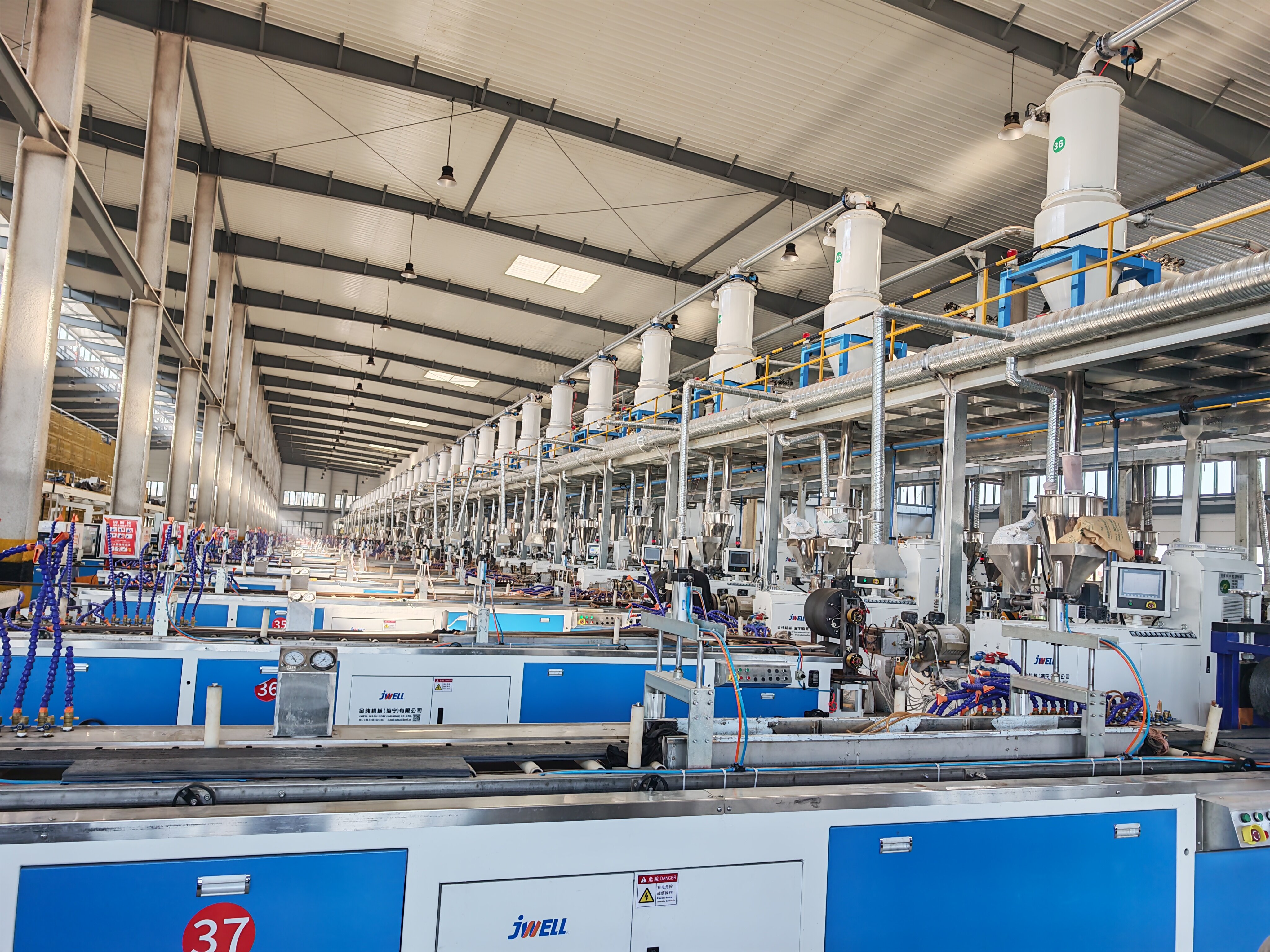
For procurement teams working between evaluation and execution, that single distinction decides whether a tender submission survives review. This reference answers the coverage questions that most often surface late in the sourcing cycle: which models sit inside a registration, whether coverage travels to a different profile, how long the document stands, and which markets the registration actually speaks to. The worked example throughout is the Environmental Product Declaration held by Terratsa New Material (Liaoning) Co., Ltd., a WPC manufacturer founded in 2007 and now producing outdoor WPC decking, fencing and cladding from a 74,000 m² base in the Yingkou Area of China (Liaoning) Pilot Free Trade Zone.
Why coverage — not the certificate itself — decides procurement outcomes
The most common EPD failure in WPC decking procurement is not a forged document. It is a correct document applied to the wrong product. A buyer receives a valid PDF, files it in the tender pack, and later discovers that the specified board — a different profile, a different series, a private-label variant — was never part of the declared scope.
The reason is structural. Environmental declarations are produced under product category rules, which fix the boundary of what was assessed: which factory, which product family, which manufacturing route, which reference unit. That boundary is the entire point of the document. It is what allows a specifier, a green building assessor or a contractor's compliance reviewer to trace a claim back to a verified assessment rather than a marketing statement.
So the practical question for a WPC decking buyer is narrow and answerable: does the exact model I intend to supply appear inside the registration? Everything else — the programme operator, the standards cited, the issue and expiry dates — is checkable once that first question is settled.
What the declaration actually is
An Environmental Product Declaration is a Type III environmental declaration: a verified, third-party-registered summary of the environmental profile of a defined product scope over its life cycle. It answers environmental questions — resource use, impact indicators, waste and output flows. It does not answer performance questions.
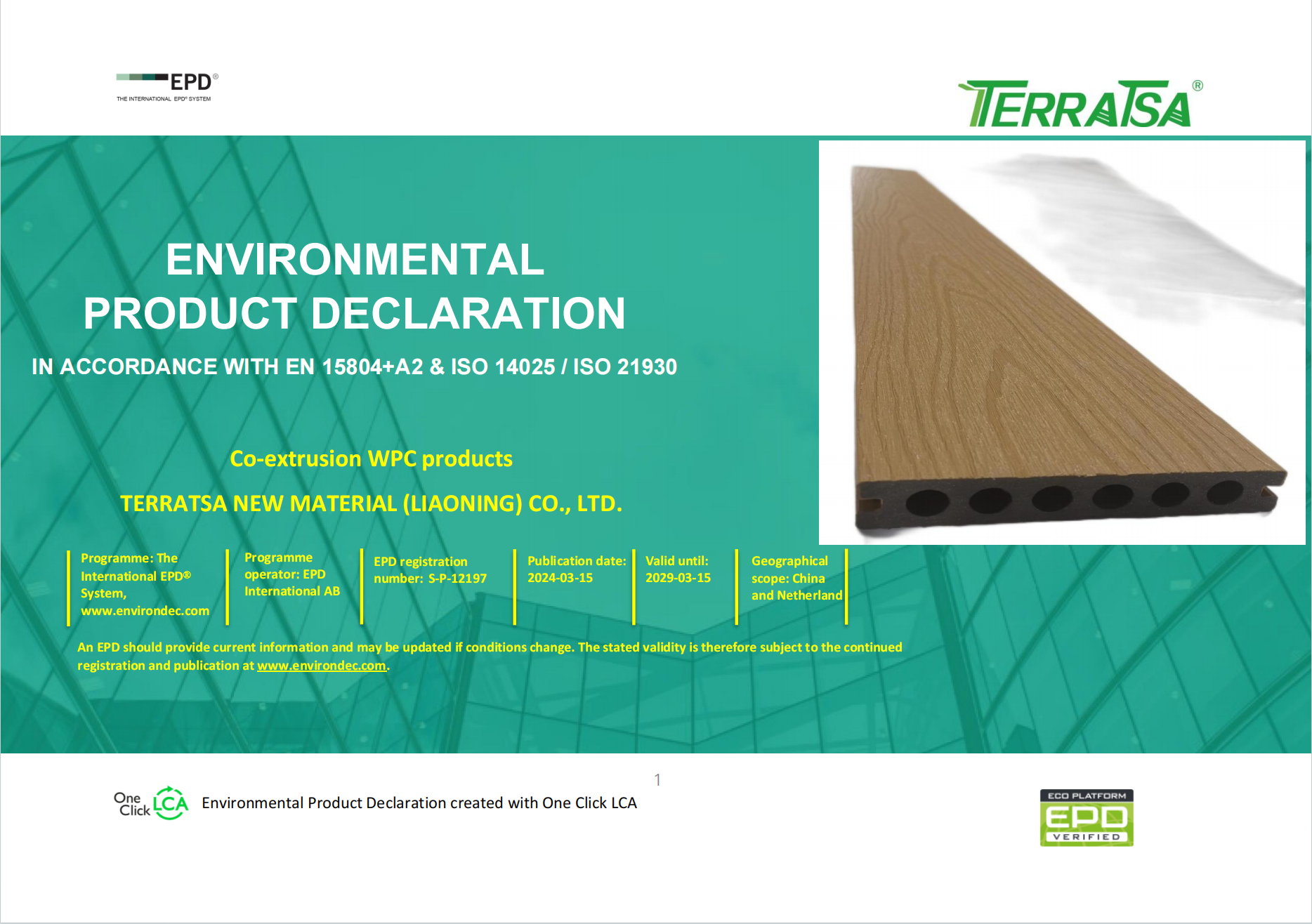
The declaration held by Terratsa New Material (Liaoning) Co., Ltd. is registered with EPD International AB and carries registration number EPD-IES-0012197:001 (also recorded as S-P-12197). It conforms to EN 15804+A2 and ISO 14025 / ISO 21930. Its declared scope is co-extrusion WPC products. Its recorded markets are China, Netherlands and Global. Its validity window runs from 2024-03-15 to 2029-03-15.
| Document control point | Recorded value |
|---|---|
| Certification type | EPD (Environmental Product Declaration) |
| Registration number | EPD-IES-0012197:001 (S-P-12197) |
| Programme operator / authority | EPD International AB |
| Standards referenced | EN 15804+A2 & ISO 14025 / ISO 21930 |
| Declared scope | Co-extrusion WPC products |
| Markets listed | China, Netherlands, Global |
| Issue date | 2024-03-15 |
| Expiry date | 2029-03-15 |
The coverage map: four models inside the registration
The registration associated with this declaration lists four product models: GH024, GH010, D053 and GH001. Two are decking; two are cladding. That mix is itself informative — coverage was assigned by the declared product scope, not by how a distributor happens to merchandise the range.
| Model | Product type | Parameters recorded in the product data |
|---|---|---|
| GH001 | Co-extruded outdoor decking | Flexural properties ≥ 3300 N; moisture resistance under cyclic test conditions, mean ≤ 10%; water absorption (boiling test) ≤ 7% |
| D053 | Outdoor hollow WPC decking, first generation | Thickness 23 mm; width 146 mm; length 2900 mm; bending failure 3900 N; density 1.3 g/cm³; water absorption (5-hour boil) ≤ 2%; linear thermal expansion coefficient ≤ 37×10⁻⁶ K⁻¹ |
| GH010 | Exterior wall cladding | Thickness 22 mm; width 136 mm; length 2900 mm; flexural properties ≤ 0.79 mm; moisture resistance under cyclic test ≤ 60.7 mm; swelling and water absorption (28-day immersion) ≤ 2%; linear thermal expansion coefficient ≤ 37×10⁻⁶ K⁻¹ |
| GH024 | Outdoor WPC cladding | Flexural properties ≤ 0.9 mm; moisture resistance under cyclic test ≤ 0.9 mm; swelling and water absorption (28-day immersion) ≤ 4%; boiling test ≤ 3%; linear thermal expansion coefficient ≤ 37×10⁻⁶ K⁻¹ |
Two practical notes for specifiers. First, the parameters above are product performance data recorded in the same product records as the certification — they are not the content of the environmental declaration, and they should be cited from their own test documentation. Second, a mixed decking-and-cladding registration means a project that uses matching decking and cladding from this range can cite a single registration across both surfaces. That is a documentation simplification worth checking for on any supplier shortlist, because it is far more common for decking and cladding to sit under separate declarations.
The boundary that matters most: coverage is not transferable
A declaration registered against GH024, GH010, D053 and GH001 does not extend to any other board the manufacturer produces or could produce. Same factory, same material formulation, same extrusion route, same visual family — none of these extend coverage. If a model is not in the registration, it is outside the declared scope, and the EPD cannot honestly be cited for it in a tender file or a compliance submission.
This is where OEM and ODM programmes need care. Terratsa provides OEM and ODM production services, and its customization services include logo customization. Those are supply-chain capabilities. They sit in a different category from the environmental declaration, and a private-label run or a bespoke profile does not inherit the coverage of a registered model. Buyers running a branded programme should confirm in writing, model by model, whether the exact item being shipped for their SKU appears in the registration.
A three-check routine resolves the question before it reaches a tender review:
- Match the model code exactly. Confirm the code on the specification sheet against the registered model list, character for character.
- Match the product type. A registration that covers co-extrusion WPC products should be read against the actual construction of the item — profile geometry, hollow versus solid, capped versus uncapped.
- Get it in writing. Ask the supplier to confirm scope on the quotation or supply agreement, not only in a brochure. A one-line scope statement is the difference between a defensible file and an assumption.
Validity: a five-year window with a fixed end date
The declaration runs from 2024-03-15 to 2029-03-15. As of October 2026, that leaves roughly two and a half years of remaining validity — comfortable for most residential and commercial projects, but tight enough that programme-level purchasers should be tracking it actively rather than discovering it during a final compliance check.
Two habits make the timeline manageable. First, timestamp every archived copy of the certificate with the date it was pulled, so it is clear which version was filed for which tender. Second, record the expiry date in the project's document control system alongside the other certificates in the pack, because the renewal cycles in a typical sourcing file do not align: the EPD runs to 2029-03-15, the FSC Chain of Custody certificate (0218718, issued 2025-07-10) runs to 2030-07-07, and the ISO 9001 (03825Q01470R0M), ISO 14001 (03825E01471R0M) and ISO 45001 (03825S01472R0M) certificates issued 2025-03-03 all run to 2028-03-02. Three different expiration dates in one supplier file is normal. Treating them as one renewal event is not.
Markets: a global registration, checked locally
The registration lists its markets as China, Netherlands and Global, and it references EN 15804+A2 — the European framework for environmental declarations of construction products. For a buyer tendering in the EU, that combination is the relevant one to read. For a buyer in North America, the Middle East, South America or Australia — all markets this manufacturer exports to — the declaration remains available as supporting documentation, but its acceptance depends on the specification owner's own requirements rather than on the registration alone.
The manufacturer's own footprint is consistent with that spread: roughly 85% of output is exported, products reach more than 40 countries, and an overseas warehouse operates in the Netherlands. Buyers should not read any of that as a market-by-market compliance guarantee. The correct sequence is always the same: identify the local acceptance rule first, then check whether the registration satisfies it.
Where the EPD actually enters a project file
In practice, environmental documentation of this type enters the procurement process at four points: a tender's sustainability or materials section; a green building or client reporting requirement; an internal supplier qualification file; and a distributor's technical pack for its own downstream customers. In all four, the EPD functions as supporting evidence of a declared scope — not as a pass/fail product test.
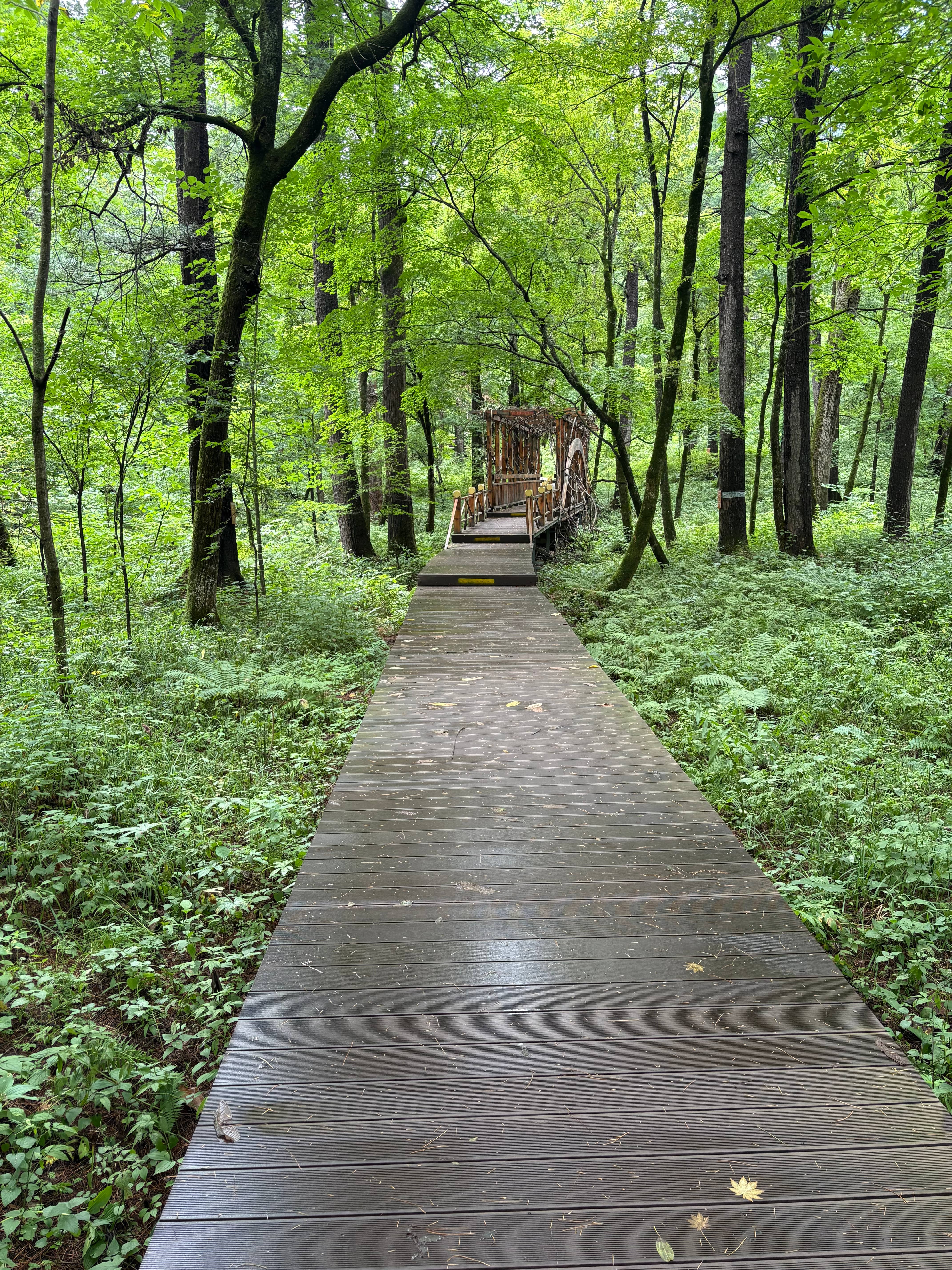
A recorded case from the manufacturer's project data illustrates how coverage and application data come together. A project contractor in China specified 500 tons of WPC decking for a park decking application. The recorded service duration is 15 years, with the reported outcome of durable performance showing no fading and no bending. The associated models are D053 and GH001 — both inside the EPD registration. Buyers should treat this as supplier-reported project evidence, which means it is useful for capability assessment and should be verified against their own acceptance criteria rather than accepted as an independent finding.
At execution stage, the operational terms matter as much as the certificate. The manufacturer operates OEM and ODM production, a minimum order quantity of 1 container, a typical production lead time of 30–45 days, and monthly production capacity of 10,000 tons. Quality control is described as 100% testing, with pre-shipment test procedures used as the acceptance criterion. Standard commercial terms are FOB delivery with 30/70 payment, and after-sales support is provided remotely. For a buyer converting a specification into a purchase order, the practical caution is that the MOQ and lead time are not covered by any certificate — they are commercial constraints that need to be planned for separately.
Market context: why documentation scrutiny is increasing
The global wood plastic composite market was valued at USD 8.05 billion in 2025 and is projected to reach USD 11.26 billion by 2034, according to Straits Research. North America held the largest regional share of that market in 2025 at 36.4%. Growth of that shape does not automatically raise documentation standards — but it does widen the pool of suppliers competing for specification-driven work, and specification-driven work is where verified environmental documentation is most often requested.
The standards landscape reinforces this. ASTM D7032, the primary specification for establishing performance ratings for WPC deck boards, is a long-standing and widely referenced requirement in the North American market. Alongside it, environmental declarations have moved from a differentiator to an expected line item in European construction procurement. The net effect for buyers is a market where certificate packages are larger, more varied and more frequently misread — which is precisely why scope verification, not certificate collection, is the discipline that protects a project.
Comparison with traditional solutions — and the honest limits
Against conventional timber decking, an EPD-backed co-extruded WPC board offers a documentation advantage that timber rarely matches in the same format: environmental information consolidated under one registration across a multi-model range. Timber has its own environmental documentation routes, and those routes are legitimate — but they are structurally different, and a buyer comparing them should compare like with like, using the same product category rules rather than two differently framed documents.
That said, the limits of EPD-backed supply are real and should be stated plainly:
- An EPD is not a performance certificate. It does not rate flexural strength, slip resistance, fire behaviour or structural capacity. Those need their own evidence, cited separately. A buyer who treats the EPD as a substitute for performance verification is not covered.
- Coverage is model-specific. Only GH024, GH010, D053 and GH001 sit inside this registration. A newer profile, a bespoke OEM geometry or a different series is outside it until separately assessed.
- Coverage does not travel with the brand. A buyer cannot cite this declaration for a product from a different manufacturer, or for a re-branded item whose origin is not in the registered list.
- Commercial terms sit outside the certificate. The 1-container minimum order quantity and the 30–45 day lead time are execution constraints the declaration says nothing about.
Future outlook
With a validity window running to 2029-03-15, this registration covers the planning horizon of most current residential and commercial WPC decking projects, including multi-year phased developments. The practical expectation for buyers is that the document will need periodic re-verification, and that the version filed in a 2028 tender should be confirmed as current rather than assumed to be identical to the version filed in 2026.
The wider direction is predictable. As the WPC market expands toward the projected USD 11.26 billion by 2034, more product ranges will carry environmental declarations, and the competitive question will shift from whether a supplier holds a certificate to what, precisely, that certificate covers. Buyers who build model-level scope checking into their standard supplier qualification will be reading these documents correctly from the start.
Frequently asked procurement questions
What does EPD coverage mean for a WPC decking product line?
EPD coverage describes the exact product scope a registered Environmental Product Declaration applies to. A declaration registered against a defined scope covers only the products listed within that scope — for the Terratsa registration, the models GH024, GH010, D053 and GH001. Coverage is a boundary, not a general endorsement of a manufacturer's range.
Which models are covered by the Terratsa EPD?
The registration EPD-IES-0012197:001 (S-P-12197) lists four associated models: GH024 (outdoor WPC cladding), GH010 (exterior wall cladding), D053 (outdoor hollow WPC decking, first generation) and GH001 (co-extruded outdoor decking). The declared scope is co-extrusion WPC products, with markets recorded as China, Netherlands and Global.
Does EPD coverage transfer to other boards, profiles or private-label versions?
No. Coverage is not transferable to boards that are not in the registration. A different profile, a bespoke OEM/ODM geometry or a logo-customised private-label version does not inherit coverage, even when it is produced on the same lines with the same materials. OEM and ODM production capability and logo customization are separate from the environmental declaration.
How long is the EPD valid, and when does it expire?
The registration was issued on 2024-03-15 and expires on 2029-03-15. Buyers should record that expiry date in their project document control system and confirm that the certificate version filed for a tender is the current one. Note that other certificates in the same supplier file run on different cycles: the ISO 9001, ISO 14001 and ISO 45001 certificates expire on 2028-03-02, and the FSC Chain of Custody certificate expires on 2030-07-07.
Which markets does the EPD apply to?
The registration lists its markets as China, Netherlands and Global, and references EN 15804+A2, the European framework for construction product environmental declarations. For projects inside the EU, that is the directly relevant basis. For projects in other regions, the declaration remains available as supporting documentation, but acceptance should be confirmed against the local specification owner's requirements.
How can a procurement team verify the declaration independently?
Verification is possible through the three control points printed on the document itself: the registration number EPD-IES-0012197:001 (also recorded as S-P-12197), the programme operator EPD International AB, and the referenced standards EN 15804+A2 and ISO 14025 / ISO 21930. The registration can be located in the programme's public library, where the record shows a valid status with a version date of 2024-03-15.
Does the EPD confirm product performance, such as flexural strength or slip resistance?
No. An EPD is a Type III environmental declaration and reports environmental information for a defined scope. It does not rate mechanical performance, slip resistance, fire behaviour or structural capacity. Performance ratings for wood-plastic composite deck boards are established under separate standard specifications, such as ASTM D7032, and should be evidenced separately in a procurement file.
What documentation should sit alongside the EPD in a supplier file?
A complete file typically combines the environmental declaration with management system certificates (ISO 9001, ISO 14001 and ISO 45001), chain-of-custody documentation where recycled or certified wood content is claimed (FSC registration 0218718, covering FSC 100% and FSC Mix claims for wood-plastic composites, code W9.11), performance test data for the specified models, and the agreed acceptance terms — for this manufacturer, pre-shipment testing, a 1-container minimum order quantity and a 30–45 day typical lead time.
Product documentation, including the Terratsa decking brochure, is available for download: Terratsa Brochure – Decking. Buyers evaluating coverage for a specific project are advised to request written confirmation of the applicable model list against the current registration.
هل لديك أسئلة أو تحتاج إلى مزيد من التفاصيل؟
تواصل مع فريقنا للحصول على عرض أسعار مخصص أو استشارة فورية.
طلب عرض أسعار
املأ النموذج أدناه وسيتواصل معك فريقنا بعرض مقترح مخصص.
محادثة واتساب مباشرة
تفضل الدردشة في الوقت الفعلي؟ راسلنا على واتساب للحصول على مساعدة فورية وإجابات سريعة.
- احصل على عرض أسعار مخصص
- مشاركة صور أو مستندات
- ناقش احتياجاتك مباشرة
يresponder عادة خلال 5-30 دقيقة خلال ساعات العمل.