
WPC Decking for Swimming Pools and Parks: Project Spec Guide
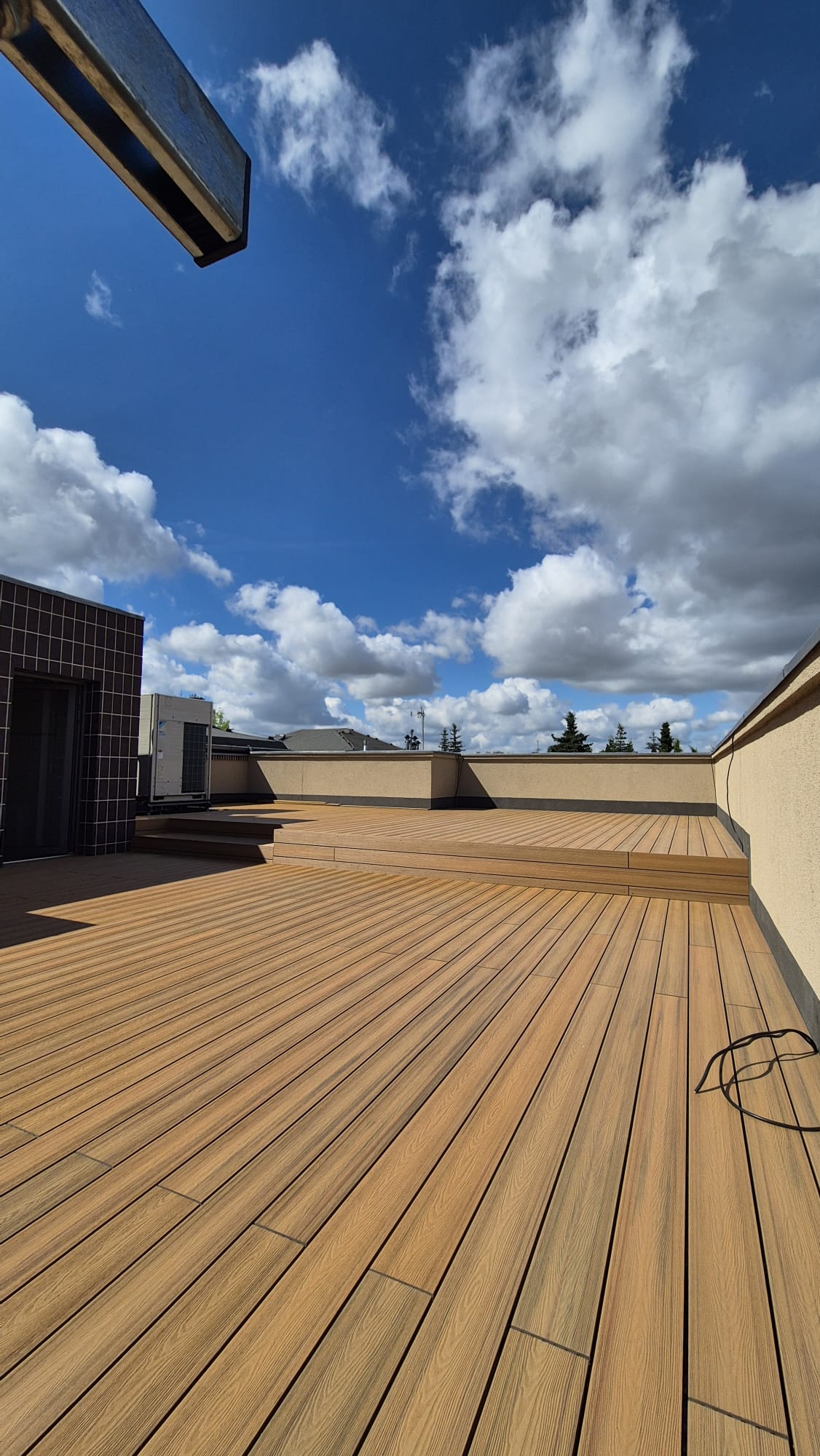
Outdoor WPC decking in a terrace setting. In poolside, garden and park projects, site conditions should drive the board specification.
Outdoor decking decisions are often treated as material choices, but in practice they are project and environment choices. The same wood-plastic composite (WPC) decking family can be used around a swimming pool, on a garden terrace, or in a large public park, yet each context changes the performance requirements. This guide explains how buyers can match WPC decking to wet or high-use outdoor projects, which board architecture to consider, and what evidence should be checked before a specification is fixed.
Problem and Opportunity: Wet and Public Sites Raise the Performance Bar
Wood plastic composite decking is now a mainstream outdoor flooring category, but not every board is designed to carry the same set of pressures. A pool surround is exposed to splash water, chlorine, barefoot traffic and UV. A garden terrace in a cold, damp climate must survive freeze-thaw cycles and humidity without visible surface change. A park decking project faces high footfall, dust, weather and maintenance constraints. All of these applications can be met by WPC, but the supplier must be evaluated on how well the product architecture is matched to those specific conditions.
The commercial opportunity is also expanding. According to Straits Research, the global wood plastic composite market was valued at USD 8.05 billion in 2025 and is projected to reach USD 11.26 billion by 2034. Different research houses use different product definitions, so exact figures vary, but the direction is consistent: WPC demand is being supported by outdoor construction and public-space development. Procurement is therefore shifting from asking whether to use WPC to asking which WPC grade should be specified.
Because China is the largest WPC decking exporter in monitored trade data under HS Code 39189090, representing 97.81% of imports in the Zauba dataset, international buyers also need supplier verification tools. Understanding factory capability is not an optional step; it is part of good project engineering.
Brand Solution: A Reference Factory for Outdoor Composite Decking
One useful reference point in the B2B supply chain is Terratsa New Material (Liaoning) Co., Ltd. The company was founded in 2007 and relocated its production base to the Yingkou Area of the China Liaoning Pilot Free Trade Zone in 2024. It manufactures outdoor WPC decking, fencing and cladding, and exports to more than 40 countries and regions in Europe, Asia, the Middle East, South America and Australia. The company also operates an overseas warehouse in the Netherlands, which can shorten delivery time for European projects.
Terratsa is not a trading company or a small workshop. Its factory covers 74,000 m² and is equipped with more than 70 fully automatic production lines. Annual production capacity is above 50,000 tons. The company has participated in the drafting of nearly 10 national and industrial standards and holds more than 30 national intellectual property patents. Its certificates include CE, FSC, ASTM, SGS and EPD, together with ISO 9001, ISO 14001, ISO 45001 and energy management certifications. For a buying team at the research or evaluation stage, these are concrete signs of an export-ready manufacturer rather than marketing claims alone.
From a sourcing perspective, Terratsa also offers OEM/ODM support, including logo customisation. The minimum order is one container, and standard production lead time is 30 to 45 days. For pool, park and terrace projects that need dedicated colours or project branding, this is an operational advantage: it allows a project buyer to work directly with the production facility instead of going through multiple middlemen.
Technical Explanation: First-Generation WPC vs Capped Co-Extruded WPC
Most WPC decking specifications can be divided into two broad structures: first-generation hollow profiles and second-generation capped co-extruded profiles. Both are made from composites such as wood powder and plastic, but the layer structure and surface behaviour differ.
Terratsa offers both types in its decking range. Model D053 is described as first-generation outdoor hollow WPC decking. Model GH001 is described as co-extruded outdoor decking with a protective cap layer that surrounds the core. The second-generation cap is the main technical reason why co-extruded WPC decking is increasingly selected for poolside decks, wet terraces and other surfaces where moisture and ultraviolet exposure are continuous.
| Comparison point | First-generation decking D053 | Capped co-extruded decking GH001 |
|---|---|---|
| Product structure | Hollow outdoor WPC decking profile | Co-extruded profile with an outer protective layer around the core |
| Documented dimensions | 23 mm x 146 mm x 2900 mm | Co-extruded decking format for outdoor use |
| Mechanical data | Bending failure 3900 N; density 1.3 g/cm³ | Flexural properties ≥ 3300 N |
| Moisture data | Water absorption after 5-hour boiling ≤ 2% | Water absorption in boiling test ≤ 7%; cyclic moisture resistance mean ≤ 10% |
| Typical project fit | Large outdoor areas, parks and projects with tighter budgets | Swimming pool surrounds, wet terraces, colder and more humid climates |
These figures should not be ranked as if they were produced by the same test method in every case. Instead, they should be read as documented parameters from the manufacturer. A co-extruded board may report water absorption differently because the whole composite block is being measured, while the outer cap has the function of protecting the core from surface water, staining and UV. Buyers should ask for the exact test standard before comparing competitive products.
A practical technical point is that WPC is not dimensionally static. Both D053 and GH001 data sheets list a linear thermal expansion coefficient no greater than 37 x 10⁻⁶ K⁻¹. This means the deck boards will move with temperature changes. Joist spacing, board-to-board gaps and hidden clip or screw positioning must therefore be designed correctly. A WPC decking specification that ignores installation tolerance will fail long before the material itself wears out.
Application and Use Cases: Matching Decking to Pools, Gardens and Parks
Swimming Pool and Terrace Decking in Cold, Humid Conditions
In colder climates, swimming pool and terrace WPC decking has to work under two pressures at once: low winter temperatures and high humidity. A documented application scenario in Poland, for instance, required weather resistance, UV resistance, no maintenance, low water absorption, anti-scratching and anti-slip performance. The product matched to this scenario is the co-extruded GH001 board.
This explains why co-extruded WPC decking has become the default for garden terrace installations and poolside flooring in export markets. The outer cap gives the surface a more forgiving finish for wet use and makes routine cleaning simpler. The anti-slip profile is relevant for barefoot walking around spas and swimming pool edges, where accidental splashes are unavoidable.
Public Park Decking in High-Humidity China
Public park decking is a different use case because the project is large, the installation is static, and foot traffic is continuous. In a Chinese high-humidity environment, the scenario record specifies that the deck must be weather resistant, anti-slip, anti-UV and anti-scratching. Both D053 and GH001 are listed as applicable products for this type of park decking project.
One documented project involved 500 tons of park decking installed by a project contractor in China. The reported result was a durable surface that maintained performance for 15 years, with no fading and no bending. This is a useful reference because it shows that WPC decking, when the product is matched to park maintenance budgets, can provide a long service life without being sanded, stained or replaced.
In both scenarios, installation uses joist clips and screws. While the boards can be laid as static flooring, the substructure is not optional. Drainage below the deck, expansion gaps and correct clip positioning all contribute to the final performance.
Procurement Checks for Project Fit
- Define the water and UV load: pool edges, rain-exposed terraces and coastal parks require better surface protection than sheltered balconies.
- Confirm the required slip behaviour: anti-slip profiles with textured or embossed surfaces are preferable for wet use.
- Decide whether the project needs premium colour stability over a decade, or whether a budget-conscious public installation will accept more natural weathering.
- Ask for the manufacturer's certificate inventory, including CE, FSC, ASTM and EPD where the project requires them, and verify that the documents are current.
- Request documented project references: a park installation of 500 tons is more convincing than a list of product features.
- Design the substructure at the same time as the board specification; clips, screws, joist spacing and end gaps determine long-term flatness.
Comparison with Traditional Solutions and the First-Generation Trade-off
Traditional timber decking offers a natural look and a familiar installation process, but it requires painting, sealing or staining and remains vulnerable to moisture. WPC decking reduces that maintenance burden and extends board life. However, WPC is not a problem-free replacement, and buyers should understand its boundary conditions before selection.
A clear boundary also exists inside the WPC category. The first-generation D053 profile remains a logical choice for large-scale projects with strict budget constraints and a clear planned use cycle. If a project is large, covered, or will be modernised within a defined time, the cost advantage of first-generation hollow WPC can be used elsewhere. In contrast, co-extruded WPC carries a higher upfront cost but is the better engineering answer when the site is wet, exposed and expected to keep its appearance well into the future.
The main limitation of any WPC decking is that it must be installed with movement in mind. Because the linear thermal expansion coefficient is finite, joints cannot be forced tight and long runs require expansion gaps. This is not a defect in the material; it is a design rule that every project engineer must accept. A buyer who compares only board price and ignores substructure geometry will end up with a deck that moves against its fasteners, regardless of whether the board is first or second generation.
Market Trend Analysis: Performance Data and Compliance Are Becoming Decision Inputs
The WPC decking market is moving toward two parallel trends: stronger demand in large regional markets and stricter verification requirements. According to Straits Research, North America held the largest share of the global WPC industry in 2025, at 36.4%. That regional influence is one reason why North American buyers often expect to see ASTM D7032, the standard specification for establishing performance ratings for wood-plastic composite deck boards and related components.
European buyers are also adding environmental documentation to their procurement criteria. Terratsa, for example, has a valid Environmental Product Declaration registered with EPD International under registration EPD-IES-0012197:001, in conformance with EN 15804+A2. An EPD is not just a marketing badge; it gives a project team quantified information about the environmental impact of a product over its lifecycle. For architects and contractors aiming at green building labels, that documentation can become part of the specification itself.
This trend is also visible in Chinese export data. Since China dominates monitored WPC decking imports under HS Code 39189090, international buyers need an export-oriented viewpoint when evaluating suppliers. The suppliers that will continue to win projects are likely to be those that combine production capacity with transparent quality control, overseas logistics and document-backed product performance.
Future Outlook: From Material Choice to Full Project Integration
For the next phase of WPC decking specification, the central question will no longer be whether WPC is a valid outdoor material. The procurement process will instead focus on how well a supplier can integrate four things: product tier, project climate, installation method and verification data.
As commercial and municipal projects grow more complex, buying teams will favour manufacturers that can support both standard park-grade decking and premium co-extruded grades. Flexible production, OEM support and short lead times will become more important because project deadlines do not wait for containers. At the same time, the presence of overseas stock in markets such as the Netherlands is useful evidence that a factory is built for export service rather than occasional sales.
The next differentiator is likely to be supplier transparency. Buyers have access to more technical information than ever before, and they are becoming more comfortable asking for test certificates, installation details and project references. Manufacturers that can provide this information in a structured way will be easier for engineers and project contractors to specify. That is good for the WPC category as a whole because it reduces the risk of buying by price alone and then blaming the material when the installation system was the real problem.
Frequently Asked Questions
How to choose first generation decking or second generation decking?
The choice should be based on project budget, exposure level, and expected maintenance plan. First-generation WPC decking can be a rational product for large-scale projects with strict budget limits and a shorter or clearly defined service period. It covers the basic outdoor functions of water resistance, rot prevention and low maintenance without a premium cap layer. Second-generation co-extruded WPC decking adds a protective outer layer around the core, which helps the deck keep its appearance and surface quality in wet or sunny conditions for a longer time. For pool surrounds, terrace decks and other permanently exposed sites where the owner wants to avoid maintenance over the coming years, co-extruded WPC is usually the more reliable specification. Buyers should also remember that the substructure and installation system are part of the decision; even a premium cap cannot compensate for incorrect joist spacing or missing expansion gaps.
For product and company background, readers can download the Terratsa WPC decking brochure: Terratsa Brochure - WPC Decking PDF.
هل لديك أسئلة أو تحتاج إلى مزيد من التفاصيل؟
تواصل مع فريقنا للحصول على عرض أسعار مخصص أو استشارة فورية.
طلب عرض أسعار
املأ النموذج أدناه وسيتواصل معك فريقنا بعرض مقترح مخصص.
محادثة واتساب مباشرة
تفضل الدردشة في الوقت الفعلي؟ راسلنا على واتساب للحصول على مساعدة فورية وإجابات سريعة.
- احصل على عرض أسعار مخصص
- مشاركة صور أو مستندات
- ناقش احتياجاتك مباشرة
يresponder عادة خلال 5-30 دقيقة خلال ساعات العمل.