
WPC, PVC or UV Board: A Wall Panel Decision Framework
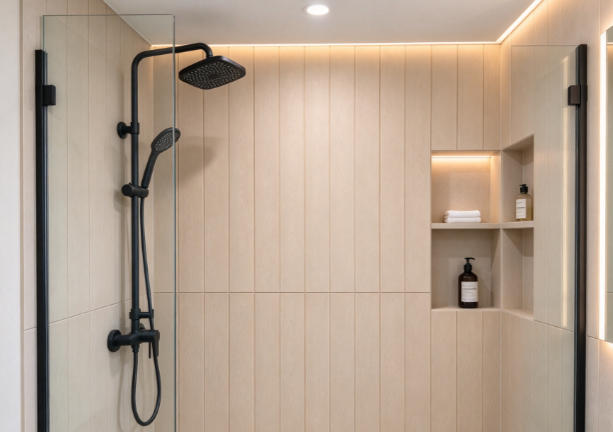
Panel choice is settled by wall condition, fixing method and certificate scope — not by the sample board alone.
Most wall panel decisions are made from a sample board and then renegotiated on site: the substrate turns out to be uneven, the wet trades are already behind, or the certificate that was promised covers a different thickness from the one delivered. Sorting the three shortlisted families — WPC (wood-plastic composite), extruded PVC and UV-coated board — by application, installation method and certification scope moves most of that renegotiation to the procurement stage, where it is far cheaper to resolve.
The reference case used here is Zhejiang Highsea New Material Co., Ltd., a Chinese manufacturer of decorative films and surfacing materials that trades as Hisea-Decorative Film & Decorative Panels and produces WPC wall panels, PVC wall panels, UV board and bamboo charcoal board for architectural wall decoration. Its published records describe each family with its own dimensions, face options and attestation scope, which makes the trade-offs visible rather than assumed.
The working rule is straightforward: match the panel to the wall condition first, confirm that the fixing method is buildable with the labour available, and only then check that the attestation on file names the exact model on the packing list. Price comparison belongs after those three checks.
Three families, three different briefs
The three products are frequently presented as interchangeable decorative finishes. In construction terms they are not. A specifier choosing between them is really choosing between a profiled cladding system with mechanical fixing, a thin washable sheet for wet service areas, and a flat decorative panel that behaves like furniture board.
WPC wall panels are a wood-plastic composite, blended from wood fibre and thermoplastic resin, supplied in fluted, slatted, louver and flat profiles. Extruded PVC wall panels form a continuous non-porous sheet in narrower panel widths. UV board carries a UV-cured coating that hardens into a dense sealed film over a flat base sheet, and is sold in large-format sheets rather than in profiles. Each family therefore answers a different brief, and each one fails differently when it is pushed into the wrong brief.
| Panel family | Recorded formats | Face options | Fixing method | Attestation on record |
|---|---|---|---|---|
| WPC wall panel | Wood-plastic composite; 160×22 mm, 160×24 mm, 150×10 mm, 150×15 mm, 195×12 mm | Fluted, slatted, louver and flat profiles; wood grain or solid colour faces | Dry fix with hidden clips; cut and drilled with ordinary woodworking tools | EN 17104:2021 attestation covering the listed models |
| PVC wall panel | Extruded PVC; 300×8 mm and 300×8.5 mm | Wood grain, marble and solid colour prints; non-porous surface | Clips, screws or adhesive onto battens or a flat dry substrate, with matching trims | CE attestation under EN 17104:2021 for 1220×3000×3 mm and 300×8×2900 mm |
| UV board | UV-cured sealed film over base sheet; 1220×2440×3 mm and 1220×2440×2.5 mm | Marble, stone and solid colour designs; gloss or matte faces | Cut, drilled and edge banded with standard panel tooling in a fabrication shop | No panel-specific attestation listed for this construction in the source record |
The table is a specification summary, not a ranking. The correct panel is the one whose format, fixing method and documentation fit the wall being built.
Application fit: where each panel earns its place
Application is the first filter because it removes options quickly. Wet service areas, entertainment walls, hotel corridors, retail fronts and covered external walls place different demands on a panel, and the three families do not meet all of them equally.
WPC wall panels
WPC is specified where a wall has to read as timber but behave as a polymer. The composite pairs the grain and warmth of timber with the dimensional stability of a polymer, so the board keeps a flat, true surface in humid or dry climates where solid timber would tend to warp. The polymer content around the wood fibre limits water uptake, which is what allows the same material to be used for bathrooms, laundry areas and covered outdoor walls such as balcony or patio cladding.
The manufacturer's published application list for WPC wall panels covers interior feature walls, TV backgrounds, living rooms and bedrooms, hotel lobbies and corridors, offices and meeting rooms, restaurants, retail stores and showrooms, and ceilings. The application record for architectural wall decoration adds the project requirements that usually decide the specification: waterproof performance, termite resistance, low formaldehyde emission and easy cleaning. The same scenario is recorded as common in markets including Indonesia, Japan, Saudi Arabia and Poland, and the underlying application data lists a wider set of countries across Asia, Europe and the Middle East.
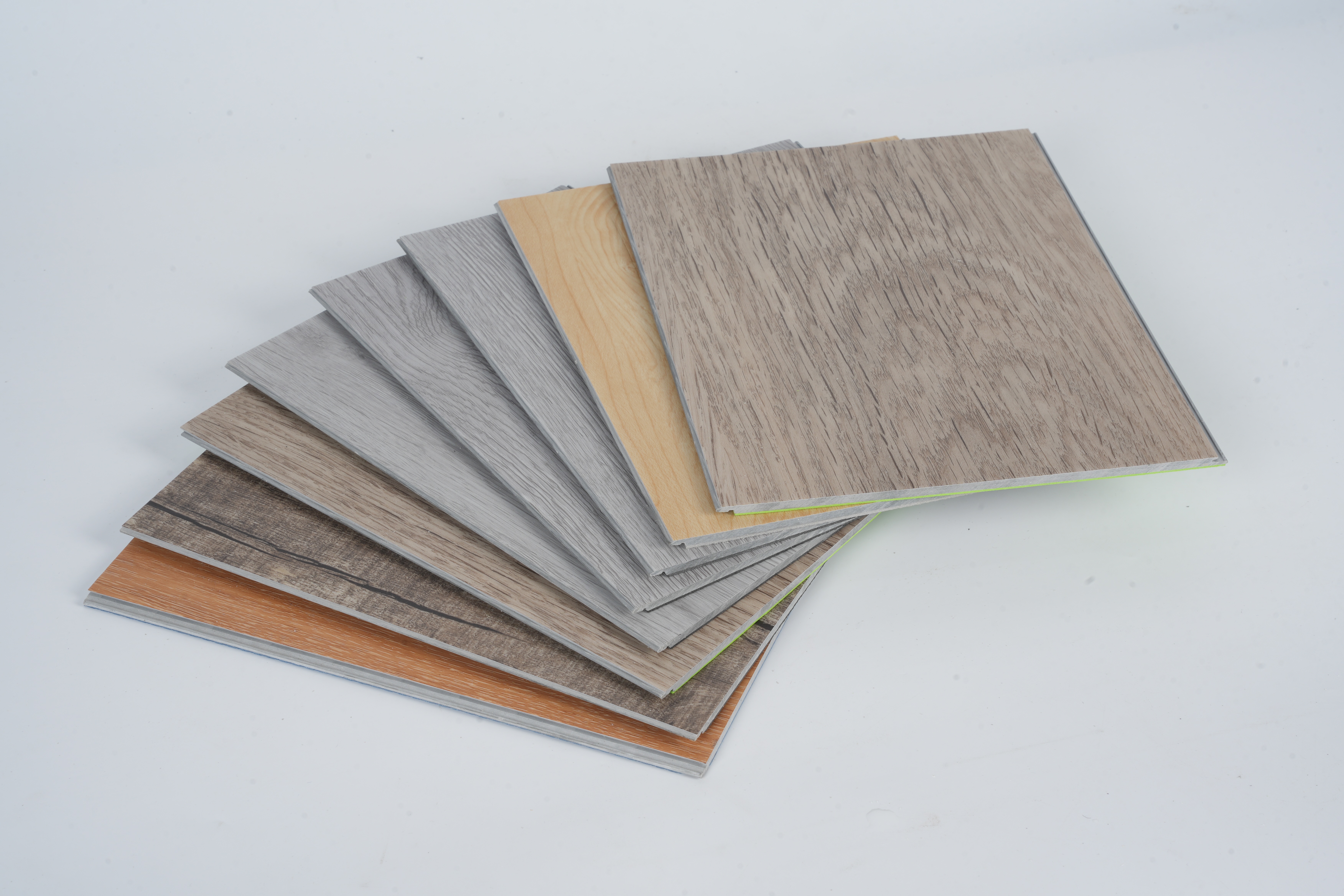
PVC wall panels are extruded sheets, supplied in fixed panel widths with wood grain, marble and solid colour print faces.
PVC wall panels
PVC is usually the answer when the question is how to get a washable surface into a room that is already built. Because the panel is extruded from polyvinyl chloride, it forms a continuous non-porous surface that does not absorb water or hold odours. Splashes, grease and everyday marks stay on the face rather than soaking in, so routine cleaning is normally a wipe with a damp cloth rather than hard scrubbing — which is why the material is widely chosen for clinics, food preparation rooms, laboratories, public washrooms, kitchens and bathrooms.
The face range matters commercially: wood grain, marble and solid colour prints across the available panel widths allow a room to be matched to a joinery or tile scheme using trims and profiles from the same range. For a hotel bathroom refurbishment or a retail back-of-house corridor, that combination of a sealed surface and a coordinated trim set is often the decisive argument.
UV board
UV board is best understood as a furniture face that can also serve as a wall face. The UV-cured coating hardens under ultraviolet light into a dense sealed film, so the decorative face keeps its sheen through daily contact, wiping and handling, and resists common household marks such as water rings, grease spots and light scratches. Marble, stone and solid colour designs in gloss or matte reproduce the character of natural slab at a fraction of the weight.
In practice the board is used for kitchen and bathroom cabinets, TV background walls, hotel room furniture and retail fixtures. It is the right answer where the wall and the joinery are meant to read as one continuous surface, and the wrong answer where the wall is irregular, continuously wet or fully exposed to weather.
Installation method changes the programme, not just the finish
Installation is the second filter, because a panel that is technically suitable but cannot be fixed by the labour on site becomes a delay. The three families sit in three different installation models: site-based mechanical fixing, site-based adhesive or batten fixing, and workshop fabrication.
Dry fix with hidden clips
WPC panels are cut, drilled and fixed with ordinary woodworking tools and hidden clips. There are no wet trades, no curing time and no heavy demolition work, which shortens site programmes and lets a room or facade be refinished without emptying the adjacent space for days. The fixing is static and requires no supporting equipment and no power consumption at the panel itself. The visible result is a shadow-line profile with concealed fasteners, which is why fluted and slatted WPC is often chosen for feature walls where the joint detail is part of the design.
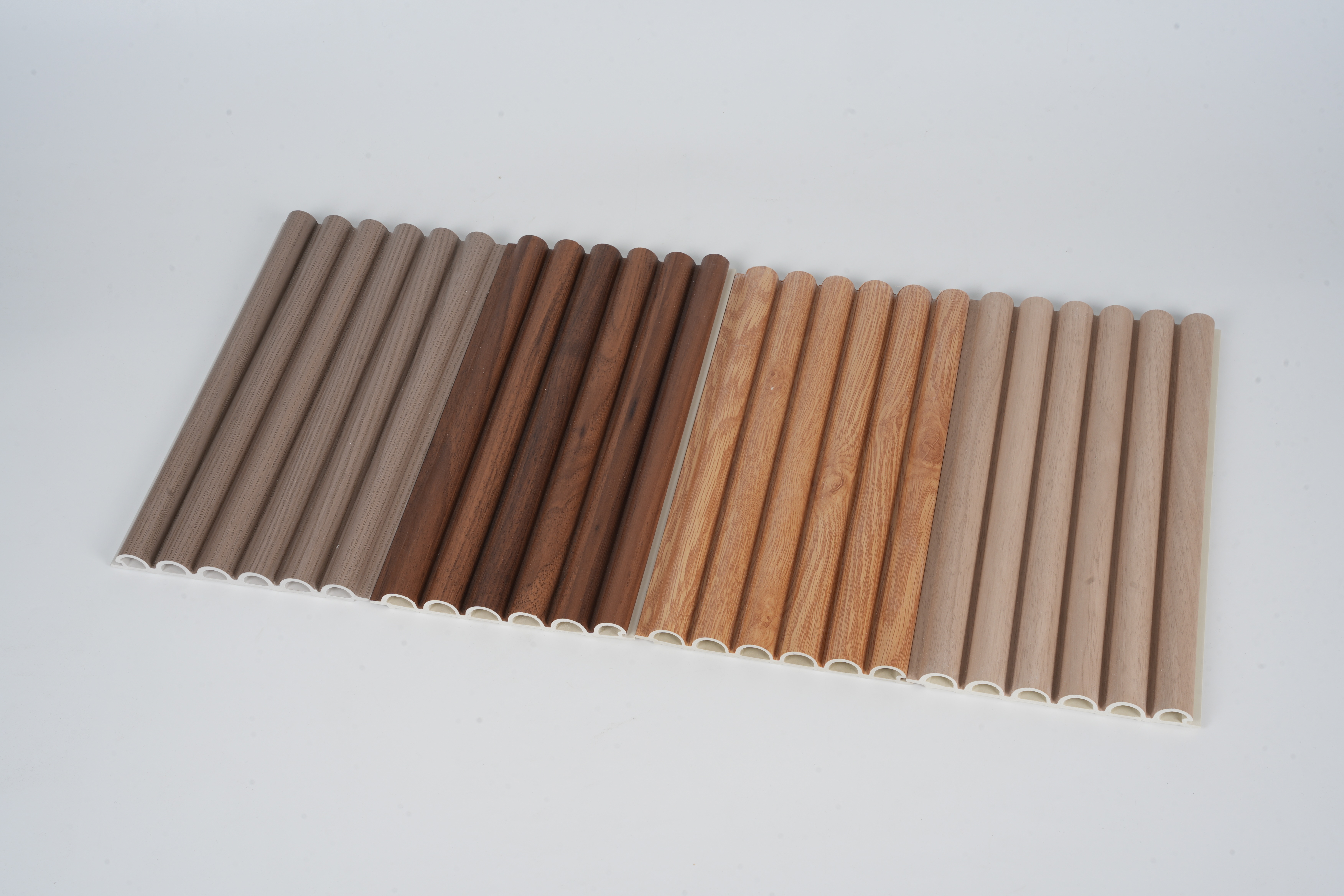
WPC profiles are cut and fixed with ordinary woodworking tools and hidden clips, so no wet trades are needed on site.
Battens, adhesive or direct fix
PVC panels can be fixed on battens or directly onto a flat, dry substrate using clips, screws or adhesive, with matching corner and edge trims to finish the joints. Cutting is done with standard woodworking tools and no painting or finishing is required on site. Because the sheet is light next to ceramic tile or stone, one installer can carry and align full lengths, and panels trim with a utility knife or fine-tooth saw before being joined with matching edge trims. The practical constraint is the substrate: the panel follows the wall, it does not correct it.
Panel-shop fabrication
UV board behaves like a panel product rather than a cladding profile. The sheet cuts, drills and edge bands with standard panel tooling, so fabricators can turn it into cabinet doors, wardrobe fronts and wall cladding without changing their existing production line or adding new machines. That is an advantage for a joinery-led project and a disadvantage for a fast site retrofit, because it introduces a workshop step and requires the exposed edges to be banded before the panel reaches the wall.
Certification coverage: read the model scope, not the logo
Certification is the third filter and the one most often misread. An attestation is a statement about a defined construction, not a company-wide guarantee, and the difference matters at customs and at handover.
For WPC wall panels, the record shows an EN 17104:2021 attestation covering the listed models — that is, the profiles and dimensions named in the documentation. For PVC wall panels, the record shows CE attestation under EN 17104:2021 for two specific constructions, 1220×3000×3 mm and 300×8×2900 mm. Buyers should note that the CE scope is written around those named constructions while the catalogue widths are 300×8 mm and 300×8.5 mm, so the document set should be checked against the exact construction ordered rather than against the product family name.
For the European market, EN 13245-2:2008 is the harmonised standard covering unplasticized PVC profiles for interior and exterior wall and ceiling finishes, and it is the reference against which a PVC panel attestation is normally read. Reaction-to-fire evidence sits in a separate framework: EN 13501-1 is used in Europe and the UK, ASTM E84 in the USA and Canada, and GB 8624 in China, and the applicable requirement depends on the jurisdiction and the project specification. These systems use different test methods and classifications, and their classes should not be combined or treated as equivalent without a formal basis.
Commercial procurement guidance on supplier compliance claims recommends a specific verification sequence, and it is a practical checklist for any of the three families:
- Confirm the report names the exact product, thickness, construction and surface finish being purchased.
- Confirm the report cites a current edition of the standard, not a superseded one.
- Confirm the testing laboratory's accreditation scope covers the test method used.
- Confirm the fire classification, if required by the project, is stated for the panel as supplied — including substrate and fixing — and not for a generic material category.
The source record lists no panel-specific attestation for UV board. That is not evidence of non-compliance; it means the document should be requested for the exact construction before the board is approved for a regulated project.
Purchasing terms and acceptance criteria
Once the family, the format and the documentation are settled, the purchase order turns on quantity, lead time and what happens when the container is opened.
For this supplier, trial orders normally start from 300 pieces and can be mixed by colour and size, which matters for a project that needs several face options in one shipment. Lead time is quoted at 20–30 days in the company's capability record, and the container-order FAQ states a typical 20–25 days after deposit for a 40HQ container. Production capacity is stated at 20 × 40ft high-cube containers per month, which supports container-level and multi-container procurement with a relatively stable delivery expectation on large orders. Customization is available on patterns, packaging, colours and sizes under an OEM arrangement, and after-sales support is handled remotely.
Quality control runs through three stages: incoming raw materials are inspected batch by batch to keep formulation and process parameters consistent; in-process control points monitor thickness, density, colour difference, surface flatness and texture consistency; and every batch is inspected before shipment, with loading arranged only after the batch passes. That structure is worth mirroring in the buyer's own acceptance routine:
- Check dimensions against the ordered size list — 160×22, 160×24, 150×10, 150×15 and 195×12 mm for WPC; 300×8 and 300×8.5 mm for PVC; 1220×2440×3 mm and 1220×2440×2.5 mm for UV board.
- Check profile geometry on fluted, slatted and louver panels: groove depth, pitch and the consistency of the shadow line along the full length.
- Check colour difference against the approved sample and across batches within the same container.
- Check surface flatness, texture consistency and print registration on marble and wood grain faces.
- Count accessories against the fixing schedule — hidden clips, corner trims and edge trims are part of the system, not optional extras.
- Check the document set: attestation naming the model, packing list, batch record, and loading photographs taken before the container is closed.
A five-year supply relationship with a customer in the Philippines, Poland, Palestine and Portugal illustrates how this works in practice: a 40-foot high-cube container was supplied for resale and for the buyer's own indoor and outdoor decoration, with the reported outcome being a satisfactory installation effect, correct sizing and no colour difference across the order. The useful lesson is not the volume but the mechanism — an approved sample plus a batch-check routine is what makes repeat orders predictable.
Limits and boundaries: what each option will not do
A decision framework is only useful if it states where each option stops.
- WPC wall panels are supplied in the listed profile sizes only, so a project needing a wider module has to adapt the design rather than the product. Hidden-clip fixing assumes a sound, reasonably flat substrate or batten grid, and the panel is a decorative cladding, not a structural element. The outdoor claim in the record refers to balcony, patio and covered outdoor walls; it is not a statement of performance in fully exposed façade conditions.
- PVC wall panels are thin extruded profiles at 8 mm and 8.5 mm. They depend on a flat, dry substrate and will follow an uneven wall rather than correct it. Printed faces are produced in batches, so an approved sample and a retained reference panel are essential before a multi-container order. The CE attestation on record scopes two named constructions, which must be matched to the order.
- UV board is an interior panel. It is positioned for cabinets, furniture faces, feature walls and fixtures, requires edge banding on exposed edges, and is not the choice for continuously wet or fully external walls. Its document set does not include a panel-specific attestation in the record, so it should be requested where the project requires one.
- All three families: the source records do not state a fire classification for the panels, so fire performance must be established from project-specific test documentation before specification in a regulated compartment.
Market trend: what the growth numbers actually say
Two published datasets frame the commercial context, and they should be read as directional rather than directly comparable, because they come from different research houses using different product definitions.
The global PVC panels market was valued at USD 14.8 billion in 2025, with wall panels the largest product type at a 42.5% share, according to Dataintelo's 2026 market report. Grand View Research projects the global wood-plastic composites market to move from USD 8.9 billion in 2025 to USD 21.5 billion by 2033, an 11.7% CAGR. The second figure describes a composite market, not wall panels specifically, so it should not be set against the first as if the two measured the same thing.
Read together, they point in one direction: composite products are expanding at a faster rate than rigid PVC panel volumes, which is consistent with specifiers asking for wood-effect profiles in projects where timber would previously have been used. On the cost side, commercial price tracking put average FOB China prices for standard 3 mm PVC marble sheets at USD 3.00–3.60 per m² in 2024, described as gradual stabilisation after a period of volatility. That is a useful indicator of price direction for early budgeting, not a quotation for any specific construction.
One procurement consequence follows from the portfolio structure rather than the market data. A supplier that carries WPC, PVC and UV board under one roof can reduce the number of vendors a project has to qualify, but each family still requires its own samples, specifications and compliance verification — vendor consolidation is not the same as verification consolidation.
Future outlook
Through 2026–2029, the pressure is likely to fall on documentation rather than on decoration. Buyers are already moving from asking whether a supplier is certified to asking which construction a certificate covers, which standard edition it cites, and whether the laboratory behind it is accredited for the method. Suppliers with a closed production loop from formulation through extrusion or calendering, surface treatment, cutting and packaging — and with batch-level inspection records at incoming, in-process and outgoing stages — will be easier to qualify than suppliers who can only produce a certificate image.
On the product side, the three families are likely to keep converging in appearance while diverging in installation logic. Fluted and slatted profiles will continue to absorb demand that once went to timber; thin washable sheets will hold the refurbishment and hygiene segment; and UV-cured flat panels will keep moving into joinery and fixture work where a stone or marble face is wanted without slab handling. The specifier's task does not change: identify the wall condition, choose the fixing model, then verify the document that names the model.
A downloadable catalogue covering the bamboo charcoal wall panel range, including profiles and face options, is available here: Bamboo Charcoal Wall Panel catalogue (PDF).
Frequently asked questions
What are the standard WPC wall panel sizes?
The product record lists WPC wall panels at 160×22 mm, 160×24 mm, 150×10 mm, 150×15 mm and 195×12 mm, supplied in fluted, slatted, louver and flat profiles with wood grain or solid colour faces.
Where are WPC wall panels used?
Interior feature walls, TV backgrounds, living rooms and bedrooms, hotel lobbies and corridors, offices and meeting rooms, restaurants, retail stores and showrooms, and ceilings. The same material is also positioned for bathrooms, laundry areas and covered outdoor walls such as balcony or patio cladding.
How are PVC panels installed?
Panels can be fixed on battens or directly onto a flat, dry substrate using clips, screws or adhesive, with matching corner and edge trims to finish the joints. Cutting is done with standard woodworking tools, and no painting or on-site finishing is required.
Does an EN 17104:2021 attestation cover every panel a supplier sells?
No. An attestation covers the constructions it names. In this record, the WPC attestation covers the listed models, and the PVC CE attestation under EN 17104:2021 covers 1220×3000×3 mm and 300×8×2900 mm. Buyers should confirm that the document matches the exact construction ordered, including thickness and face finish.
What is the MOQ and lead time?
Trial orders normally start from 300 pieces and can be mixed by colour and size. Typical production lead time is 20–25 days after deposit for a 40HQ container, with the capability record quoting 20–30 days overall; monthly capacity is stated at 20 × 40ft high-cube containers.
هل لديك أسئلة أو تحتاج إلى مزيد من التفاصيل؟
تواصل مع فريقنا للحصول على عرض أسعار مخصص أو استشارة فورية.
طلب عرض أسعار
املأ النموذج أدناه وسيتواصل معك فريقنا بعرض مقترح مخصص.
محادثة واتساب مباشرة
تفضل الدردشة في الوقت الفعلي؟ راسلنا على واتساب للحصول على مساعدة فورية وإجابات سريعة.
- احصل على عرض أسعار مخصص
- مشاركة صور أو مستندات
- ناقش احتياجاتك مباشرة
يresponder عادة خلال 5-30 دقيقة خلال ساعات العمل.