
Wall Panel Compliance Files: B1 Claims and Acceptance
Wall Panel Compliance Files: B1 Claims and Acceptance
Wall panels are approved on documents, not on samples. A distributor can hold a B1 fire rating, a waterproof statement and a formaldehyde-free claim for the same panel and still lose a submittal, because the file behind each claim names a different standard, a different product scope or a different market. For buyers moving from research into evaluation, the useful question is not whether a panel is B1, but which document says so, for which model, under which classification scheme, and for how long.
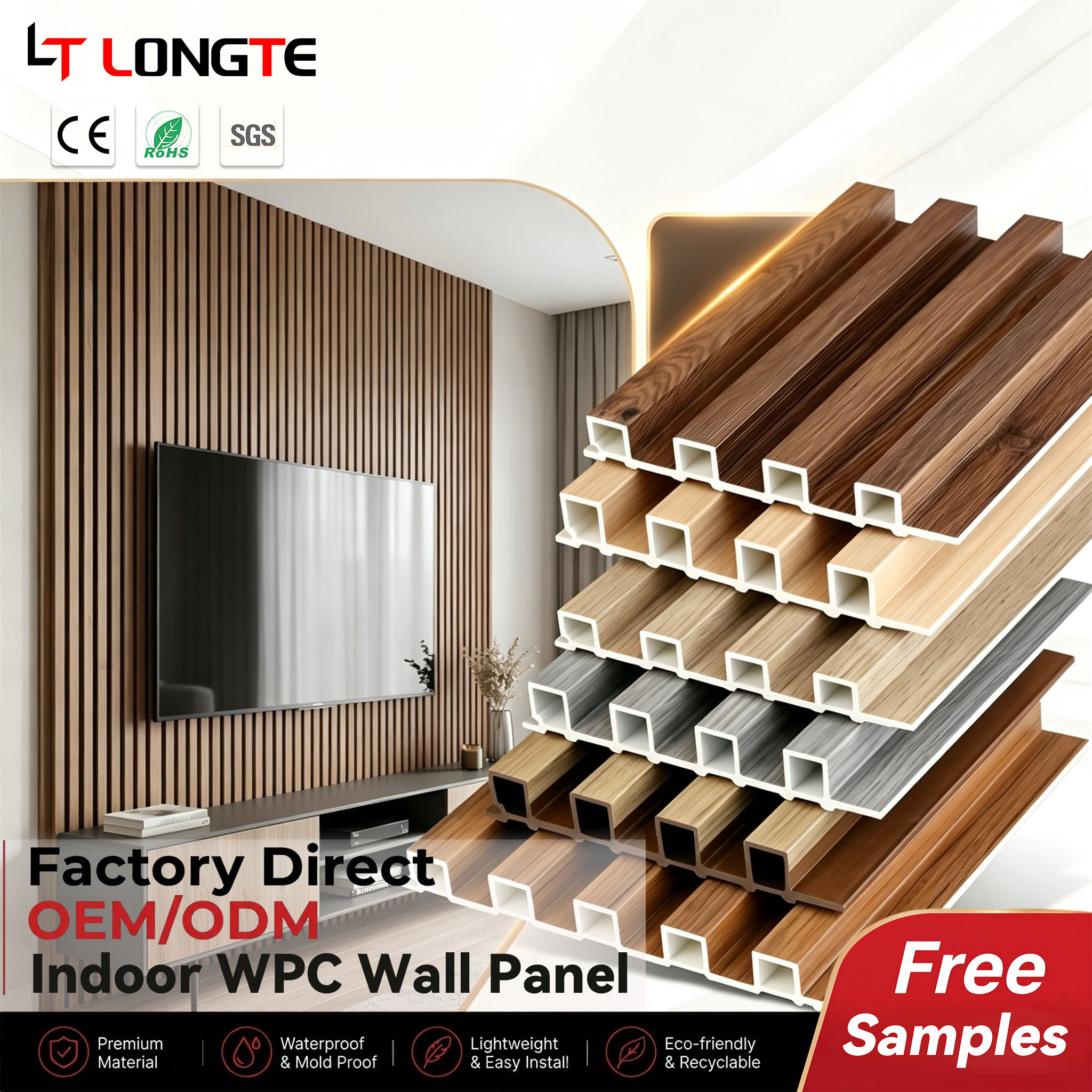
This guide works through that question using five LONGTE wall panel models: LT-PM PVC Marble, LT-BC Bamboo Charcoal Wood, LT-WG WPC Fluted, LT-SW SPC Stone Plastic Composite and LT-PU PU Faux Stone. LONGTE is the trading name of Haining Longtime Industry Co., Ltd., a Chinese manufacturer of PVC, WPC and SPC building materials founded in 2003, operating an 80,000 m² factory base, with 220 employees and roughly 85% of output exported.
Documentation has become a commercial variable rather than an administrative one. Research cited for the global decorative wall panel market values the segment at USD 30.70 billion in 2025 (SRC-001), and the panels moving through those volumes carry fire, substance and moisture claims into projects across North America, Europe and Asia-Pacific. The five models below show why a per-model file has to be assembled even when one supplier publishes a single grade across a whole range.

Why a Wall Panel Compliance File Is Not a Certificate Photo
A compliance file is an argument, not an attachment. It connects four things: the claim made about the panel, the document that tests or attests that claim, the specification in which the claim is being applied, and the clause in the order that makes it enforceable. A photograph of a certificate satisfies only the second of those and leaves the reviewer to guess the other three.
The distinction is visible in the LONGTE document set. A combustion report exists for PVC wall panel. CE documentation exists for specific models under a decorative wall covering standard. RoHS documentation covers a list of panel families. Each of these is a genuine third-party record, issued by bodies including BITFR (Henan) Company Limited, EUTEST Belgelendirme in Turkey, Intertek Testing Services Shenzhen and Ningbo Helmsman Quality Testing Services. None of them, on its own, is a complete approval for a project.
For a distributor, that gap translates into a predictable cycle: the sample arrives, the panel performs, the project asks for the fire file, and the file turns out to be scoped to a different format or a different family. Building the file at the enquiry stage, rather than at the submittal stage, removes most of that cycle.
What a B1 Rating Records, and What It Leaves Open
B1 is a class inside a named classification scheme, and the scheme is the part the buyer actually accepts. In the combustion performance test report supplied for LONGTE's PVC wall panel — report number BITFR202507063, issued on 15 July 2025 by BITFR (Henan) Company Limited — the tested classification is Class B1(B) under GB 8624-2012, assessed using the methods in GB/T 20284-2006 and GB/T 8626-2007, with the scope stated as PVC wall panel.
GB 8624-2012 is a Chinese national classification. European reaction-to-fire classification runs under EN 13501-1, which expresses classes from A1 to F with additional smoke sub-classes (s1 to s3) and flaming-droplet sub-classes (d0 to d2). A European Class B and a Chinese B1 are therefore not interchangeable statements, and a submittal that converts one into the other without a document invites rejection at review.
The practical rule is to write the criterion with the standard attached: "Class B1(B) to GB 8624-2012, supported by report BITFR202507063", or "Class B-s1,d0 to EN 13501-1". A bare "B1 grade" line in a purchase order gives neither the supplier nor the site team anything to check against on delivery.
A second distinction matters just as much. Test reports, certificates of conformity and declarations are different instruments. BITFR202507063 is a combustion test report. The CE documentation held for LT-PM and LT-PU is a verification or attestation of conformity against a harmonised standard. The RoHS records are substance-restriction documents. Each answers one question, and the acceptance file should state which of them it holds rather than treating them as a single certificate pack.
Six Checks That Turn a Claim into a File
The same six checks apply to any panel family, and they take less time than resolving a rejection.
- Identity. Record the report or certificate number, the issuing body and the issue date exactly as printed, without reformatting the number.
- Standard, method and class. Name the classification standard, the test methods behind it and the class obtained, including smoke and droplet sub-classes where the scheme uses them.
- Scope wording. Note the product family, model designation, thickness or format and the market the document was issued for. This line is where most submittals fail.
- Validity at delivery. Check the date against the scheduled delivery or handover, not against the enquiry date.
- The specification it supports. Match the document to the dimension, thickness, density or weight, surface and colour being ordered.
- The claim actually measured. Fire class, restricted substances, moisture resistance and formaldehyde emission are four separate records. None substitutes for another.
B1 Ratings Across Five LONGTE Wall Panel Models
All five models state a B1 fire rating in their product specification. The documents behind those statements differ in scope, and that difference is what a reviewer will find first.
| Model | Fire statement in specification | Documents in this review | Moisture / exposure statement | Shop-checkable values |
|---|---|---|---|---|
| LT-PM PVC Marble Wall Panel | B1 | Combustion report BITFR202507063 (Class B1(B), GB 8624-2012); CE number TD15322307 (EN 15102:2007+A1:2011); RoHS record HN202410860; Intertek report 231031181GZU-001 for UV marble sheet | Interior decorative application; no exterior weather claim stated | 1220×2800 mm; 3–8 mm; density 1.4–1.5 g/cm³ |
| LT-BC Bamboo Charcoal Wood Wall Panel | B1, stated as fireproof | RoHS record HN202410860, whose scope lists bamboo charcoal wood veneer wall panel | Waterproof, interior use | 600×2900 mm; 9 mm; 20+ colours |
| LT-WG WPC Fluted Wall Panel | B1 | RoHS record HN202410860, whose scope lists wpc wall panel and fluted wall panel | Waterproof and termite-proof, interior use | 159×2900 mm; 12 mm; groove depth 8 mm |
| LT-SW SPC Stone Plastic Composite Wall Panel | B1 | RoHS record HN202410860, whose scope lists spc wall panel | 100% waterproof; anti-scratch; wear-resistant | 1220×2800 mm; 4 mm |
| LT-PU PU Faux Stone Wall Panel | B1, stated as fireproof | CE number TD15322305 (EN 15102:2007+A1:2011) | Weather-resistant; exterior facade | 600×1200 mm; 20–30 mm; 2–3 kg/m² |
Read together, the supplied documents show a pattern common in this category. The combustion report is scoped to PVC wall panel. The RoHS record HN202410860, issued by Ningbo Helmsman Quality Testing Services on 5 December 2024, lists pvc wall panel, wpc wall panel, spc wall panel, fluted wall panel, pvc marble sheet, uv marble sheet and bamboo charcoal wood veneer wall panel in its scope, so substance compliance is documented at family level. CE documentation exists for LT-PM under TD15322307 and for LT-PU under TD15322305, both referencing EN 15102:2007+A1:2011 and issued by EUTEST Belgelendirme. A bamboo charcoal or SPC submittal therefore needs the copy of each record that names that family, not a generic certificate pack.
Reading Each Model's File
The model notes below describe what each specification claims, what the reviewed documents cover, and which numerical values a buyer can check on arrival.
LT-PM PVC Marble Wall Panel
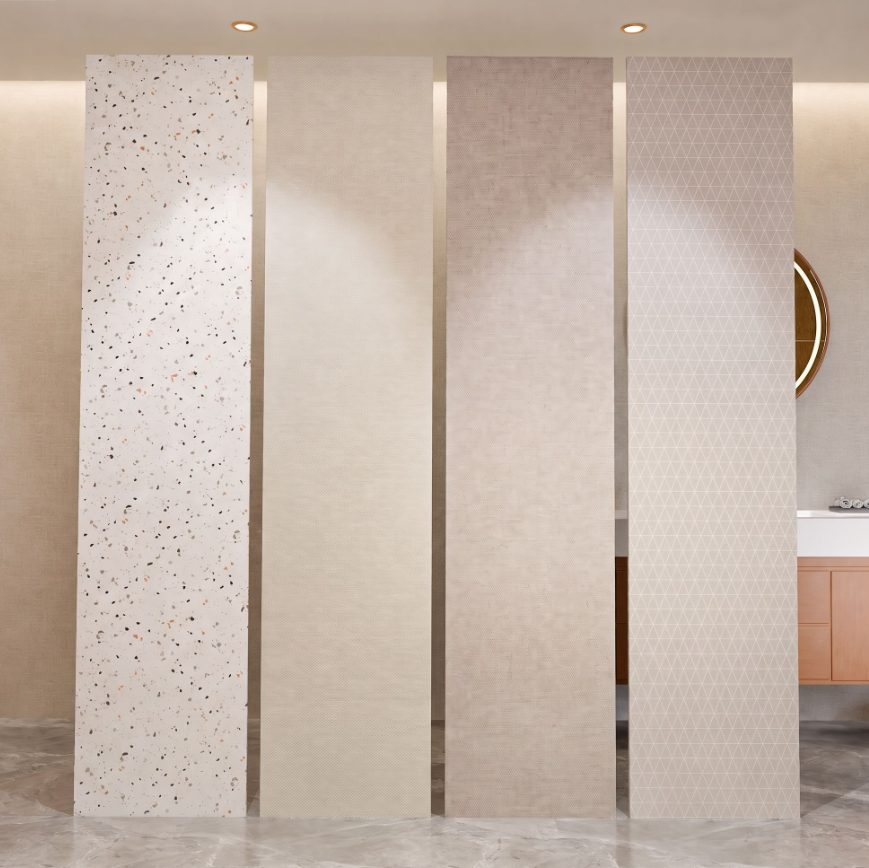
The LT-PM panel is a PVC and CaCO₃ composite with a UV-coated marble surface, listed at 1220×2800 mm in 3–8 mm thickness with a density of 1.4–1.5 g/cm³ and a B1 fire rating, for interior decoration, hotel, villa and commercial spaces. Its file is the most layered of the five: the combustion report BITFR202507063, CE documentation TD15322307, RoHS compliance under Directive 2011/65/EU and its amendment (EU) 2015/863, and an Intertek product test report, 231031181GZU-001, issued 13 November 2023 for UV marble sheet under Intertek's performance protocol.
One reconciliation point deserves attention. The scope line recorded for CE number TD15322307 reads "PVC Panel 600 x 9mm", while the LT-PM specification is 1220×2800 mm at 3–8 mm. A buyer approving LT-PM should ask, in writing, which document covers the ordered format, and keep that answer with the submittal. That is not a criticism of the file; it is the normal consequence of a certificate being issued for one format and a product range being offered in several.
LT-BC Bamboo Charcoal Wood Wall Panel
LT-BC is a bamboo charcoal fibre and PVC composite panel at 600×2900 mm and 9 mm thickness, specified as formaldehyde-free, waterproof and fireproof B1, available in more than 20 colours, for residential, hotel, office and kids' room interiors. The substance side of its file is covered at family level by the RoHS record HN202410860, whose scope explicitly lists bamboo charcoal wood veneer wall panel.
The fire statement sits in the product specification. Because the combustion report in this review is scoped to PVC wall panel, a bamboo charcoal submittal should include the copy of the fire documentation that names the bamboo charcoal family, together with the emission document discussed later in this article. Colour is also an acceptance item here: with more than 20 colours offered, batch colour approval against a retained sample belongs in the order, not in the after-sales discussion.
LT-WG WPC Fluted Wall Panel
LT-WG is a 3D fluted cladding made from wood powder, PVC and additives, sized 159×2900 mm at 12 mm thickness with an 8 mm groove depth, specified as waterproof, termite-proof and B1, for living room TV backgrounds, hotel lobbies and offices. The groove depth is the most useful line in its file, because it is both a design characteristic and a measurable one: a 12 mm profile with an 8 mm groove can be verified with a depth gauge on arrival, which makes it a stronger acceptance criterion than a visual match alone.
For substance compliance, HN202410860 lists wpc wall panel and fluted wall panel in its scope. As with LT-BC, the fire class needs the document copy that names the WPC family, since the combustion report in this review is written against PVC wall panel.
LT-SW SPC Stone Plastic Composite Wall Panel
LT-SW is a rigid limestone-powder and PVC panel at 1220×2800 mm and 4 mm thickness with a UV layer, specified as wear-resistant, anti-scratch, 100% waterproof and B1, for bathroom, kitchen, hotel and commercial interiors. Its substance compliance is covered by the RoHS record, which lists spc wall panel in scope.
The 100% waterproof statement refers to the panel, not to the finished assembly. In a wet area, joint detailing, substrate flatness and sealant specification determine whether a wall stays dry, and those belong in the installation scope rather than the product certificate. A reviewer comparing LT-SW against a 20–30 mm decorative panel should also note the thickness difference: at 4 mm, the panel follows the substrate closely, so substrate preparation is part of the acceptance criteria.
LT-PU PU Faux Stone Wall Panel
LT-PU is a polyurethane foam panel with a surface coating, sized 600×1200 mm at 20–30 mm thickness and 2–3 kg/m², specified as weather-resistant, impact-resistant and fireproof B1, for exterior facades, villas, hotels and restaurants. It is the only model in this group with an exterior weather-resistance statement, and its CE documentation, number TD15322305, covers models PU, PU_1 and PU_2 under EN 15102:2007+A1:2011, issued by EUTEST Belgelendirme with validity recorded from 18 December 2023 to 17 December 2028.
Two numbers in the specification carry procurement weight. The 2–3 kg/m² weight determines adhesive and substrate selection on a facade, and the 20–30 mm thickness tolerance is wide enough that the project should state the accepted range rather than a nominal figure. Weather resistance is also an application claim, not a universal one: the statement supports facade use, and does not extend to every climate or fixing method without the project confirming both.
Waterproof, Weather-Resistant and the Application Gap
Among the five models, LT-SW states 100% waterproof, LT-BC and LT-WG state waterproof, and LT-PU states weather-resistant. These are not three ways of saying the same thing. Waterproof describes resistance to water ingress in interior wet areas such as bathrooms, kitchens and hotel guest rooms. Weather resistance describes outdoor exposure, where ultraviolet radiation, thermal cycling and rain loading act together.
Substituting one claim for the other is the most common compliance error in this category, because the panels look similar in a sample folder. An interior waterproof panel specified on a facade inherits an untested exposure profile, and an exterior panel specified in a bathroom carries a thickness and weight that the wall build-up may not suit. The safe rule is that the exposure statement must match the application the panel is being ordered for, and the acceptance file should quote the statement rather than paraphrase it.
Termite resistance is a third, separate property. LT-WG's termite-proof statement describes the WPC composition; it says nothing about fire class or moisture performance, and it should not be presented to a reviewer as evidence of either.
The Formaldehyde-Free Claim Needs Its Own Document
LT-BC's specification states formaldehyde-free, and the panel is positioned for residential, hotel, office and kids' room interiors, where that claim often decides the specification. The documents reviewed for this article do not include a formaldehyde emission test; the claim is stated at product level, while the third-party record attached to the family is the RoHS documentation.
Those two things are not equivalent. RoHS under Directive 2011/65/EU and amendment (EU) 2015/863 restricts the use of specified substances in electrical and electronic equipment and, by extension, in the materials declared against it. It does not measure formaldehyde emission from a panel. A project that requires an emission class should therefore name the emission document and the class in the purchase order, alongside — not instead of — the RoHS and fire records, and should request that document before approval rather than after delivery.
Acceptance Criteria That Can Be Checked at Goods-In
Criteria that can be measured survive a change of site team; criteria that depend on interpretation do not. Each model offers at least one objective check.
- LT-PM: overall size 1220×2800 mm, thickness within the ordered band between 3 mm and 8 mm, and density in the 1.4–1.5 g/cm³ range, checked against the approved marble pattern and surface gloss.
- LT-BC: 600×2900 mm at 9 mm, colour matched to the retained sample across the 20+ colour range, edges and surface free of visible defects.
- LT-WG: 159×2900 mm at 12 mm with an 8 mm groove depth, checked with a depth gauge, plus flute alignment across adjoining panels.
- LT-SW: 1220×2800 mm at 4 mm, surface scratch resistance confirmed against the approved sample, and flatness checked before installation.
- LT-PU: 600×1200 mm within the 20–30 mm range and weight of 2–3 kg/m², confirmed per carton rather than per container.
The process side of acceptance is documented too. LONGTE's stated quality control covers 100% incoming raw material inspection, in-process inspection every two hours, and 100% finished goods visual and dimension checks, with third-party pre-shipment inspection by SGS, BV or TUV available on request. For a distributor, that last point is the one to convert into a clause: a named inspection at a named stage is enforceable, while a general expectation of quality is not.
Writing Claims into the Purchase Order
Claims become enforceable when they appear as clauses with numbers and standards attached. A workable set for a wall panel order runs to six items: the model and dimension; the classification standard and class for fire; the report or certificate number, issuer and validity; the scope wording as printed; the approved colour sample with retention; and the inspection arrangement including any third-party pre-shipment check.
Two further lines prevent most disputes. The first states the intended application — interior wet area, interior dry area or exterior facade — so that the exposure claim being relied on is on the record. The second states the timeline: LONGTE's stated lead times are 7–15 days for standard stock, 25–40 days for custom orders and 45–60 days for large projects, with claim handling within 7 days and a 5-year quality warranty on major products, so a validity date can be tested against the delivery date before the order is placed.
Customization needs its own line. LONGTE offers OEM, ODM, private label and custom design across size, thickness, colour, surface pattern, logo printing, packaging, accessory kits and installation manual language, with a 500 m² minimum for custom designs and a mixed 1×20GP trial container. Where a customized size or thickness differs from the format named in a certificate's scope, the file should record which document covers the customized specification. That single sentence closes the gap between a compliant product and a compliant order.
Matching the File to the Application
Application determines which documents matter most, not the other way round. Hospitality projects set a recognisable requirement profile — B1 fire performance, low volatile emissions, scratch resistance and moisture tolerance across guest rooms, corridors and bathrooms — and each of those points maps to a different part of the file.
- Hotel lobbies and corridors: LT-WG, where the fluted profile supplies the visual depth and the B1 statement and 8 mm groove depth both enter the submittal.
- Guest bathrooms and kitchens: LT-SW, where the 100% waterproof and anti-scratch statements support wet-area use and the 4 mm thickness sets the substrate requirement.
- Villa and hotel exteriors: LT-PU, where the weather-resistant statement and the 2–3 kg/m² weight govern both approval and fixing method.
- Residential, kids' rooms and offices: LT-BC, where the formaldehyde-free statement and 9 mm profile are the deciding lines, supported by the emission document if the project requires one.
- Interior feature walls and commercial fit-outs: LT-PM, where the UV-coated marble surface and density range are the specification anchors.
How LONGTE Structures Its Documentation
Manufacturing scale explains why a per-model file exists at all. LONGTE operates six manufacturing hubs across Asia, including PVC ceiling and film production in Haining, panel plants in Guangxi, Indonesia and Vietnam, and a flooring centre in Malaysia, with 220 employees, 12 engineers and an annual output stated at 8,000,000 units. Stated monthly capacity runs to 800,000 m² of PVC panel, 500,000 m² of SPC flooring, 200,000 m² of WPC decking, 150,000 m² of PU stone and 80,000 m² of acoustic panel.
The export profile — around 85% of output, with the United States, UAE, India, the Philippines, Colombia and other South American markets named as main destinations — is the reason the document set spans both Chinese and European frameworks. A supplier selling into multiple jurisdictions accumulates a GB 8624-2012 report, EN 15102 documentation and RoHS records as parallel instruments rather than as a single certificate, and buyers should expect to assemble them model by model.
Project Evidence and Its Limits
Project records show how the file behaves under review. LONGTE's record for a UAE villa developer and interior fit-out contractor describes 6,000 m² of PU stone panel and 4,000 m² of acoustic panel across a villa community and a five-star hotel, and states that the project passed the Dubai Civil Defense fire test with B1 compliance to UAE regulations, with the developer subsequently signing a three-year frame agreement. A Philippines resort record describes 8,000 m² of WPC decking and 3,500 m² of wall panel in a beachfront setting, with no warping or fading reported after three years and a repeat order for a second phase.
Both are company-reported project records rather than independent audits, and they should be read that way. What they establish is that a documented fire file has been accepted in at least one Gulf jurisdiction and that coastal installations exist; they do not establish that every configuration, colour or thickness will be approved in every market. Buyers in a new jurisdiction should confirm the local acceptance route before ordering, because the authority reviewing the submittal is not the same as the body that issued the report.
What Buyers Should Expect Next
Two pressures are visible in the documents themselves. Market research cited for the category places decorative wall panels at USD 30.70 billion in 2025 (SRC-001), and standards work in Europe already classifies flexible stone panels under EN 13501-1 with smoke and droplet sub-classes, at levels such as B-s1,d0 or A2. As more markets write performance-based fire requirements into approvals, the value of a panel file shifts from the certificate cover page to the scope line beneath it.
The practical response for a distributor or project buyer is to build the file once per model and keep it current: model and dimension, standard and class, number and issuer, scope wording, market, validity, and the acceptance measurements. That file answers the reviewer's questions in the order they are asked, and it turns a B1 claim from a marketing line into a purchasing term.
A full product and specification overview is available in the LONGTE catalogue.
FAQ: Wall Panel Compliance Files
What does a B1 fire rating on a wall panel actually certify?
B1 is a class within a named classification scheme, so the standard must be read with the grade. On the LONGTE PVC wall panel documentation, the class is B1(B) under GB 8624-2012, assessed with GB/T 20284-2006 and GB/T 8626-2007 and reported under number BITFR202507063 by BITFR (Henan) Company Limited. It is not equivalent to a European EN 13501-1 class unless a document states that classification explicitly.
Do all five LONGTE wall panels carry the same fire documentation?
All five product specifications state a B1 fire rating, but the supporting documents differ in scope. The combustion report in this review is scoped to PVC wall panel; the RoHS record HN202410860 lists the PVC, WPC, SPC, fluted and bamboo charcoal wood veneer families; CE documentation exists under TD15322307 for LT-PM and TD15322305 for LT-PU, both referencing EN 15102:2007+A1:2011. A submittal should carry the copy of each record that names the ordered model and format.
Is a waterproof wall panel suitable for exterior cladding?
Not on the strength of the waterproof claim. Among these five models, LT-SW states 100% waterproof and LT-BC and LT-WG state waterproof, all in interior applications, while LT-PU carries the weather-resistant statement and is listed for exterior facades at 2–3 kg/m². Waterproof and weather-resistant describe different exposures, and the exposure statement in the file should match the application being ordered.
Does RoHS certification prove that a wall panel is formaldehyde-free?
No. RoHS documentation under Directive 2011/65/EU and amendment (EU) 2015/863 addresses restricted substances. LT-BC's formaldehyde-free statement appears in its product specification, and the documents reviewed for this article do not include a formaldehyde emission test. A project that requires an emission class should request that specific document and name the class in the purchase order.
What should an acceptance file contain before a wall panel order ships?
Six items: the model and dimension; the fire classification standard and class; the report or certificate number with issuer and validity date; the scope wording and the market it was issued for; the approved colour sample retained by both parties; and the inspection arrangement, covering incoming material checks, in-process inspection, final dimension and visual checks, and any agreed third-party pre-shipment inspection. The intended application should be recorded alongside them.
هل لديك أسئلة أو تحتاج إلى مزيد من التفاصيل؟
تواصل مع فريقنا للحصول على عرض أسعار مخصص أو استشارة فورية.
طلب عرض أسعار
املأ النموذج أدناه وسيتواصل معك فريقنا بعرض مقترح مخصص.
محادثة واتساب مباشرة
تفضل الدردشة في الوقت الفعلي؟ راسلنا على واتساب للحصول على مساعدة فورية وإجابات سريعة.
- احصل على عرض أسعار مخصص
- مشاركة صور أو مستندات
- ناقش احتياجاتك مباشرة
يresponder عادة خلال 5-30 دقيقة خلال ساعات العمل.