
Wall Panel Material Selection: What Buyers Should Verify Before Sourcing
Wall panels are no longer a single-material purchase. For importers, distributors, and contractors, the question has shifted from “which design should we pick” to “which material and compliance profile can actually be delivered at scale.” That shift makes supplier verification—not product photography—the real buying task.
Why Procurement Criteria Matter More Than Surface Trends
Buyers researching wall panels are typically comparing several categories: wooden wall panels, marble-look panels, PVC wall panels, Stone Plastic Composite panels, foam panels, polyester and PU leather panels, as well as self-adhesive and click-locking systems. Each category serves a different installation condition, durability expectation, and budget range.
According to market research cited by Dataintelo, the global wall panels market was valued at USD 32.4 billion in 2025 and is projected to reach USD 43.7 billion by 2033. The same report indicates that metal wall panels led category share in 2025 at 28.5%, while the Asia Pacific region accounted for 42.3% of the global market. These figures show a large, competitive market where specification differences and regional supply chains matter.
What Does “Compliant Wall Panel” Mean in Practice?
Compliance is one of the most frequently misunderstood parts of wall panel sourcing. A decorative panel can look identical to a compliant product, but its material composition, thickness, and test documentation may be completely different.
For the EU market, importers should check whether a product can demonstrate compliance with relevant substance restrictions and construction product requirements. One document that supports this is the SGS RoHS Test Report (certificate number SHAEC1709394501), issued by SGS-CSTC, covering 3D wall brick (PE material) manufactured by Shanghai Yuanguan Rubber & Plastic Co., Ltd. The test scope references RoHS Directive (EU) 2015/863 and is applicable to the EU market.
Buyers should also be aware that EU construction products may require reaction-to-fire classification under EN 13501-1. A common commercial interior rating is B-s1,d0. Not every decorative panel is tested or classified for fire performance, so buyers should confirm what is actually documented before specifying a panel for a commercial project.
Key Wall Panel Categories Explained
PVC Wall Panels
PVC wall panels are widely used in interior decoration and building materials projects. They are valued for their lightweight handling, moisture resistance, and broad design flexibility. For example, the SXP WB-PVC wall panel is available in sizes 30×30 cm, 50×50 cm, and 96×48 cm with a thickness of 2.5 mm. Another PVC option, the WB-PVC wall sticker, is available in sizes such as 30×30 cm, 30×60 cm, 40×80 cm, 60×60 cm, 60×120 cm, and 120×300 cm, with a thickness of 2 mm.
PET Marble Wall Panels
PET marble wall stickers, identified as model WB-PET, are designed for home, building materials, and interior decoration use. Available sizes include 30×30 cm, 30×60 cm, 60×60 cm, 40×80 cm, 60×120 cm, 60×300 cm, and 120×300 cm, with thickness options of 2 mm and 2.5 mm. This category suits buyers looking for a marble-like surface without the weight of natural stone.
PU Leather and Velvet Wall Panels
For decorative surfaces with a soft, upholstered look, the SXP WB-PG leather wall sticker is one option. It is available in sizes including 60×60 cm, 60×240 cm, 70×70 cm, 70×280 cm, and 70×300 cm, with a thickness of 6 mm. Leather-grain and fabric-texture panels are commonly used in feature walls, bedroom headboard areas, and commercial hospitality spaces.
3D Foam Slat Wall Panels
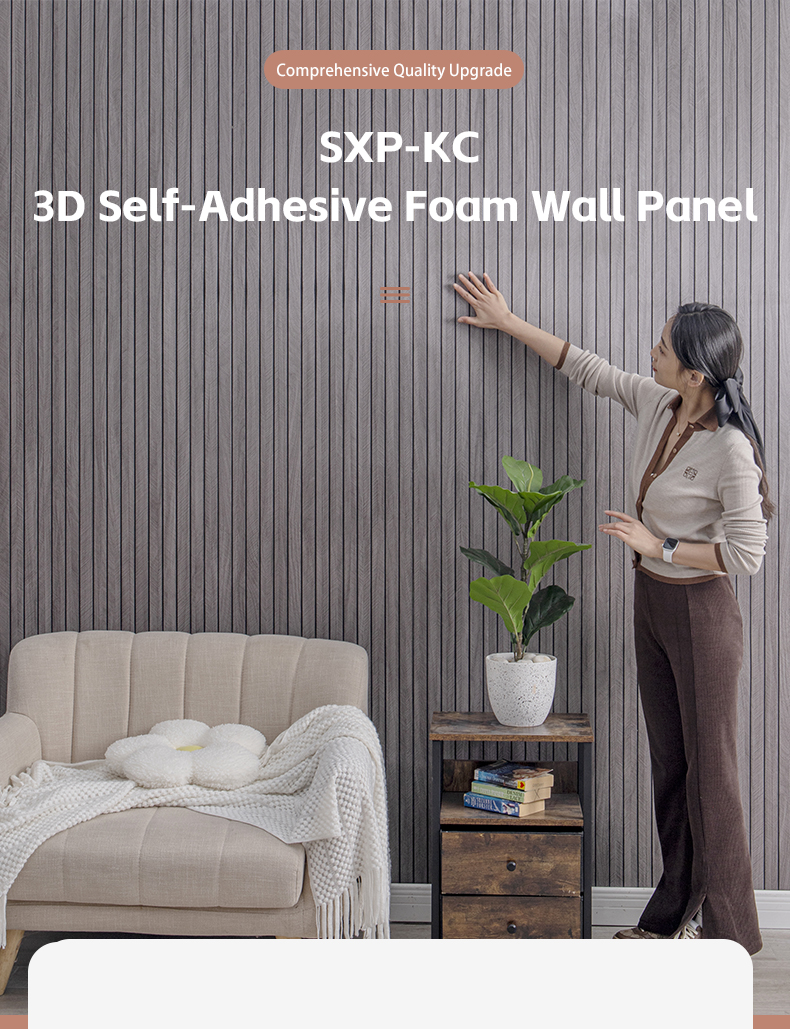
Three-dimensional foam slat wall stickers, identified as model WB-KC, offer a textured, decorative effect. Available sizes include 30×30 cm, 60×60 cm, 30×60 cm, 40×300 cm, 60×300 cm, and 120×300 cm, with custom lengths available. The thickness is 2.8 mm, and the material is PVC.
WPC Wall Panels
Wood Plastic Composite (WPC) wall panels are used for interior decoration and building materials applications. The SXP WB-WPC panel has a size of 160×23×2900 mm, with 16 pieces per box and weight options of 690 g/m, 810 g/m, and 830 g/m. WPC is often chosen for its wood-like appearance combined with dimensional stability.
Verification Points Before Placing a Bulk Order
Experience in wall panel trading shows that price differences across suppliers are rarely accidental. The main drivers include raw material quality (virgin versus recycled material), thickness, formulation, quality control procedures, and certification status.
Low-cost products often use recycled material, which can lead to dimensional deviation, fading, odor, and incomplete compliance documentation. For export shipments, missing certificates may result in customs detention, return shipment, or financial loss. Buyers should request full valid certificates before placing an order and should not make purchasing decisions purely on unit price.
For wall panels exported to the EU, buyers should verify compliance with CE-CPR construction product certification where applicable, REACH hazardous substance regulation, and PPWR packaging rules. Missing or invalid documentation can disrupt customs clearance and create downstream liability.
Installation and Site Requirements
Self-adhesive wall panels are designed for dry installation. The installer peels off the protective film and presses the panel onto a smooth, solid base. No cement or glue is required. A utility knife, scraper or roller, tape measure, spirit level, and adhesive remover are typically sufficient.
The base surface must be flat, dry, and free of dust and grease. Suitable surfaces include cement floors, tiled surfaces, latex-painted walls, plasterboard, plywood, and other smooth, solid bases. Powdery, sandy, or loose surfaces are not suitable. For floor applications, the base must meet the required strength and have no hollow spots.
These panels can be used in old house remodeling, apartment renovation, hotel room makeovers, homestay renovations, chain store refurbishments, office fit-outs, temporary exhibition booths, and modular interior projects. They are intended for indoor use in normal room temperature and typical humid environments such as bathrooms and dry areas of kitchens. Long-term exposure to strong sunlight should be avoided.
Market Trends Worth Watching
Wood-based wall panels remain a significant segment. According to WiseGuyReports, wood wall panel systems are projected to grow at a 6.2% CAGR through 2035, after holding nearly 31% of global installations in 2024. This growth suggests continued demand for natural-looking surfaces, including wood-grain PVC, WPC, and PET panel alternatives.
At the same time, regulatory scrutiny in export markets is increasing. Buyers who integrate compliance checks and material verification into their sourcing process are better positioned to avoid disruptions than those who rely only on visual comparisons.
Sourcing from a Manufacturer vs. Trading Company
Buyers often ask whether it is better to work directly with a factory. A manufacturer can typically provide more transparent control over material selection, thickness, pattern development, and packaging. However, manufacturer-direct sourcing also requires buyers to verify production capacity, quality control processes, and documentation accuracy.
Shanghai Yuanguan Rubber & Plastic Co., Ltd., which supplies products under the SXP Wall Panel brand, operates a factory in Shanghai and describes itself as a professional decorative materials manufacturer. According to its company profile, it holds ISO9001 quality management system certification, owns 48 patented technologies, runs 12 independent brands, and supplies retailers and wholesalers in more than 80 countries and regions. The company also reports an intelligent factory of 7,000 square meters and a team of 200 members including R&D, QC, production, and sales personnel. For buyers, these facts are useful signals, but they should still be verified through samples, audits, and reference checks.
Customization and OEM/ODM Considerations
Wall panel buyers often need customized sizes, colors, patterns, embossing textures, material structures, thicknesses, packaging, and private labels. A manufacturer with OEM/ODM experience can support these requirements. The SXP production team reports a monthly capacity of more than 10 million square meters, a lead time of 30 days, and a minimum order quantity of 1000 square meters. All batches are described as undergoing 100% testing as part of quality control.
For buyers evaluating customization, it is important to confirm not just that customization is possible, but which parameters can be changed without affecting compliance. Changing thickness or material structure may require new test reports in some markets.
Comparison: Self-Adhesive Panels vs. Traditional Rigid Panels
| Evaluation Point | Self-Adhesive Wall Panels (e.g., SXP WB-PVC, WB-KC) | Traditional Rigid Panels (e.g., WPC, traditional wood panels) |
|---|---|---|
| Installation | Peel-and-stick, dry installation, no mortar or glue | Typically requires fixing systems, adhesive, or subframe |
| Surface preparation | Must be flat, dry, smooth, and free of grease | May tolerate less flat surfaces with framing |
| Thickness range | Typically 1.5–6 mm depending on model | Thicker profiles; e.g., WPC panel at 23 mm width profile |
| Application speed | Fast, suitable for renovation and retail fit-outs | Slower, often requires skilled labor |
| Design flexibility | High: wood grain, marble, leather, fabric, 3D textures | High, but often limited by production tooling |
| Compliance documentation | Must be verified per model and material | Must be verified per product standard; fire classification often more common |
The main limitation of self-adhesive panels is that they require a smooth, stable base. They are not appropriate for damaged, powdery, or highly uneven surfaces without prior repair. For large-scale commercial projects requiring specific fire ratings, the panel's classification must be confirmed before specification.
Storage and Handling Risks
Improper storage is a common cause of defects that are later misidentified as manufacturing issues. Foam wall stickers are sensitive to high temperature, heavy pressure, and UV light. PU stone panels are vulnerable to moisture and impact. Linen soft-pack wall stickers can be affected by dust, dampness, and mildew.
General warehouse rules include keeping the warehouse cool and ventilated, storing goods on wooden pallets away from the ground, limiting stacking height, keeping products away from heat and water sources, and following the first-in, first-out principle. Buyers should confirm these conditions with their logistics partners, especially for long ocean shipments.
Framework for Supplier Evaluation
When evaluating wall panel suppliers, use a checklist that covers the full buying decision:
- Material verification: Confirm the actual material (virgin or recycled), thickness, and construction.
- Certification verification: Request reports for the specific model and market, such as SGS RoHS test reports for the EU.
- Regulatory awareness: For EU shipments, verify CE-CPR, REACH, and PPWR requirements.
- Sample testing: Request physical samples to test adhesion, aging, scratch resistance, and dimensional consistency.
- Production capacity: Confirm capacity, lead time, and quality control process.
- After-sales support: Check response time, installation guidance, and issue handling process.
Frequently Asked Questions
What test report is available for SXP wall panels?
Shanghai Yuanguan Rubber & Plastic Co., Ltd. holds an SGS RoHS Test Report (certificate number SHAEC1709394501) issued by SGS-CSTC for 3D wall brick (PE material). The report references RoHS Directive (EU) 2015/863 and is applicable to the EU market. Buyers should request the full report and confirm the material and model covered.
Which SXP wall panel models are available for interior decoration?
The SXP range includes the WB-PVC wall panel (PVC, 2.5 mm), WB-PVC wall sticker (PVC, 2 mm), WB-PET marble wall sticker (PET, 2/2.5 mm), WB-PG leather wall sticker (leather, 6 mm), WB-KC 3D foam slat wall sticker (PVC, 2.8 mm), and WB-WPC wall panel (WPC, 160×23×2900 mm). Model selection depends on the surface texture, installation method, and project requirement.
What should buyers check before exporting wall panels to the EU?
Buyers should verify that the product and packaging comply with applicable EU regulations. These may include CE-CPR construction product certification where required, REACH hazardous substance requirements, and PPWR packaging rules. Missing certificates can lead to customs detention, return shipment, or fines.
Why are some wall panels much cheaper than others?
Price differences are mainly caused by raw materials (virgin versus recycled), thickness, formula, quality control, and certification. Low-cost panels may have dimensional deviation, fading, odor, or incomplete documentation. For export orders, these risks can result in customs problems and after-sales claims.
What surfaces can self-adhesive wall panels be applied to?
Suitable surfaces include cement floors, tiled surfaces, latex-painted walls, plasterboard, plywood, and other smooth, solid bases. The surface must be flat, dry, and free of dust and grease. Powdery, sandy, or loose surfaces are not suitable.
Download the SXP Product Brochure (PDF) for a detailed overview of available wall panel series and specifications.