
Wall Panel Qualification Cross-Check: EN 17104:2021 and REACH SVHC Certificates by Model
A wall panel qualification file is only useful if the document can be tied to the exact model being purchased. Suppliers often present a compliance folder containing attestations, test reports and declarations. The buyer's real task is narrower: confirm which document applies to which model, which standard is cited, who issued it, and what the document does not cover. For EN 17104:2021 attestations and REACH SVHC test reports, that model-level cross-check is the difference between a credible qualification pack and a folder of general claims.
This review uses the supplied qualification set for Hisea-Decorative Film& Decorative Panels, a decorative-film and decorative-panel brand whose company record covers WPC wall panels, PVC wall panels, UV board, outdoor wall panels and decking. The documents discussed here are: a WPC Panel EN 17104:2021 Technical Inspection Attestation of Conformity issued by UDEM, certificate number M.2026.06.C1.45891; a PVC Panel CE attestation under EN 17104:2021, certificate number M.2026.206.C145889, covering models 1220*3000*3MM and 300*8*2900MM; and a PVC FILM HS71001 SGS-issued REACH SVHC test report covering 253 Candidate List substances plus 1 potential SVHC, with results ≤0.1% (w/w). Each document has a different role, and each must be read at model level.

Why the first question is not 'Do you have a certificate?'
The first question in a qualification review should be: which model does this document cover? A supplier-level certificate can be valid and still be irrelevant to the purchase order. A WPC panel attestation may cover a particular product construction, while the order includes a different thickness, surface finish or profile. A PVC Panel CE attestation names two models in the supplied scope: 1220*3000*3MM and 300*8*2900MM. A buyer ordering another size should not assume that the same certificate number extends to that size without written confirmation.
The same discipline applies to REACH SVHC screening. A test report for PVC FILM HS71001 is not automatically a finished-panel declaration. It can support the film component within the panel system, but it does not by itself qualify every panel construction, adhesive, coating or accessory in the finished product. The buyer needs to know whether the report is being used as a component-level input or as a finished-product claim.
What the supplied qualification documents actually cover
The supplied documents can be organised into three evidence layers. The first is a WPC Panel attestation under EN 17104:2021. The second is a PVC Panel CE attestation under the same standard, with two named models. The third is a component-level REACH SVHC test report for PVC FILM HS71001. They should not be collapsed into one general 'compliance certificate' because they answer different questions.
| Document | Issuer / standard | Product or model scope | What the buyer should cross-check |
|---|---|---|---|
| WPC Panel EN 17104:2021 Technical Inspection Attestation of Conformity, certificate number M.2026.06.C1.45891 | UDEM; EN 17104:2021 | WPC Panel. The covered model list must be read from the attestation itself; no WPC model should be treated as covered only because the certificate number exists. | Match every WPC SKU, profile, thickness and finish in the purchase order against the model scope stated in the attestation. |
| PVC Panel CE attestation under EN 17104:2021, certificate number M.2026.206.C145889 | CE attestation; EN 17104:2021 | Models 1220*3000*3MM and 300*8*2900MM. | Confirm that the ordered dimensions, thickness and product description are exactly those named models. Other sizes require separate written coverage. |
| PVC FILM HS71001 SGS-issued REACH SVHC test report | SGS; REACH SVHC testing | PVC FILM HS71001. Covers 253 Candidate List substances plus 1 potential SVHC; reported results are ≤0.1% (w/w). | Confirm that the PVC film grade, colour or reference matches the film used in the panel, and treat the result as a point-in-time component test. |
The table also shows why a single folder-level statement is weak. The WPC attestation, the PVC attestation and the PVC film test report each have a different object of evidence. A buyer who checks only the supplier name may accept a document that is real but out of scope. A buyer who checks the model list can detect that risk before the purchase order is released.
How to cross-check a wall panel attestation by model
A model-level review does not require a legal interpretation of every standard. It requires a disciplined comparison between the commercial order and the qualification document. The following seven checks are practical for procurement and quality teams.
1. Match the commercial model to the certificate model
Start with the purchase order, not the certificate. List the exact model codes, dimensions, thickness and surface description. Then open the certificate and locate the corresponding model entry. For the PVC Panel CE attestation M.2026.206.C145889, the supplied scope names 1220*3000*3MM and 300*8*2900MM. If the order uses a different size, the certificate should not be treated as covering that size unless the supplier provides a written extension or a separate document.
2. Check the product description, not only the number
A certificate number is an identifier, not a scope statement. Read the product description on the document. For the WPC Panel attestation M.2026.06.C1.45891, the document is a Technical Inspection Attestation of Conformity under EN 17104:2021 issued by UDEM. The model coverage must be checked against that attestation. A number alone does not tell the buyer which profiles, thicknesses or finishes are included.
3. Confirm the standard edition
The supplied documents cite EN 17104:2021. The year matters because a qualification review should record the standard edition used for the attestation. If a supplier later provides a different edition or a general statement without an edition, the buyer should ask for the document that matches the project specification.
4. Identify the issuer and the document type
The WPC attestation is issued by UDEM. The PVC document is a CE attestation under EN 17104:2021. The PVC film report is issued by SGS. These are not interchangeable document types. A CE attestation, a technical inspection attestation and a REACH SVHC test report serve different purposes. The buyer should record the issuer, document type and certificate or report number in the qualification file.
5. Separate component evidence from finished-product evidence
The PVC FILM HS71001 report is component-level evidence for a PVC film. It covers 253 Candidate List substances plus 1 potential SVHC, with results ≤0.1% (w/w). That is useful information about the film, but it is not a finished wall panel certificate. If the project requires a declaration for the finished panel, the buyer should ask how the film report fits into the finished-product documentation and whether any additional components, adhesives or coatings are covered.
6. Check the report date and change control
A test report is a point-in-time record. The supplied REACH SVHC report should be filed with its date, report number and tested film reference. If the film grade or supplier changes, the old report may no longer represent the current component. The same logic applies to attestations: the buyer should know whether the document is current, whether it has an expiry or review date, and whether any change in formulation or production site affects its validity.
7. Record the result in a model-level qualification matrix
The final step is to record the outcome in a simple matrix. Each purchase-order line should have one of three statuses: covered by the named document, not covered and requiring additional evidence, or covered only at component level. This prevents a general compliance folder from being mistaken for a model-specific approval.

What the WPC Panel UDEM attestation means for buyers
The WPC Panel EN 17104:2021 Technical Inspection Attestation of Conformity, certificate number M.2026.06.C1.45891, is a formal attestation issued by UDEM. Its value in procurement is not that it replaces sampling or factory inspection. Its value is that it gives the buyer a document to compare against the ordered WPC model. The buyer should ask three questions: which WPC model is named, which product construction is described, and does the attestation match the specification in the purchase order.
If the answer to any of those questions is unclear, the document should not be used to close the qualification line. The supplier may be able to provide a model-specific clarification. The buyer should not infer coverage from the existence of the certificate number alone.
What the PVC Panel CE attestation means for buyers
The PVC Panel CE attestation under EN 17104:2021, certificate number M.2026.206.C145889, has a clear supplied model scope: 1220*3000*3MM and 300*8*2900MM. That clarity is useful because it allows a direct comparison with the purchase order. If the order is for one of those two models, the buyer can file the attestation against that line. If the order is for a different model, the buyer should request written confirmation of coverage or a separate document.
The model numbers also show why dimensional data belongs in the qualification matrix. A certificate review that records only 'PVC Panel' is too broad. The review should record the model, thickness and dimensions exactly as they appear in the attestation and in the purchase order. That is the level at which a mismatch can be detected.
Why the PVC FILM HS71001 REACH SVHC report needs separate handling
The PVC FILM HS71001 SGS-issued REACH SVHC test report covers 253 Candidate List substances plus 1 potential SVHC, with results ≤0.1% (w/w). This is a useful component-level screening document. It should be read as a report on PVC FILM HS71001, not as a blanket declaration for every wall panel in the supplier's range.
REACH SVHC screening focuses on Substances of Very High Concern. A report that covers 253 Candidate List substances plus 1 potential SVHC gives the buyer a defined test scope and a reported result threshold. The buyer should still confirm the tested article, the film reference and the relationship between the film and the finished panel. If the panel uses a different film, coating or adhesive, the report should not be extended to that variant without evidence.
Where model-level qualification matters in real projects
Wall panel projects rarely use a single generic product. A hotel decoration package may combine WPC fluted panels in corridors, PVC panels in bathroom or service areas, and UV-coated boards in feature walls. A retail showroom may use a mix of interior decorative wall panels, ceiling panels and custom profiles. Each line can have a different model and a different qualification document.
The supplied application record for WPC wall panels includes interior feature walls, TV backgrounds, living rooms and bedrooms, hotel lobbies and corridors, offices and meeting rooms, restaurants, retail stores and showrooms, and ceilings. The broader product record also covers indoor and outdoor wall decoration, humid environments, moisture- and insect-resistant use, and hygienic wall panels for damp areas. These are exactly the contexts where a buyer should connect the certificate to the model rather than treating compliance as a brand-level attribute.
For a hotel project, the qualification matrix might show the WPC model covered by the UDEM attestation, the PVC model covered by the CE attestation, and the PVC film report for the film used in a related panel. For a bathroom or damp-area project, the buyer should check whether the specified panel model is within the documented scope and whether the film report matches the film actually used. For an exterior or semi-exterior project, the same rule applies: the document must name the model and construction, not only the product family.
Market trend: more SKUs, more document control
The wall panel market is expanding across material types, and that makes document control more demanding. Dataintelo estimated the global PVC panels market at USD 14.8 billion in 2025, with wall panels holding the largest product type share at 42.5%. Grand View Research projects the global wood plastic composites market to grow at an 11.7% CAGR between 2025 and 2033. These figures describe market scale and growth, not the compliance status of any individual product. Their procurement implication is different: as product ranges widen, buyers face more models, more finishes and more documents to reconcile.
That is why a folder-level compliance check becomes less reliable as a product range grows. A supplier may hold a valid attestation for one model and a valid test report for one film, while the buyer's order includes a different combination. Model-level cross-checking is a response to product-range complexity. It does not replace testing or factory audits, but it prevents the most common documentary error: accepting a real document for the wrong model.
Model-level cross-check compared with traditional folder-level acceptance
Traditional compliance review often begins with a supplier folder. The buyer checks whether certificates exist, whether the supplier name is present and whether the documents look current. That approach is fast, but it can miss scope errors. A model-level review is slower at the start, but it produces a clearer decision record.
| Review approach | What it does well | What it can miss | Best use |
|---|---|---|---|
| Folder-level acceptance | Quickly confirms that a supplier has a compliance file and can provide documents on request. | Model mismatch, component-versus-finished-product confusion, expired or superseded reports, and documents that cover only part of the order. | Initial screening before a supplier is shortlisted. |
| Model-level cross-check | Connects each certificate or report to a specific purchase-order line and creates an auditable qualification matrix. | It is more administratively intensive and still does not prove batch-by-batch conformity. It also cannot turn a component report into a finished-product certificate. | Pre-production approval, sample sign-off and repeat-order control. |
The main limitation is administrative load. A buyer who applies model-level cross-checking to every SKU needs a controlled matrix, document owners and revision dates. That effort is justified when the project has multiple models, when the supplier range is broad, or when the product is specified for a hotel, retail or commercial interior. For a simple repeat order of a single verified model, a lighter review may be sufficient. The method should scale with the risk, not become paperwork for its own sake.
How Hisea's supply record supports the document review
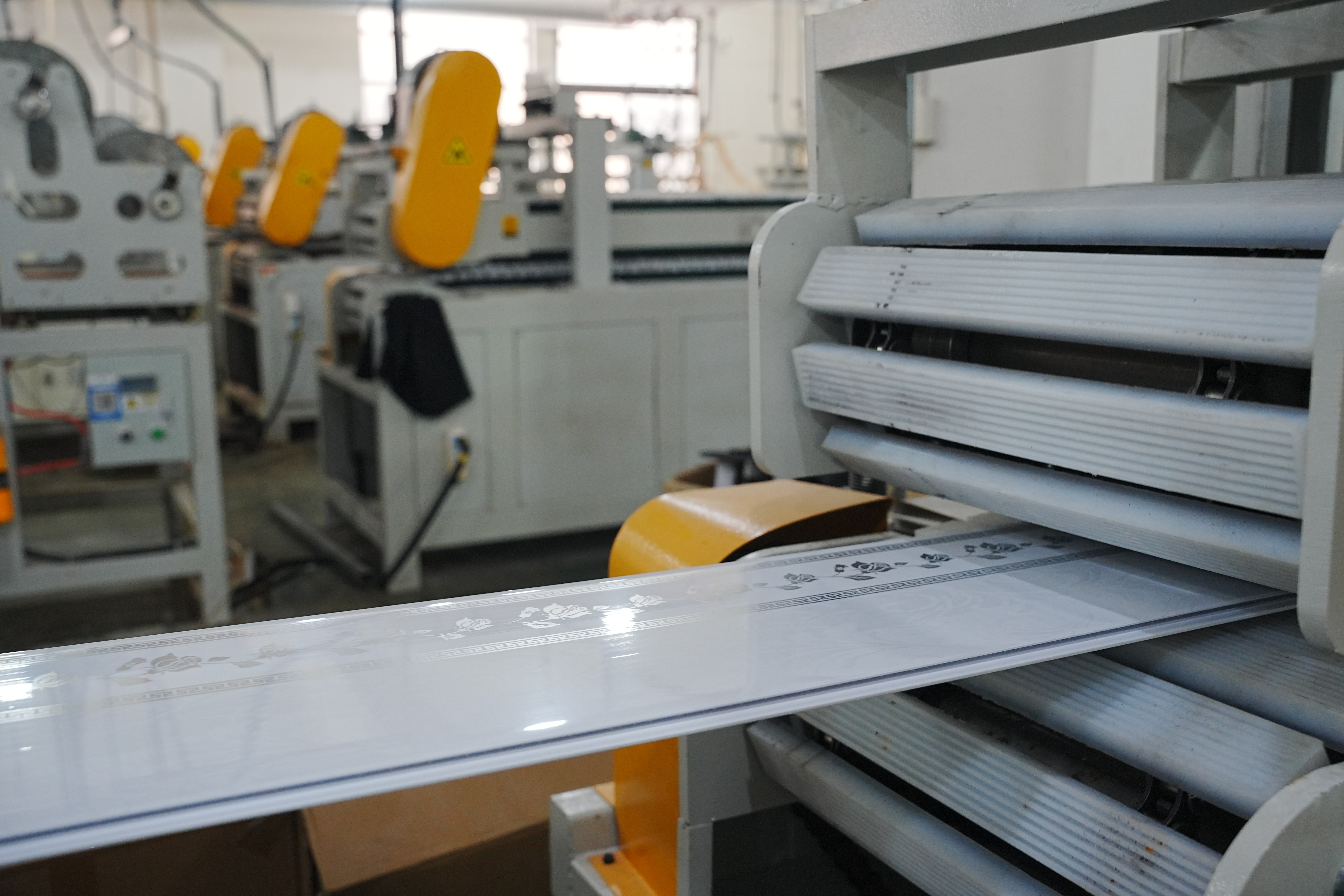
The company record for Zhejiang Highsea New Material Co., Ltd. states that the company was founded in 2002, operates a 20,000 m² factory with 300 employees, and exports about 70% of total sales to South America, Africa, Asia and the Middle East. Its monthly output reaches 20 × 40ft high-cube containers. Production is organised as a continuous process from raw material to finished product, with incoming-material inspection, in-process control points and outgoing batch inspection before loading.
These facts do not replace model-specific qualification documents. They do, however, explain why document control is relevant to repeat orders. A supplier that ships container-level volumes needs a traceable link between the model in the purchase order, the attestation or test report on file, and the batch released for loading. The supplied FAQ also states that trial orders for PVC wall panels normally start from 300 PCS and can be mixed by colour and size, with a typical production lead time of 20-25 days after deposit for a 40HQ container. The purchasing note separately lists MOQ 200 pieces and TT payment terms. Where records differ, the current quotation should be treated as the controlling commercial reference.
Future outlook
Wall panel qualification is likely to become more document-intensive rather than less. Buyers are asking for model-specific attestations, test reports with clear article references, and evidence that the reported result applies to the supplied construction. The three anchors in this review are likely to remain central: the certificate or report number, the model scope, and the issuer or laboratory. A supplier that can present those three elements clearly will be easier to qualify than one that presents a general compliance folder.
For buyers, the practical next step is to build a qualification matrix before the purchase order is finalised. The matrix should list each model, the applicable attestation or report, the issuer, the standard or test scope, and any limitation. That record can then be reused for repeat orders and updated when a model or component changes. The goal is not to collect more paper. It is to make sure the paper in the file matches the product on the order.
Product-family reference: the public catalogue is available for download at Hisea wall panel catalogue.
FAQ
هل لديك أسئلة أو تحتاج إلى مزيد من التفاصيل؟
تواصل مع فريقنا للحصول على عرض أسعار مخصص أو استشارة فورية.
طلب عرض أسعار
املأ النموذج أدناه وسيتواصل معك فريقنا بعرض مقترح مخصص.
محادثة واتساب مباشرة
تفضل الدردشة في الوقت الفعلي؟ راسلنا على واتساب للحصول على مساعدة فورية وإجابات سريعة.
- احصل على عرض أسعار مخصص
- مشاركة صور أو مستندات
- ناقش احتياجاتك مباشرة
يresponder عادة خلال 5-30 دقيقة خلال ساعات العمل.