
Wall Panel Supplier Capability Audit: Output, QC Gates and Certificate Scope
Wall Panel Supplier Capability Audit: Output, QC Gates and Certificate Scope
A Wall Panel supplier's capability claim can survive three tests before a purchase order: documented output that matches the order profile, quality-control gates that catch defects before loading, and certificates whose scope names the model being bought. Zhejiang Highsea New Material Co., Ltd., which trades under the Hisea-Decorative Film & Decorative Panels brand, publishes records that allow importers to run all three checks. This audit does not argue that capacity proves compliance. It separates capacity, process control and certificate scope into three evidence lines, explains what each line can support, and shows where each one stops.
Why a capability claim needs an audit trail
Statements about factory size, monthly output and "strict QC" appear across supplier presentations in the Wall Panel category, so on their own they rarely separate one supplier from another. The useful question for an importer moving from Evaluation into Execution is narrower: which claims can be checked against a document, a certificate or a batch record, and which cannot?
A capability audit works because it keeps three kinds of evidence apart. Output evidence describes how much a supplier can produce and ship. Process evidence describes how defects are caught before shipment. Certificate evidence describes which specific products have been assessed against which standard, by which body, and until when. Blending the three creates a false impression that a large factory is automatically a compliant one, and that a certificate for one model covers every model in the catalogue.
The audit question in this article is therefore not "how big is the factory" but "which claims are documented, which documents match the product, and which gaps remain". For a Wall Panel buyer preparing a first or repeat order, that reframing changes what to request, what to review and what to record as acceptable evidence.
What Zhejiang Highsea's facility records establish
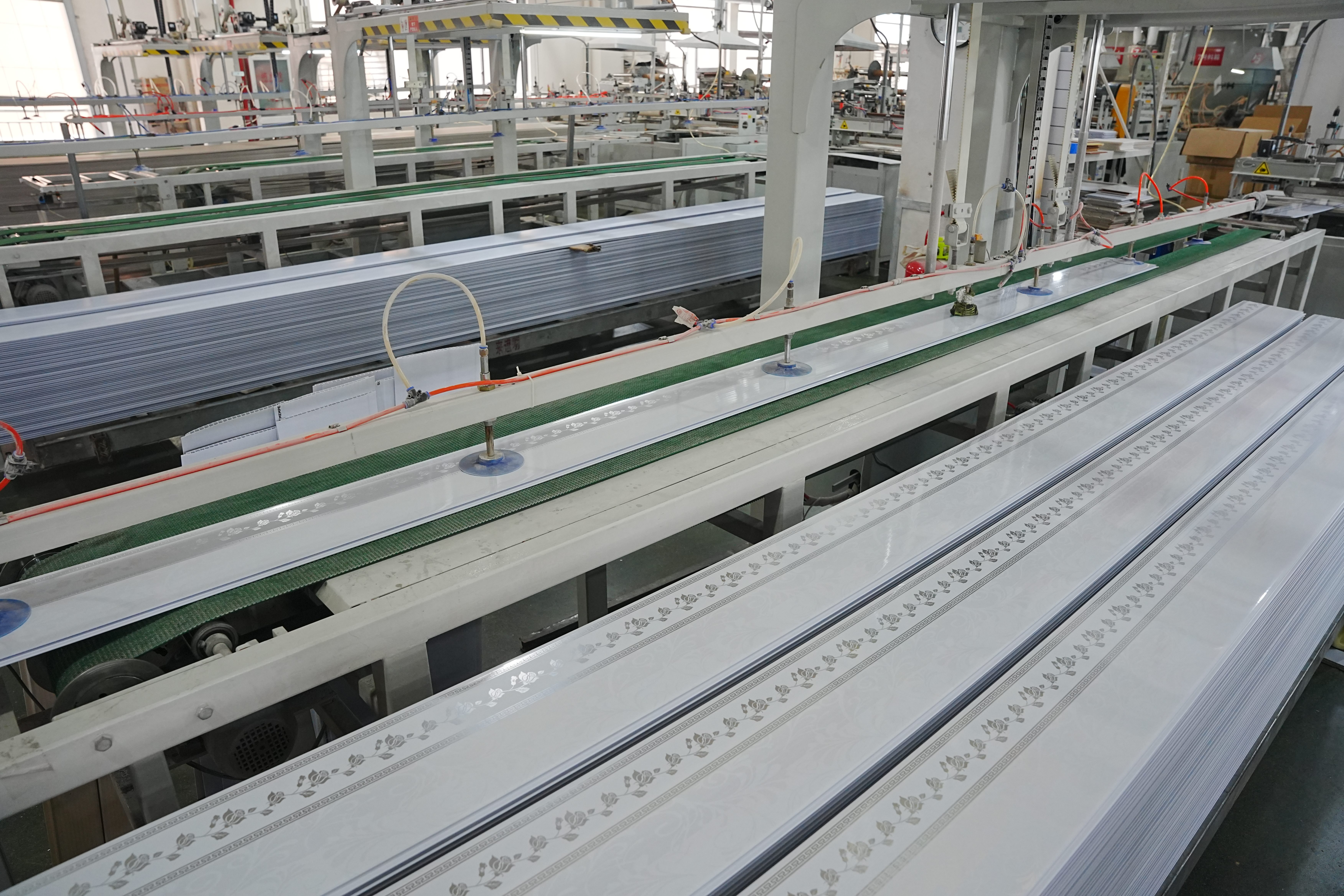
Founded in 2002, the company lists a 20,000 m² facility, approximately 300 staff and a 70% export share, with main markets in South America, Africa, Asia and the Middle East. Production is described as a continuous loop from raw material to finished product: formulation, extrusion or calendering, surface treatment, and cutting and packaging.
On output, the records present two figures side by side: a monthly output of 20 × 40ft high-cube containers and an annual capacity of 400 cabinets. These are order-profile figures. For an importer, they matter because they indicate whether a container-level or multi-container programme fits the supplier's stated rhythm, not because they say anything about product performance.
Three limits belong beside these numbers. Facility area and headcount describe scale, not capability at a specific quality level; two factories of the same size can run very different process controls. Monthly output does not state the mix of panel types, thicknesses or finishes behind that number, so an importer ordering a narrow specification should confirm the figure applies to the relevant line. Most important for the audit, capacity says nothing about compliance. A supplier can ship 20 containers a month and still need to show that the model being bought falls inside a certificate's scope. The article returns to that point when it reads the certificates.

The three QC gates: incoming, in-process and pre-shipment
Quality control at Zhejiang Highsea is described as a three-stage system, and the structure of those stages is itself audit evidence. Each gate covers a different failure mode, so an importer can check them separately.
The first gate is incoming-material inspection. Raw materials are inspected batch by batch to confirm consistency of formulation and process parameters. This is the earliest point at which a formulation drift can be caught, because a change in the incoming compound affects the extruded profile before any finished panel exists. The audit question is whether these batch records are retained and can be tied to a production run.
The second gate is in-process control. Control points are set at key stages to monitor thickness, density, colour difference, surface flatness and texture consistency. These five parameters map closely to the defects that show up at installation: thickness variation appears in joint alignment, density variation in weight and rigidity, colour and texture inconsistency in visible walls, and flatness problems in the finished surface. The audit question is whether the control points are written down with tolerance ranges, because a process check without a stated tolerance is hard to verify.
The third gate is pre-shipment batch inspection. Every batch is inspected before shipment, and loading is arranged only after the batch passes inspection. This gate protects the loading schedule rather than the production run, which is why it is the single most useful record to request in the audit: a pre-shipment record dated before the container leaves the factory ties a specific batch to a specific shipment.
| QC gate | What is inspected | Audit question |
|---|---|---|
| Incoming material | Raw-material batch; consistency of formulation and process parameters | Are batch records retained and linked to a production run? |
| In-process | Thickness, density, colour difference, surface flatness, texture consistency | Are control points written down with stated tolerances? |
| Pre-shipment | Every batch before loading | Is the inspection dated before the container departs? |
The capability record also states 100% testing. That phrase needs a definition before it can be audited, because it can mean every panel checked on every parameter, every batch sampled on a subset of parameters, or a final visual check. An importer should ask what 100% refers to, which parameters are covered and what the pass criteria are. Without that definition, the claim is a starting question rather than a conclusion.
Certificate scope: what EN 17104:2021 coverage means for WPC and PVC panels
Two EU certificates sit behind the Wall Panel range, and both are Technical Inspection Attestations of Conformity issued by UDEM Uluslararası Belgelendirme Denetim Eğitim Merkezi San. ve Tic. A.Ş. against EN 17104:2021. The PVC Panel certificate, number M.2026.206.C145889, was issued on 10 August 2026 and runs to 9 August 2031. The WPC Panel certificate, number M.2026.06.C1.45891, was issued on 7 August 2026 and runs to 9 August 2031.
| Certificate | Product scope | Standard | Issuer | Issued | Valid until |
|---|---|---|---|---|---|
| M.2026.206.C145889 | PVC Panel (listed model types) | EN 17104:2021 | UDEM | 10 Aug 2026 | 9 Aug 2031 |
| M.2026.06.C1.45891 | WPC Panel (listed model types) | EN 17104:2021 | UDEM | 7 Aug 2026 | 9 Aug 2031 |
The audit value of these documents lies in their model lists, not in the headline. The PVC certificate names a specific set of product types, including 300 × 8 × 2900 mm, 300 × 9.5 × 2900 mm, 300 × 10 × 2900 mm, 300 × 600 mm, 595 × 595 mm, 600 × 600 mm, 603 × 603 mm, and several 1220 × 3000 mm variants at 2.8, 3.0, 3.2, 5.0 and 7.5 mm. The WPC certificate names profiles including 160 × 24 mm, 160 × 22 mm, 160 × 20 mm, 150 × 10 mm, 150 × 15 mm, 140 × 18 mm, 140 × 13 mm, 150 × 13 mm, 194 × 10 mm, 180 × 20 mm, 200 × 11 mm, 200 × 20 mm, 50 × 50 mm, 50 × 10 mm, 50 × 150 mm and 50 × 90 mm, alongside several 1220 × 3000 mm flat panels.
For the buyer, the rule is simple and easy to apply: the model in the purchase order should appear in the certificate's type list. A certificate that covers 160 × 24 mm does not automatically cover 160 × 16 mm, and a certificate for a PVC profile does not transfer to a WPC profile. This is not a technicality. It is the difference between a document that supports a specific claim and a document used as general decoration.
Two scope limits should be recorded in the audit file. EN 17104:2021 is the standard named on these certificates; it is not the same as EN 13245-2, which is a separate PVC-U profile standard, and it is not a fire-classification framework. Fire performance in the EU, North America and China is normally framed through EN 13501-1, ASTM E84 and GB 8624 respectively, and those systems use different methods and classifications. A buyer whose project specifies a fire class should request the product-specific fire report separately and check that the standard edition, product construction and laboratory accreditation match the requirement. Commercial procurement guidance makes the same point: product match, standard edition and laboratory scope should all be confirmed before a compliance claim is accepted.
REACH SVHC screening for PVC Film HS71001
A separate document covers material-level screening for the PVC film used in the panel range. SGS test report SHAHL26023493001, dated 10 August 2026, records screening under Regulation (EC) No 1907/2006 for 253 substances on the Candidate List and one potential SVHC in the submitted sample. The report covers PVC FILM, Style No. HS71001, supplied by Zhejiang Highsea New Material Co., Ltd., and records each screened substance at or below 0.1% (w/w).
The audit reads this document for what it is. It is a material screening report on a specific film style, not a finished-panel REACH declaration and not a substitute for the model-level EN 17104:2021 attestations. Its buyer value sits at the input-control stage: a film style screened against the Candidate List gives the importer a material reference to check against incoming batch records and against the finish specified in the order.
Three questions keep the screening in scope. Does the order actually use HS71001, or a different film style? Is the report still current relative to the supplier's formulation? And does the project require substance restrictions beyond the Candidate List, such as specific restricted substances under other regulations? The report answers the first question for HS71001; the second and third belong to the buyer's own compliance file.
What capacity does not prove
It is worth stating the audit boundary directly, because it is the point most likely to be blurred in a supplier presentation. A 20,000 m² factory, approximately 300 staff and 20 containers a month demonstrate that a supplier can produce and ship at that rhythm. They do not demonstrate that a given panel meets a given standard. Compliance comes from the certificate's model list, the test report's material scope and the destination market's requirements, not from the size of the factory.
The same boundary applies to QC. A three-stage system shows that controls exist and where they sit. It does not, on its own, show that a particular batch passed a particular parameter at a particular tolerance. That evidence comes from the batch record and the pre-shipment record tied to the order.
Read this way, the three evidence lines reinforce each other without substituting for each other. Capacity answers "can they deliver the volume". QC answers "how do they catch defects". Certificates answer "which products have been assessed, against what, and until when". An audit that keeps these answers separate is more useful than one that averages them into a single impression of the supplier.
Application fit: where these capabilities meet buyer needs
The capability set aligns most directly with buyers running container-level programmes across interior and exterior decoration. WPC and PVC panels are used in interior feature walls, TV backgrounds, living rooms and bedrooms, hotel lobbies and corridors, offices and meeting rooms, restaurants, retail stores and showrooms, and ceilings. Exterior and moisture-prone applications require the buyer to check the specific product and installation detail against the intended exposure, because the certificate list and the application range are different pieces of evidence.
The OEM side of the capability record matters where a buyer needs a private pattern, colour, packaging or size. The manufacturer supports custom pattern development, custom colour matching, custom packaging and custom size customisation for OEM production and OEM orders. For an importer, the audit question here is not whether customisation is offered, but whether the customised model still falls inside a certificate's scope or requires separate assessment. Custom colour and custom packaging usually sit outside the certificate's type list, and the buyer should record that gap rather than assume coverage.
Order-profile figures belong in the same review. The capability record lists a production lead time of 20–30 days, an MOQ starting from 300 pieces on trial orders that can be mixed by colour and size, and a typical lead time of 20–25 days after deposit for a 40HQ container in the FAQ. The two lead-time statements differ by context, so the importer should confirm the figure that applies to the actual order profile rather than treating either number as universal.
A documented case illustrates the pattern without becoming general proof. A 40ft high-cube container was supplied to buyers in the Philippines, Poland, Palestine and Portugal for indoor and outdoor decoration and resale, within a five-year relationship, with reported installation results, correct sizes and no colour difference. The case is evidence of a repeat-order pattern for that buyer; it is not evidence that every future batch will match, and it should be read alongside the QC gates rather than instead of them.
How importers can run the capability audit
The audit becomes practical when it is reduced to a short sequence that can be run before a purchase order and repeated before each shipment.
- Confirm that the legal entity and factory address on the certificate match the supplier being contracted. Certificates name a legal entity; a trading name alone is not enough.
- Request the certificate copy for each model in the order and check the model against the type list. Record the certificate number, issuer, standard and validity dates in the audit file.
- Ask for the pre-shipment inspection record and the incoming-material batch record for the order, and confirm they are dated before loading. This step ties the QC system to a specific shipment.
- Clarify what "100% testing" covers, which parameters are checked and what the pass criteria are. Record the answer as a definition, not as a claim.
- Check whether the film style in the order matches the SVHC report (HS71001) and whether the project needs substance restrictions beyond the Candidate List.
- Match the output and lead-time figures to the order profile: container count, mix of models, customisation and destination. Confirm the applicable lead time for that profile.
- Record gaps explicitly. A model outside the certificate list, a custom colour outside the type list, or a fire class not covered by the supplied documents is a gap to be resolved, not a detail to be averaged into the overall impression.
This sequence is deliberately narrow. It does not replace a factory audit, a sample test or a project-specific compliance review. It does give the importer a documented basis for the capability claims a supplier presents, and a record of where each claim stops.
Future outlook
The direction of buyer expectations is toward model-level evidence rather than brand-level assurance. As EU buyers and their customers ask for certificate copies that name the exact model and validity period, the audit trails described here become part of routine supplier qualification rather than a one-off exercise. The same pressure applies to material-level screening: a film-style SVHC report is more useful when it can be tied to the batch records and to the finish specified in the order.
This is an analytical reading of the available evidence, not a forecast of market size or demand. What the records support is narrower: the supplier has documented output, a defined three-stage QC structure, model-level EN 17104:2021 attestations and a material-level SVHC screening report for one film style. Those records give an importer something to check. They do not remove the need to check.
For buyers assembling an audit file, the product catalogue (Bamboo Charcoal Wall Panel series) is available for download at the public catalogue link and should be read together with the certificate copies, using the model list as the reference point for both.
FAQ
What are the standard WPC wall panel sizes?
Common standard sizes for fluted WPC wall panels include 160 × 22 mm, 160 × 24 mm, 150 × 15 mm, 160 × 16 mm, 160 × 13 mm, 195 × 12 mm and 195 × 14 mm. The WPC EN 17104:2021 certificate lists a broader set of profiles, including 160 × 20 mm, 140 × 18 mm, 140 × 13 mm, 150 × 13 mm, 194 × 10 mm, 180 × 20 mm, 200 × 11 mm, 200 × 20 mm, 50 × 50 mm, 50 × 10 mm, 50 × 150 mm and 50 × 90 mm, together with several 1220 × 3000 mm panels. Buyers should confirm the exact size against the certificate list before ordering.
What is the MOQ and typical lead time for a wall panel order?
Trial orders normally start from 300 pieces and can be mixed by colour and size. The capability record lists a production lead time of 20–30 days, and the FAQ lists a typical lead time of 20–25 days after deposit for a 40HQ container. Importers should confirm the applicable figure for the specific order profile, including model mix and customisation.
How are PVC wall panels installed?
Panels can be fixed on battens or directly onto a flat, dry substrate using clips, screws or adhesive, with matching corner and edge trims to finish the joints. Cutting is done with standard woodworking tools. Installation is fast, and no painting or finishing is needed on site.
Where are WPC wall panels typically used?
Interior feature walls, TV backgrounds, living rooms and bedrooms, hotel lobbies and corridors, offices and meeting rooms, restaurants, retail stores and showrooms, and ceilings. Exterior and moisture-prone applications require the specific product and installation detail to be checked against the intended exposure.
What do the EN 17104:2021 certificates actually cover?
Two UDEM Technical Inspection Attestations of Conformity cover PVC Panel and WPC Panel product types against EN 17104:2021. The PVC certificate M.2026.206.C145889 runs from 10 August 2026 to 9 August 2031, and the WPC certificate M.2026.06.C1.45891 runs from 7 August 2026 to 9 August 2031. Coverage is limited to the models named in each certificate's type list, so the model in the purchase order should be checked against that list. The certificates are not fire-classification documents; fire performance requires separate product-specific evidence.
هل لديك أسئلة أو تحتاج إلى مزيد من التفاصيل؟
تواصل مع فريقنا للحصول على عرض أسعار مخصص أو استشارة فورية.
طلب عرض أسعار
املأ النموذج أدناه وسيتواصل معك فريقنا بعرض مقترح مخصص.
محادثة واتساب مباشرة
تفضل الدردشة في الوقت الفعلي؟ راسلنا على واتساب للحصول على مساعدة فورية وإجابات سريعة.
- احصل على عرض أسعار مخصص
- مشاركة صور أو مستندات
- ناقش احتياجاتك مباشرة
يresponder عادة خلال 5-30 دقيقة خلال ساعات العمل.