
Wall Panel Supplier Vetting: Signals That Outlast an Order
Wall Panel Supplier Vetting: Signals That Outlast an Order
Wall panel programmes rarely go wrong on the first container. They go wrong after it — a certificate enters its renewal cycle and nobody holds the updated version, a colour run drifts once a resin or film batch changes, a ten-container order lands while the factory is already booked, and the person who remembered the acceptance criteria has left the buyer's team. Long-term supplier evaluation is the discipline of judging whether a wall panel partner can reproduce the same board, the same file set and the same scheduling commitment across multiple cycles, SKUs and markets.
That is a different question from sample approval. Sample approval asks whether a board can be made correctly once. Sustainability assessment asks whether the same factory can make it correctly repeatedly, and whether anything in its documentation proves it. The framework below is built for the second question: which signals are worth checking before the first order, and when they should be re-checked afterwards.
Zhejiang Highsea New Material Co., Ltd. is a decorative materials manufacturer based in Zhejiang, China, founded in 2002, producing WPC wall panels, PVC wall panels, UV board, outdoor wall panels and WPC decking, marketed under the brand Hisea-Decorative Film & Decorative Panels. Its published record — certificate numbers, production structure, quality-control stages and export composition — can serve as the worked example for this evaluation, without relying on marketing language.
What Changes Between an Order and a Programme
At sample stage, buyers look at four things: colour, surface, dimensions and price. From the second and third shipment onward, a different set of variables decides whether the supply can be sustained.
- Document continuity. A certificate issued in 2026 still has to be valid when the project runs into 2031. Who tracks the expiry, and who re-issues if the scope changes?
- Process repeatability. Is colour consistency held by a named technician's experience, or by tracked process control points that survive staff turnover?
- Capacity headroom. A line running 20 × 40ft high-cube containers a month has a certain amount of scheduling slack. What happens to that slack when a ten-container order arrives?
- Export structure. Which markets the factory already serves repeatedly determines which trade, inspection and after-sales habits it has actually practised.
Moving these four questions to the front of the evaluation is considerably cheaper than discovering them during the third shipment.
Certification Continuity: What Can Be Verified, and Until When
Certificates are usually treated as a static image — present or absent. For repeat programmes, the more useful reading is coverage, validity window and issuing body, because those three determine whether the document still holds when the delivery cycle repeats.
Hisea's public record currently contains three documents that sit at different layers of the product.
| Document | Standard / regulation | Issuer | Number | Validity | Market |
|---|---|---|---|---|---|
| Technical Inspection Attestation of Conformity — PVC Panel | EN 17104:2021 | UDEM Uluslararasi Belgelendirme Denetim Egitim Merkezi San. ve Tic. A.S. | M.2026.206.C145889 | Issued 2026-08-10, expires 2031-08-09 | EU |
| Technical Inspection Attestation of Conformity — WPC Panel | EN 17104:2021 | UDEM (UDEM Uluslararası Belgelendirme Denetim Eğitim Merkezi San. ve Tic. A.Ş.) | M.2026.06.C1.45891 | Valid 2026-08-07 to 2031-08-09 | EU |
| SVHC test report — PVC FILM (Style No.: HS71001) | Regulation (EC) No 1907/2006 (REACH) | SGS | SHAHL26023493001 | Issued 2026-08-10 | EU |
Each document answers a different question. The two UDEM attestations concern the panel body — one for the PVC panel, one for the WPC panel, both under EN 17104:2021. The SGS report concerns the surface material: SVHC screening of PVC FILM, Style No. HS71001, covering 253 substances in the Candidate List plus 1 potential SVHC, with results at ≤ 0.1% (w/w) in the submitted sample.
That distinction deserves to be pulled out during evaluation. In many wall panel compliance narratives the finished panel and the surface film are described as one block, and buyers inherit the ambiguity. A supplier that can state which report belongs to which material layer is giving the buyer something that can actually be re-checked when a customer or a project consultant asks a second question.
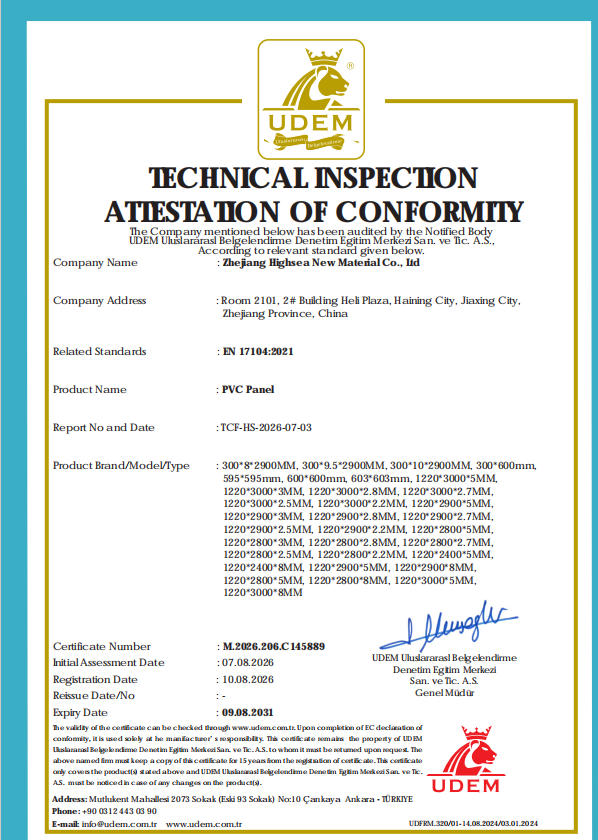
UDEM Technical Inspection Attestation of Conformity M.2026.206.C145889, issued to Zhejiang Highsea New Material Co., Ltd. for PVC Panel under EN 17104:2021, valid to 09.08.2031.
Model Scope: The Page Buyers Most Often Skip
Certificate numbers and expiry dates usually get copied into the procurement sheet. The model list rarely does — and that is exactly where repeat orders tend to trip.
The UDEM attestation for the PVC Panel covers 300*8*2900MM, 300*9.5*2900MM, 300*10*2900MM, 300*600mm, 595*595mm, 600*600mm, 603*603mm, 1220*3000*5MM, 1220*3000*3MM, 1220*3000*2.8MM, 1220*3000*7.5MM, 1220*3000*3.2MM and 1220*2900*3.2MM. The attestation for the WPC Panel covers 160*24MM, 160*22MM, 160*20MM, 150*10MM, 150*15MM, 140*18MM, 140*13MM, 150*13MM, 194*10MM, 180*20MM, 200*11MM, 200*20MM, 50*50MM, 50*10MM, 50*150MM, 50*90MM, 1220*3000*5MM, 1220*3000*3MM and 1220*3000*2.8MM.
If the purchasing specification sits inside that list, the task is to record the number and track the expiry date. If it sits outside, the scope needs extension or separate evaluation — a supplier being the same factory does not automatically extend a certificate to a size it does not name. In multi-year programmes, specification adjustments are routine. Every adjustment should re-trigger a scope confirmation rather than assuming continuity.
Process Control: Three Stages That Decide Whether Two Batches Match
Repeat-order quality problems are rarely a single failed batch. More often they are near-misses that no longer fit together — a slightly different sheen, a marginally different thickness, a groove depth that reads differently on a completed wall.
Hisea structures quality control across three stages:
- Incoming materials — raw materials are inspected batch by batch to keep formulation and process parameters consistent.
- In-process — control points at key stages monitor thickness, density, colour difference, surface flatness and texture consistency.
- Outgoing goods — every batch is inspected before shipment, and loading is arranged only after the batch passes inspection.
Each stage addresses a different failure mode. Incoming inspection addresses raw-material substitution: a changed supplier or lot shifts formulation parameters downstream. In-process control addresses batch drift from equipment condition, tooling wear or coating variation. Outgoing inspection is the final intercept — everything has passed, but the batch may still not be shippable.
The useful follow-up question for a repeat buyer is not 'do you have quality control', but which of these three stages leaves a record, how long that record is kept, and whether it is still retrievable after staff changes. That question tends to separate suppliers who only run a final inspection from those who control the process.
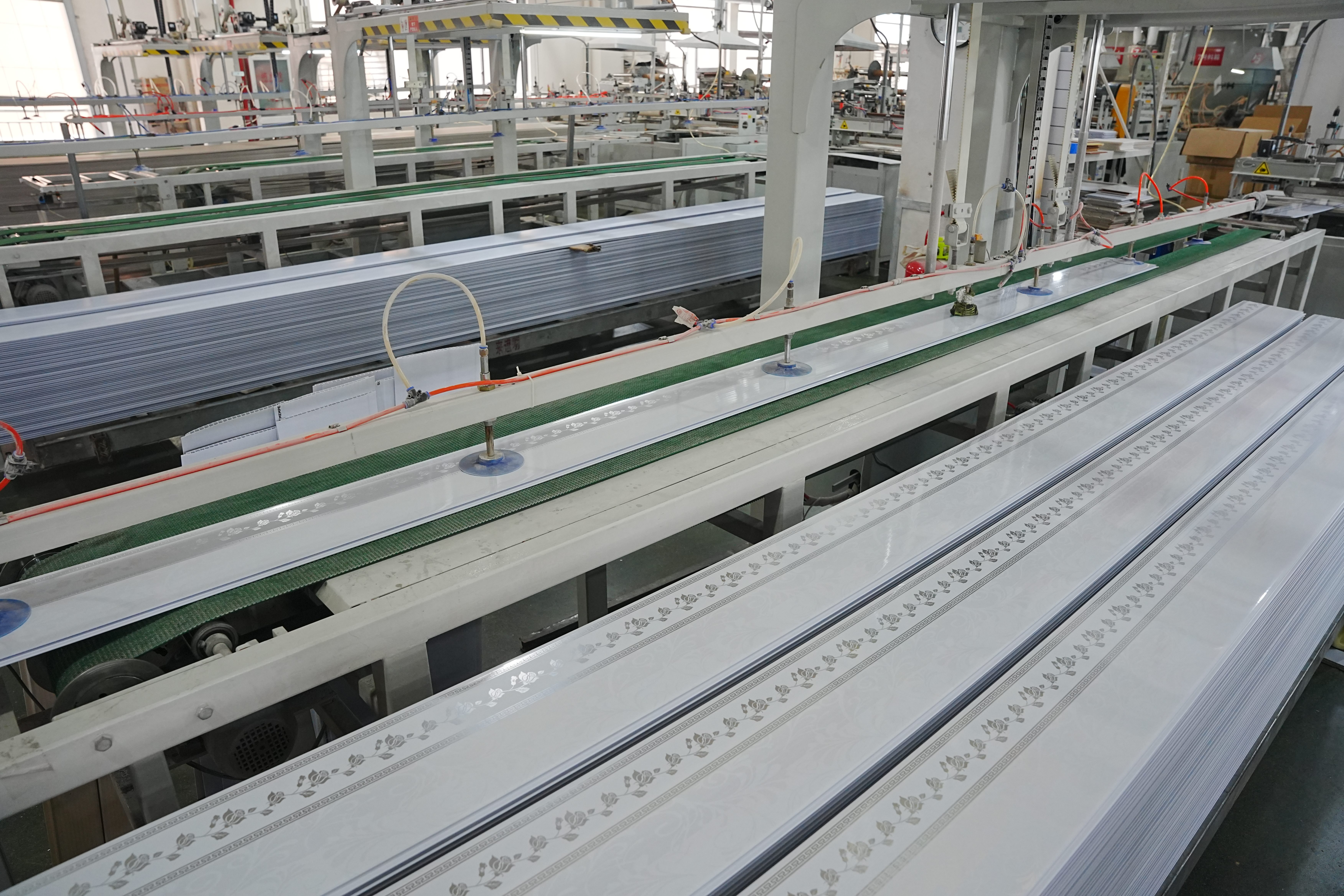
Continuous production from formulation to cutting and packaging keeps formulation, process parameters and surface treatment inside one record system.
Continuous Flow: What Raw-Material-to-Finished-Product Actually Buys
Hisea organises production as a continuous process from raw material to finished product: formulation — extrusion/calendering — surface treatment — cutting and packaging.
The value of that structure for repeat orders is control, not appearance. When an intermediate step is outsourced, the formulation, process parameters or surface-treatment records break at the handover point. If colour difference or thickness drift appears in the finished panel, the traceable path is short but shallow — it stops at the subcontractor's door. A continuous flow keeps the same questions inside one record system, so an explanation can be reconstructed rather than implied.
This is why plant structure belongs in a long-term evaluation at all. It determines whether a supplier can answer a technical complaint with evidence or only with reassurance.
Capacity Depth: Read Headroom, Not Peak Numbers
Capacity figures are easy to misread as 'bigger is better'. For a repeat programme the question is narrower: when the volume I need falls inside this factory's normal scheduling band, how much slack remains?
Hisea's published capacity baseline is 20,000 m² of factory space, approximately 300 employees, 400 cabinets of annual capacity and 20 × 40ft high-cube containers per month. The company has operated since 2002, with a 70% export share concentrated in South America, Africa, Asia and the Middle East.
Those figures support three specific judgements:
- Monthly container volume versus the order shape. At 20 × 40HQ per month, an order in the several-container range still sits inside routine scheduling rather than requiring a line expansion.
- Output versus workforce. 400 cabinets a year alongside roughly 300 employees indicates a production organisation where people remain a major control variable — which makes process discipline, rather than a single machine, the deciding factor in consistency.
- Export share as evidence of cross-border routine. A 70% export ratio means most output passes through export documentation and container loading as a matter of daily practice, not as an exception.
All three point at the same question for a buyer: how close is this factory's normal operating state to the order pattern I will place? The closer it is, the lower the friction in each repeat cycle.
Application Fit Across Interior, Exterior and Wet-Area Projects
Wall panel application determines what should be evaluated. In interior and exterior wall decoration projects, working conditions typically involve indoor and outdoor use, humid environments and normal ambient temperature. Functional requirements centre on decorative wall panel performance, moisture and insect resistance, and suitability for both interior and exterior zones — with hygienic wall panels replacing tiles or coatings in damp areas. Special requirements commonly include waterproofing, termite resistance, low formaldehyde and easy cleaning.
Material families divide the use cases fairly clearly:
- WPC wall panel — interior feature walls, TV backgrounds, living rooms and bedrooms, hotel lobbies and corridors, offices and meeting rooms, restaurants, retail stores and showrooms, and ceilings. The material offers moisture and rot resistance, which is why it is used where solid timber would tend to move.
- PVC wall panel — a non-porous surface that does not absorb water or hold odours, widely chosen for clinics, food preparation rooms, laboratories and public washrooms where routine cleaning demands are high.
- UV board — a UV cured coating forming a dense sealed film, used for kitchen and bathroom cabinets, TV background walls, hotel room furniture and retail fixtures where the decorative face is wiped frequently.
For long-term supply, the practical consequence of this spread is coverage within a single project. A hotel scheme typically combines guest-room feature walls, corridors, public washrooms and some exterior cladding. If one factory supplies all of those zones, colour and surface consistency are easier to hold, and replenishment matching costs less when a floor is added two years later.
One documented case offers a usable sample. A customer recorded in the PH, PL, PS and PT markets ordered a 40-foot high-cube container for resale and for personal decoration, over a five-year relationship. The recorded outcome was a good installation result, correct dimensions and no colour difference, with orders continuing. The value here is not the order size — it is that same-specification supply across several years can be recorded at all.
Market Direction: Cheap Panels Are Not the Hard Part
Two published market signals belong in the background of any long-term evaluation.
Dataintelo's PVC panels market report, published in March 2026, estimated the global PVC panels market at USD 14.8 billion in 2025, with wall panels holding the largest product-type share at 42.5%. Grand View Research, in a September 2026 publication, estimated the global wood plastic composites market at USD 8.9 billion in 2025, projected to reach USD 21.5 billion by 2033 at an 11.7% CAGR.
Read together, these figures do not say 'the market is large'. They say the demand structure is moving. Wall panels holding the largest share of PVC panels indicates a mature category; the higher growth rate on the WPC side indicates that material substitution is still underway. For buyers, that suggests a supplier portfolio will increasingly need to cover a mature category and a growing one at the same time — and a factory that runs both reduces the friction of switching.
Hisea's product line spans WPC wall panel, PVC wall panel, UV board, outdoor wall panel and WPC decking. In evaluation terms, that means a project moving from PVC to WPC, or from interior to exterior, does not have to restart the full supplier introduction. It does not mean validation can be skipped: each material family still needs its own samples, specifications and compliance documents.
Where This Case Does Not Extend
Any supplier evaluation framework needs stated boundaries, otherwise it becomes another piece of promotional material.
- Certificate scope is finite. Both UDEM attestations apply to the model lists they name. Sizes outside those lists are not automatically covered.
- Material-layer documents are not product-wide documents. The REACH SVHC report covers PVC FILM, Style No. HS71001 — not every finished SKU in the range.
- EN 17104:2021 is not a reaction-to-fire classification. It is a conformity attestation at product level. Where a project specification or destination market requires a fire class, a separate product-specific fire test document is needed.
- Export structure is regionally weighted. With 70% of exports concentrated in South America, Africa, Asia and the Middle East, repeat-trade experience is deepest in those regions. EU market access is covered by the certificates listed above, but a first-time EU buyer still has to check destination rules item by item.
- Lead time depends on scheduling. The stated production lead time is 20–30 days after deposit. Multi-container orders need to be locked into the schedule in advance rather than extrapolated from single-container timing.
A Renewal Checklist for Multi-Year Wall Panel Programmes
Compressed into an operating list, the framework looks like this:
- Certificate validity — record issue and expiry dates; set a review reminder six months ahead of expiry.
- Model scope — re-compare the certificate list every time the purchasing specification changes.
- Material-layer documents — keep panel-body documents and surface-material documents separate.
- Process records — confirm that all three quality-control stages leave retrievable records.
- Capacity headroom — review monthly container volume against the open order book each quarter.
- Market structure — confirm the target market sits inside the supplier's practised export regions.
- Case continuity — ask for cross-year repeat orders, not only single-delivery samples.
The list does not need rewriting every year. It needs re-running every year.
Future Outlook
Over the next few years, the split in wall panel procurement is unlikely to happen on price. It is more likely to happen on verifiability. As PVC wall panels settle into a mature category and WPC continues to expand faster, buyers will face a different question: not whether panels can be bought, but whether the same panel can be bought for several years running.
For suppliers, that shifts certificate management, process records and capacity transparency from nice-to-have to entry requirement. For buyers, it moves the centre of the evaluation sheet from what this order costs to how long this relationship can hold. Hisea's published record — an operating history since 2002, two conformity attestations running to 2031, a three-stage quality-control structure, a continuous production flow and a monthly capacity of 20 × 40ft high-cube containers — provides a comparable reference point. It still has to be walked through the checklist item by item rather than accepted as a whole.
FAQ
Which certifications can be used to assess a wall panel supplier for multi-year programmes?
Hisea's record includes a Technical Inspection Attestation of Conformity for the PVC Panel issued by UDEM under EN 17104:2021, certificate number M.2026.206.C145889, valid from 2026-08-10 to 2031-08-09, and a corresponding attestation for the WPC Panel, certificate number M.2026.06.C1.45891, valid from 2026-08-07 to 2031-08-09. A separate SGS SVHC test report, number SHAHL26023493001, was issued on 2026-08-10 under Regulation (EC) No 1907/2006 (REACH) for PVC FILM, Style No. HS71001.
How can a buyer confirm that a certificate covers the exact size being ordered?
By reading the model list attached to the attestation. The PVC Panel attestation names 300*8*2900MM, 300*9.5*2900MM, 300*10*2900MM, 300*600mm, 595*595mm, 600*600mm, 603*603mm, 1220*3000*5MM, 1220*3000*3MM, 1220*3000*2.8MM, 1220*3000*7.5MM, 1220*3000*3.2MM and 1220*2900*3.2MM. The WPC Panel attestation names 160*24MM, 160*22MM, 160*20MM, 150*10MM, 150*15MM, 140*18MM, 140*13MM, 150*13MM, 194*10MM, 180*20MM, 200*11MM, 200*20MM, 50*50MM, 50*10MM, 50*150MM, 50*90MM, 1220*3000*5MM, 1220*3000*3MM and 1220*3000*2.8MM. A size outside those lists requires scope extension or separate evaluation.
How does the supplier keep quality consistent between batches?
Quality control runs through three stages: incoming materials are inspected batch by batch to keep formulation and process parameters consistent; in-process control points monitor thickness, density, colour difference, surface flatness and texture consistency at key stages; every batch is inspected before shipment and loading is arranged only after the batch passes inspection.
What are the MOQ and typical lead time for wall panel orders?
Trial orders normally start from 300 pieces and can be mixed by colour and size. The stated production lead time is 20–30 days after deposit.
What evidence indicates that a wall panel supplier can support repeat programmes over several years?
Several verifiable elements sit alongside each other: an operating history since 2002, 20,000 m² of factory space with approximately 300 employees, 400 cabinets of annual capacity and 20 × 40ft high-cube containers per month, a continuous production flow from formulation through cutting and packaging, and a 70% export share across South America, Africa, Asia and the Middle East. A documented case covering the PH, PL, PS and PT markets describes a 40-foot high-cube container order sustained over a five-year relationship, with correct dimensions, no colour difference and continued ordering.
Full product range and specifications are listed in the downloadable catalogue: Hisea wall panel catalogue (PDF).
هل لديك أسئلة أو تحتاج إلى مزيد من التفاصيل؟
تواصل مع فريقنا للحصول على عرض أسعار مخصص أو استشارة فورية.
طلب عرض أسعار
املأ النموذج أدناه وسيتواصل معك فريقنا بعرض مقترح مخصص.
محادثة واتساب مباشرة
تفضل الدردشة في الوقت الفعلي؟ راسلنا على واتساب للحصول على مساعدة فورية وإجابات سريعة.
- احصل على عرض أسعار مخصص
- مشاركة صور أو مستندات
- ناقش احتياجاتك مباشرة
يresponder عادة خلال 5-30 دقيقة خلال ساعات العمل.