
Wall Socket Supplier Longevity: Certificates, Models, Cycles
Wall Socket Supplier Longevity: Certificates, Models, Cycles
A long-term wall socket programme is rarely decided by a single certificate, even though it is usually sold on one. The question that matters in year three is different from the question at purchase: does the supplier's evidence still cover the models being ordered, in the markets already entered, with endurance data that describes the product actually on the pallet? Certification breadth, model coverage and endurance data answer three separate questions, and reading them together is more useful than treating any one document as proof of long-term supply capability.
Three Separate Questions Behind One Supplier Claim
Certification breadth asks which markets a supplier's documents actually reach. Model coverage asks whether those documents attach to the products a buyer will order next year, across plug families rather than around a single flagship item. Endurance data asks whether the product survives the cycles a building, a hotel corridor or a retail checkout will apply over a decade of use.
One certificate can answer the first question for one model in one market. It cannot answer the other two, and that gap is where most long-term supply risk actually sits. Buyers assume a document covering model A travels to model B, or that a European credential satisfies an Australian project. Neither assumption survives contact with a certificate's real scope, which names a standard framework, a model list and a validity period — nothing more.
This reference examines the evidence set around Wenzhou Huafeng Electric Co., Ltd. (HYFF), a Chinese manufacturer of wall switches and wall sockets, using three anchors: the Schuko model 6765's CE marking under the Low Voltage Directive, the Australian model HT337's SAA certificate, and the endurance figures recorded for model S149. The purpose is not to certify the supplier on the reader's behalf. It is to show what each document establishes, where it stops, and which requests a buyer should make before a multi-year agreement is signed.
Why One Certificate Cannot Carry a Multi-Year Programme
Standards define requirements; they do not certify products. That distinction is the foundation of any supplier review, and it is frequently lost once a badge appears on a catalogue page.
IEC 60884-1:2022, the international reference for household and similar plugs and socket-outlets, applies to AC plugs and to fixed or portable socket-outlets with or without earthing contact, rated above 50 V and up to 440 V, at currents not exceeding 32 A, for indoor or outdoor use. The standard's existence tells a buyer what a compliant socket is expected to satisfy. It says nothing about whether a particular socket does.
The same logic holds in Australia and New Zealand, where AS/NZS 3112:2017 sets out requirements and test methods for plugs and socket-outlets used in that market. A product approved within that framework holds a market-specific credential, and it does not inherit one from a European file.
Two risks follow, and both surface late rather than at the quotation stage:
- Model substitution. A buyer qualifies a supplier on one certificate, then orders a different model in year two. Certificates list models; if the new item is not on that list, the buyer's compliance position has changed without anyone noticing.
- Market expansion. A distributor adds Australia, or a project adds a data outlet. The European certificate covers neither, and the additional documentation can easily take longer to obtain than the shipment takes to produce.
Neither risk is visible in a product catalogue. Both are visible in the certificate and in the model list attached to it — which is why the evaluation has to start with documents, not samples.
HYFF: The Manufacturer Behind the Evidence
Wenzhou Huafeng Electric Co., Ltd. (HYFF) is a manufacturer of wall switches and wall sockets founded in 2011, operating a 7,000 m² facility with 118 employees and an annual output of approximately 35 million units. The company reports a 10-engineer R&D team, a 100% export ratio and main markets across Europe, the Americas, Oceania, Asia and Africa. Its company profile describes ISO-based quality control systems and a control sequence running from incoming material inspection through plastic parts inspection, process inspection, glowing filament testing, silver layer thickness inspection, performance life testing, plastic ball pressure testing, and switch and socket on-off testing, to finished-product control.
Those are company-provided facts about scale and process. They establish that the supplier is large enough to serve multi-market programmes and that a test regime exists on the line. They do not, by themselves, establish certification for any specific model — which is precisely why the three evidence columns have to be read separately rather than as one combined credibility score.
Certification Breadth: What the Documents Actually Cover
HYFF's European evidence centres on the Schuko plug standard. Model 6765 carries CE marking under the Low Voltage Directive 2014/35/EU, with certificate reference DACE260330001RL, and additionally holds TUV and CB credentials. Model V149, a 1-gang Schuko socket measuring 86 × 86 mm in a flush-mounted format, is CE and TUV certified and rated 16 A at 220–250 V~.
For Australia, model HT337 holds SAA certificate SAA-250865-EA, placing it inside the AS/NZS 3112 framework that governs Australian and New Zealand socket-outlets.
Read as a set, these documents show a supplier that has pursued market-specific approvals rather than a single generic mark. Read certificate by certificate, they show something more practical: each document is tied to a named model, a named standard framework and a named issuing route. The CE file under the LVD is a European route; the SAA certificate is an Australian one; CB certification belongs to an international mutual-recognition arrangement for test results, which reduces duplicated testing across markets but is not itself a market authorisation anywhere.
Three reading habits matter here:
- Read the certificate, not the catalogue page. The certificate names the standard, the model list and the validity period; a catalogue line compresses all three into one badge and loses the detail that a buyer needs.
- Check the model list against the order code. References such as DACE260330001RL and SAA-250865-EA become meaningful only once the buyer confirms that the exact variant being purchased appears on the corresponding document.
- Keep issuing routes distinct. A TUV credential, a CB test certificate and a CE marking under a directive are three different artefacts with three different evidence values, and they should not be merged into one line in a supplier comparison sheet.
Model Coverage: Line by Line, Not Badge by Badge
Breadth in a wall socket catalogue is usually counted in product photographs. For supplier evaluation it should be counted in documented families, because each plug family carries its own geometry, its own safety requirements and therefore its own evidence.
- Schuko line. Models 6765 and V149 carry the European documentation described above, and S149 supplies the endurance anchor discussed below. The line answers one plug standard in several mounting and format choices.
- Australian line. HT337 sits under SAA certificate SAA-250865-EA. Australian practice also differs in function rather than only in certification: wiring rules in that market are described as requiring individually switched socket outlets, which changes what a buyer specifies.
- French and Russian lines. Both use plug geometries distinct from Schuko, and neither is covered by a Schuko certificate. A supplier listing these lines without separate documents has catalogue breadth, not evidence breadth.
- USB and Type-C line. A USB socket adds a power-conversion circuit inside the wall plate. The mains-side approval does not describe the charging side; port-level output, thermal behaviour under simultaneous load and the charging circuit's own safety evidence must be requested per model.
- Data socket line. Data outlets, including CAT6 formats, are evaluated against transmission requirements that sit outside socket-outlet safety standards, so a separate document set applies.
The practical rule: breadth equals the number of families for which the supplier can produce a document naming the model, the standard and the validity period. A supplier with five families and five documents is broader than one with fifteen families and one certificate, even when the second catalogue is longer.
Endurance Data: What S149's Numbers Establish
Endurance evidence is the column buyers most often accept without reading. The figures recorded for model S149 are specific enough to be checked: more than 10,000 plug-in and plug-out cycles, 40,000 switching cycles, and a polycarbonate housing specified as 850 °C flame-retardant.
Each figure addresses a different degradation mechanism:
- Insertion cycles stress the contact system. Repeated plug insertion relaxes contact springs, reduces retention force and raises resistance at the contact interface. A socket that has lost retention force runs warmer under the same load, which is the start of the overheating path rather than cosmetic ageing.
- Switching cycles stress the mechanism on switched versions. The relevant question is whether contacts still open and close cleanly after tens of thousands of operations, not whether the rocker still moves.
- Material specification addresses housing behaviour when something goes wrong. An 850 °C flame-retardant polycarbonate is specified for resistance to a glowing-hot source; it is a material property, not a product-level fire rating.
What these numbers do not establish matters equally. They are not a service-life guarantee, not a warranty period and not a field failure rate. They record how a model behaved in a defined test, which is exactly what a buyer needs for comparison — provided the buyer also asks who ran the test, at what load, and against which acceptance criteria.
The figures also sit inside a broader regime rather than standing alone. HYFF's described quality process includes glowing filament testing, performance life testing, plastic ball pressure testing and switch-and-socket on-off testing, alongside inspection of socket contact retention force, copper thickness, wiring terminals, grounding structures and plastic materials, with raw-material inspection, assembly inspection and finished-product sampling carried out during production.
The Failure Modes the Evidence Is Meant to Control
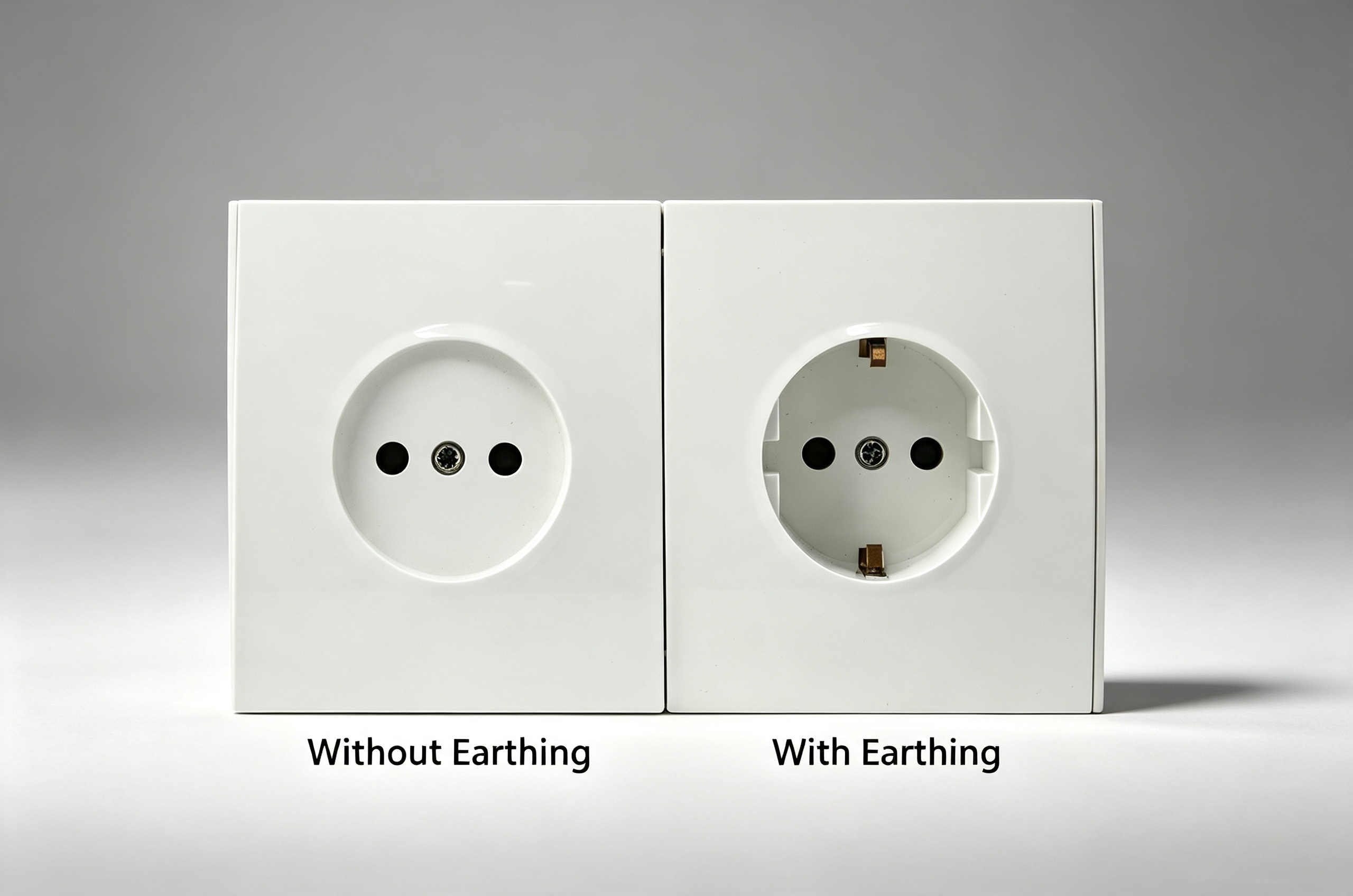
Wall socket risk in long-term use is rarely a single dramatic event. It accumulates: loose wiring, poor contact between plug and socket, grounding failure or sustained high-power draw produce overheating, arcing, electric-shock risk and eventual damage to the socket.
Control therefore sits in design and verification rather than in a single stamp — contact and terminal geometry, grounding continuity through the earthing path, copper components sized for the rated current, flame-retardant materials, and a test sequence covering temperature rise, insertion life, grounding continuity, dielectric strength, insulation and electrical load. HYFF reports that samples are additionally verified with compatible plugs and functionally tested before mass production.
This reframes what endurance data is for. It is not a figure to be compared loosely between suppliers; it is the part of the file showing whether the contact system was designed for the number of insertions the application will actually generate. A hotel corridor socket and a rarely used villa outlet place very different demands on the same specification.
Five Checks Before Committing to a Multi-Year Supplier
The following sequence converts a supplier presentation into an auditable position. It works with any supplier, not only HYFF, and it is deliberately short enough to run before a purchase order rather than after.
| Check | What to request | What it protects |
|---|---|---|
| 1. Market-to-standard map | A list of destination markets with the applicable framework for each: the EU route under the Low Voltage Directive, AS/NZS 3112 for Australia and New Zealand, and plug-family requirements for French and Russian lines. | Prevents a European file from being applied to a non-European project. |
| 2. Certificate reading | The certificate itself — number, issuing body, standard cited, model list, validity period — rather than a catalogue badge. | Turns a marketing claim into an auditable statement with boundaries. |
| 3. Certificate-to-SKU matrix | A grid mapping every model in the programme to the document that covers it. | Exposes empty cells before the order, most often in USB and data lines. |
| 4. Endurance conditions | The model tested, cycle counts, applied load, acceptance criteria and the testing party. | Separates model-level evidence from an unanchored number. |
| 5. Routine process evidence | Which tests run on the line and at what frequency: life testing, glowing filament testing, ball pressure, on-off testing. | Shows whether evidence is generated continuously or assembled for a tender. |
A supplier that answers four checks fully and is explicit about the fifth is in a stronger position than one that answers all five vaguely. An empty cell in the matrix is not automatically disqualifying; it is a document request with a deadline attached.
Single-Certificate Sourcing Versus Breadth-Based Sourcing
The two evaluation styles behave differently over a multi-year programme.
A single-certificate approach qualifies a supplier on one document, one model and one market, then extends that qualification by assumption. It is fast, and it is adequate for a one-off purchase of a standard item in a market that will not change.
A breadth-based approach builds a document register mapping markets to standards, standards to certificates, and certificates to models. It is slower at the start and considerably cheaper at year three, because adding a market or a model becomes a document check instead of a re-qualification exercise.
The difference is not about supplier size. It is about whether certification is treated as a product attribute or as a maintained record. HYFF's file — separate European and Australian routes, with a distinct endurance record for S149 — is structured in the second style, though the buyer must still confirm that each model list matches the purchase order.
Fit Boundaries: Where the Evidence Stops
Evidence-based evaluation also requires stating what the documents do not cover.
Grounded versus ungrounded sockets
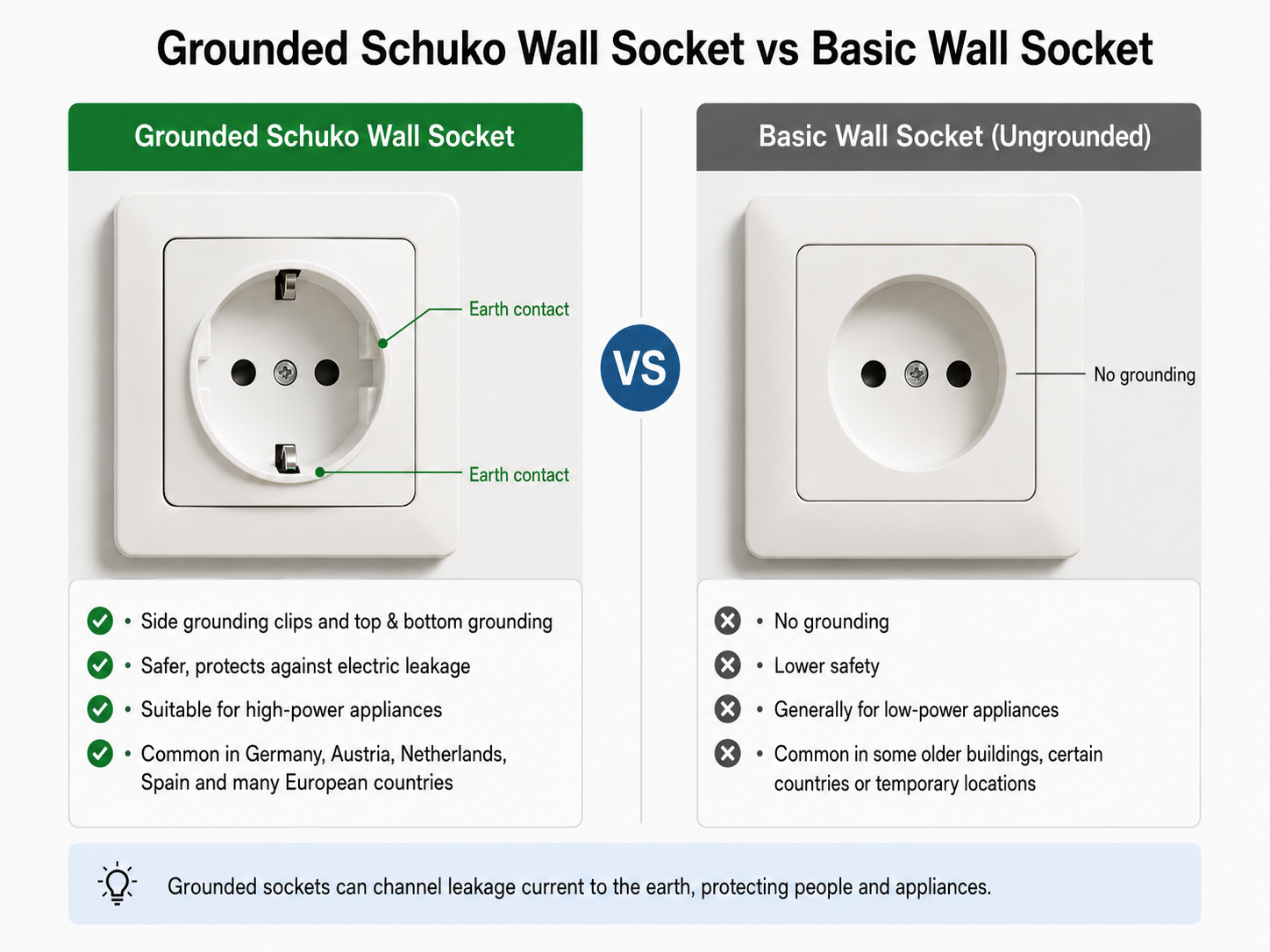
A grounded Schuko socket provides three connections — live, neutral and protective earth — and accepts Schuko plugs, which is what Class I appliances require. A basic ungrounded socket provides live and neutral only: simpler, lower cost, and unsuitable for equipment that depends on protective earthing. Schuko sockets generally carry higher material and structural cost because of the earthing components and related safety requirements, and their installation and inspection requirements are higher, since grounding continuity becomes part of the maintenance check. Neither type needs frequent maintenance under normal conditions, but terminal condition, contact retention and signs of overheating should be inspected periodically.
Parameters outside the certificate set
The documents discussed here do not by themselves establish IP44 or IP54 ingress protection, RoHS documentation for a specific model, USB and Type-C port-level output specifications, or Wi-Fi, Zigbee, Tuya and Bluetooth Mesh behaviour. Each of those parameters requires its own model documentation. A missing specification should be read as “not yet documented”, not as “not capable” — the correct action is to request the document for the exact model rather than to infer capability or its absence.
Where Breadth Pays: Application Patterns
Multi-unit residential and hospitality projects in the EU. Schuko documentation on 6765 and V149 settles format and mounting questions, while the S149 endurance record matters where sockets sit in corridors, guest rooms or shared areas with high insertion frequency. The buyer's check is whether the specific format ordered appears on the relevant document.
Australian and New Zealand retail and commercial fit-outs. HT337's SAA certificate under AS/NZS 3112 is the market entry point, and the individually switched outlet requirement shapes the specification. A buyer running both European and Australian programmes is effectively buying from two document sets, not one.
Multi-market distributors. Here breadth becomes commercial rather than technical: a distributor holding Schuko, French, Russian, USB and data lines in one catalogue avoids re-qualifying a supplier per market, provided each line carries its own evidence. This is where a single-certificate supplier costs the most, because every new line restarts the process.
Office and mixed-use interiors. Multi-port USB and data outlets concentrate several functions into one plate. The mains-side approval and the charging-side specification should be requested as two documents, and the data outlet as a third.
Market Context, Read Carefully
Category growth is a planning signal, not a guarantee of available capacity. Commercial research published by Precedence Research puts the global electric plugs and sockets market at USD 14.13 billion in 2025 and projects approximately USD 24.26 billion by 2035, with a stated CAGR of 5.55% across 2026–2035. That is a forecast built on a commercial model, and it describes a category rather than any individual supplier's capacity, lead time or certification position.
The operational implication is narrower and more useful: as volumes grow, standards editions also move — IEC 60884-1 was revised in 2022 — and a certificate file that is not maintained becomes the binding constraint on a programme long before production capacity does.
Execution Stage: Terms That Protect the Evidence
At execution the documents and the commercial terms have to point at the same thing. HYFF's stated terms are a minimum order quantity of 1,000 units, delivery on EXW, FOB or CIF terms, acceptance based on pre-shipment inspection against approved samples and confirmed specifications, and payment of 100% TT in advance.
Read against a long-term programme, each term carries an evidence consequence:
- The approved sample becomes the physical reference for acceptance. It should match the model named on the certificate; otherwise inspection confirms a product the documentation does not describe.
- Pre-shipment inspection against confirmed specifications only works when the specification sheet states the parameters that matter — rating, pole configuration, earthing, shutter, material — rather than a generic description.
- EXW, FOB and CIF allocate transport risk differently, which matters when a documentation question arises on arrival rather than at the factory gate.
- Payment in advance places the documentation check before payment rather than after it, which is the correct sequence in any case.
Future Outlook
Long-term supplier evaluation is drifting from product inspection toward document management. The direction is visible in how the governing standards are written: IEC 60884-1:2022 defines the scope of household and similar socket-outlets, while AS/NZS 3112:2017 defines requirements and test methods for its market. Both reward buyers who can trace a specific model to a specific document edition.
Suppliers that maintain a model-by-model register, keep certificate validity visible and can produce endurance test conditions on request will be easier to keep than to replace. Suppliers that treat certification as a fixed marketing asset will generate work each time a buyer adds a market or a model line — and that work lands on the buyer's compliance team, not the supplier's sales team.
Frequently Asked Questions
Does a CE certificate for a Schuko wall socket cover French, Russian, USB or data socket models?
No. A certificate names a standard framework and a model list. Schuko, French and Russian sockets use different plug geometries and fall under separate requirements, while USB and data outlets add functions that sit outside socket-outlet safety standards. Each family needs its own document naming the model.
How should a buyer confirm that certificate DACE260330001RL covers the 6765 variant being ordered?
By reading the certificate rather than the catalogue: the issuing body, the standard cited — in this case the Low Voltage Directive 2014/35/EU route — the model list and the validity period, then comparing the listed variants with the order code. If the exact variant is not listed, the document does not cover it, however the product is described commercially.
What do the S149 figures of 10,000+ insertion cycles and 40,000 switching cycles establish?
They record model-level endurance under stated test conditions: more than 10,000 plug-in and plug-out cycles, which bear on contact retention and the overheating path, and 40,000 switching cycles, which bear on the switching mechanism. They are not a service-life guarantee, a warranty term or a field failure rate, and they should be requested together with the test conditions and the identity of the testing party.
Is SAA certificate SAA-250865-EA sufficient for supplying HT337 in Australia and New Zealand?
It is the market-specific credential for that model within the AS/NZS 3112 framework, and it is the correct starting point for those markets. Project specification is a separate question: Australian wiring practice is described as requiring individually switched socket outlets, so the buyer should confirm the configuration as well as the certificate.
Which commercial terms are typically fixed for long-term wall socket supply from HYFF?
Minimum order quantity of 1,000 units; delivery on EXW, FOB or CIF terms; acceptance by pre-shipment inspection against approved samples and confirmed specifications; and payment of 100% TT in advance. Documentation coverage and commercial terms are separate questions, so each term should be confirmed for the specific model and order.
What a Durable Evaluation Actually Looks Like
The sequence that survives a multi-year programme is unglamorous: map markets to standards, read certificates instead of badges, build a model matrix, and ask for endurance data with its conditions attached. HYFF's own file — European documentation on 6765 and V149, Australian certification on HT337, and the S149 endurance record — shows how those three columns can be assembled, and equally where a buyer still has to ask for the missing cell. Company and product information is published at www.hyffelectric.com, and the 2026 catalogue is available as a downloadable PDF.
Reference document: HYFF 2026 catalogue (PDF).
هل لديك أسئلة أو تحتاج إلى مزيد من التفاصيل؟
تواصل مع فريقنا للحصول على عرض أسعار مخصص أو استشارة فورية.
طلب عرض أسعار
املأ النموذج أدناه وسيتواصل معك فريقنا بعرض مقترح مخصص.
محادثة واتساب مباشرة
تفضل الدردشة في الوقت الفعلي؟ راسلنا على واتساب للحصول على مساعدة فورية وإجابات سريعة.
- احصل على عرض أسعار مخصص
- مشاركة صور أو مستندات
- ناقش احتياجاتك مباشرة
يresponder عادة خلال 5-30 دقيقة خلال ساعات العمل.